
South · VA
Steel Buildings in Virginia
A federal contractor in Loudoun County, a cattle operation along I-81, and a waterman near Hampton Roads are all technically shopping for a Virginia steel building, and almost nothing else about their projects overlaps. This guide separates Virginia into the five regions that actually drive those differences.
Overview
One State, Three Very Different Building Economies
Virginia's steel building demand clusters around three centers of gravity: federal and technology-driven construction in Northern Virginia, working waterfront and boat storage around Hampton Roads, and cattle, poultry and orchard buildings threading down the Shenandoah Valley and into Southwest Virginia.
None of those three markets competes for the same building. A Loudoun County office shell answers to parking ratios and site plan review long before it answers to floor area; a Valley cattle operation answers to clear height and end-opening width; a Tidewater boat owner answers to vessel dimensions and salt exposure. Treating a Virginia project as one generic 'metal building' question skips past the decision that actually matters most.
The frame underneath these projects is usually one of two systems — a rigid pre-engineered frame for clear span and taller eaves, or post-frame construction for simpler agricultural cover — and that choice tends to follow the building's job rather than its region.
Northern Virginia
Site Plan Review Shapes Northern Virginia Buildings Before the Frame Does
In Fairfax, Loudoun and Prince William counties, a commercial steel building is judged first against site coverage limits, parking ratios and how it presents to the surrounding development, and only afterward against the building program itself.
Government-contracting and technology employment support steady demand for office and light commercial shells, but the tighter constraint is usually the county, not the client. Confirming setback, coverage and parking limits before dimensions are finalized avoids paying twice for a redesign after a quote is already in hand.
Farther from the urban core, larger residential lots still support suburban metal garages, where door width and setback allowance decide the footprint more than anything about the surrounding commercial market.
Tidewater and Hampton Roads
Building for Salt Air Around Norfolk and Virginia Beach
Around Norfolk, Virginia Beach and Newport News, boat storage and waterfront support buildings answer to vessel dimensions first, then to corrosion protection second, because coastal air treats an unprotected frame far less kindly than an inland one.
Measuring a vessel including its trailer, tongue length and any tower or antenna sets the real clear-height requirement, and it's worth doing that measurement before comparing floor-area numbers between quotes. A building sized for the boat but not the trailer approach is a common and avoidable mistake.
Coating and fastener specification deserve a direct question to each supplier, since two visually similar buildings can differ meaningfully in how well they hold up against salt exposure over time.
Across the state
Planning by Region: Tidewater, Piedmont, Valley, Southwest and Northern Virginia
Virginia's five regions differ enough in land use and terrain that identical building programs call for different plans depending on where the site actually sits.
Piedmont
Rolling country between the coastal plain and the Blue Ridge, including Richmond and Charlottesville, mixing agricultural acreage with suburban commercial growth.
Shenandoah Valley
Cattle, poultry, orchard and hay operations run the length of I-81, where open-sided farm buildings are a routine project rather than an exception.
Southwest Virginia
Appalachian ridge-and-valley terrain with sloped sites, smaller communities and a mix of agricultural and light industrial land use.
Northern Virginia
The Washington D.C. suburbs, where dense residential and government-contracting growth push demand toward commercial shells and suburban garages under close site plan review.
Building types
Steel Building Types Across Virginia
From Tidewater boat storage to Northern Virginia commercial shells and Valley farm buildings, these categories span Virginia's regional project mix.
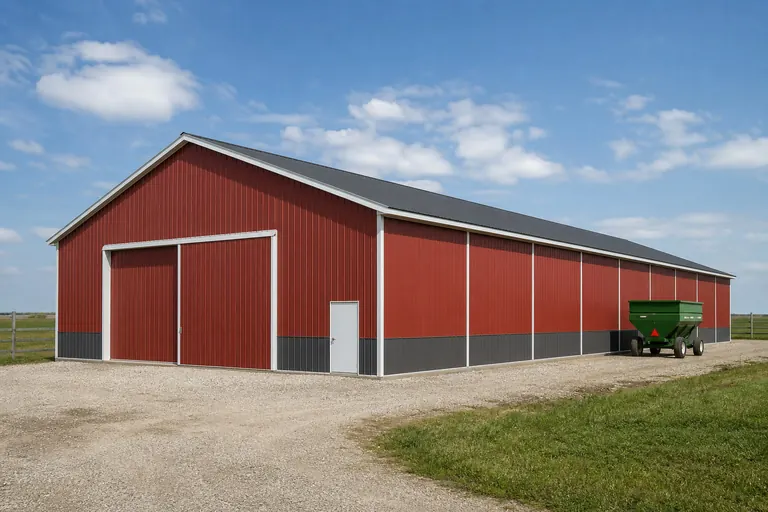 Agricultural BuildingEquipment and hay storage for Shenandoah Valley and Southwest Virginia farm operations.
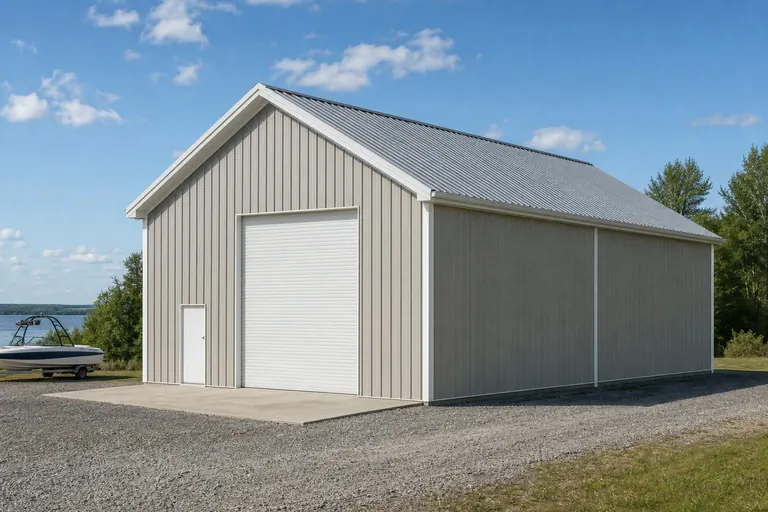 Boat StorageCovered or enclosed storage for Tidewater and Hampton Roads waterfront properties.
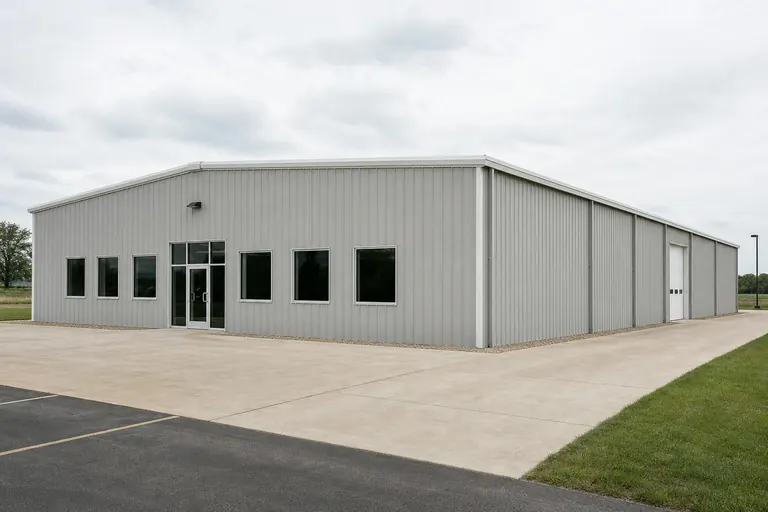 Commercial BuildingService, retail and office shells common in Northern Virginia's suburban commercial corridors.
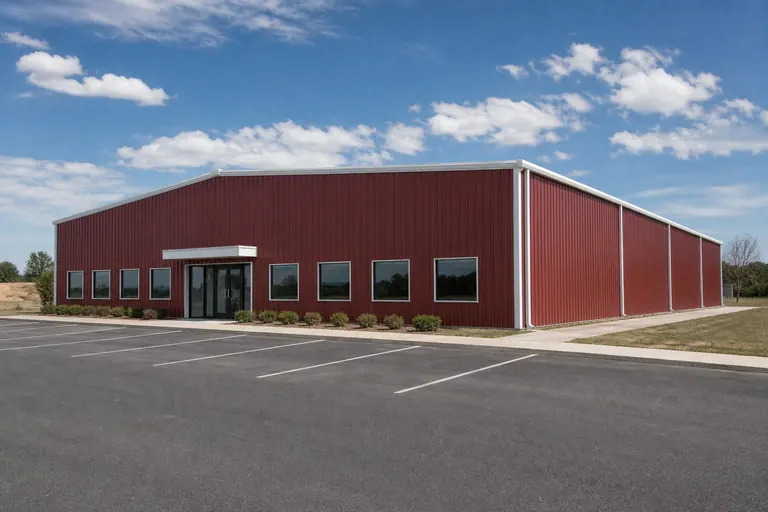 Office BuildingSmall professional and government-contractor office space near federal employment centers.
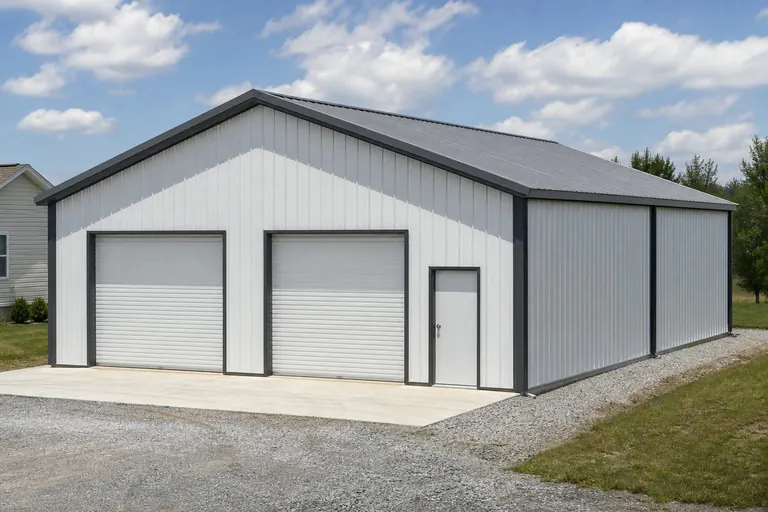 Metal GarageEnclosed vehicle storage for Piedmont, Valley and Northern Virginia lots, where setback rules shift the practical footprint.
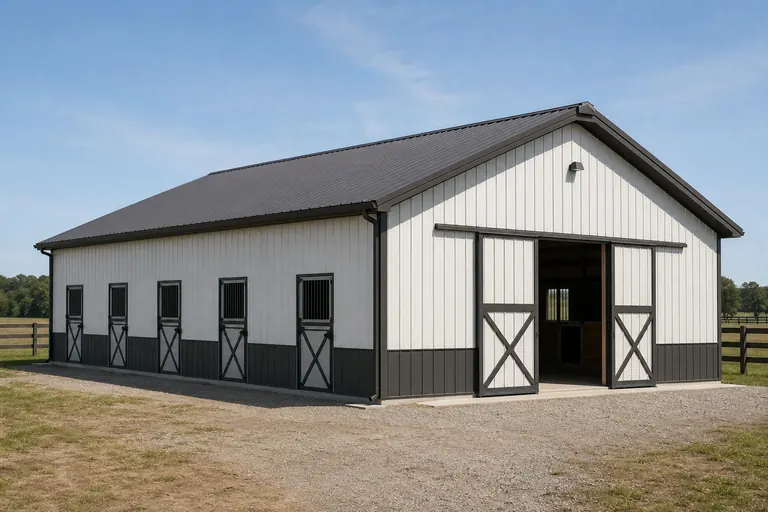 Horse BarnEquine facilities across the Piedmont and Valley horse country.
Example Configuration — for planning purposes only.
Shenandoah Valley
Cattle, Poultry and Orchard Buildings Along I-81
A Shenandoah Valley farm building's dimensions follow the operation it serves — cattle and hay call for wide clear-span cover, poultry calls for long, narrow, carefully ventilated structures, and orchards call for equipment and packing storage that rarely resembles either.
An open hay or equipment barn keeps a build simple and airflow strong. Once maintenance work needs to happen indoors, a slab, insulation and a separate service door change the framing plan, so that decision belongs early rather than as a change order mid-project.
Poultry buildings, in particular, need airflow and curtain or fan placement designed into the layout from the outset, which is a different conversation from the wide clear-span barns that cattle and equipment storage typically call for.
Southwest Virginia
Ridge-and-Valley Terrain Sets the Southwest Virginia Timeline
Across Southwest Virginia's Appalachian ridge-and-valley country, the earthwork ahead of a build is frequently the larger unknown in the budget, not the steel package itself.
Walking the site with a contractor before ordering a kit is the step that surfaces grading costs early enough to plan around, rather than discovering them once a foundation crew is already on site.
Winter weather here is enough of a scheduling factor that many buyers deliberately plan delivery and erection around it, a consideration that carries far less weight in Tidewater or the Piedmont.
Footprints
Building Sizes to Consider Across Virginia
Let the region and the job set the footprint — farm equipment in the Valley, a commercial shell in Northern Virginia, boat storage on a Tidewater waterfront.
40′ × 60′2,400 sq ft
Shenandoah Valley farm shop or combined storage building.
30′ × 50′1,500 sq ft
Tidewater boat storage with room to walk around the vessel.
40′ × 80′3,200 sq ft
Northern Virginia commercial or office shell with parking behind it.
24′ × 30′720 sq ft
Suburban two-vehicle garage with a bench strip.
36′ × 48′1,728 sq ft
Piedmont horse barn with stalls and an aisle.
Example Configuration — for planning purposes only.
Multiply width by length for square footage; treat these as starting points, since your regional review process may adjust the final footprint.
Match your goal
Which Building Type Fits Your Virginia Project?
Combine the intended use with the Virginia region it will sit in, then let the deciding factor set the specification.
| Project goal | Starting building type | Deciding factor |
|---|---|---|
| Store hay or equipment in the Valley | Agricultural building | Clear height and end-opening width |
| Store a boat on the Tidewater waterfront | Boat storage building | Vessel height and trailer length |
| Run a professional or contracting office in NoVa | Office building | Site plan compliance and parking layout |
| Keep horses on Piedmont acreage | Horse barn | Stall count and aisle width |
| Park vehicles on a suburban or rural lot | Metal garage | Door width and setback allowance |
Store hay or equipment in the Valley
- Starting building type
- Agricultural building
- Deciding factor
- Clear height and end-opening width
Store a boat on the Tidewater waterfront
- Starting building type
- Boat storage building
- Deciding factor
- Vessel height and trailer length
Run a professional or contracting office in NoVa
- Starting building type
- Office building
- Deciding factor
- Site plan compliance and parking layout
Keep horses on Piedmont acreage
- Starting building type
- Horse barn
- Deciding factor
- Stall count and aisle width
Park vehicles on a suburban or rural lot
- Starting building type
- Metal garage
- Deciding factor
- Door width and setback allowance
Before you order
A Virginia Pre-Order Checklist
Steps that keep a Virginia project comparable across very different regional conditions.
Step 1
Locate the right authority
The county or municipal building department covering your exact address.
Step 2
Read the county site plan rules
Especially in Fairfax, Loudoun and Prince William, before dimensions are finalized.
Step 3
Ask about coastal coating
Tidewater and Hampton Roads buyers should confirm fastener and cladding protection explicitly.
Step 4
Price the grading separately
Southwest Virginia's ridge-and-valley sites often carry earthwork costs beyond the building package.
Step 5
Match the interior to the operation
A Valley poultry building's ventilation plan differs sharply from a cattle barn's.
Step 6
Agree on scope before bidding
Kit-only, kit plus erection, or turnkey — settle it before comparing quotes.
Around the state
Projects Near Major Virginia Markets
Local terrain and the typical building purpose both vary across these markets.
- Richmond
- Virginia Beach
- Norfolk
- Arlington
- Roanoke
- Charlottesville
- Lynchburg
- Winchester
- Harrisonburg
- Fredericksburg
Planning a building?
Planning a Building in Virginia?
Use the planning guides to narrow the footprint and building system that fits your project, then request quotes with your Virginia details already attached.
Requesting information does not require a purchase.
Questions
Virginia Steel Building FAQs
Answers for Virginia buyers, without publishing regulatory values or pricing claims.
Footprint, span, site conditions, engineering and erection scope drive the number more than a statewide average could. Northern Virginia site plan requirements or Southwest Virginia grading can each add cost a Valley farm building would not carry.
In most jurisdictions, yes. The county or municipality with authority over your address sets the requirement, and Northern Virginia counties commonly layer on additional site plan review. Confirm before ordering.
Open or partly enclosed agricultural buildings suit Valley cattle, hay and orchard operations well. Confirm equipment and livestock dimensions before the door width and clear height are locked in.
Size around the largest equipment or livestock need rather than a round number. Cattle, poultry and orchard operations in the Valley each call for different clear heights and opening widths.
It's a common project on rural acreage across the Piedmont, Valley and Southwest Virginia. Zoning for combined living and shop space varies by county, so confirm with the local planning office first.
Northern Virginia projects answer to site plan review, parking ratios and zoning in dense suburban counties, while Valley projects answer to farm equipment size and open-sided storage needs on rural acreage.
Measure the vessel with its trailer and any tower height before sizing the building, and ask each supplier directly what coating and fastener protection is included for salt exposure.
Start your project
Ready to plan your Virginia steel building?
Start from your region — Tidewater, Piedmont, the Shenandoah Valley, Southwest Virginia or Northern Virginia — and let local terrain, land use and review requirements shape your specification before comparing quotes.
Virginia
Building type guides
Building Types Planned in Virginia
What actually changes for each building type when the project is planned in Virginia.
- Carport in Virginia
Virginia's carport buyer sits between two diverging trend lines.
- Garden shed in Virginia
Virginia is not one terrain to plan a shed around — it's five.
- Guest house in Virginia
A Virginia guest house project should start with a question that's easy to overlook: which of the state's five physiographic provinces is the host parcel actually in? Virginia E...
- Horse barn in Virginia
Virginia Energy, the state's geological survey, names five distinct physiographic provinces crossing the state: the Coastal Plain, Piedmont, Blue Ridge, Valley and Ridge, and Ap...
- Metal garage in Virginia
Virginia Energy, the state's geological survey, identifies five distinct physiographic provinces running west from the coast: the Coastal Plain, Piedmont, Blue Ridge, Valley and...
- Pole barn in Virginia
Virginia lost more than 4,200 farms between 2017 and 2022 — down to 38,995 statewide — a decline that tends to push the remaining working land toward one flexible pole barn rath...
- Shed in Virginia
Virginia Energy, the commonwealth's geological survey, splits Virginia into five physiographic provinces rather than the three-way split some neighboring states use: Coastal Pla...
- Storage building in Virginia
A storage building large enough to hold a tractor, a fleet vehicle, or a season's inventory is heavy enough that the ground underneath it matters as much as the shell on top.