
Pole barn · VA
Pole Barns in Virginia
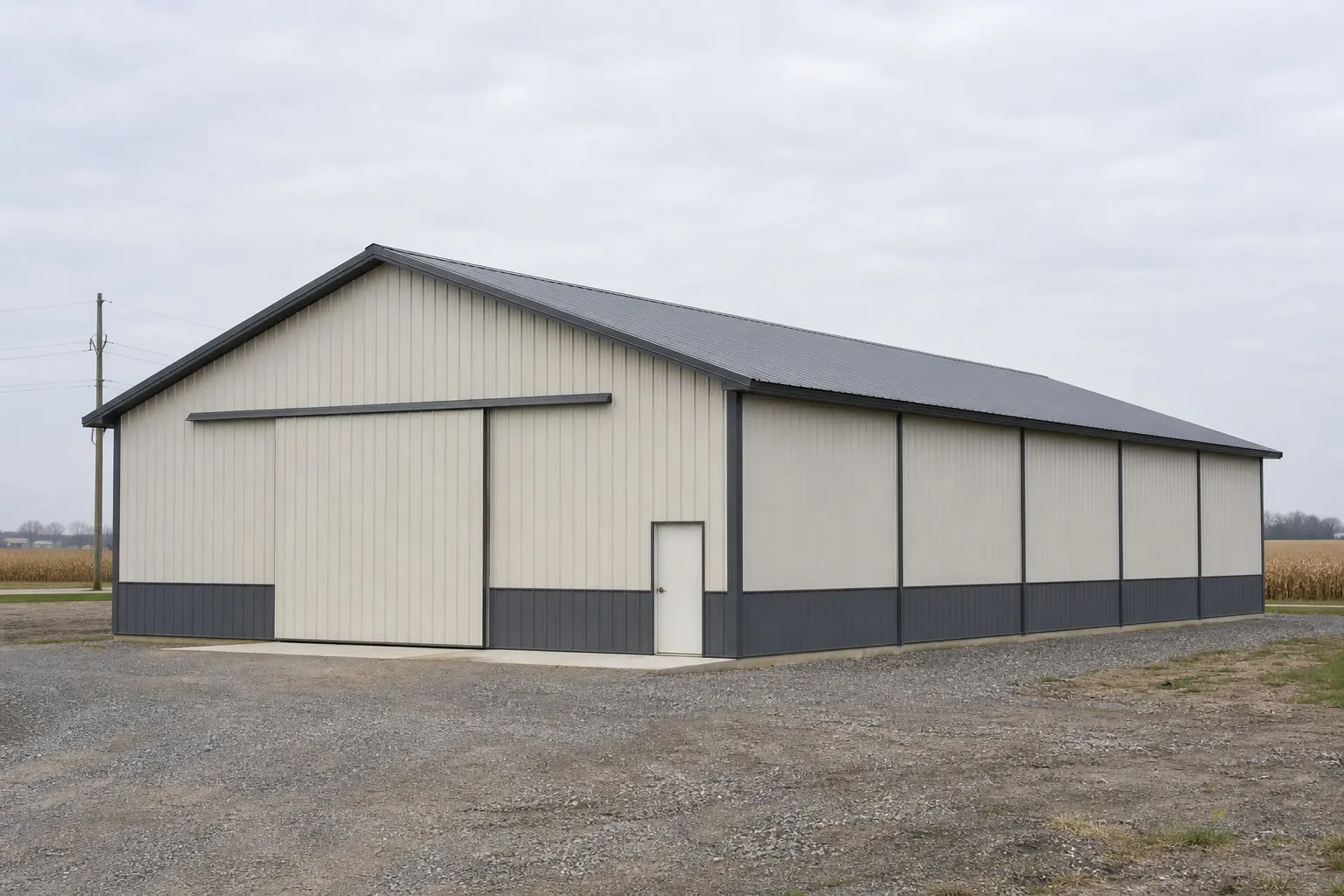
Virginia lost more than 4,200 farms between 2017 and 2022 — down to 38,995 statewide — a decline that tends to push the remaining working land toward one flexible pole barn rather than a cluster of purpose-built buildings spread across a larger operation. Sitting that single building correctly is the harder half of the project, because Virginia Energy and the Department of Conservation and Recreation both describe the state as splitting across five physiographic provinces: Coastal Plain, Piedmont, Blue Ridge, Valley and Ridge, and Appalachian Plateau. A pad that grades easily in the Piedmont doesn't behave the same way on a Blue Ridge slope or a Coastal Plain floodplain edge.
Program
Why a shrinking farm count favors one flexible pole barn
Virginia's farm count fell by more than 4,200 between 2017 and 2022, and that consolidation reshapes what a pole barn brief typically looks like on the remaining working land.
USDA's National Agricultural Statistics Service Virginia Field Office recorded 38,995 farms in 2022, down from 43,225 in 2017. That trend doesn't mean every remaining Virginia farm is shrinking, but it does mean fewer separate operations are dividing the state's agricultural land, and on many properties that consolidation makes a single adaptable pole barn a more sensible program than several purpose-built structures spread thin across the parcel.
That consolidation raises the stakes on layout. Door placement, clear-span width, and utility entry points all need to serve multiple functions well — equipment storage, hay, a workshop bay — rather than one function perfectly, since there often isn't a second structure to pick up the slack.
This is a planning tendency drawn from statewide farm statistics, not a rule for every parcel. A buyer consolidating several former smaller operations onto one larger holding may still want separate buildings. But on a typical remaining Virginia farm, sizing one flexible pole barn correctly the first time carries more consequence than it would on a larger, multi-building operation.
Site context
Grading and access across Virginia's five provinces
The five physiographic provinces Virginia Energy and DCR both document behave differently once you're trying to get a level post-frame pad in place.
Coastal Plain
Flat, low-relief ground with a higher water table; drainage planning around the pad matters more here than grading.
Piedmont
Rolling terrain across central Virginia, generally the easiest province for a straightforward graded pad.
Blue Ridge
Mountainous terrain where cut-and-fill grading and a confirmed delivery-truck access route are essential before finalizing a footprint.
Valley and Ridge
Alternates ridgelines with flatter valley floors; valley-floor sites are usually the easier build, though proximity to streams draining the ridges is worth checking.
Appalachian Plateau
Southwestern Virginia's steepest terrain, where access grade and site prep can be a larger share of total planning effort than the shell itself.
Climate
Planning drainage and ventilation with a representative figure, not a rule
The Richmond Intl Airport 1991-2020 normal of 45.50 inches of annual precipitation and 8.8 inches of snow illustrates why drainage and ventilation planning matters, without dictating what any specific Virginia site will see.
NOAA's National Centers for Environmental Information reports Richmond's 1991-2020 annual climate normal at 45.50 inches of precipitation with 8.8 inches of annual snowfall. NWS Wakefield's daily climatological reports for the same station reference a period of record dating back to 1871, which is long enough to smooth out any single unusually wet or dry year. Even so, this is one station's normal in a state that spans five physiographic provinces with real elevation and coastal-proximity differences, so it's cited here as a representative figure for drainage planning, not a design value for any specific pad.
Ridge and soffit ventilation, paired with a raised or well-drained floor, keeps stored hay or equipment dry through wet stretches statewide. On Coastal Plain sites with a higher water table, deciding where pad runoff goes before the building is placed avoids a chronically damp strip along one side of the structure.
- Grade or drain, depending on province
- Blue Ridge and Appalachian Plateau sites need grading; Coastal Plain sites need drainage planning around a higher water table.
- Ventilate for humidity
- Ridge and soffit vents help manage moisture buildup regardless of which province the barn sits in.
Get Virginia post-frame quotes
Tell us your county or city, physiographic province, and the single job the building needs to do; we route it with Virginia siting context attached.
Process
Checking county-level hazard data and current permit timelines
FEMA scores Virginia's hazard exposure locality by locality, and a rising statewide construction volume is a reason to confirm a current permit timeline rather than assume last year's estimate.
FEMA's National Risk Index provides county- and tract-level composite and hazard-specific scores for all 133 of Virginia's counties and independent cities across 18 natural hazard types. A pole barn sited near a Coastal Plain waterway carries a different exposure profile than one on a Piedmont ridge, and the only reliable way to know your own site's exposure is to look up the specific locality rather than assume a single statewide risk level.
Separately, the U.S. Census Bureau recorded 34,059 total new privately-owned housing units authorized statewide in Virginia in 2024. A pole barn is frequently exempt from residential permitting where it's purely agricultural, but a busy statewide construction environment is still a fair signal to bring to your first planning conversation: ask your county or city building department for a current review estimate rather than relying on an outdated one.
- Look up your locality's NRI score
- Check the specific county or independent city, not a statewide average, before finalizing a pad location near water or slope.
- Ask for a current review timeline
- Given statewide construction volume, confirm your county or city's current permit turnaround directly.
Footprint
Sizes that fit a consolidating Virginia farm program
Given the shrinking farm count and one-building-does-more pattern, common Virginia pole barn footprints skew toward flexible mid-size options.
30′ × 40′
1,200 sq ft
A common flexible size covering equipment storage plus a small workshop bay.
40′ × 60′
2,400 sq ft
A larger combined building for equipment, hay and general storage on a consolidated operation.
Example Configuration — for planning purposes only.
Footprint choice should follow the buildable, gradeable pad your specific province and site support, not just the acreage on the deed.
Planning
Before finalizing a Virginia pole barn site
These steps address terrain and permitting realities specific to Virginia.
Step 1
Identify your physiographic province
Confirm whether your site is Coastal Plain, Piedmont, Blue Ridge, Valley and Ridge, or Appalachian Plateau before choosing a foundation approach.
Step 2
Price grading or drainage separately from the shell
On Blue Ridge or Appalachian Plateau slopes, site work can be a meaningful share of the total budget; on Coastal Plain sites, drainage work plays that role instead.
Step 3
Check your county or city's FEMA NRI score
Look up your specific locality's hazard-type scores rather than assuming a single statewide risk level.
Step 4
Confirm delivery access
Verify a delivery truck can reach the pad on graded, sloped ground before ordering materials.
Questions
Virginia pole barn questions
Answered honestly at state level; county- or city-specific rules are routed to the local authority.
It depends on your county or independent city and how the building will be used. Permit thresholds and agricultural-exemption rules are set locally, so your building department is the reliable source for your specific project.
Virginia Energy identifies five distinct physiographic provinces — Coastal Plain, Piedmont, Blue Ridge, Valley and Ridge, and Appalachian Plateau — and each behaves differently for grading, drainage and access, so site work varies more here than in a single-terrain state.
It's a contextual factor. With the state's farm count down from 43,225 in 2017 to 38,995 in 2022, a single flexible pole barn covering multiple uses is often a more practical program than several smaller purpose-built buildings, though the right size still depends on your specific operation.
There is no official standard size. Common footprints run from around 30x40 up to 40x60, though the buildable pad your province and site support should drive the final choice.
The Richmond Intl Airport 1991-2020 normal of 45.50 inches of annual precipitation is a representative figure, not a statewide constant given the state's provincial range. Regardless of your exact location, planning drainage away from the building and adequate ventilation is a sound practice statewide.
FEMA's National Risk Index scores all 133 of Virginia's counties and independent cities individually across 18 hazard types. Check your specific locality before finalizing a pad location near water or slope.
Sources for the Virginia facts on this page
This page states no code requirement, wind speed, snow load, permit rule, price or supplier claim. The state-specific facts it does use are listed with their publisher below.
Virginia had 38,995 farms in 2022, down from 43,225 farms in 2017.
USDA National Agricultural Statistics Service (NASS), Virginia Field Office · 2022 (with 2017 comparison) · Tier 2
https://articles.vafb.com/new-census-reveals-a-decrease-in-farms-and-farmland/Virginia Energy (the state geological survey) identifies five distinct physiographic provinces crossing the state: the Coastal Plain, Piedmont, Blue Ridge, Valley and Ridge, and Appalachian Plateau.
Virginia Energy (Virginia Department of Energy, Division of Geology and Mineral Resources) · Reference material, current · Tier 2
https://energy.virginia.gov/geology/FossilProvinces.shtmlThe Virginia Department of Conservation and Recreation publishes a statewide overview describing the physiography and vegetation differences across Virginia's Coastal Plain, Piedmont, Blue Ridge, Ridge and Valley, and Appalachian Plateau provinces.
Virginia Department of Conservation and Recreation (DCR), Division of Natural Heritage · Version 2.0, March 2021 · Tier 2
https://www.dcr.virginia.gov/natural-heritage/natural-communities/document/ncoverviewphys-veg.pdfRichmond, VA's 1991-2020 annual climate normal precipitation is 45.50 inches with an annual normal snowfall of 8.8 inches.
NOAA National Centers for Environmental Information (NCEI) · 1991-2020 · Tier 1
https://www.ncei.noaa.gov/access/services/data/v1?dataset=normals-annualseasonal-1991-2020&dataTypes=ANN-PRCP-NORMAL,ANN-SNOW-NORMAL&stations=USW00013740&format=jsonFEMA's National Risk Index tool provides county- and tract-level composite and hazard-specific risk scores for all 133 of Virginia's counties and independent cities across 18 natural hazard types.
Federal Emergency Management Agency (FEMA) · Current NRI release · Tier 1
https://www.fema.gov/flood-maps/products-tools/national-risk-index