
Shed · VA
Sheds in Virginia
Virginia Energy, the commonwealth's geological survey, splits Virginia into five physiographic provinces rather than the three-way split some neighboring states use: Coastal Plain, Piedmont, Blue Ridge, Valley and Ridge, and Appalachian Plateau. A shed is too small a structure to need engineering that changes by province, but the ground under it does change five ways, not three, and that finer split is the first thing a Virginia buyer should sort out before ordering a pad or a delivery date. Layer in a farm count that fell from 43,225 operations in 2017 to 38,995 in 2022, and a Richmond climate normal of 45.50 inches of annual precipitation with 8.8 inches of snow, and the practical shed questions in Virginia are about where exactly the lot sits and how wet that ground stays across a year.
The intersection
Why five provinces, not three, is the first Virginia question
Virginia Energy's five-province classification means a shed buyer should locate their lot on that map before choosing a pad type, since the ground condition differs more finely than a simple coastal-versus-inland split.
Virginia Energy, the state's geological survey, identifies five distinct physiographic provinces crossing the commonwealth: the Coastal Plain along the Atlantic and Chesapeake Bay, the rolling Piedmont through the center of the state, the Blue Ridge, the Valley and Ridge province further west, and the Appalachian Plateau in Virginia's far southwest corner. A shed itself is small enough that this classification rarely changes the structure a buyer orders, but it changes almost everything about preparing the ground it sits on.
A Coastal Plain lot near Virginia Beach or along the James River tends toward flat, low-relief ground where water has nowhere obvious to drain, so a shed pad benefits from a deliberate crown or a raised gravel base. Move to the Piedmont around Richmond or Charlottesville and the terrain rolls enough that leveling, not drainage, becomes the first task. Push further west into the Blue Ridge, the Valley and Ridge, or the Appalachian Plateau near the Kentucky and Tennessee borders, and slope itself is often the dominant constraint — a shed pad there may need cut-and-fill work before the unit can sit level at all.
None of this makes a shed harder to own in Virginia. It does mean the same shed model asks a different first question depending on which of the five provinces the lot falls into, and skipping that check is a documented way a shed ends up with a damp floor or an unlevel base after delivery.
Exposure
What Richmond's climate normal means for venting
Richmond's station normal of 45.50 inches of annual precipitation and 8.8 inches of snow points toward steady year-round moisture, which is a venting problem at shed scale more than a structural one.
NOAA's 1991-2020 climate normal for Richmond International Airport records 45.50 inches of annual precipitation alongside 8.8 inches of annual snowfall. That single station's normal is not a design value for every Virginia county — a Coastal Plain or Appalachian Plateau site could see different totals — but it is a documented data point showing that moisture arrives across the calendar rather than in one short wet season.
For a shed, the practical consequence sits inside the building, not around it. A sealed metal shed with no ridge vent, gable louver, or cracked door traps humid air against its walls, and tools or seasonal goods stored inside can pick up surface moisture even when the exterior looks bone dry. Combining that airflow fix with a raised pad addresses the two complaints that come up most with a shed in a climate like Virginia's: a damp floor and a musty interior.
- Vent before you insulate
- A ridge or gable vent does more for a Virginia shed's interior air quality than any amount of sealing.
- Raise the floor on flatter ground
- A gravel or paver base lifts the shed above standing water on Coastal Plain and lower Piedmont lots.
- Treat the Richmond normal as a reference, not a rule
- Confirm your own county's rainfall pattern rather than assuming Richmond's station figure applies identically statewide.
Site context
Shed siting by Virginia province
Each of Virginia Energy's five named provinces hands a shed buyer a different starting task before the unit arrives.
Coastal Plain (Tidewater, Eastern Shore)
Flat, low-relief ground makes drainage and a raised pad the priority; grading is rarely needed but standing water is the real risk.
Piedmont (Richmond, Charlottesville corridor)
Rolling terrain means leveling the pad and directing runoff away from the shed matters more than raising it above grade.
Blue Ridge
Steeper slopes call for careful cut-and-fill pad work and confirming equipment access to the delivery site before ordering.
Valley and Ridge
Alternating ridgelines and narrow valleys mean the flattest usable ground on a property may not be the most convenient spot; plan the pad location before the delivery truck arrives.
Appalachian Plateau (far southwest Virginia)
The most rugged of the five provinces; a shed here often needs a built-up or engineered pad rather than a simple gravel bed.
Get Virginia shed quotes
Tell us your province, rough size and intended use. We route it with the Virginia and shed context already attached.
Configuration
Common Virginia shed uses
How Virginia households and smaller working properties tend to put a metal shed to use.
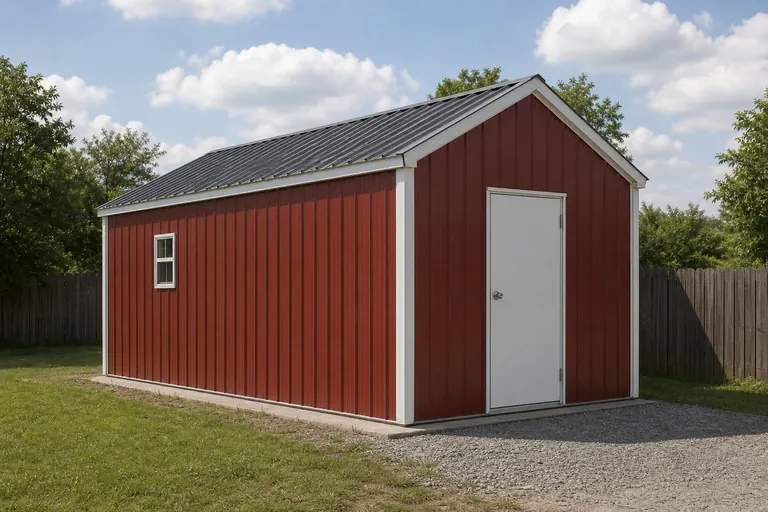 Suburban Piedmont storageLawn equipment and tools for a Richmond or Charlottesville-area lot, sized for easy mower access.Tidewater utility shedSited above grade on flat Coastal Plain ground to keep tools and gear clear of standing water after storms.Small working-land tool storageA dedicated shed separate from a main barn, useful given Virginia's declining farm count and the narrower storage need that follows.
Example Configuration — for planning purposes only.
Preparation
Before you place a Virginia shed order
A short list resolved in advance keeps a shed dry and level no matter which of the five Virginia provinces it sits in.
- Identify your provinceCoastal Plain, Piedmont, Blue Ridge, Valley and Ridge, or Appalachian Plateau each ask a different first question about drainage, leveling, or slope.
- Confirm setback and permit rules locallySmall-shed permit thresholds and setback distances are set by your city or county; confirm before finalizing placement.
- Plan the pad before deliveryA raised gravel or paver base prevents standing water on flatter Coastal Plain and Piedmont lots; mountain-province lots may need cut-and-fill work instead.
- Add ventilation from day oneRidge or gable vents reduce interior condensation given Richmond's documented 45.50-inch annual precipitation normal.
- Check your specific locality's hazard exposureReference FEMA's National Risk Index for your county or independent city rather than assuming a single statewide hazard picture.
- Confirm delivery access on sloped provincesBlue Ridge, Valley and Ridge, and Appalachian Plateau properties should confirm truck access grade before scheduling delivery.
Questions
Virginia shed questions
Honest state-level answers, with anything jurisdiction-specific routed to the right office.
Permit thresholds vary by city or county and are often tied to footprint or height. Your local building or zoning department is the only reliable source for your specific lot.
Yes. Virginia Energy names five physiographic provinces — Coastal Plain, Piedmont, Blue Ridge, Valley and Ridge, and Appalachian Plateau — and each presents a different drainage, leveling, or slope condition before pad work begins.
It can without ventilation. Richmond's 1991-2020 normal shows 45.50 inches of annual precipitation and 8.8 inches of snow; a sealed shed without ridge or gable vents is prone to interior condensation.
No. FEMA's National Risk Index scores all 133 of Virginia's counties and independent cities individually across 18 hazard types, so check your specific locality rather than assuming a single statewide condition.
Virginia's farm count fell from 43,225 in 2017 to 38,995 in 2022, so we avoid claiming a growing or dominant role for sheds on working land; a shed there typically supplements other storage rather than replacing it.
We do not publish state-level prices, since cost depends on size, materials and site work. Our cost pages cover what drives the number; a quote covers your specific project.
Sources for the Virginia facts on this page
This page states no code requirement, wind speed, snow load, permit rule, price or supplier claim. The state-specific facts it does use are listed with their publisher below.
Virginia Energy (the state geological survey) identifies five distinct physiographic provinces crossing the state: the Coastal Plain, Piedmont, Blue Ridge, Valley and Ridge, and Appalachian Plateau.
Virginia Energy (Virginia Department of Energy, Division of Geology and Mineral Resources) · Reference material, current · Tier 2
https://energy.virginia.gov/geology/FossilProvinces.shtmlRichmond, VA's 1991-2020 annual climate normal precipitation is 45.50 inches with an annual normal snowfall of 8.8 inches.
NOAA National Centers for Environmental Information (NCEI) · 1991-2020 · Tier 1
https://www.ncei.noaa.gov/access/services/data/v1?dataset=normals-annualseasonal-1991-2020&dataTypes=ANN-PRCP-NORMAL,ANN-SNOW-NORMAL&stations=USW00013740&format=jsonVirginia had 38,995 farms in 2022, down from 43,225 farms in 2017.
USDA National Agricultural Statistics Service (NASS), Virginia Field Office · 2022 (with 2017 comparison) · Tier 2
https://articles.vafb.com/new-census-reveals-a-decrease-in-farms-and-farmland/FEMA's National Risk Index tool provides county- and tract-level composite and hazard-specific risk scores for all 133 of Virginia's counties and independent cities across 18 natural hazard types.
Federal Emergency Management Agency (FEMA) · Current NRI release · Tier 1
https://www.fema.gov/flood-maps/products-tools/national-risk-index