
Carport · VA
Carports in Virginia
Virginia's carport buyer sits between two diverging trend lines. USDA's National Agricultural Statistics Service counted 38,995 farms in the state in 2022, down from 43,225 in 2017, a genuine decline that shrinks the working-farm base a carport might serve for equipment cover. At the same time, the U.S. Census Bureau recorded 34,059 total new privately-owned housing units authorized statewide in 2024. Those two facts together mean a Virginia carport enquiry is more likely than a decade ago to come from a new suburban or exurban home rather than an established working farm, which changes what the open structure is actually being asked to protect.
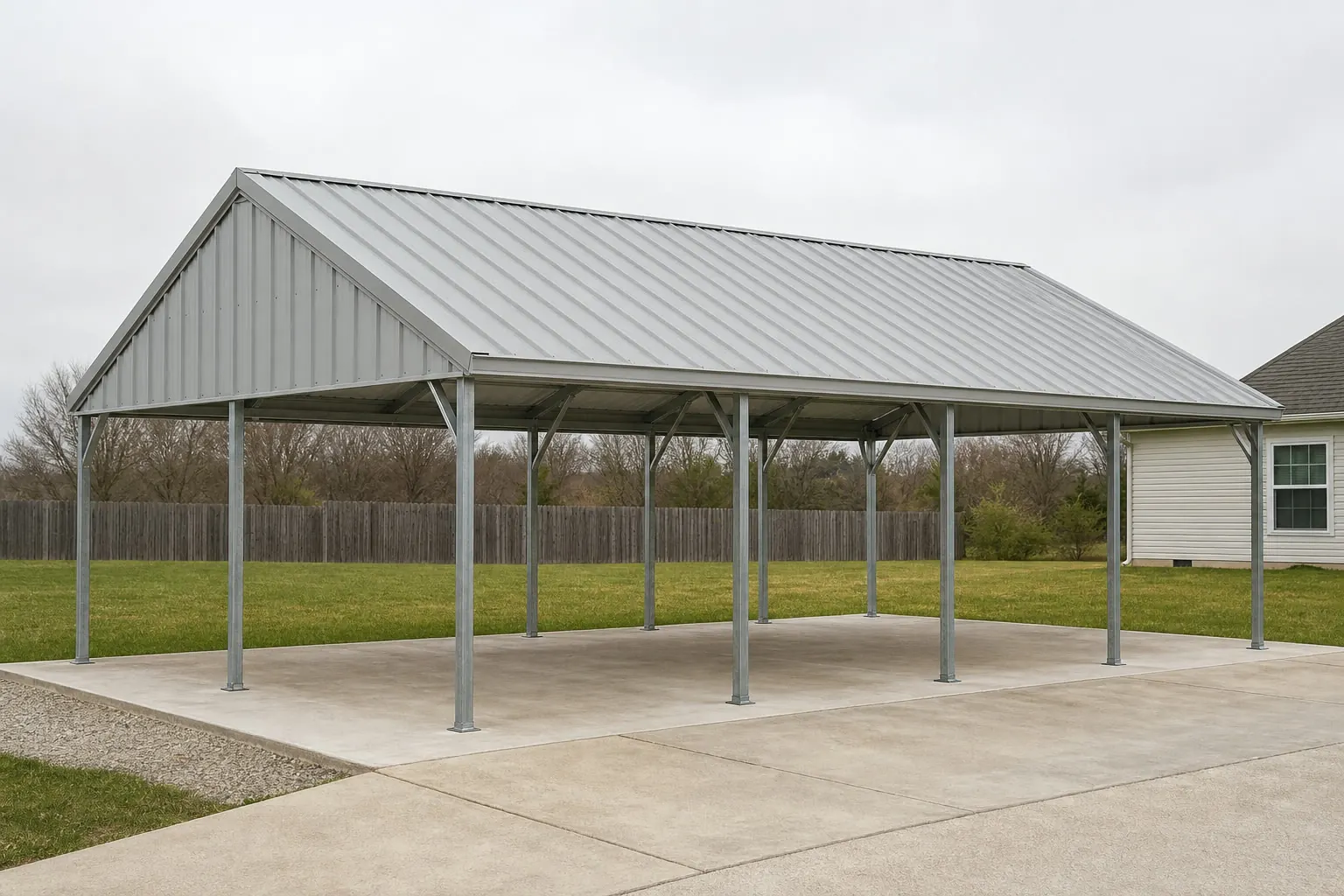
A shrinking farm base and a large new-home pipeline, at the same time
Virginia's carport buyer profile is being pulled by two documented trends moving in opposite directions: a declining farm count and a large annual volume of new housing authorizations. Neither trend by itself tells the whole story, but together they explain why a modern Virginia carport enquiry is at least as likely to come from a new suburban driveway as from an established working farm.
The intersection
Why Virginia's declining farm count matters for carport demand
A real drop in farm count between 2017 and 2022 shrinks, but does not eliminate, the working-land carport use case.
USDA's National Agricultural Statistics Service counted 38,995 farms in Virginia in 2022, down from 43,225 in 2017. That is a documented, real decline, not a rounding difference, and it is worth naming honestly rather than assuming Virginia's carport demand is dominated by farm-equipment cover the way it might be in a state with a larger or growing agricultural base. Working farms that remain still need open cover for trucks, tractors and small implements, but the base of properties generating that specific demand has shrunk over five years.
The exact 2022 statewide acreage figure sits inside USDA's Table 8 county-level dataset, and we did not extract the summary row line-by-line for this page. Rather than estimate an average farm size, this page routes a working-land buyer to that table directly, since acreage varies enough by county that a single statewide number would understate the real range between, say, a Coastal Plain row-crop operation and a Blue Ridge livestock operation.
Context
New construction, provincial orientation, and coastal hazard exposure
A large 2024 permitting pipeline and Virginia's five-province geography both change how and where a carport gets sited.
The U.S. Census Bureau recorded 34,059 total new privately-owned housing units authorized in Virginia in 2024. A carport planned alongside new construction has an advantage a retrofit carport does not: the driveway grade, orientation, and utility routing can all be set together during the initial site plan rather than worked around an existing layout.
Because a carport has open sides, its orientation relative to prevailing wet weather matters more than it would for an enclosed building, and Virginia's five physiographic provinces — Coastal Plain, Piedmont, Blue Ridge, Valley and Ridge, and Appalachian Plateau, as named by Virginia Energy — do not all face weather the same way. A Coastal Plain carport near the Chesapeake Bay benefits from orientation planning around coastal wind and rain patterns, while a Valley and Ridge carport in the Shenandoah faces a different, terrain-influenced wind exposure.
For any coastal Virginia site, FEMA's National Risk Index scores 18 hazard types, including coastal flooding and hurricane wind, for every one of Virginia's counties and independent cities. Checking that tool for the specific locality is a better basis for a carport's placement and anchoring conversation than assuming a general inland condition applies.
- Coordinate siting with new-home construction
- If the carport is part of a new build, plan its orientation and driveway access together with the home's site work.
- Orient by province, not by a single statewide rule
- Coastal Plain, Piedmont, and mountain-province sites can face different prevailing wet-weather directions.
- Check your locality's FEMA NRI score if coastal
- Every Virginia county and independent city is scored individually across 18 hazard types.
Get Virginia carport quotes
Tell us your vehicle or equipment needs, locality and rough size. We route it with the Virginia and carport context already attached.
Configuration
What Virginia carports are being asked to protect
A shrinking farm base and a growing new-home pipeline together shape the two recurring use cases.
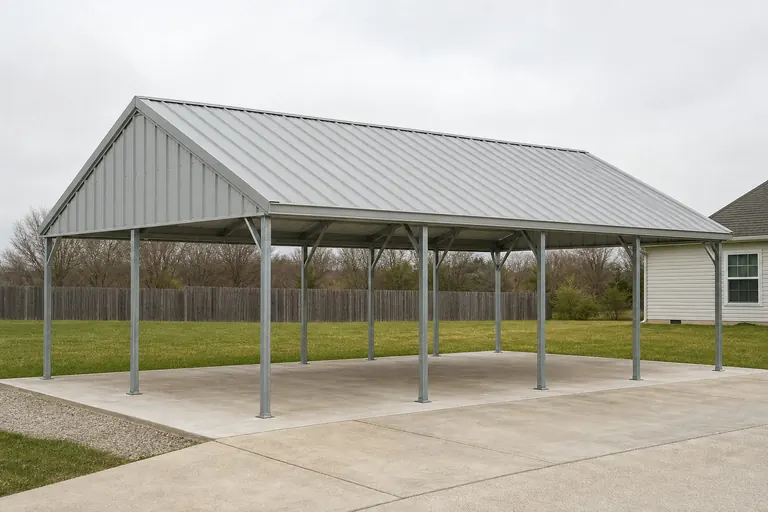 New-home vehicle coverA daily-driver carport sited and oriented as part of a fresh suburban or exurban home build, taking advantage of Virginia's large 2024 permit pipeline.Working-farm equipment coverOpen cover for a truck, tractor or implement on one of Virginia's remaining 38,995 farms, sized to the specific operation rather than an assumed statewide average.
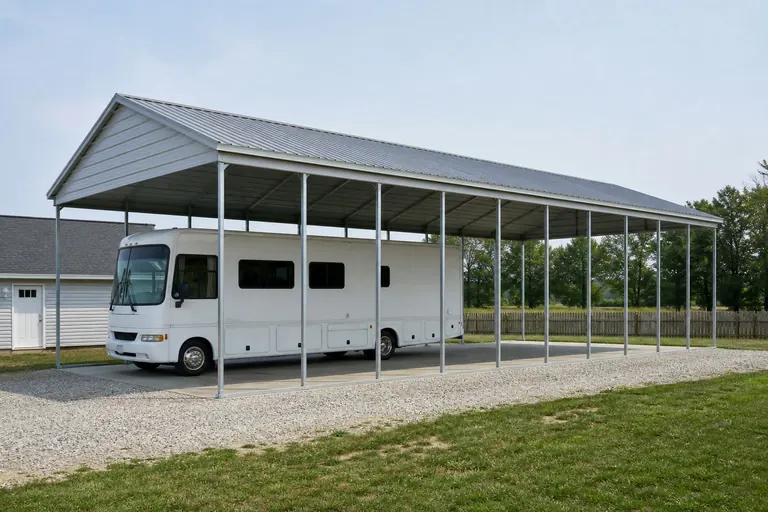 Coastal boat or trailer storageTaller open cover near Chesapeake Bay or Tidewater communities, sited with FEMA NRI hazard exposure checked for the specific locality first.
Example Configuration — for planning purposes only.
Footprint
Sizes that suit Virginia's two dominant use cases
Carport sizing tracks vehicle or equipment count directly once province and use case are known.
18′ × 20′
360 sq ft
A standard two-vehicle footprint for a new suburban Virginia home.
20′ × 30′
600 sq ft
Common where a truck or small farm equipment needs cover alongside a passenger vehicle.
24′ × 36′
864 sq ft
A larger option for boat or multi-vehicle cover near Chesapeake Bay or Tidewater properties.
Example Configuration — for planning purposes only.
Footprint pages carry layout and clearance detail for each of these; this page explains why Virginia buyers land in this range.
Preparation
Before you order a Virginia carport
Resolving these in advance avoids a second site visit once posts are ready to set.
Step 1
Name your physiographic province
Coastal Plain, Piedmont, Blue Ridge, Valley and Ridge, or Appalachian Plateau siting changes the orientation and drainage conversation.
Step 2
Confirm your use case up front
Tell your builder whether the carport is for daily-driver vehicles, farm equipment, or a boat, since clearance heights and bay widths differ.
Step 3
Check your locality's FEMA NRI hazard score if coastal
Every Virginia county and independent city carries its own score across 18 hazard types; check yours rather than assuming a general condition.
Step 4
Coordinate with new-home site work where relevant
With a large statewide 2024 permit pipeline, a carport built alongside a new home can share driveway and grading planning from the start.
Questions
Virginia carport questions
Answered honestly at the state level, with anything jurisdiction-specific routed to the right office.
USDA NASS counted 38,995 farms in 2022, down from 43,225 in 2017, a real decline worth knowing if you're comparing carport demand to a working-farm use case.
Permit thresholds and setback rules are set locally across Virginia's counties and independent cities. Your local building or zoning department is the only reliable source for your specific parcel.
There's no single statewide answer. Virginia spans five physiographic provinces with different prevailing weather exposure, so orient any partially enclosed side toward your own site's typical wet-weather direction.
It can be near the Chesapeake Bay or Atlantic coast. FEMA's National Risk Index scores coastal flooding and hurricane exposure across 18 hazard types for all of Virginia's counties and independent cities; check yours before finalizing placement.
Yes, potentially. With 34,059 housing units authorized statewide in 2024, a carport built alongside a new home can have its orientation and driveway planned together with the house from the start.
We do not publish state-level prices, since cost depends on size, materials, anchoring and site work. Our cost pages cover what drives the number; a quote covers your specific project.
Sources for the Virginia facts on this page
This page states no code requirement, wind speed, snow load, permit rule, price or supplier claim. The state-specific facts it does use are listed with their publisher below.
Virginia had 38,995 farms in 2022, down from 43,225 farms in 2017.
USDA National Agricultural Statistics Service (NASS), Virginia Field Office · 2022 (with 2017 comparison) · Tier 2
https://articles.vafb.com/new-census-reveals-a-decrease-in-farms-and-farmland/Virginia's 2022 Census of Agriculture reports state-level farm counts, land in farms, and market value of land and buildings in its county-level Table 8 dataset, with statewide totals shown in the 'Virginia' column.
USDA NASS · 2022 (with 2017 comparison) · Tier 1
https://www.nass.usda.gov/Publications/AgCensus/2022/Full_Report/Volume_1,_Chapter_2_County_Level/Virginia/st51_2_008_008.pdfVirginia builders and developers were authorized (by building permit) to build 34,059 total new privately-owned housing units in 2024 (22,796 in single-family buildings, 448 in 2-unit buildings, 80 in 3-4 unit buildings, and 10,735 in buildings of 5+ units).
U.S. Census Bureau · 2024 (final annual) · Tier 1
https://www2.census.gov/econ/bps/State/st2024a.txtVirginia Energy (the state geological survey) identifies five distinct physiographic provinces crossing the state: the Coastal Plain, Piedmont, Blue Ridge, Valley and Ridge, and Appalachian Plateau.
Virginia Energy (Virginia Department of Energy, Division of Geology and Mineral Resources) · Reference material, current · Tier 2
https://energy.virginia.gov/geology/FossilProvinces.shtmlFEMA's National Risk Index tool provides county- and tract-level composite and hazard-specific risk scores for all 133 of Virginia's counties and independent cities across 18 natural hazard types.
Federal Emergency Management Agency (FEMA) · Current NRI release · Tier 1
https://www.fema.gov/flood-maps/products-tools/national-risk-index