
Metal garage · VA
Metal Garages in Virginia
Virginia Energy, the state's geological survey, identifies five distinct physiographic provinces running west from the coast: the Coastal Plain, Piedmont, Blue Ridge, Valley and Ridge, and Appalachian Plateau. That is a wider spread of named landforms than a single-region state has to plan around, so a metal garage sited near Virginia Beach is answering a different grading question than one sited in the Shenandoah Valley or the far southwest coalfields. Layered on top, the U.S. Census Bureau recorded 34,059 total new privately-owned housing units authorized statewide in 2024, including 22,796 in single-family structures, which means a stand-alone garage permit often lands on a desk already busy with a large residential caseload.
The intersection
Virginia's five provinces set the garage siting question before size does
Five named physiographic provinces mean a garage buyer should identify their region before assuming a grading approach.
Virginia Energy, the state's geological survey, maps five distinct physiographic provinces running from the Atlantic coast to the far southwest: the Coastal Plain, Piedmont, Blue Ridge, Valley and Ridge, and Appalachian Plateau. That is more named regions than many states carry, and it means a generic 'Virginia garage' plan does not exist. A garage sited on flat Coastal Plain ground near the Chesapeake Bay is solving a drainage-and-orientation problem; one sited in the folded Valley and Ridge province around the Shenandoah is solving a grading-and-access problem instead, and one in the Appalachian Plateau counties in the far southwest may be working with genuinely steep terrain.
The Virginia Department of Conservation and Recreation publishes a companion overview describing physiography and vegetation differences across these same five provinces. The vegetation detail matters practically: a Piedmont site cleared from mixed hardwood forest carries a different site-prep scope than an already-open Coastal Plain parcel, and that scope belongs in an early conversation with a local excavator or builder, not discovered after a slab is poured.
Site conditions
What each Virginia province tends to mean for a garage site
Province identity, not statewide averages, is the practical starting point for grading and access planning.
| Province | General character (Virginia Energy / DCR) | What it means for a garage site |
|---|---|---|
| Coastal Plain | Flat, low-relief land along the Atlantic and Chesapeake Bay | Drainage and orientation typically matter more than grading; check water table depth locally. |
| Piedmont | Rolling terrain between the coast and the mountains | A level pad often needs some grading; confirm slope with an excavator before fixing a footprint. |
| Blue Ridge | Mountainous province forming a narrow spine through the state | Steeper parcels are common; access grade to the garage door deserves early attention. |
| Valley and Ridge | Folded, elongated ridges and valleys, including the Shenandoah Valley | Terrain varies sharply over short distances; a nearby valley floor and an adjacent ridge can require very different site work. |
| Appalachian Plateau | Far southwestern Virginia's plateau and coalfield terrain | Access road grade and cut-and-fill costs are often the limiting factor, more than the building itself. |
Coastal Plain
- General character (Virginia Energy / DCR)
- Flat, low-relief land along the Atlantic and Chesapeake Bay
- What it means for a garage site
- Drainage and orientation typically matter more than grading; check water table depth locally.
Piedmont
- General character (Virginia Energy / DCR)
- Rolling terrain between the coast and the mountains
- What it means for a garage site
- A level pad often needs some grading; confirm slope with an excavator before fixing a footprint.
Blue Ridge
- General character (Virginia Energy / DCR)
- Mountainous province forming a narrow spine through the state
- What it means for a garage site
- Steeper parcels are common; access grade to the garage door deserves early attention.
Valley and Ridge
- General character (Virginia Energy / DCR)
- Folded, elongated ridges and valleys, including the Shenandoah Valley
- What it means for a garage site
- Terrain varies sharply over short distances; a nearby valley floor and an adjacent ridge can require very different site work.
Appalachian Plateau
- General character (Virginia Energy / DCR)
- Far southwestern Virginia's plateau and coalfield terrain
- What it means for a garage site
- Access road grade and cut-and-fill costs are often the limiting factor, more than the building itself.
Context
A large statewide housing pipeline changes what a garage permit application competes with
34,059 authorized housing units in 2024 is a sizable single-year pipeline for a garage permit to move through.
The U.S. Census Bureau's Building Permits Survey recorded 34,059 total new privately-owned housing units authorized in Virginia in 2024, split across 22,796 single-family units, 448 in 2-unit structures, 80 in 3-4 unit structures, and 10,735 in buildings of five or more units. That is a genuinely large annual volume for local building departments statewide to process. A stand-alone garage permit application in an active county or independent city can share a review queue with that broader residential caseload, so arriving with a complete, clearly labeled site plan on the first submission is worth the effort rather than assuming a quick turnaround.
FEMA's National Risk Index scores all 133 of Virginia's counties and independent cities across 18 hazard types, from flooding to high wind. Because exposure genuinely differs between a Tidewater county and a mountain county, checking the specific locality's NRI profile before finalizing a garage site is a better use of time than assuming any single statewide hazard level.
- Submit a complete plan the first time
- A large statewide permit volume means incomplete applications are more likely to sit in queue; confirm required documents with your locality before filing.
- Check your locality's own hazard profile
- FEMA NRI covers all 133 Virginia counties and independent cities individually; use your own locality's score rather than a general assumption.
- Identify your province before grading estimates
- Whether the site is Coastal Plain, Piedmont, Blue Ridge, Valley and Ridge, or Appalachian Plateau changes what a fair grading quote looks like.
Get Virginia metal garage quotes
Tell us your locality, province and rough footprint. We route it with the Virginia and metal-garage context already attached.
Configuration
What Virginia metal garages are commonly asked to do
Provincial terrain and Virginia's working-farm base both shape recurring configurations.
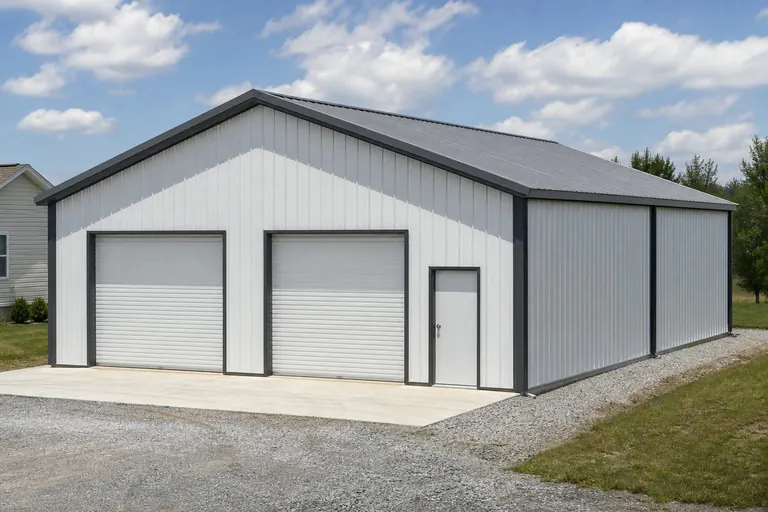 Vehicle storage on varied terrainGarage siting depends on province and grading as much as door count; a level pad in the Valley and Ridge province can require different site work than one on the Coastal Plain.
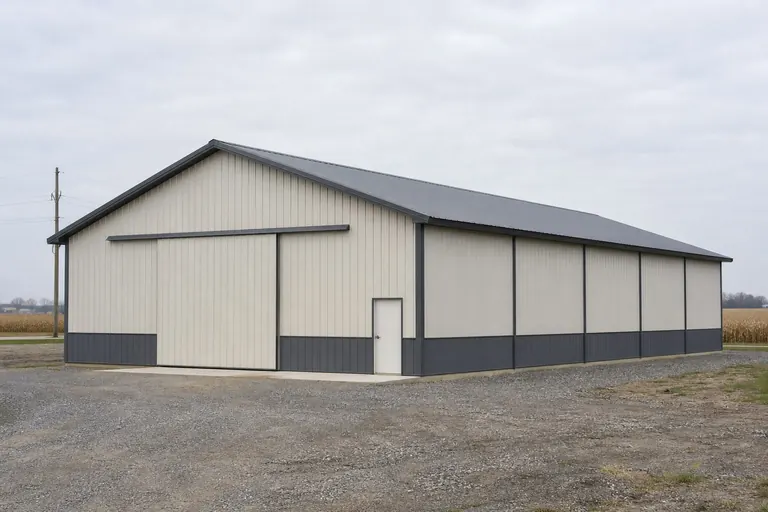 Working-land equipment storageVirginia's 38,995 farms in 2022 support demand for garages that also cover trucks, trailers or small implements alongside passenger vehicles.New-construction pairingWith a large statewide housing pipeline, garages are increasingly planned alongside new home builds where grading and utilities can be coordinated from the start.
Example Configuration — for planning purposes only.
Footprint
Sizes that fit a Virginia garage brief
Provincial terrain and access, not budget alone, often set the practical footprint ceiling.
20′ × 24′
480 sq ft
A compact single-vehicle footprint suited to tighter Piedmont or mountain building envelopes.
24′ × 30′
720 sq ft
A common two-car starting point where a level pad is achievable.
30′ × 40′
1,200 sq ft
Room for vehicles plus farm equipment on larger, flatter Coastal Plain or valley-floor acreage.
Example Configuration — for planning purposes only.
Footprint pages carry layout and door detail for each of these; this page explains why Virginia briefs weigh province and grading before size.
Preparation
Before you request a Virginia metal-garage quote
Resolving these in advance keeps quotes comparable across builders.
Step 1
Identify your physiographic province
Tell your builder whether the site is Coastal Plain, Piedmont, Blue Ridge, Valley and Ridge, or Appalachian Plateau terrain, since grading approach differs.
Step 2
Check your county or independent city's FEMA NRI profile
All 133 Virginia localities are scored individually across 18 hazard types; use your own locality's figures.
Step 3
Contact your local building department early
Permit thresholds and adopted code editions are set locally; Virginia's large 2024 permit volume means an early, complete application helps.
Step 4
Confirm access grade for mountain or plateau sites
Blue Ridge and Appalachian Plateau parcels can carry steep access; confirm delivery-vehicle access before ordering.
Step 5
Plan drainage on Coastal Plain sites
Flat, low-relief ground near tidal water often needs orientation and drainage planning more than grading.
Questions
Virginia metal garage questions
Answered honestly at the state level, with the rest routed to whoever owns that answer.
Permit requirements and adopted code editions are set locally across Virginia's counties and independent cities. Your local building department is the only reliable source for your specific parcel.
Yes. Virginia Energy documents five distinct physiographic provinces — Coastal Plain, Piedmont, Blue Ridge, Valley and Ridge, and Appalachian Plateau — and grading needs differ meaningfully between them.
It can be. With 34,059 total housing units authorized statewide in 2024, a stand-alone garage permit in a busy locality may share a review queue with that broader caseload, so a complete first submission is worth the effort.
There is no official typical size. Terrain and achievable pad grading in your specific province often set the practical limit more than budget alone.
FEMA's National Risk Index scores all 133 Virginia counties and independent cities individually across 18 hazard types; check your own locality rather than assuming a statewide condition.
We do not publish state-level prices, since site grading, specification and current material pricing all drive the number. Our cost pages cover what drives cost; a quote covers your building.
Sources for the Virginia facts on this page
This page states no code requirement, wind speed, snow load, permit rule, price or supplier claim. The state-specific facts it does use are listed with their publisher below.
Virginia Energy (the state geological survey) identifies five distinct physiographic provinces crossing the state: the Coastal Plain, Piedmont, Blue Ridge, Valley and Ridge, and Appalachian Plateau.
Virginia Energy (Virginia Department of Energy, Division of Geology and Mineral Resources) · Reference material, current · Tier 2
https://energy.virginia.gov/geology/FossilProvinces.shtmlThe Virginia Department of Conservation and Recreation publishes a statewide overview describing the physiography and vegetation differences across Virginia's Coastal Plain, Piedmont, Blue Ridge, Ridge and Valley, and Appalachian Plateau provinces.
Virginia Department of Conservation and Recreation (DCR), Division of Natural Heritage · Version 2.0, March 2021 · Tier 2
https://www.dcr.virginia.gov/natural-heritage/natural-communities/document/ncoverviewphys-veg.pdfVirginia builders and developers were authorized (by building permit) to build 34,059 total new privately-owned housing units in 2024 (22,796 in single-family buildings, 448 in 2-unit buildings, 80 in 3-4 unit buildings, and 10,735 in buildings of 5+ units).
U.S. Census Bureau · 2024 (final annual) · Tier 1
https://www2.census.gov/econ/bps/State/st2024a.txtFEMA's National Risk Index tool provides county- and tract-level composite and hazard-specific risk scores for all 133 of Virginia's counties and independent cities across 18 natural hazard types.
Federal Emergency Management Agency (FEMA) · Current NRI release · Tier 1
https://www.fema.gov/flood-maps/products-tools/national-risk-indexRichmond, VA's 1991-2020 annual climate normal precipitation is 45.50 inches with an annual normal snowfall of 8.8 inches.
NOAA National Centers for Environmental Information (NCEI) · 1991-2020 · Tier 1
https://www.ncei.noaa.gov/access/services/data/v1?dataset=normals-annualseasonal-1991-2020&dataTypes=ANN-PRCP-NORMAL,ANN-SNOW-NORMAL&stations=USW00013740&format=json