
Metal garage · AZ
Metal Garages in Arizona
Arizona has no single state agency that writes and enforces a general building code the way some states do; the state's own uniform statewide code adoption covers the Fire Code only, and every other construction question is decided city by city or county by county under state statute. For a garage buyer, that means the first real question is not what the building needs, but which jurisdiction's rules apply to the parcel — and whether the parcel is even privately buildable, since federal and state trust land cover the large majority of Arizona's roughly 34.4 million acres.
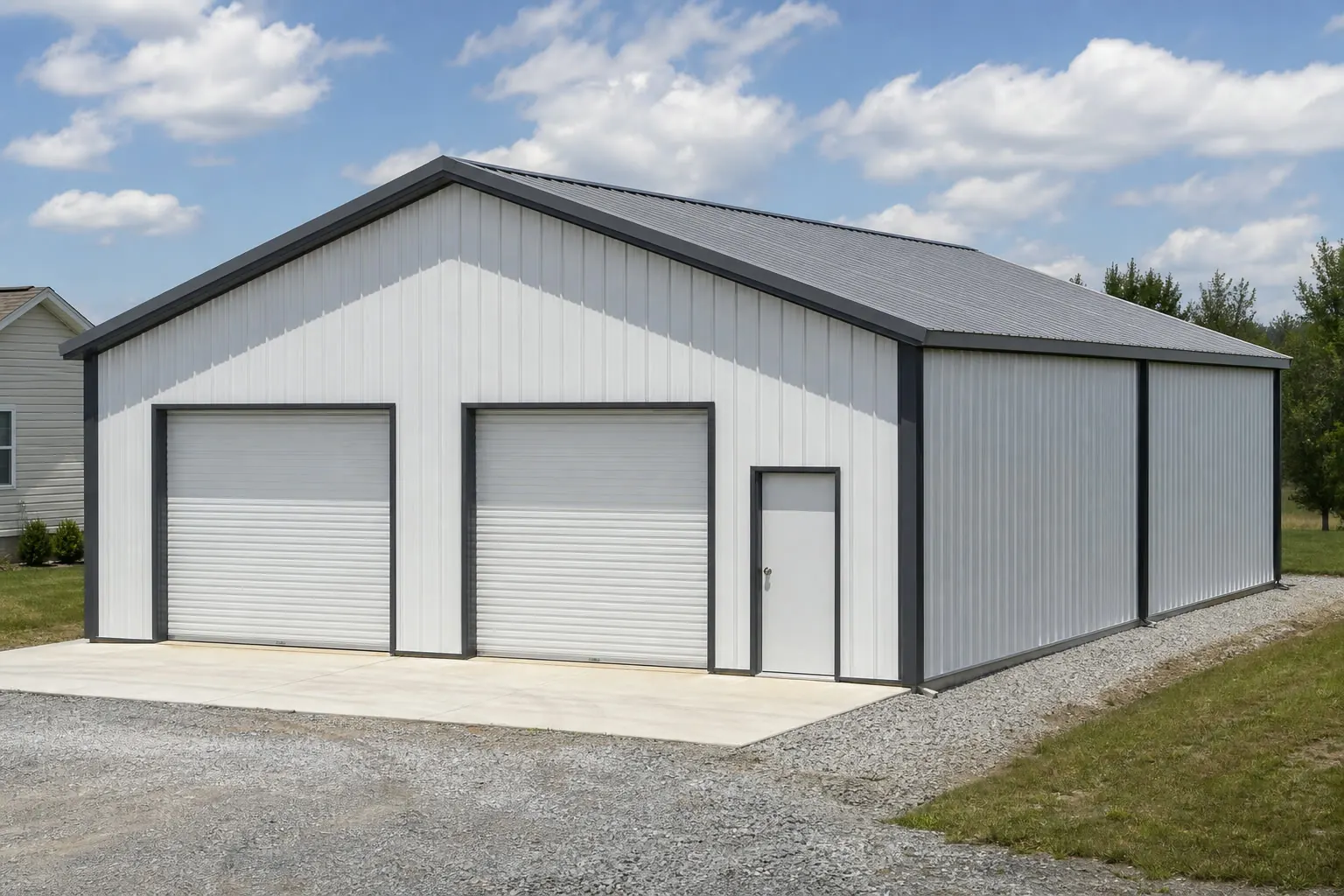
The intersection
Arizona's code question starts at the city or county, not the state
Arizona is unusual among states in that its uniform statewide code adoption reaches only the Fire Code. Everything else — including the code that will govern a garage slab, framing or setback — is decided locally.
Arizona statute lets counties and municipalities adopt construction codes by reference on their own schedule, which is why two garages a few miles apart, in different jurisdictions, can be answering to different code editions and different local amendments. There is no single state building department a buyer can call for a definitive national answer; the definitive answer lives with whichever city or county the parcel sits in.
That is not a defect, and it is not something this page tries to resolve for you — code editions and permit thresholds are exactly the kind of detail only the local building department can give correctly. What it does mean is a different order of operations than a state with a single uniform code: identify the jurisdiction first, call them, and treat whatever they say as the actual rule for that site.
Site eligibility
Land ownership shapes where an Arizona garage can go
Before jurisdiction even comes into play, a large share of Arizona's land is not privately buildable at all.
| Land category | Scale in Arizona | What it means for a garage site |
|---|---|---|
| Federal land | About 28.1 million of roughly 34.4 million total acres | Federally managed land is not a private building site; confirm parcel status before planning anything. |
| State Trust land | More than 9 million surface acres, about 13% of the state | Managed by the Arizona State Land Department for trust beneficiaries — distinct process from private parcel permitting. |
| Privately held parcels | The remaining share of the state's acreage | This is where a garage project actually proceeds, verified with the local assessor and building department. |
Federal land
- Scale in Arizona
- About 28.1 million of roughly 34.4 million total acres
- What it means for a garage site
- Federally managed land is not a private building site; confirm parcel status before planning anything.
State Trust land
- Scale in Arizona
- More than 9 million surface acres, about 13% of the state
- What it means for a garage site
- Managed by the Arizona State Land Department for trust beneficiaries — distinct process from private parcel permitting.
Privately held parcels
- Scale in Arizona
- The remaining share of the state's acreage
- What it means for a garage site
- This is where a garage project actually proceeds, verified with the local assessor and building department.
Exposure
Heat and monsoon dust drive how the garage gets used, not just how it's sited
A fixed monsoon calendar and a documented warming trend change how buyers think about ventilation, insulation and daily use far more than they change the structure itself.
NOAA and the National Weather Service define the North American Monsoon in Arizona as running June 15 through September 30 every year — a calendar definition, not a rainfall trigger — and that window brings the thunderstorm outflow dust events, known locally as haboobs, that NWS documents as one of the state's most underrated weather hazards. A garage used as a workshop or storage space during that window is dealing with blowing dust getting into everything left uncovered, not just occasional rain.
Separately, NOAA's state climate summary for Arizona records roughly 2.5°F of warming since the early 1900s and flags drought as an ongoing serious concern for the state. Neither figure is a design value and neither belongs in a specification. What they support is a planning conversation: ventilation, insulated doors and whether the space needs to be comfortable to work in during the hottest months, versus purely storage that can sit closed up.
Those two use cases pull the specification in different directions, so it helps to decide which one you are buying. A garage intended as a working space benefits from ventilation, shading of the west elevation, an insulated door and a light-coloured roof; a garage intended purely for covered storage can be simpler and cheaper. Buyers who describe the intended use rather than just the dimensions tend to get quotes that are actually comparable to each other.
Dust and monsoon-season water are the maintenance realities. Door seals and the transition between the slab and the surrounding ground do most of the work of keeping both out, and both are easier to get right at build time than to retrofit. On rural Arizona parcels, the approach surface is worth thinking about at the same time, since an unimproved drive that is fine in May behaves differently during a summer storm.
As with the code question, none of this is a statewide requirement. It is the set of practical items that come up repeatedly on Arizona sites and that a good local builder will raise unprompted.
- Door and vent choices
- Whether the garage needs powered ventilation or is left as sealed storage is a decision worth making before the shell is ordered, not after a first summer inside it.
- Dust-season housekeeping
- Anything stored loose is worth sealing or shelving before the monsoon window opens each June.
- Slab and apron drainage
- Even infrequent monsoon downpours can move a lot of water fast; a driveway apron that sheds water away from the door threshold avoids a recurring nuisance.
Get Arizona metal garage quotes
Tell us your city or county, how the garage will be used and your rough footprint. We route it with the Arizona and metal garage context already attached.
Configuration
What Arizona metal garages are usually asked to do
Heat is the variable that most often decides which configuration an Arizona buyer actually wants, more than the number of vehicles alone.
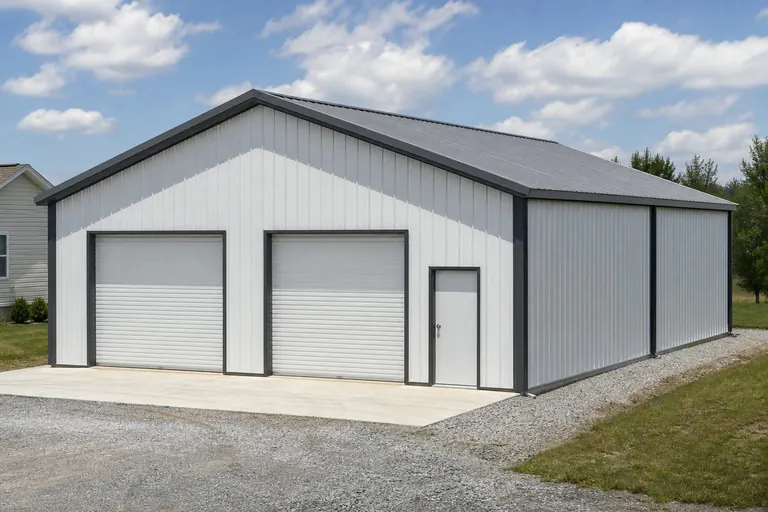 Vehicle storage onlyA sealed, unconditioned bay for vehicles and equipment kept out of direct sun; ventilation is the main comfort decision even without any workshop use.Shop and vehicle combinationA partitioned end used as a workshop needs more attention to ventilation and door placement than the vehicle side, since it is occupied for longer stretches during hot months.
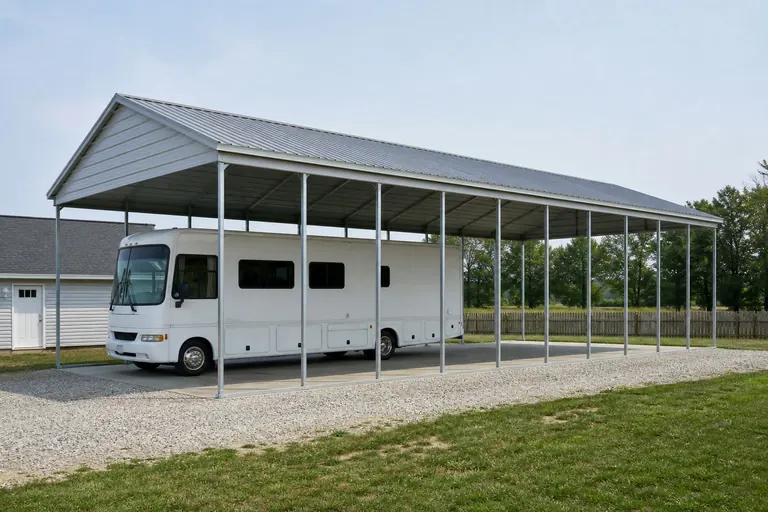 RV and oversized storageTaller door openings for RVs or trailers change clearance planning; check the door height against the tallest thing you intend to park before fixing a footprint.
Example Configuration — for planning purposes only.
Footprint
Sizes that fit an Arizona garage brief
Arizona enquiries commonly land in the multi-bay range, reflecting a garage that substitutes for indoor space during the hottest months rather than a minimal single-car add-on.
24′ × 30′
720 sq ft
A common starting point for a two-car garage with a small amount of extra bay depth.
30′ × 40′
1,200 sq ft
Enough width to add a partitioned shop end without crowding the vehicle bay.
20′ × 30′
600 sq ft
A compact option where the lot itself, not the budget, sets the limit.
30′ × 30′
900 sq ft
A square footprint that suits corner lots and tighter setbacks.
18′ × 26′
468 sq ft
The smallest practical single-bay-plus-storage footprint in this range.
12′ × 20′
240 sq ft
A single-vehicle or equipment-only footprint for a minimal-use case.
40′ × 40′
1,600 sq ft
Room for multiple vehicles plus a genuine shop area.
40′ × 60′
2,400 sq ft
The largest footprint in this range, typically for a buyer combining vehicle storage with a business or hobby use.
Example Configuration — for planning purposes only.
Footprint pages carry layout and door detail for each of these; this page only explains why Arizona briefs land in this range.
Local context
Arizona metros with published local guides
Phoenix and Tucson each sit in a different building-department landscape and a different piece of the monsoon and heat pattern described above.
Phoenix
A large metro with its own municipal building department and surrounding jurisdictions that each adopt codes on their own schedule, so the jurisdiction question is worth confirming by address rather than by metro.
Tucson
A separate jurisdictional landscape in the southern part of the state, where monsoon activity and dust management feature more prominently in day-to-day use.
Questions
Arizona metal garage questions
Questions we can answer honestly at state level, with the ones we cannot routed to whoever actually owns them.
No. Arizona's uniform statewide code adoption applies only to the Fire Code; general building code adoption and enforcement happen at the city or county level under state statute. Your local building department is the source for what applies to your parcel.
Only on land you can privately build on. A large share of Arizona acreage is federal land or State Trust land, both of which involve a different process than a standard private-parcel permit. Confirm your parcel's status before planning a garage.
Arizona's monsoon runs a fixed June 15 to September 30 window and brings documented blowing-dust and outflow-storm hazards. It does not change the structure, but it is a reason to think through ventilation, door sealing and stored-item housekeeping ahead of that window.
There is no official typical size. Arizona enquiries commonly land between 24x30 and 40x60, often reflecting a shop-plus-vehicle brief rather than a minimal single-car garage, because the building substitutes for outdoor or uncooled space during hot months.
We do not publish state-level prices, because a credible number depends on your specification, site work and current material pricing. Our cost pages cover what drives the number; a quote covers your building.
Sources for the Arizona facts on this page
This page states no code requirement, wind speed, snow load, permit rule, price or supplier claim. The state-specific facts it does use are listed with their publisher below.
Arizona building codes are governed at the local jurisdiction level rather than by a single statewide building code agency; the state's uniform statewide adoption applies only to the Fire Code.
UpCodes (citing Arizona State Fire Marshal statewide fire code adoption) · current, accessed 2024/2025 · Tier 3
https://up.codes/codes/arizonaArizona Revised Statutes govern how counties and municipalities adopt construction codes by reference, confirming code adoption is a local government function.
Arizona State Legislature · current statute text · Tier 2
https://www.azleg.gov/ars/11/00861.htmCRS's federal land ownership dataset lists Arizona federal acreage at roughly 28.1 million acres (2013 data) against total state acreage of approximately 34.4 million acres.
Congressional Research Service · data as of FY2013, report dated March 3, 2017 · Tier 1
https://www.everycrsreport.com/files/20170303_R42346_95ce191e74ed8e08054bb5476971544bc55823f2.htmlArizona has more than 9 million surface acres of State Trust land, about 13% of the state's total surface land ownership.
Arizona State Land Department · current, accessed 2024 · Tier 2
https://land.az.gov/our-agency-missionThe North American Monsoon in Arizona runs from June 15 to September 30 each year (a fixed calendar definition, not a rainfall trigger).
NOAA/National Weather Service (Tucson office) · current/ongoing definition · Tier 1
https://www.weather.gov/media/twc/Monsoon.pdfNWS documents blowing dust and dust storms (haboobs) as an underrated Arizona weather hazard, tied to monsoon thunderstorm outflows.
NOAA/National Weather Service · July 2016 · Tier 1
https://www.weather.gov/media/wrh/online_publications/TMs/TM-290.pdfNOAA's State Climate Summary reports Arizona temperatures have risen about 2.5°F since the early 20th century and identifies drought as a serious threat in the water-scarce state.
NOAA National Centers for Environmental Information (NCEI) · 2022 summary · Tier 1
https://statesummaries.ncics.org/downloads/Arizona-StateClimateSummary2022.pdf