
RV carport · AZ
RV Carports in Arizona
An RV carport covers more open roof area at a taller clearance than a standard vehicle carport, and in Arizona that larger surface sits directly inside a defined risk window: the National Weather Service marks the North American Monsoon as running June 15 through September 30 each year, and separate NWS technical documentation ties blowing dust and dust storms to monsoon thunderstorm outflow gusts. A bigger open roof takes more of that gust load than a standard carport does, with no walls to help resist it. Layer on Arizona's locally administered permitting — UpCodes documents no single statewide building-code agency here, with construction codes adopted city by city or county by county — and an RV carport brief in Arizona is really two separate conversations: structural scale against a known seasonal hazard, and a permit path that has to be confirmed locally rather than assumed statewide.
The intersection
A bigger roof meets the same fixed monsoon window
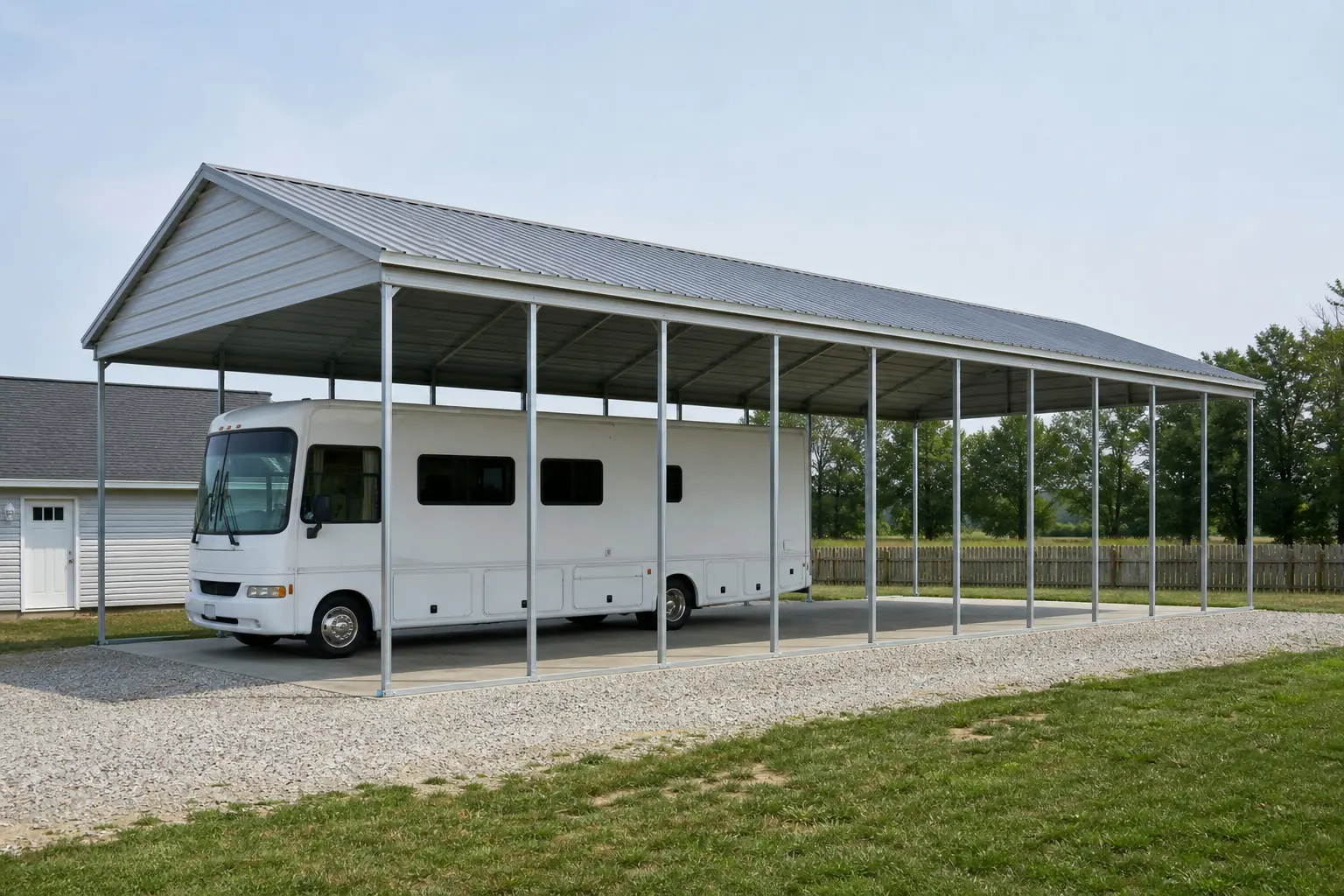
An RV carport's larger open span turns Arizona's defined monsoon outflow hazard into a bigger structural question than it is for a standard carport.
The National Weather Service defines Arizona's North American Monsoon as a fixed calendar window, June 15 through September 30 each year — an administrative boundary, not a rainfall-triggered season. That definition applies to the whole state regardless of structure size, but what an RV carport experiences inside that window is different from what a passenger-vehicle carport experiences, simply because there is more open roof to load. NWS technical memorandum TM-290 documents blowing dust and dust storms tied to monsoon thunderstorm outflow as an underrated Arizona hazard, and an outflow gust front hitting a taller, longer RV carport roof puts more force through the posts and footings than the same gust hitting a smaller structure.
That is a structural conversation worth having directly with a builder — post gauge, footing depth and roof-to-post connection detail scaled to the RV carport's actual span, not a generic carport spec. It is also a scheduling opportunity: because the monsoon window is fixed on the calendar, an owner can plan an anchoring inspection before June 15 rather than discovering a weak connection mid-season.
None of this substitutes for a wind design value or an engineering requirement, both of which are set by the local building department for a specific parcel, not by this page.
Jurisdiction
A larger footprint makes local permitting confirmation more important
Arizona has no single statewide building-code agency covering a structure like this, and a bigger RV carport footprint is more likely to trigger different local requirements than a small one.
UpCodes documents that Arizona codes are adopted and enforced at the city or county level, not by one statewide building-code agency, with the state's uniform statewide adoption limited to the Fire Code. Arizona Revised Statutes A.R.S. §11-861 confirms counties adopt construction codes by reference under their own authority. For a small accessory structure this can sometimes mean a lighter review; for a larger RV carport footprint, the size itself is more likely to cross a local threshold that triggers full plan review, engineering documentation or setback requirements that a smaller carport would not hit.
The practical takeaway is to confirm with your specific city or county building department early, using the RV's actual dimensions, rather than assuming the same review path that a standard vehicle carport would follow.
- Confirm your RV's height and length first
- Clearance and span drive both the structural spec and which local review threshold applies.
- Ask about outflow-wind anchoring at this scale
- A taller, longer roof takes more load from monsoon outflow gusts than a standard carport.
- Check jurisdiction near federal or trust land
- RV storage sites near public land boundaries should confirm the governing authority before finalizing plans.
Site context
Where an Arizona RV carport sits changes the practical checklist
Federal, trust and agricultural land patterns across Arizona shape which jurisdiction and site conditions an RV carport buyer needs to confirm.
Metro and suburban residential lots
Standard city or county review applies; confirm the RV carport's footprint against local setback and permit thresholds directly.
Parcels near federal land
CRS data lists roughly 28.1 million federal acres of Arizona's approximately 34.4 million total acres; confirm governing jurisdiction for parcels adjacent to that boundary.
State Trust land-adjacent sites
The Arizona State Land Department reports over 9 million surface acres of State Trust land; nearby private parcels may involve additional review steps.
Rural and agricultural acreage
With 25,525,087 acres in farms per the 2022 Census, RV storage on working agricultural land can follow a different local review track worth confirming ahead of time.
Get Arizona RV carport quotes
Tell us your RV's dimensions, planned use and rough footprint. We route it with the Arizona and RV carport context already attached.
Configuration
What Arizona RV carports are usually asked to do
Long-term UV and outflow-wind protection for a motorhome, travel trailer or boat is the recurring brief, at a bigger structural scale than an everyday-vehicle carport.
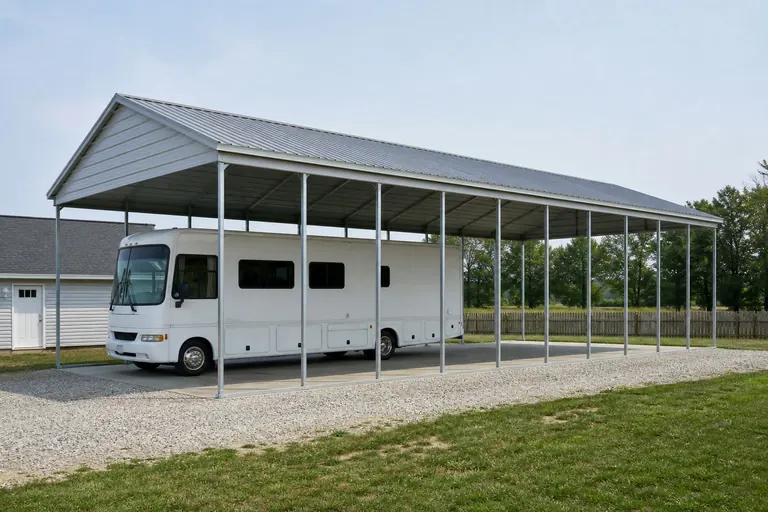 Motorhome or Class A storageTall clearance and a long roof span address year-round Arizona sun exposure on a parked motorhome's roof and finish.Travel trailer and toy hauler coverA lower-clearance but still long open structure suits trailers stored between trips through the monsoon season.
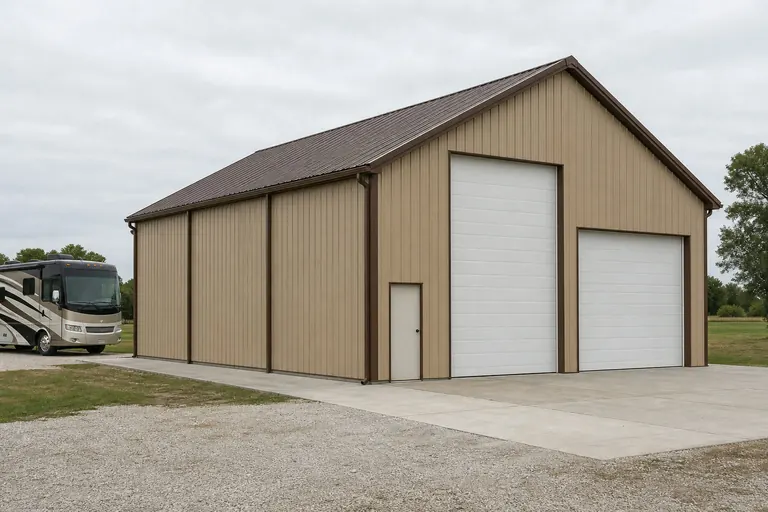 Enclosed upgrade pathWhere full weather protection or security matters more than budget, an RV garage is the enclosed alternative worth comparing.
Example Configuration — for planning purposes only.
Footprint
Sizes that suit Arizona RV carport projects
Arizona RV carport enquiries are sized around the specific vehicle's height and length, running longer and taller than a standard vehicle carport.
14′ × 36′
504 sq ft
A common single-RV footprint sized for a mid-size motorhome or large trailer.
18′ × 40′
720 sq ft
Adds width and length for a larger motorhome or a trailer-plus-tow-vehicle combination.
20′ × 50′
1,000 sq ft
Fits longer Class A motorhomes or a toy hauler with additional storage needs.
24′ × 60′
1,440 sq ft
A wider, longer footprint for multiple RVs or an RV plus a boat under one roof.
Example Configuration — for planning purposes only.
Footprint pages carry clearance-height detail for each of these; this page only explains why the Arizona brief centers on monsoon outflow wind and local permitting at RV scale.
Preparation
Before you request an Arizona RV carport quote
Resolving these in advance makes the difference between a comparable quote and a re-quote on an Arizona RV storage site.
Step 1
Confirm your RV's exact height and length
Clearance and span are sized to the specific vehicle, not a generic carport footprint.
Step 2
Contact your city or county building department
Arizona sets permit requirements locally, and a larger RV carport footprint is more likely to cross a local review threshold.
Step 3
Ask about anchoring at RV scale
A taller, longer structure carries more monsoon outflow load than a standard carport, per NWS documentation on the hazard.
Step 4
Time inspections around the monsoon calendar
Confirm anchoring and connections before the June 15 to September 30 window opens.
Questions
Arizona RV carport questions
Questions we can answer honestly at state level, with the ones we cannot routed to whoever actually owns them.
Structurally, yes in scale: a taller, longer roof presents more surface area to the outflow gusts NWS documents as tied to Arizona's monsoon thunderstorms, which is worth raising with a builder when specifying anchoring.
Before June 15, since NWS defines the monsoon as running June 15 through September 30 each year on a fixed calendar rather than a rainfall trigger.
Requirements are set locally, since Arizona has no single statewide building-code agency for this kind of structure. Confirm directly with your city or county building department using your RV's actual dimensions.
It can. Larger footprints are more likely to cross local review thresholds that a smaller structure would not, and since codes are adopted county by county under A.R.S. §11-861, the specific threshold varies by jurisdiction.
NOAA's state climate summary reports about 2.5°F of warming since the early 20th century, and that warming trend is the honest backdrop for why UV and heat exposure, not snow load, are the main concerns for a parked RV's roof and finish here.
We do not publish state-level prices, because a credible number depends on your specification, site work and current material pricing. Our cost pages cover what drives the number; a quote covers your building.
Sources for the Arizona facts on this page
This page states no code requirement, wind speed, snow load, permit rule, price or supplier claim. The state-specific facts it does use are listed with their publisher below.
The North American Monsoon in Arizona runs from June 15 to September 30 each year (a fixed calendar definition, not a rainfall trigger).
NOAA/National Weather Service (Tucson office) · current/ongoing definition · Tier 1
https://www.weather.gov/media/twc/Monsoon.pdfNWS documents blowing dust and dust storms (haboobs) as an underrated Arizona weather hazard, tied to monsoon thunderstorm outflows.
NOAA/National Weather Service · July 2016 · Tier 1
https://www.weather.gov/media/wrh/online_publications/TMs/TM-290.pdfNOAA's State Climate Summary reports Arizona temperatures have risen about 2.5°F since the early 20th century and identifies drought as a serious threat in the water-scarce state.
NOAA National Centers for Environmental Information (NCEI) · 2022 summary · Tier 1
https://statesummaries.ncics.org/downloads/Arizona-StateClimateSummary2022.pdfArizona building codes are governed at the local jurisdiction level rather than by a single statewide building code agency; the state's uniform statewide adoption applies only to the Fire Code.
UpCodes (citing Arizona State Fire Marshal statewide fire code adoption) · current, accessed 2024/2025 · Tier 3
https://up.codes/codes/arizonaArizona Revised Statutes govern how counties and municipalities adopt construction codes by reference, confirming code adoption is a local government function.
Arizona State Legislature · current statute text · Tier 2
https://www.azleg.gov/ars/11/00861.htmCRS's federal land ownership dataset lists Arizona federal acreage at roughly 28.1 million acres (2013 data) against total state acreage of approximately 34.4 million acres.
Congressional Research Service · data as of FY2013, report dated March 3, 2017 · Tier 1
https://www.everycrsreport.com/files/20170303_R42346_95ce191e74ed8e08054bb5476971544bc55823f2.html