
Carport · AZ
Carports in Arizona
A carport in Arizona spends most of the year doing a simple job — keeping a windshield out of direct sun — and a few weeks a year doing a harder one, because the National Weather Service defines the North American Monsoon as running June 15 through September 30 every year, a fixed calendar window rather than a rainfall trigger. NWS technical documentation separately names blowing dust and dust storms tied to monsoon thunderstorm outflow as an underrated Arizona hazard, and that outflow wind hits an open-sided structure differently than it hits a walled garage. On top of that, Arizona has no single statewide building-code agency for structures like a carport; UpCodes documents that construction codes are adopted locally by city and county, with the state's uniform statewide adoption reaching only the Fire Code. Those two facts, not a generic desert-climate description, are what actually change a carport plan here.
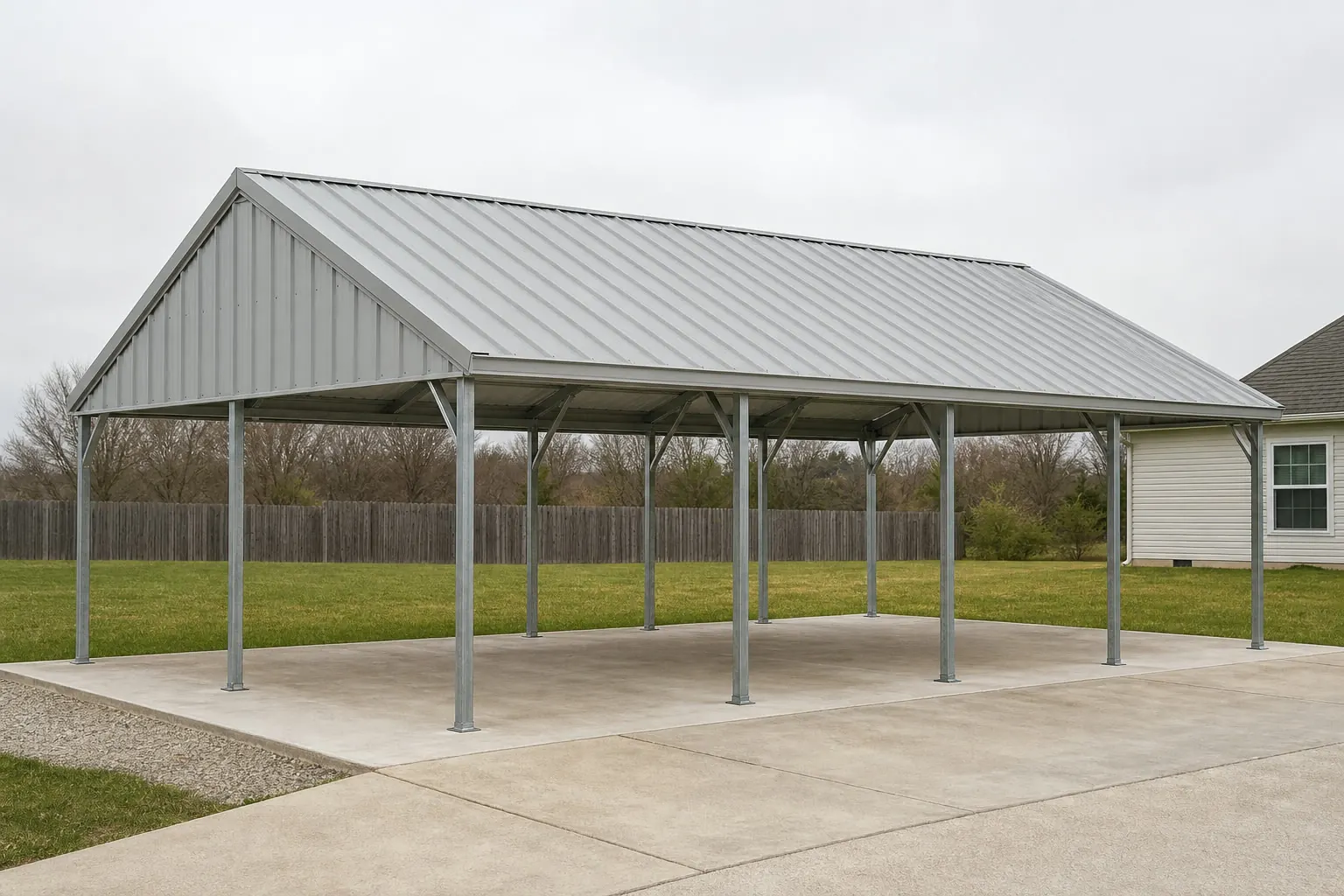
The calendar
Arizona runs its carport risk season on a fixed calendar
The monsoon is a defined date range, not a weather forecast, which lets an Arizona carport owner plan around a known window rather than an unpredictable one.
Most states describe carport wind exposure in vague seasonal terms. Arizona does not have to: the National Weather Service defines the North American Monsoon as running from June 15 through September 30 each year, an administrative calendar boundary used for forecasting and public messaging rather than a trigger tied to actual rainfall onset. For a carport owner, that fixed window is useful in a very practical way — anchoring bolts, roof fasteners and post connections are worth inspecting before June 15 rather than after a storm has already tested them.
What the calendar window actually delivers is documented separately. NOAA/NWS technical memorandum TM-290 identifies blowing dust and dust storms, including haboobs, as tied to monsoon thunderstorm outflow and calls the hazard underrated relative to how often it is discussed. An outflow gust front arrives suddenly and can exceed the load a structure experiences on an ordinary windy day, which matters more for an open-sided carport than for a walled garage, because a carport's posts and roof connections take that load directly with no wall sheathing to help distribute it.
None of this is a substitute for asking a builder about post gauge, footing depth and roof-to-post connection detail for your specific site. It is, however, a reason to raise those questions before the June 15 window opens rather than after a storm season has already passed.
Jurisdiction
Arizona permitting for a carport is a local decision, not a state one
There is no single statewide building-code agency covering a structure like a carport, so the same footprint can face different documentation requirements depending on which Arizona city or county reviews it.
UpCodes documents that Arizona building codes are governed at the local jurisdiction level rather than by one statewide building-code agency, and that the state's uniform statewide code adoption applies only to the Fire Code. Arizona Revised Statutes further confirm that counties and municipalities adopt construction codes by reference under their own authority — A.R.S. §11-861 for counties, with §34-461 addressing local code applicability. Practically, that means a carport plan approved in one Arizona county carries no guarantee of matching requirements in the next.
This matters for carports specifically because open-sided accessory structures sit near the edge of many local permit thresholds — sometimes reviewed lightly, sometimes requiring the same engineering documentation as an enclosed structure. The only reliable way to know which applies to a given parcel is to ask the city or county building department directly before finalizing a specification.
- Call before you spec
- Ask your city or county building department what documentation an open-sided carport needs on your parcel.
- Don't assume county-to-county consistency
- A.R.S. §11-861 confirms code adoption is a county-level decision, so neighboring counties can differ.
- Check State Trust land status if relevant
- Arizona's State Trust land program covers over 9 million surface acres; parcels near it may involve an additional layer of review.
Land context
How Arizona's land ownership pattern touches carport siting
Arizona's large share of federal and State Trust acreage means the jurisdiction question for a carport can extend beyond a simple city-versus-county split.
Federal land-adjacent parcels
CRS data lists roughly 28.1 million federal acres out of about 34.4 million total Arizona acres (2013 figures); a private parcel bordering federal land is worth an extra jurisdiction check.
State Trust land boundaries
The Arizona State Land Department reports more than 9 million surface acres of State Trust land, about 13% of the state's surface area, which carries its own leasing and use framework separate from private-parcel permitting.
Established residential and metro parcels
The most straightforward carport siting cases: standard city or county permit review with no adjacent federal or trust-land question to resolve first.
Rural agricultural acreage
With farm land totaling 25,525,087 acres in the 2022 Census, a carport on working agricultural land may sit under a different local review track than a suburban residential lot — confirm with the local department rather than assuming.
Get Arizona carport quotes
Tell us your vehicle count, planned use and rough footprint. We route it with the Arizona and carport context already attached.
Configuration
What Arizona carports are usually asked to do
Everyday sun shading and dust-exposure reduction are the recurring briefs here, distinct from an RV carport's larger clearance and span needs.
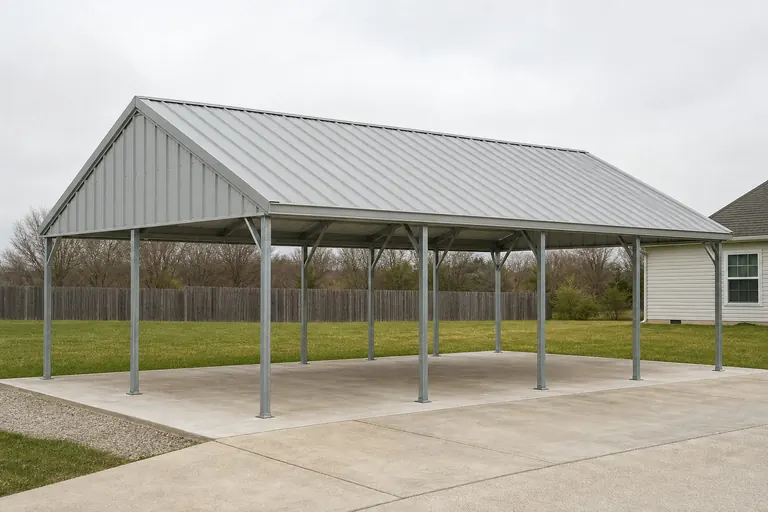 Daily-driver sun shadingA single or double bay over a driveway, aimed mainly at UV and heat protection given NOAA's documented warming trend.Outflow-season anchoring upgradeBuyers near the state's dust-storm-prone corridors sometimes specify heavier post gauge ahead of the June-to-September window.
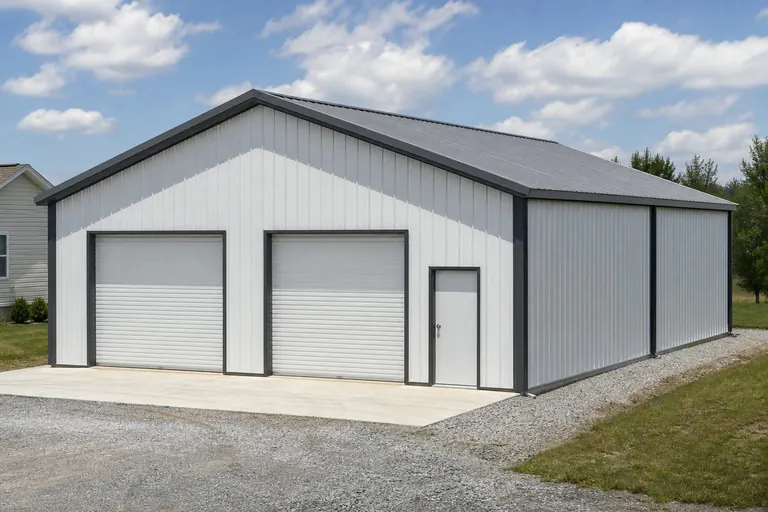 Enclosed upgrade pathWhere full dust exclusion or security matters more than budget, a metal garage is the enclosed alternative worth comparing.
Example Configuration — for planning purposes only.
Footprint
Sizes that suit Arizona carport projects
Arizona carport enquiries typically size around one or two everyday vehicles rather than RV-scale clearance.
12′ × 21′
252 sq ft
A common single-vehicle footprint for a driveway installation.
18′ × 21′
378 sq ft
A double-bay footprint for two daily-driver vehicles side by side.
20′ × 30′
600 sq ft
Adds depth for a vehicle plus equipment or trailer storage.
24′ × 30′
720 sq ft
A wider footprint for households needing extra open-sided coverage.
Example Configuration — for planning purposes only.
The 20x30 footprint page carries layout and post detail; this page only explains why the Arizona brief centers on the monsoon calendar and local permitting.
Preparation
Before you request an Arizona carport quote
Four things resolved in advance make the difference between a comparable quote and a re-quote on an Arizona lot.
Step 1
Contact your city or county building department
Carport permit requirements are set by your specific city or county, not by a single statewide rule; confirm what your local building department requires before you design or quote.
Step 2
Ask about outflow-wind anchoring
Post gauge and footing depth matter more for an open structure exposed to monsoon thunderstorm outflow than roof pitch does.
Step 3
Time inspections around the monsoon calendar
June 15 to September 30 is the defined monsoon window; check anchoring and fasteners before it opens.
Step 4
Confirm parcel jurisdiction near federal or trust land
If your parcel borders federal or State Trust acreage, verify which authority actually reviews your project.
Questions
Arizona carport questions
Questions we can answer honestly at state level, with the ones we cannot routed to whoever actually owns them.
The National Weather Service defines it as June 15 through September 30 each year, a fixed calendar window rather than a rainfall-based trigger, which is useful for scheduling anchoring inspections.
No. UpCodes documents that Arizona has no single statewide building-code agency for structures like carports; codes are adopted and enforced locally by city and county building departments, with only the Fire Code adopted uniformly statewide.
The dust itself is a visibility and cleaning issue, but the NWS technical memorandum on the hazard ties it to thunderstorm outflow gusts, and it's that sudden gust load — not the dust — that matters for an open-sided structure's anchoring.
It depends entirely on your city or county, since Arizona permitting for this kind of structure is set locally. Your building department is the only reliable source for that answer.
It can raise an additional jurisdiction question. Arizona has more than 9 million acres of State Trust land, and parcels near that boundary are worth confirming with the local authority before assuming standard county rules apply.
We do not publish state-level prices, because a credible number depends on your specification, site work and current material pricing. Our cost pages cover what drives the number; a quote covers your building.
Sources for the Arizona facts on this page
This page states no code requirement, wind speed, snow load, permit rule, price or supplier claim. The state-specific facts it does use are listed with their publisher below.
The North American Monsoon in Arizona runs from June 15 to September 30 each year (a fixed calendar definition, not a rainfall trigger).
NOAA/National Weather Service (Tucson office) · current/ongoing definition · Tier 1
https://www.weather.gov/media/twc/Monsoon.pdfNWS documents blowing dust and dust storms (haboobs) as an underrated Arizona weather hazard, tied to monsoon thunderstorm outflows.
NOAA/National Weather Service · July 2016 · Tier 1
https://www.weather.gov/media/wrh/online_publications/TMs/TM-290.pdfNOAA's State Climate Summary reports Arizona temperatures have risen about 2.5°F since the early 20th century and identifies drought as a serious threat in the water-scarce state.
NOAA National Centers for Environmental Information (NCEI) · 2022 summary · Tier 1
https://statesummaries.ncics.org/downloads/Arizona-StateClimateSummary2022.pdfArizona building codes are governed at the local jurisdiction level rather than by a single statewide building code agency; the state's uniform statewide adoption applies only to the Fire Code.
UpCodes (citing Arizona State Fire Marshal statewide fire code adoption) · current, accessed 2024/2025 · Tier 3
https://up.codes/codes/arizonaArizona Revised Statutes govern how counties and municipalities adopt construction codes by reference, confirming code adoption is a local government function.
Arizona State Legislature · current statute text · Tier 2
https://www.azleg.gov/ars/11/00861.htmArizona has more than 9 million surface acres of State Trust land, about 13% of the state's total surface land ownership.
Arizona State Land Department · current, accessed 2024 · Tier 2
https://land.az.gov/our-agency-mission