
Metal garage · TX
Metal Garages in Texas
A metal garage in Texas is almost always an enclosed accessory structure next to an existing home, and the two things that most change the project are heat and administration, not acreage or open-sided wind exposure. NOAA's State Climate Summary reports Texas temperatures have risen almost 1.5°F since the early 20th century, which is a long-run planning signal worth weighing when you decide how much ventilation, insulation, and door configuration a garage that will store a vehicle, tools, or a workshop actually needs. Because Texas has no single statewide building code authority enforcing a mandatory code for most construction, whether an enclosed accessory garage needs a permit, how close it can sit to your house or property line, and how it is classified relative to your residence are all questions for your specific city or county, not a statewide standard.
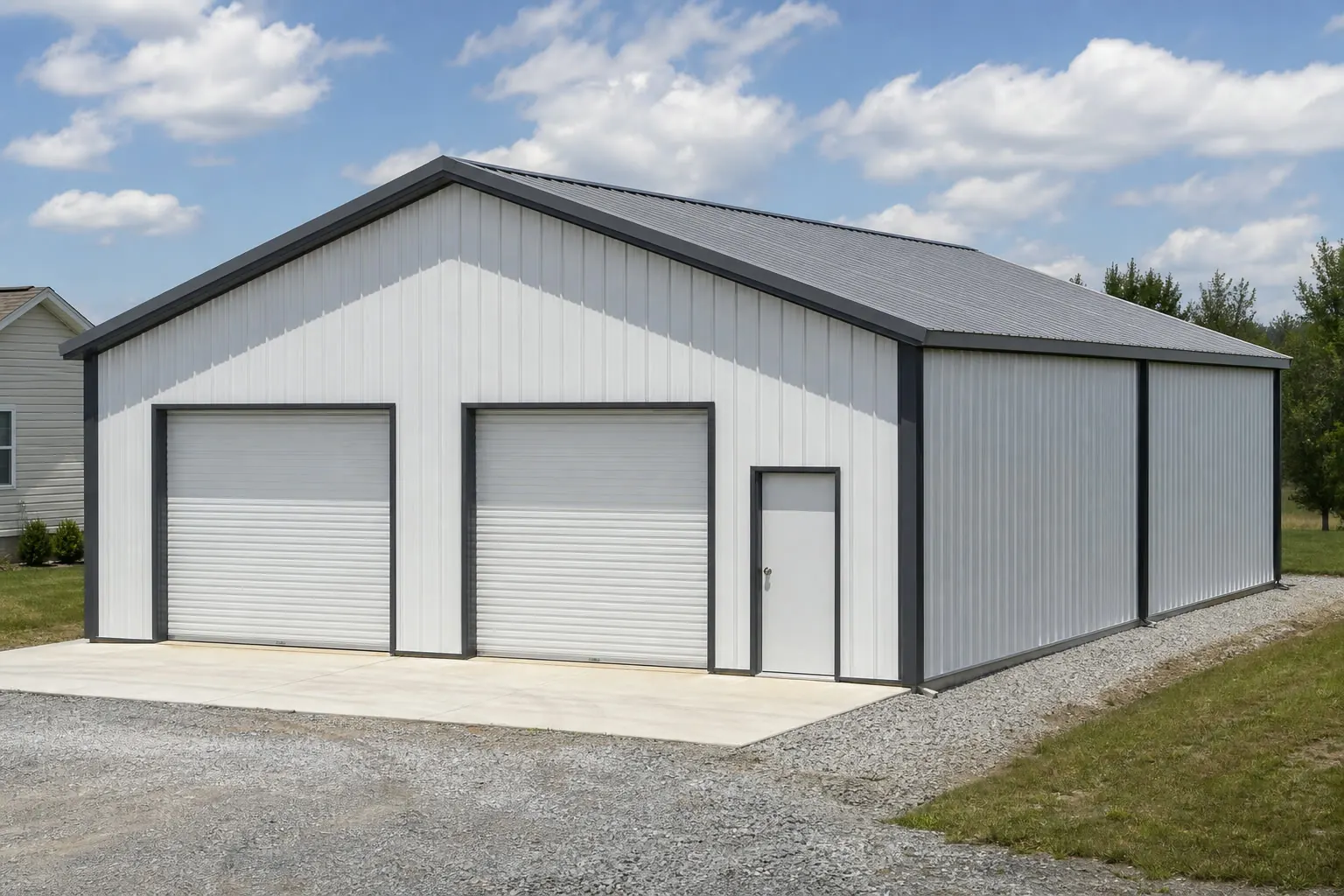
The intersection
In Texas, heat and local rules shape the metal garage brief
An enclosed metal garage in Texas has to be planned around long-run heat trends and a purely local approval process, rather than around acreage or open-sided wind loading.
NOAA's NCEI State Climate Summary reports that Texas temperatures have risen almost 1.5°F since the beginning of the 20th century. That is a climate trend, not an engineering value, but it is a real planning input for an enclosed structure: a garage that will store a vehicle, tools, or double as a workshop benefits from thinking through ventilation, roof venting and door configuration with that long-run warming trend in mind, especially compared with a climate where average temperatures have stayed flatter over the same period.
The regulatory picture is entirely local. Texas has no single statewide building code authority enforcing a mandatory code for most construction, so whether your enclosed garage needs a permit, how far it must sit from your property line, and how it is classified relative to your primary residence are all determined by your specific city or county. That local variability matters more for a metal garage than it might for a freestanding agricultural building, because a garage is usually sited close to an existing home and has to work with whatever setback and accessory-structure rules that jurisdiction already applies to the main house.
Wind and hazard exposure still matter, but differently than for an open-sided structure. FEMA's National Risk Index tracks 18 hazard types for Texas communities, including hail and strong wind alongside hurricane, and the state has recorded 64 direct hurricane hits since 1851 — second only to Florida. An enclosed garage's walls and doors carry that load differently than an open carport's posts do, which is a reason to have your builder confirm door and wall anchoring appropriate to your specific site and region rather than assume a one-size design.
Site context
How Texas region changes garage ventilation planning
The same enclosed garage shell meets different heat and moisture conditions depending on where in Texas it sits.
| Region | Dominant condition | Garage planning implication |
|---|---|---|
| Gulf Coastal Plains | High humidity, coastal wind exposure | Ventilation to manage moisture and, near the coast, door and wall anchoring appropriate to hurricane-prone geography |
| Blackland Prairies / Interior | Warm, moderate humidity | Standard ventilation planning with attention to expansive clay soils under the slab |
| High Plains | Arid, greater temperature swing | Insulation and vapor management matter more than humidity control here |
| Trans-Pecos | Arid with wide day-night temperature range | Ventilation for daytime heat buildup inside an enclosed structure |
Gulf Coastal Plains
- Dominant condition
- High humidity, coastal wind exposure
- Garage planning implication
- Ventilation to manage moisture and, near the coast, door and wall anchoring appropriate to hurricane-prone geography
Blackland Prairies / Interior
- Dominant condition
- Warm, moderate humidity
- Garage planning implication
- Standard ventilation planning with attention to expansive clay soils under the slab
High Plains
- Dominant condition
- Arid, greater temperature swing
- Garage planning implication
- Insulation and vapor management matter more than humidity control here
Trans-Pecos
- Dominant condition
- Arid with wide day-night temperature range
- Garage planning implication
- Ventilation for daytime heat buildup inside an enclosed structure
Configuration
Common Texas metal garage configurations
Most Texas metal garage projects fall into a small number of recurring configurations, driven by what the enclosed space has to protect.
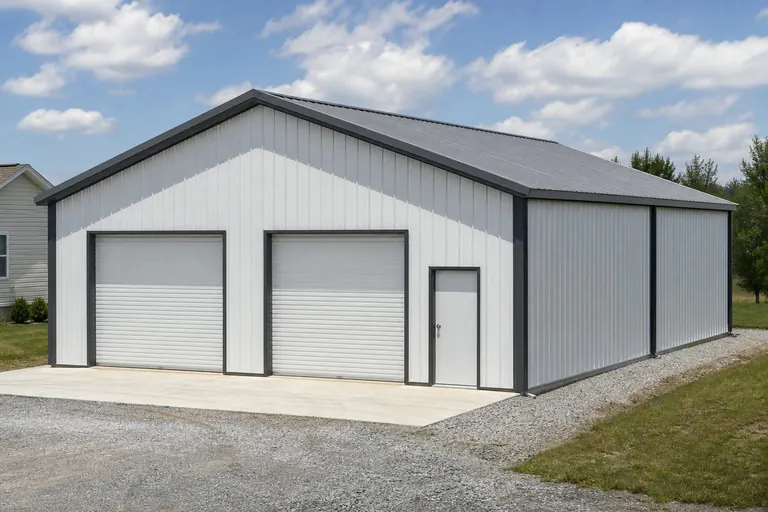 Single or double vehicle bayAn enclosed bay for one or two vehicles, suited to a residential-adjacent garage.
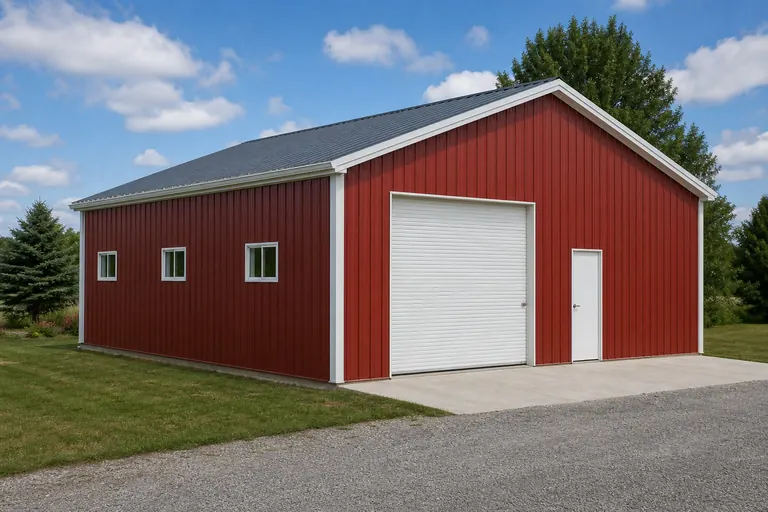 Vehicle bay plus workshopA partitioned or open combination of vehicle storage and workbench space, where ventilation planning matters most.
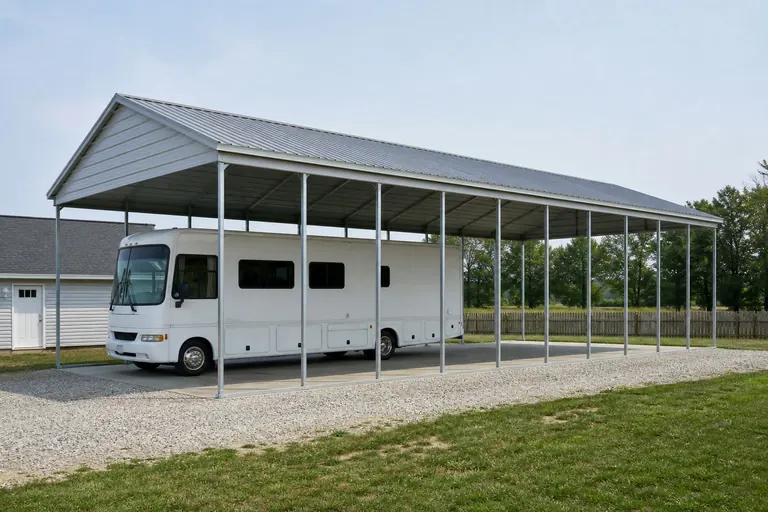 RV or equipment bayA taller enclosed bay sized for an RV, boat, or larger equipment rather than a passenger vehicle.
Example Configuration — for planning purposes only.
Get Texas metal garage quotes
Tell us your lot, vehicle count and intended use, and we route it with the Texas heat and permitting context already attached.
Footprint
Sizes common for a Texas residential-lot metal garage
Because most Texas metal garages sit next to an existing home rather than on open acreage, footprints tend to be set by vehicle count and lot space rather than land scale.
24′ × 30′
720 sq ft
A common footprint for a two-vehicle enclosed garage on a standard residential lot.
30′ × 40′
1,200 sq ft
Adds room for a workbench or extra storage alongside vehicle bays.
40′ × 60′
2,400 sq ft
Suited to combined vehicle, equipment and workshop use on a larger lot.
Example Configuration — for planning purposes only.
Footprint pages carry bay and door allocation for each size; this page explains only why Texas heat and local siting rules matter for these dimensions.
Preparation
Before you request a Texas metal garage quote
Five things resolved up front help keep an enclosed accessory garage project from stalling mid-quote.
- Confirm setback and accessory-structure rules with your local building departmentAsk how close the garage can sit to your property line and to your primary residence.
- Ask about permit requirements before finalizing sizeRequirements vary by city and county since there is no single statewide code authority.
- Plan ventilation for your specific regionGulf Coastal humidity, High Plains aridity, and Trans-Pecos heat swings call for different ventilation approaches.
- Confirm whether the garage sits near the coastal windstorm catastrophe areaIf so, ask your insurer whether the structure affects your coverage.
- State every intended use up frontA garage priced for vehicle storage alone that later needs workshop power or extra ventilation is a common cause of re-quoting.
Questions
Texas metal garage questions
Honest answers at the state level, with permitting, zoning and pricing questions routed to whoever actually owns them.
Permit requirements are set locally, since Texas has no single statewide building code authority enforcing a mandatory code for most construction. Ask your city or county building department before finalizing your plan.
Setback and accessory-structure distance rules are set by your local jurisdiction, not by a statewide standard. Your local building or zoning department can confirm the rule for your specific parcel.
Long-run NOAA data shows Texas temperatures have risen almost 1.5°F since the early 20th century, which is a reasonable factor to weigh when planning ventilation, insulation and door configuration, though the right specification depends on your specific site and use.
There is no official typical size. On a standard residential lot, 24x30 through 40x60 are common ranges depending on vehicle count and whether the garage also serves as a workshop.
We do not publish state-level prices, since cost depends on size, specification, site work and current material pricing. Our cost pages explain what drives the number; a builder quote covers your specific project.
Yes. A metal garage is fully enclosed with walls and doors, while a carport is open-sided. Wind and hazard exposure are carried differently by each, which is why anchoring and design details differ between the two building types.
Sources for the Texas facts on this page
This page states no code requirement, wind speed, snow load, permit rule, price or supplier claim. The state-specific facts it does use are listed with their publisher below.
NOAA's NCEI State Climate Summary reports that temperatures in Texas have risen almost 1.5°F since the beginning of the 20th century.
NOAA National Centers for Environmental Information · 2022 report, covering 20th century-present · Tier 1
https://www.txdot.gov/content/dam/docs/division/env/toolkit/725-01-rpt-appendixb.pdfTexas does not have a single statewide building code authority enforcing a mandatory building code for most construction; code adoption and enforcement occur primarily at the local/municipal level.
KHOU 11 (Verify) / Texas State Law Library · current · Tier 3
https://www.khou.com/article/news/verify/verify-statewide-enforced-residential-building-code-texas/285-cc7c6343-cdf1-4751-b855-713601cf6b8bFEMA's National Risk Index scores U.S. communities, including Texas counties, across 18 defined natural hazard types.
FEMA · current dataset · Tier 1
https://www.fema.gov/about/openfema/data-sets/national-risk-index-dataNOAA's Hurricane Research Division data show Texas has recorded 64 direct hurricane hits (all categories) for 1851-2018, second only to Florida.
NOAA Atlantic Oceanographic and Meteorological Laboratory (AOML), Hurricane Research Division · 1851-2018 · Tier 1
https://www.aoml.noaa.gov/hrd/tcfaq/E19.htmlThe USGS-published Bureau of Economic Geology map identifies major Texas physiographic regions including the Gulf Coastal Plains, Interior Plains, Great Plains, and Basin and Range provinces.
Bureau of Economic Geology, University of Texas at Austin · 1996 · Tier 2
https://txmn.org/st/files/2022/09/BEG_PHYSIOGRAPHY_1996.pdfTexas's total land area was 261,226 square miles per the 2008 Census Bureau state area measurements, the largest of the contiguous 48 states.
U.S. Census Bureau, Statistical Abstract of the United States: 2011 · 2008 · Tier 1
https://www2.census.gov/library/publications/2010/compendia/statab/130ed/tables/11s0355.pdf