Pole barn · TX
Pole Barns in Texas
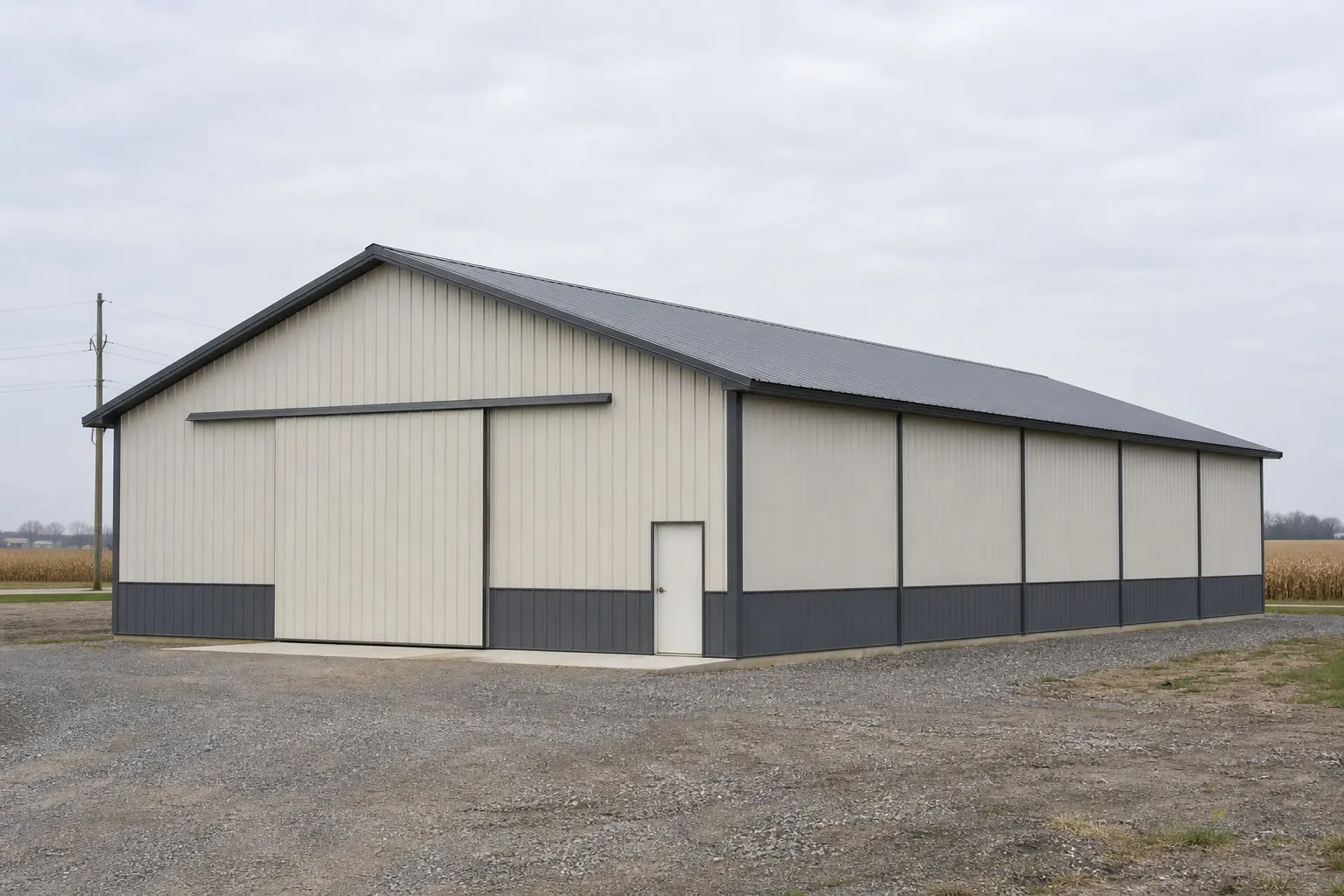
A Texas pole barn is, in the overwhelming majority of cases, a working farm or ranch building — and the state's agricultural scale explains why post-frame construction is such a common answer to that need. The 2022 Census of Agriculture counted 230,662 farms in Texas, more than any other state, spread across 125,471,325 acres for an average farm size of 544 acres. That scale means equipment, hay, feed and livestock storage needs routinely outgrow a small outbuilding, and a pole barn's open-span post-frame layout is built for exactly that kind of flexible, low-cost-per-square-foot working space. What changes from one Texas site to the next is soil and moisture: the Gulf Coastal Plains, Blackland Prairies, High Plains and Trans-Pecos regions mapped by the Bureau of Economic Geology carry different footing, drainage and humidity conditions, and because Texas has no single enforced statewide building code, whether a given pole barn qualifies for agricultural exemption treatment or triggers a local permit is a conversation with your county appraisal district and building department, not a statewide answer.
The intersection
Texas farm scale is the reason pole barns show up so often
A pole barn's post-frame design exists to cover large open spans cheaply, and Texas has more working land per operation than buyers coming from smaller states typically encounter.
The 2022 USDA Census of Agriculture counted 230,662 farms in Texas — more than any other state — covering 125,471,325 acres, for an average farm size of 544 acres. That average masks huge range, from small operations to massive ranches, but the practical signal for a pole barn buyer is that Texas working land tends to generate storage and shelter needs at a scale that a small garden shed or single-bay garage cannot meet: hay and feed storage, equipment bays for tractors and implements, and open shelter for livestock. Post-frame construction is built for exactly that combination of wide clear spans and open interior space, uninterrupted by support columns, which matches what large-scale equipment, hay and feed storage requires on Texas working land.
The administrative side is equally Texas-specific. The state has no single statewide building code authority enforcing a mandatory code for most construction; adoption and enforcement happen at the city or county level. For a pole barn, that local routing intersects with a second, separate process: agricultural-use valuation through the county appraisal district. Whether a given structure qualifies for agricultural exemption treatment, and whether it also needs a local building permit, are both decided locally and are not the same determination — a buyer should expect to have two separate conversations, one with the appraisal district and one with the building department, rather than assume one covers the other.
Soil and terrain add a third Texas-specific layer. The Bureau of Economic Geology at UT Austin maps four major physiographic regions across the state — Gulf Coastal Plains, Blackland Prairies/Interior Plains, Great Plains/High Plains, and Basin and Range/Trans-Pecos — and USGS has separately documented the stratigraphy and drainage of the Gulf Coastal Plain in detail. A post-frame building's footing depends on ground conditions that vary meaningfully across those regions, which is a reason to involve a local engineer or your builder's site assessment before fixing a footing plan, not a reason to assume one statewide footing approach applies.
Site context
How Texas region changes pole barn site conditions
The same open-span pole barn design meets different ground conditions depending on where in Texas it sits.
Gulf Coastal Plains
Documented by USGS as having distinct stratigraphy and aquifer systems; humidity, drainage and periodic standing water are the recurring site-planning variables for equipment and hay storage here.
Blackland Prairies / Interior Plains
Rolling farmland where a large share of the state's working farms sit; expansive clay soils in parts of this belt are worth flagging to a local engineer before finalizing a footing approach.
Great Plains / High Plains
Flatter, more arid terrain in the north and west where wind exposure and water access, rather than drainage, tend to dominate open-span building placement.
Basin and Range / Trans-Pecos
More topographic relief in far-west Texas; access road length, grading and delivery logistics for a remote parcel are the practical variables to confirm early.
Use case
What a Texas pole barn is doing versus a barndominium or garage
Three Texas building types share a post-frame or steel-frame lineage but answer different questions; keeping the use case straight changes what you should be planning for.
| Question | Pole barn | Barndominium |
|---|---|---|
| Primary use | Working storage: equipment, hay, feed, livestock shelter | Combined residence and shop or storage space |
| Occupancy classification | Typically non-residential, decided locally | Often a mixed classification question for the local building department |
| Exemption relevance | Agricultural-use valuation is a live question with the county appraisal district | Residential portion generally is not exemption-eligible in the same way |
| Design priority | Clear span, door height and eave clearance for equipment | Separation between living and working space |
Primary use
- Pole barn
- Working storage: equipment, hay, feed, livestock shelter
- Barndominium
- Combined residence and shop or storage space
Occupancy classification
- Pole barn
- Typically non-residential, decided locally
- Barndominium
- Often a mixed classification question for the local building department
Exemption relevance
- Pole barn
- Agricultural-use valuation is a live question with the county appraisal district
- Barndominium
- Residential portion generally is not exemption-eligible in the same way
Design priority
- Pole barn
- Clear span, door height and eave clearance for equipment
- Barndominium
- Separation between living and working space
Get Texas pole barn quotes
Tell us your acreage, region and intended use — equipment, hay, or livestock — and we route it with the Texas agricultural context already attached.
Configuration
Common Texas pole barn configurations
Farm and ranch operations at Texas's average scale tend toward a handful of recurring layouts, driven by what the building has to hold, not by a fixed formula.
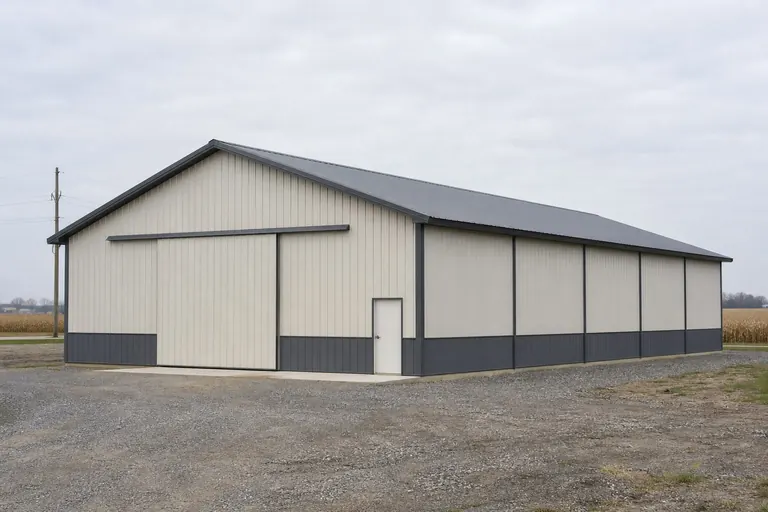 Open equipment bayWide clear-span bays sized for tractors, implements and trailers, often with no interior partitions so equipment can be repositioned freely.Hay and feed storageEnclosed or partially enclosed bays prioritizing ventilation and moisture control over finish, especially relevant in the humid Gulf Coastal Plains.
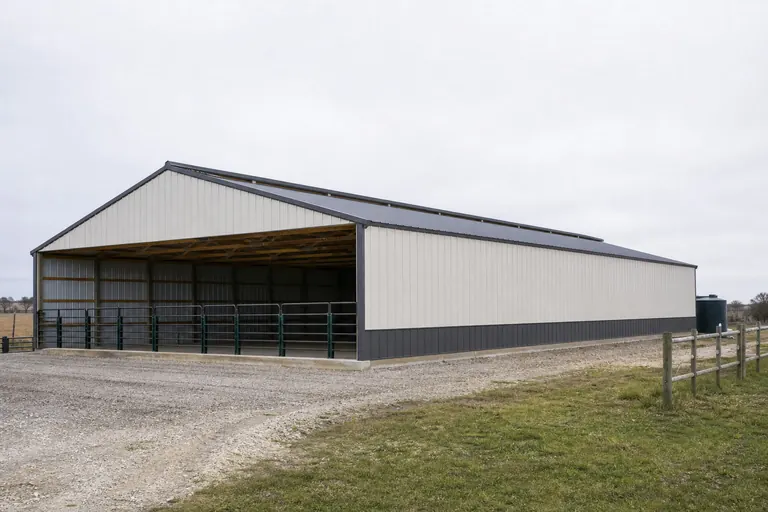 Livestock run-in shelterOpen-sided or three-sided structures giving cattle or horses shade and wind break without full enclosure.
Example Configuration — for planning purposes only.
Footprint
Sizes that suit Texas working-land scale
At a 544-acre average farm size, footprint decisions are usually driven by what equipment or how many head of livestock the building has to serve, not by lot constraints.
30′ × 40′
1,200 sq ft
A common starting point for a single-family operation's equipment and hay storage.
40′ × 80′
3,200 sq ft
Suits larger operations running multiple pieces of equipment plus feed storage in one structure.
60′ × 100′
6,000 sq ft
Scale associated with larger ranch operations or combined equipment-and-livestock use.
Example Configuration — for planning purposes only.
Footprint pages carry bay and door allocation for each size; this page explains only why Texas farm scale supports these dimensions.
Preparation
Before you request a Texas pole barn quote
Five things resolved up front help avoid a Texas-specific delay on an agricultural post-frame project.
Step 1
Confirm agricultural exemption eligibility with your county appraisal district
Ask specifically whether the intended use and structure type qualify before you finalize the design.
Step 2
Check local permit requirements separately from the exemption question
Exemption status and permit requirement are decided by different offices and are not the same approval.
Step 3
Name your region, not just your county
Gulf Coastal, Blackland, High Plains or Trans-Pecos siting changes drainage, soil and moisture planning even within the same state.
Step 4
List every intended use up front
A building priced for hay storage alone that later needs to house equipment or livestock is a common source of re-quoting.
Step 5
Confirm site access for delivery
On Texas's largest-in-the-lower-48 land area, remote parcels can mean longer haul distances worth flagging early.
Questions
Texas pole barn questions
Honest answers at the state level, with exemption, permitting and engineering questions routed to whoever actually owns them.
Permit requirements are set locally and vary by county and municipality, since Texas has no single statewide building code authority enforcing a mandatory code for most construction. Check with your local building department before finalizing plans.
That depends on the use, the structure, and your county's specific criteria. Your county appraisal district is the authority on agricultural-use valuation and is the only reliable source for your parcel.
There is no official typical size. Texas's 544-acre average farm size supports larger working buildings than lot-constrained markets, and 30x40 through 60x100 are common starting points depending on equipment and livestock needs.
Gulf Coastal Plains, Blackland Prairies, High Plains and Trans-Pecos sites carry different drainage, soil and moisture conditions, documented by the Bureau of Economic Geology and USGS. A site visit from your builder or a local engineer is the way to get a parcel-specific answer.
We do not publish state-level prices, since cost depends on size, specification, site work and current material pricing. Our cost pages explain what drives the number; a builder quote covers your specific project.
No. A pole barn is a working agricultural or storage structure; a barndominium combines living space with a shop or storage area and raises separate residential occupancy questions with your local building department.
Sources for the Texas facts on this page
This page states no code requirement, wind speed, snow load, permit rule, price or supplier claim. The state-specific facts it does use are listed with their publisher below.
Texas had 230,662 farms in 2022 per the USDA Census of Agriculture, the most of any U.S. state.
USDA National Agricultural Statistics Service (NASS) · 2022 · Tier 1
https://www.nass.usda.gov/Publications/AgCensus/2022/Full_Report/Volume_1,_Chapter_1_State_Level/Texas/Land in farms in Texas totaled 125,471,325 acres in 2022.
USDA NASS · 2022 · Tier 1
https://www.nass.usda.gov/Publications/AgCensus/2022/Full_Report/Volume_1,_Chapter_1_State_Level/Texas/The average farm size in Texas was 544 acres in 2022.
USDA NASS · 2022 · Tier 1
https://www.nass.usda.gov/Publications/AgCensus/2022/Full_Report/Volume_1,_Chapter_1_State_Level/Texas/Texas does not have a single statewide building code authority enforcing a mandatory building code for most construction; code adoption and enforcement occur primarily at the local/municipal level.
KHOU 11 (Verify) / Texas State Law Library · current · Tier 3
https://www.khou.com/article/news/verify/verify-statewide-enforced-residential-building-code-texas/285-cc7c6343-cdf1-4751-b855-713601cf6b8bThe USGS-published Bureau of Economic Geology map identifies major Texas physiographic regions including the Gulf Coastal Plains, Interior Plains, Great Plains, and Basin and Range provinces.
Bureau of Economic Geology, University of Texas at Austin · 1996 · Tier 2
https://txmn.org/st/files/2022/09/BEG_PHYSIOGRAPHY_1996.pdfUSGS has published detailed geologic studies of the Gulf Coastal Plain of Texas, describing its stratigraphy and aquifer systems.
U.S. Geological Survey · 1994/1995 · Tier 2
https://pubs.usgs.gov/of/1994/0461/report.pdfTexas's total land area was 261,226 square miles per the 2008 Census Bureau state area measurements, the largest of the contiguous 48 states.
U.S. Census Bureau, Statistical Abstract of the United States: 2011 · 2008 · Tier 1
https://www2.census.gov/library/publications/2010/compendia/statab/130ed/tables/11s0355.pdfFEMA's National Risk Index scores U.S. communities, including Texas counties, across 18 defined natural hazard types.
FEMA · current dataset · Tier 1
https://www.fema.gov/about/openfema/data-sets/national-risk-index-data