
Metal garage · SC
Metal Garages in South Carolina
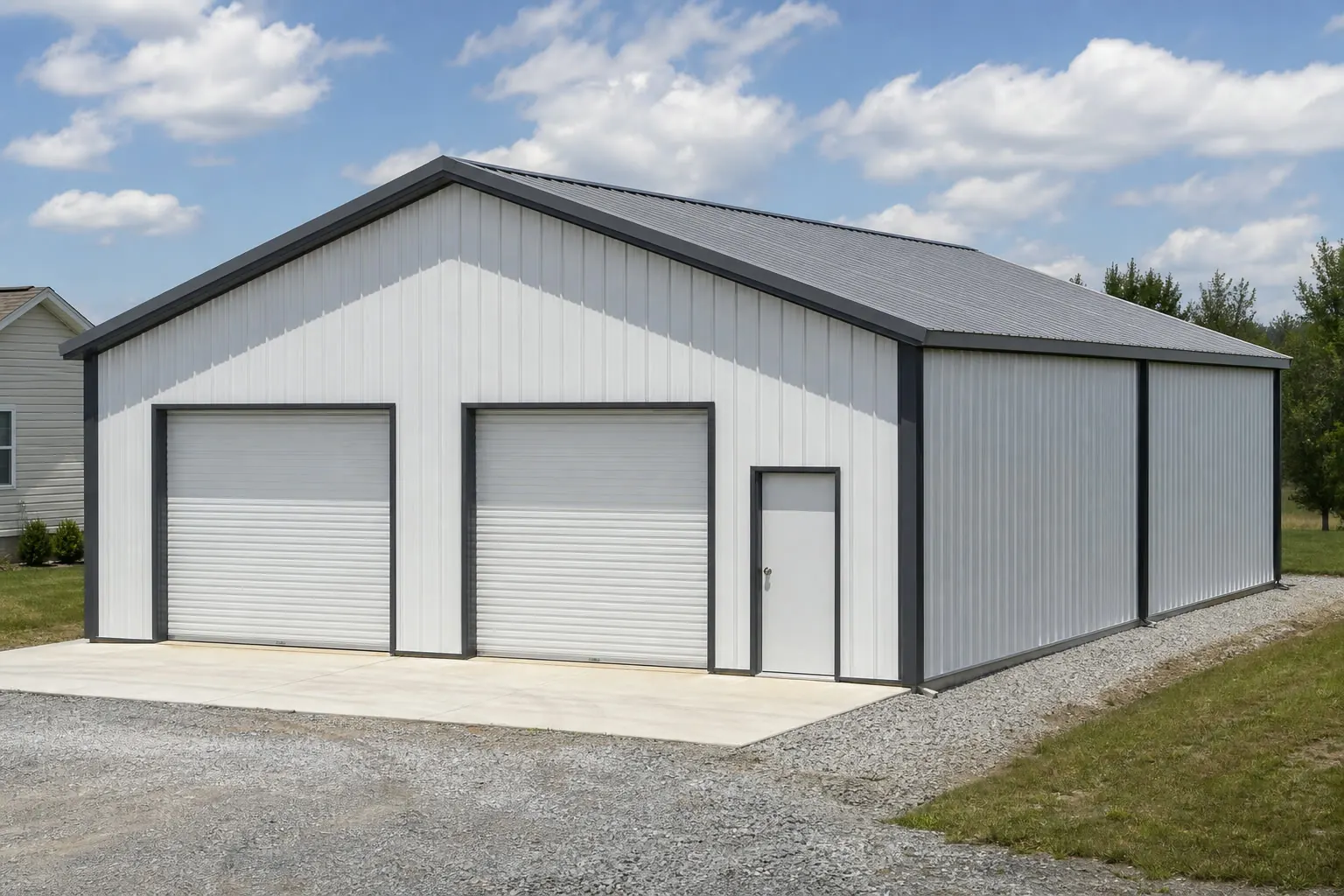
A metal garage in South Carolina is a specialized shield against the state's relentless environmental cycle. Across the 30,064.1 square miles of the Palmetto State, from the salt-heavy air of the Coastal Plain to the red clay of the Upstate, vehicle storage must account for high humidity and rapid temperature swings. With an average farm size of 201 acres, South Carolina garages often double as essential service hubs for agricultural equipment, requiring clear-span designs that can handle the humid subtropical (Köppen Cfa) conditions without trapping moisture that leads to vehicle corrosion.
Protecting Your Assets
Garages for the South Carolina environment
South Carolina's heat and humidity make a metal garage more than a luxury; it's a necessary tool for vehicle longevity.
In the Midlands and Lowcountry, the combination of high humidity and intense summer sun can destroy a vehicle's finish and interior in just a few seasons. A metal garage provides the immediate benefit of shade, but its long-term value in South Carolina is its ability to stay dry. Because the state falls under the humid subtropical (Köppen Cfa) classification, a garage that is sealed too tightly will trap ground moisture rising through the slab, creating a greenhouse effect that promotes rust.
To combat this, South Carolina metal garages should be built with a vapor barrier beneath the concrete slab and equipped with adequate airflow. Many owners opt for insulated doors to keep the interior temperature more stable, which reduces the frequency of the 'sweating' that occurs when warm humid air hits cooler metal surfaces.
The layout of a garage in South Carolina is also influenced by the state's land base. On properties that contribute to South Carolina's 22,633 farms, the 'garage' often needs to accommodate more than just a truck. It needs to fit a tractor, a boat for the weekends, and perhaps a workspace for maintenance, leading to larger, multi-bay footprints that take advantage of the 201-acre average farm size.
Dimensions
Common South Carolina garage footprints
Selecting a size that accounts for both daily drivers and recreational equipment.
20′ × 20′
400 sq ft
A standard two-car garage suitable for suburban lots in Greenville or Columbia.
24′ × 30′
720 sq ft
Provides extra depth for a workbench or tool storage, popular in the Piedmont region.
30′ × 40′
1,200 sq ft
A frequent choice for SC farm properties, allowing for two vehicles and a small tractor.
Example Configuration — for planning purposes only.
Larger sizes are common in rural counties where land is more available and equipment counts are higher.
Configuration
Specialized South Carolina garage setups
How owners tailor their garages to the Palmetto State lifestyle.
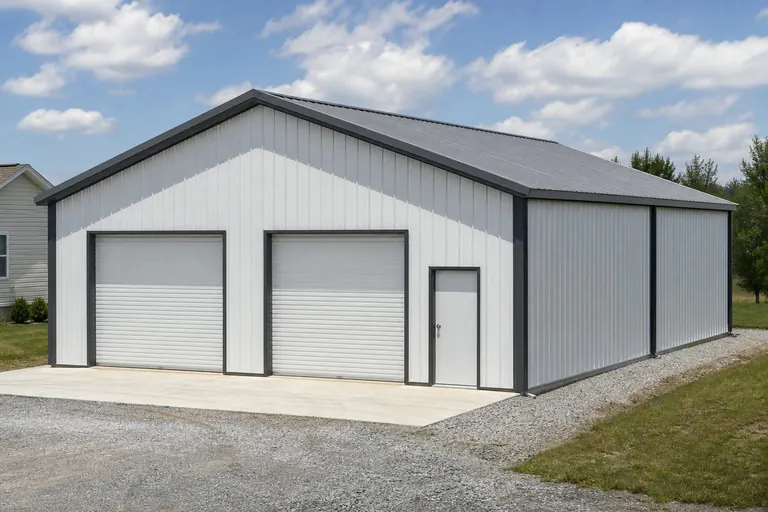 The Coastal Boat GarageExtra tall doors (10-12 feet) and corrosion-resistant panels for boat storage near the coast.The Midlands WorkshopIncludes insulation and a side entry door to allow for climate-controlled hobby space.The Upstate Farm GarageSited on a reinforced slab to handle the weight of tractors and agricultural implements.
Example Configuration — for planning purposes only.
Get your South Carolina garage quote
Tell us your location and storage needs, and we'll connect you with local experts who understand SC conditions.
Foundation & Soil
The slab: your garage's most important component
South Carolina's soil diversity requires a tailored approach to concrete work.
The red clay of the South Carolina Piedmont is notorious for its expansion and contraction. For a metal garage, which is lighter than a brick building but still requires a level base, the slab must be properly reinforced with rebar or wire mesh to prevent cracking as the clay shifts. Builders in the Upstate often recommend a thicker edge (monolithic slab) to provide extra support for the building's weight.
In the sandy Coastal Plain, the challenge is ensuring the site doesn't wash away. With FEMA NRI data indicating high risks for inland and coastal flooding, garages here are often sited on slightly elevated pads to keep water from entering during heavy tropical rain events. Proper grading around the garage is essential to move water away from the foundation and prevent the sandy soil from eroding beneath the slab.
- Vapor Barrier
- Critical statewide to prevent ground moisture from entering the garage through the concrete.
- Reinforced Edges
- Recommended for clay soils in the Piedmont to support the garage frame.
- Elevated Siting
- A safety measure against the flooding risks noted in South Carolina's hazard profile.
Storm-Season Readiness
Seasonal checks for a South Carolina garage
A metal garage protects vehicles daily, but hurricane season and winter freeze cycles each demand their own short checklist.
- Coastal: inspect door tracks and seals each springSalt-laden air along the Lowcountry and Grand Strand accelerates corrosion on garage door tracks and rubber seals faster than inland sites, so a pre-season inspection catches failures before a storm arrives.
- Statewide: confirm slab drainageWith FEMA NRI listing inland flooding as a statewide risk, regrading the apron so water flows away from the garage entrance prevents standing water from working under the door threshold.
- Upstate: check for ice dam risk on the rooflineIn the cooler Upstate, ice accumulation at the roof edge can back water up under panel seams; keeping gutters clear ahead of winter reduces this risk.
- Plan vehicle relocation for named stormsA garage is not flood or surge protection; owners in evacuation-zone counties should have a plan to move high-value vehicles inland ahead of a mandatory evacuation order.
Coating Choice
Matching coating grade to coastal or Upstate exposure
South Carolina's transition from salt-laden coastal air to inland humidity means the right coating spec for a metal garage is not the same statewide.
In Charleston, Beaufort, Georgetown, and other counties near the coast, salt spray carried on prevailing winds accelerates corrosion on exposed steel fasteners, door tracks, and panel edges far faster than the same materials would degrade in the Midlands or Upstate. Garage buyers within a few miles of the coast should ask specifically about a heavier-gauge Galvalume or marine-grade coating package, since standard finishes are calibrated for general humidity, not salt exposure.
Inland, in the Piedmont and Upstate, the corrosion driver is simply sustained humidity rather than salt, so a standard coating package paired with good ventilation is typically sufficient. Where the two regions converge is hurricane season: even Upstate garages within a storm's inland wind field should have anchoring inspected each spring, since remnant tropical systems can carry damaging wind well past the coast before losing strength.
Questions
South Carolina Metal Garage FAQ
Answering local questions about building and owning a metal garage in SC.
The sun can heat up the metal skin significantly. However, adding basic insulation and ensuring good ventilation (like ridge vents) can keep the interior temperature within a reasonable range, often cooler than a wooden garage without airflow.
Yes, in almost all cases. Because a garage is a structural building often requiring a concrete slab and electrical service, local building departments will require a permit and inspections to ensure it meets safety and wind-load standards.
Choosing high-quality galvanized steel is the first step. The second is moisture control: ensure you have a vapor barrier under your slab and adequate ventilation to prevent condensation from forming on the inside of the panels.
Where the site allows, avoid orienting the main door directly into the prevailing storm-wind direction for your region, since wind-driven rain intrusion is worse on a door that faces the weather head-on. Your installer can advise based on your specific lot.
Sites within a few miles of the coast generally benefit from upgraded coatings on fasteners, tracks, and panel edges because salt spray accelerates corrosion beyond what standard finishes are rated for. Ask your builder about coastal-grade options for your specific distance from the shoreline.
Sources for the South Carolina facts on this page
This page states no code requirement, wind speed, snow load, permit rule, price or supplier claim. The state-specific facts it does use are listed with their publisher below.
The South Carolina State Climatology Office (SC DNR) states most of the state falls within the humid subtropical (Köppen Cfa) classification, producing hot, humid summers with mild winters, while portions of the Upstate mountains have a different, cooler climate regime.
South Carolina Department of Natural Resources (SC DNR), State Climatology Office · SC DNR reference publication · Tier 2
https://www.dnr.sc.gov/climate/sco/Publications/SCClimateOverview.pdfSouth Carolina had 4,553,922 acres of land in farms in 2022 (down 4% since 2017), with an average farm size of 201 acres (up 5%).
USDA NASS · 2022 · Tier 1
https://www.nass.usda.gov/Publications/AgCensus/2022/Online_Resources/County_Profiles/South_Carolina/cp99045.pdfThe Census Bureau's current data profile lists South Carolina with a land area of 30,064.1 square miles and a water area of 1,959.4 square miles, ranking it the 39th largest state by area.
U.S. Census Bureau · Current Census Bureau geography data · Tier 1
https://data.census.gov/profile/South_Carolina?g=0400000US45FEMA's National Risk Index is the federal tool providing county-level natural hazard risk scoring (including hurricane, coastal flooding, tornado, and inland flooding categories) for all 46 South Carolina counties; a state-specific hazard narrative from FEMA itself was not directly retrieved in this session.
Federal Emergency Management Agency (FEMA) · Current NRI release · Tier 1
https://www.fema.gov/flood-maps/products-tools/national-risk-indexNOAA NCEI publishes a narrative 'Climate of South Carolina' describing the state's climatic transition from coastal plain to Piedmont to mountainous Upstate terrain.
NOAA National Centers for Environmental Information (NCEI) · Historical narrative (NCEI climate normals series) · Tier 1
https://www.ncei.noaa.gov/data/climate-normals-deprecated/access/clim60/states/Clim_SC_01.pdf