
Barndominium · TX
Barndominiums in Texas
A Texas barndominium project starts on land, not on a floor plan. With 230,662 farms averaging 544 acres in the 2022 Census of Agriculture, most Texas barndominium buyers are placing a combined home and shop on a working parcel that already has its own access, water and drainage questions — a very different starting point from a suburban infill lot. Because the state has no single enforced statewide building code for most construction, whether that hybrid structure gets treated as a residence, an accessory building, or both is a conversation with your specific county or city, not a statewide rule. On the coast, a second track applies: TDI and TWIA administer windstorm inspection and certification before wind and hail coverage is issued, which matters enormously for a structure people will live in.
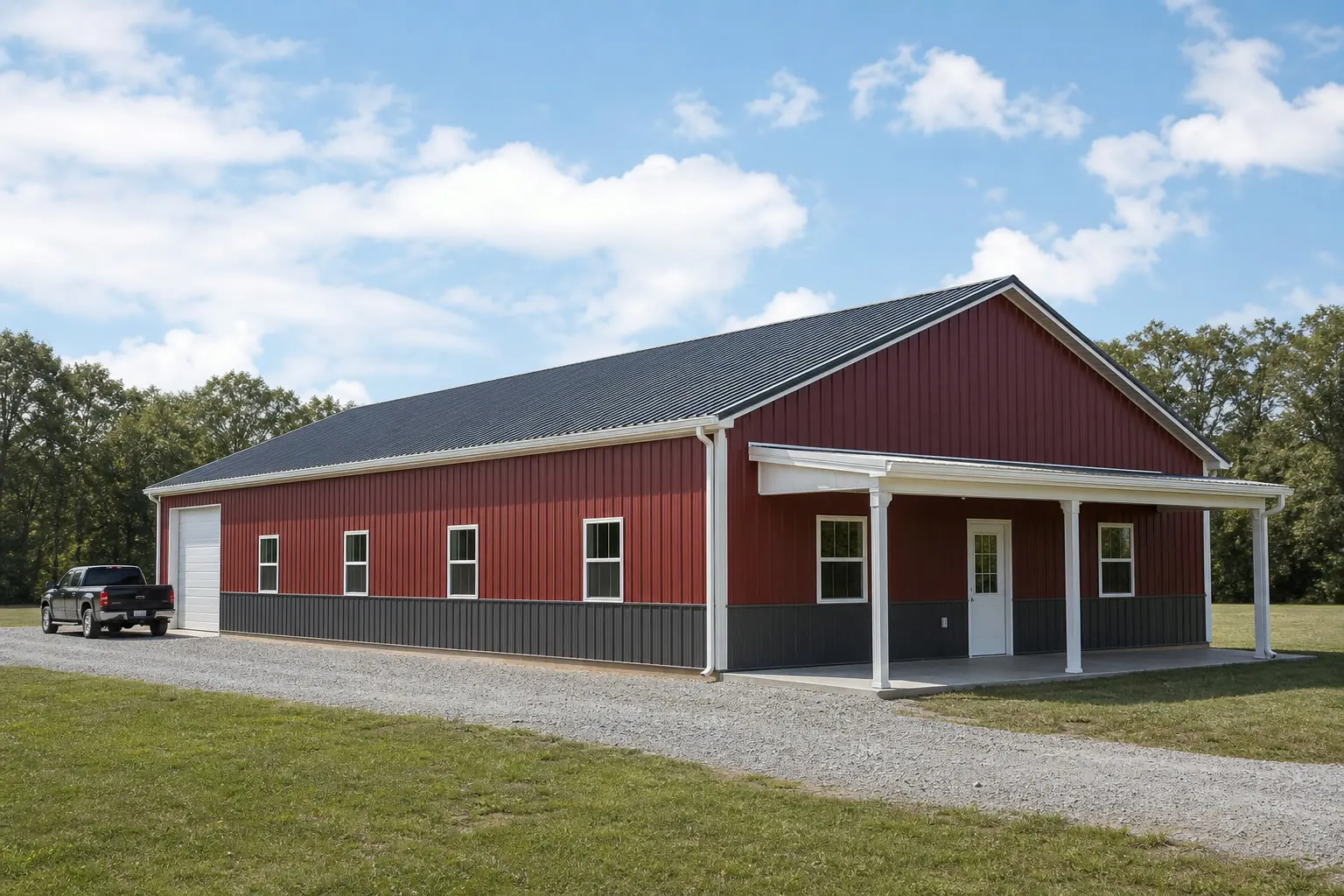
The intersection
In Texas, the land decides the barndominium brief
Before a floor plan gets drawn, a Texas barndominium buyer is usually answering questions about the parcel: how big it is, what region it sits in, and who administers the rules there.
The USDA's 2022 Census of Agriculture counted 230,662 farms in Texas — more than any other state — covering 125,471,325 acres, for an average farm size of 544 acres. Averages hide a lot, but the practical signal for a barndominium buyer is that a large share of Texas projects sit on genuine acreage rather than a platted subdivision lot. That changes the brief: private water and septic, a driveway long enough to matter, and often an existing outbuilding or fence line the new structure has to relate to. None of that is barndominium-specific engineering; it is simply the site context that a suburban infill barndominium buyer elsewhere does not usually have to plan around.
The second Texas-specific fact is administrative. Texas has no single statewide building code authority enforcing a mandatory code for most construction; adoption and enforcement happen primarily at the city or county level. For an ordinary shop building that is a procedural detail. For a barndominium — a structure that is simultaneously a residence and, in the buyer's mind, a barn or shop — it is a defining one, because whether the local authority treats the whole footprint as a dwelling, splits it into separate occupancies, or applies different requirements to the living and shop portions is a decision made by that specific jurisdiction, not by a statewide standard.
Coastal parcels carry a third layer entirely. Inside the state's designated windstorm catastrophe area — 14 coastal counties plus the part of Harris County east of Highway 146 — the Texas Department of Insurance runs a windstorm inspection program, and TWIA requires a Windstorm Certificate of Compliance under Insurance Code Chapter 2210 before it will write wind and hail coverage. A barndominium in that zone is a home, so this is not an optional detail: it is a documentation track that should start the same week as the local permit conversation, not after the shell is up.
Site context
How the region changes the barndominium site
Texas's physiographic regions, mapped by the Bureau of Economic Geology at the University of Texas at Austin, are a practical lens for anticipating site work on a specific parcel.
Gulf Coastal Plains
Low-lying coastal and near-coastal ground, documented in USGS geologic studies of the Gulf Coastal Plain's stratigraphy and aquifer systems. Drainage, humidity and — near the coast — the windstorm insurance track are the recurring planning variables here.
Blackland Prairies / Interior Plains
Rolling farmland transitioning from the coast toward the interior. Many of the state's working farms sit in this belt, and expansive clay soils in parts of it are a foundation-design conversation worth raising with a local engineer rather than assuming a standard slab.
Great Plains / High Plains
Flatter, more arid ground in the state's north and west. Wind exposure and water access tend to dominate site planning here more than drainage does.
Basin and Range / Trans-Pecos
Far-west Texas terrain with more topographic relief. Grading, access road length and delivery logistics for a remote parcel are the variables to confirm before fixing a footprint.
Process
Coastal versus inland barndominium administration
The same building follows two different administrative paths depending on where in Texas the parcel sits.
| Planning question | Inside the windstorm catastrophe area | Elsewhere in Texas |
|---|---|---|
| Insurance path | Windstorm Certificate of Compliance via TDI/TWIA inspection, tied to the build sequence | Standard homeowner or farm insurance underwriting through your carrier |
| Permit authority | The local building department, plus documentation for the certificate | Whichever city or county has jurisdiction over the parcel |
| Occupancy classification | Decided locally, same as inland — the coastal overlay is insurance, not occupancy | Decided locally by the authority having jurisdiction |
| First call to make | Insurer or agent, alongside the local permitting office | The county or municipal building department |
Insurance path
- Inside the windstorm catastrophe area
- Windstorm Certificate of Compliance via TDI/TWIA inspection, tied to the build sequence
- Elsewhere in Texas
- Standard homeowner or farm insurance underwriting through your carrier
Permit authority
- Inside the windstorm catastrophe area
- The local building department, plus documentation for the certificate
- Elsewhere in Texas
- Whichever city or county has jurisdiction over the parcel
Occupancy classification
- Inside the windstorm catastrophe area
- Decided locally, same as inland — the coastal overlay is insurance, not occupancy
- Elsewhere in Texas
- Decided locally by the authority having jurisdiction
First call to make
- Inside the windstorm catastrophe area
- Insurer or agent, alongside the local permitting office
- Elsewhere in Texas
- The county or municipal building department
Get Texas barndominium quotes
Tell us your acreage, region and whether the parcel sits in the coastal windstorm area. We route it with the Texas and barndominium context already attached.
Configuration
What a Texas barndominium usually has to combine
On a 544-acre average operation, the barndominium is often one building carrying several jobs, so the configuration decisions are about separation and access, not raw square footage.
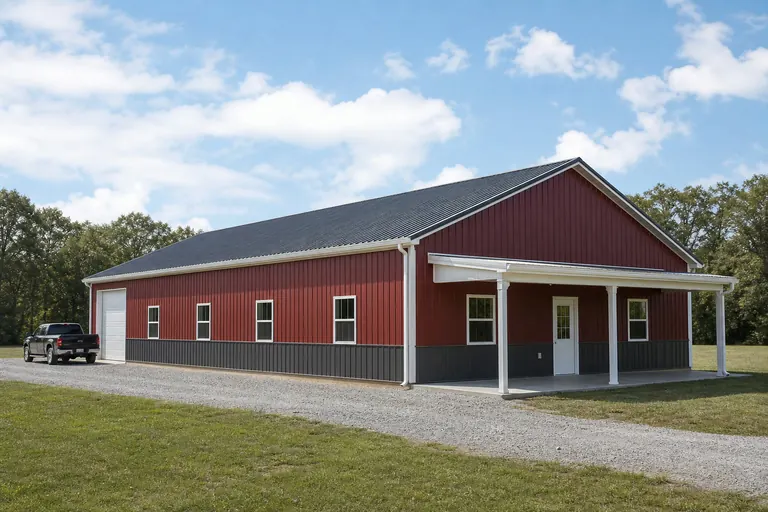 Living quarters plus shopA finished residential end and an open working end. The separation between them — insulated wall, fire-rated assembly, or simple partition — is a local-code question, not a stylistic one.
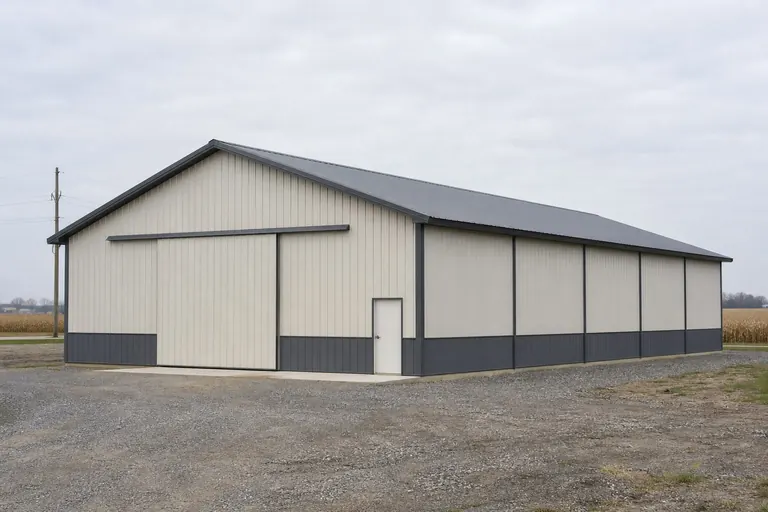 Living plus equipment storageWhere the working end shelters tractors or trailers rather than a workbench, door height and turning radius drive the plan more than total area does.
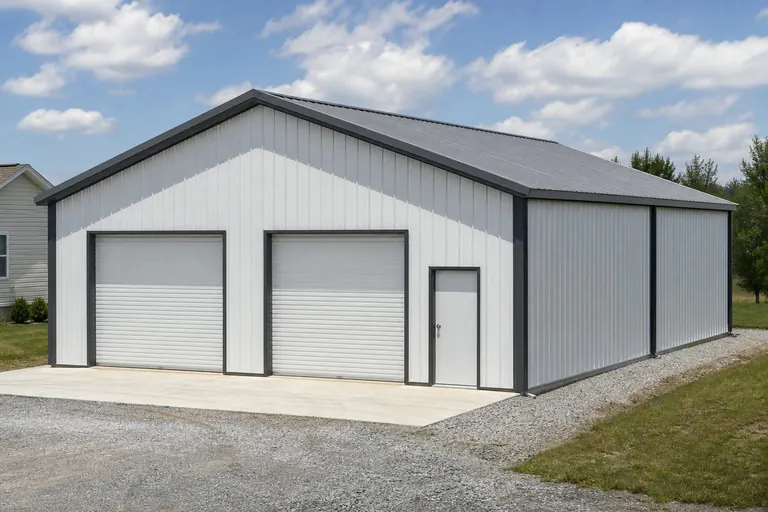 Living plus detached garageSome Texas buyers keep the residence and vehicle storage as separate structures on the same parcel rather than one combined shell, which changes the permitting scope on each building.
Example Configuration — for planning purposes only.
Footprint
Sizes that suit a Texas acreage barndominium
Large-acreage sites remove the pressure to minimize footprint, so Texas barndominium enquiries commonly run larger than lot-constrained states.
40′ × 60′
2,400 sq ft
A workable minimum for a genuine living-plus-shop split without cramping either end.
30′ × 80′
2,400 sq ft
A longer, narrower footprint that suits a linear living-to-shop layout on an open parcel.
30′ × 100′
3,000 sq ft
Common where the shop end needs to handle full-size equipment alongside the residence.
Example Configuration — for planning purposes only.
Footprint pages carry the room and bay allocation for each size; this page explains only why Texas acreage pushes toward these dimensions.
Preparation
Before you request a Texas barndominium quote
Five things resolved up front keep a hybrid residential build from needing a second round of quoting.
Step 1
Confirm occupancy classification with your local building department
Ask specifically how they classify a combined living-and-shop structure before you fix the floor plan.
Step 2
Check whether the parcel sits in the windstorm catastrophe area
TDI and TWIA can confirm coverage status; start that conversation alongside your first permit call, not after framing.
Step 3
Confirm septic and well capacity for the site
Acreage parcels rarely have municipal utilities, and capacity limits can affect the residential square footage you can support.
Step 4
Name the region, not just the county
Coastal, prairie, plains or Trans-Pecos siting changes drainage and access planning even within the same state.
Step 5
State every function the building will serve
A residence-plus-shop brief priced as a residence alone is the most frequent cause of a second round of quoting.
Questions
Texas barndominium questions
Honest answers at the state level, with jurisdictional and pricing questions routed to whoever actually owns them.
Legality and classification depend on your specific city or county, since Texas has no single statewide building code authority enforcing a mandatory code for most construction. Your local building department is the only reliable source on how they will classify a combined living-and-shop structure.
Permit requirements are set locally and depend on your parcel, jurisdiction and intended use. Ask your county or municipal building department before finalizing dimensions or floor plan.
Inside the state's designated windstorm catastrophe area, the Texas Windstorm Insurance Association requires a Windstorm Certificate of Compliance, tied to an inspection process administered by the Texas Department of Insurance, before it will issue wind and hail coverage. Outside that area, standard underwriting applies through your carrier.
There is no official typical size. What we can say is that Texas's 544-acre average farm size supports larger footprints than lot-constrained markets, and 40x60 through 30x100 are common starting points for a combined living-and-shop layout.
We do not publish state-level prices, because cost depends on specification, finish level, site work and current material pricing. Our cost pages explain what drives the number; a builder quote covers your specific project.
Yes, in a general planning sense. Gulf Coastal Plains, Blackland Prairies, High Plains and Trans-Pecos sites present different drainage, soil and access conditions. A site visit from your builder or a local engineer is the only way to get a specific answer for your parcel.
Sources for the Texas facts on this page
This page states no code requirement, wind speed, snow load, permit rule, price or supplier claim. The state-specific facts it does use are listed with their publisher below.
Texas had 230,662 farms in 2022 per the USDA Census of Agriculture, the most of any U.S. state.
USDA National Agricultural Statistics Service (NASS) · 2022 · Tier 1
https://www.nass.usda.gov/Publications/AgCensus/2022/Full_Report/Volume_1,_Chapter_1_State_Level/Texas/Land in farms in Texas totaled 125,471,325 acres in 2022.
USDA NASS · 2022 · Tier 1
https://www.nass.usda.gov/Publications/AgCensus/2022/Full_Report/Volume_1,_Chapter_1_State_Level/Texas/The average farm size in Texas was 544 acres in 2022.
USDA NASS · 2022 · Tier 1
https://www.nass.usda.gov/Publications/AgCensus/2022/Full_Report/Volume_1,_Chapter_1_State_Level/Texas/Texas does not have a single statewide building code authority enforcing a mandatory building code for most construction; code adoption and enforcement occur primarily at the local/municipal level.
KHOU 11 (Verify) / Texas State Law Library · current · Tier 3
https://www.khou.com/article/news/verify/verify-statewide-enforced-residential-building-code-texas/285-cc7c6343-cdf1-4751-b855-713601cf6b8bThe Texas Department of Insurance (TDI) administers a Windstorm Inspection Program for coastal construction, established under a 1987 state law, to allow structures to qualify for windstorm coverage.
Texas Department of Insurance (TDI) · since 1988 · Tier 2
https://www.tdi.texas.gov/wind/generalquestio.htmlThe Texas Windstorm Insurance Association (TWIA) requires coastal properties to hold a Windstorm Certificate of Compliance under Texas Insurance Code Chapter 2210 before TWIA wind/hail coverage is issued; TDI states the designated catastrophe area covers 14 coastal counties and part of Harris County east of Highway 146.
Texas Windstorm Insurance Association (TWIA) / Texas Department of Insurance (TDI) · current · Tier 2
https://www.tdi.texas.gov/tips/need-windstorm-inspection.htmlThe USGS-published Bureau of Economic Geology map identifies major Texas physiographic regions including the Gulf Coastal Plains, Interior Plains, Great Plains, and Basin and Range provinces.
Bureau of Economic Geology, University of Texas at Austin · 1996 · Tier 2
https://txmn.org/st/files/2022/09/BEG_PHYSIOGRAPHY_1996.pdfTexas's total land area was 261,226 square miles per the 2008 Census Bureau state area measurements, the largest of the contiguous 48 states.
U.S. Census Bureau, Statistical Abstract of the United States: 2011 · 2008 · Tier 1
https://www2.census.gov/library/publications/2010/compendia/statab/130ed/tables/11s0355.pdf