Barndominium · SC
Barndominiums in South Carolina
South Carolina's climate and geography turn a barndominium from a simple steel shell into a specialized residential project. Across the state's 30,064.1 square miles, planning shifts from coastal wind resistance to Upstate thermal efficiency. With an average farm size of 201 acres, South Carolina barndominiums often serve as primary residences on working land, where the transition from hot, humid summers to mild winters requires a specific focus on humidity control and building envelope integrity. Whether you are building in the humid subtropical Midlands or the cooler mountainous Upstate, the honest path to a South Carolina barndominium is balancing large-scale utility with residential-grade comfort.
The South Carolina Context
Why a barndominium fits the Palmetto State
South Carolina's traditional farm layout is evolving toward integrated living spaces as owners weigh durable, low-maintenance steel against wood framing in a humid, termite-prone climate.
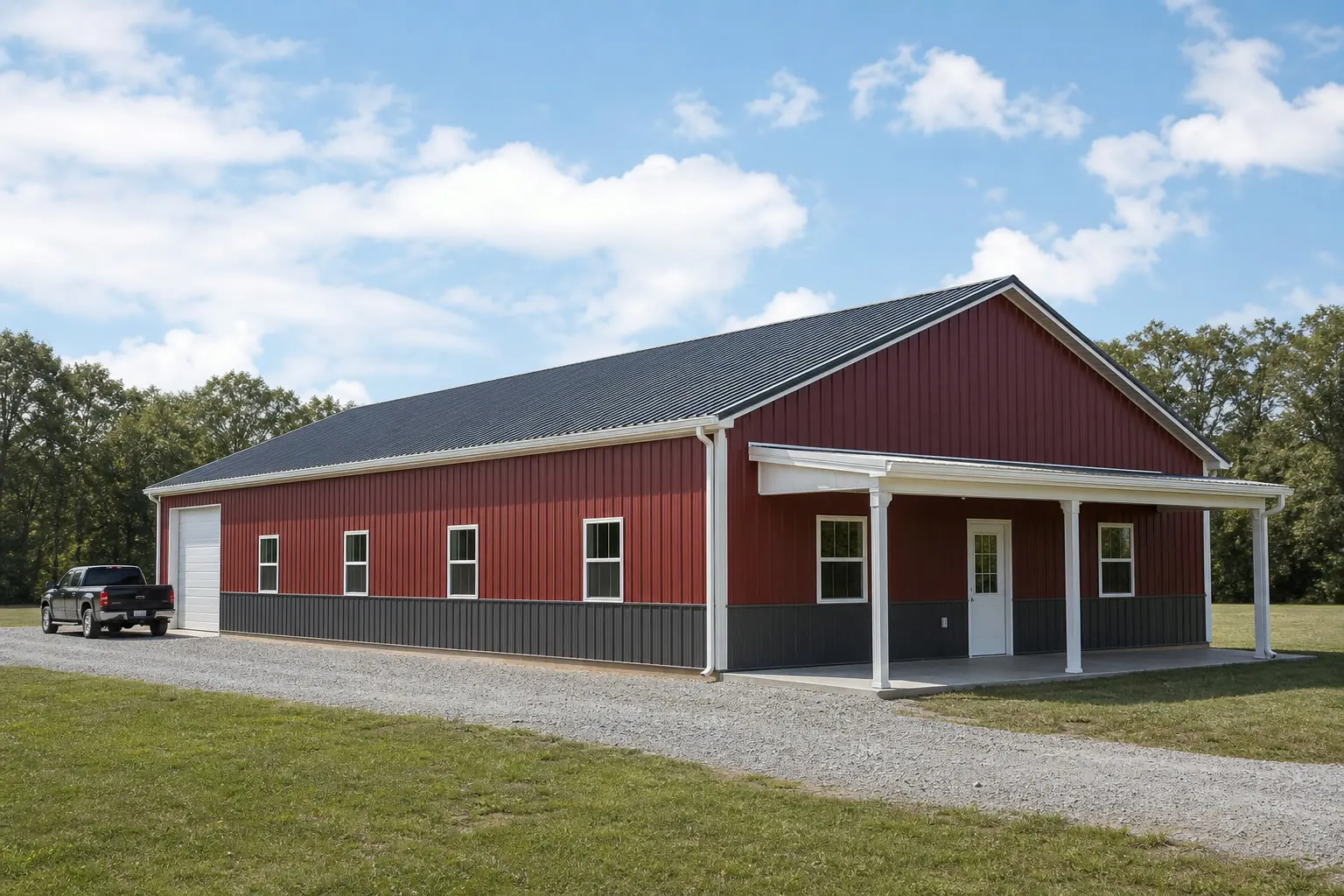
In South Carolina, a barndominium is rarely just a barn with a bedroom. It is a response to the state's specific environmental pressures. The humid subtropical climate makes traditional wood framing susceptible to rot and termite pressure, especially in the low-lying areas of the Coastal Plain. A steel building provides a resistant alternative, but it introduces its own set of South Carolina requirements—specifically how you manage the dew point inside a metal envelope during a typical Columbia summer.
The state's 201-acre average farm size provides enough room for the signature barndominium footprint, which often includes large shop bays or horse stalls attached directly to the primary living quarters. Unlike tighter suburban lots in neighboring states, South Carolina's rural tracts allow for the wide, single-story 'rambler' style barndominiums that maximize porch space for ventilation and shade.
Planning here starts with the land. The transition from the sandy soils of the coast to the red clay of the Piedmont changes how you approach the slab. A barndominium is a massive, rigid structure; ensuring it sits on a stable foundation in South Carolina clay is the most important step before the steel ever arrives on site.
Regional Planning
Designing for South Carolina's regions
A barndominium in the Upstate mountains faces different environmental stress than one in the Lowcountry.
The Lowcountry & Coastal Plain
Wind resistance and drainage are the primary concerns. With FEMA NRI data highlighting hurricane and coastal flooding risks, these builds often require elevated slabs and specialized tie-downs to secure the steel frame against tropical force winds.
The Midlands (Columbia area)
This region faces the peak of South Carolina's heat and humidity. Climate control systems must be sized not just for temperature, but for massive latent moisture loads. Closed-cell spray foam insulation is a common standard here to prevent condensation on the interior steel panels.
The Upstate (Greenville/Spartanburg)
Moving toward the mountains, the climate regime cools. Heating becomes as important as cooling, and the terrain often involves steeper slopes. Site prep here typically involves more significant grading to create a level pad for the large barndominium footprint.
Efficiency
Managing the humid subtropical envelope
The Köppen Cfa classification isn't just a label; it's a guide for how you must insulate your South Carolina barndominium.
South Carolina's heat is persistent. While temperatures have risen more than 1°F since the 20th century, the humidity has remained a constant challenge for metal buildings. In a barndominium, the steel skin can become a condenser if the temperature difference between the air-conditioned interior and the outside air isn't managed correctly. This makes the choice of insulation the most critical technical decision in the project.
Standard fiberglass batts often fail in South Carolina metal homes because moisture can become trapped against the steel, leading to hidden corrosion and mold. Most South Carolina builders recommend a continuous thermal break. This usually means spray foam or a high-grade rigid board system that prevents warm, moist air from ever touching the cold interior side of the metal panel.
- Continuous Thermal Break
- Essential for preventing interior condensation during humid Midlands summers.
- HVAC Dehumidification
- Sizing systems to handle South Carolina's high moisture levels, not just the heat.
- Vapor Barriers
- Required to keep ground moisture from migrating into the living space through the slab.
Start your South Carolina barndominium project
Get connected with specialists who understand South Carolina's climate-specific residential steel requirements.
Application
Typical South Carolina layouts
How South Carolina owners utilize the flexibility of a residential steel building.
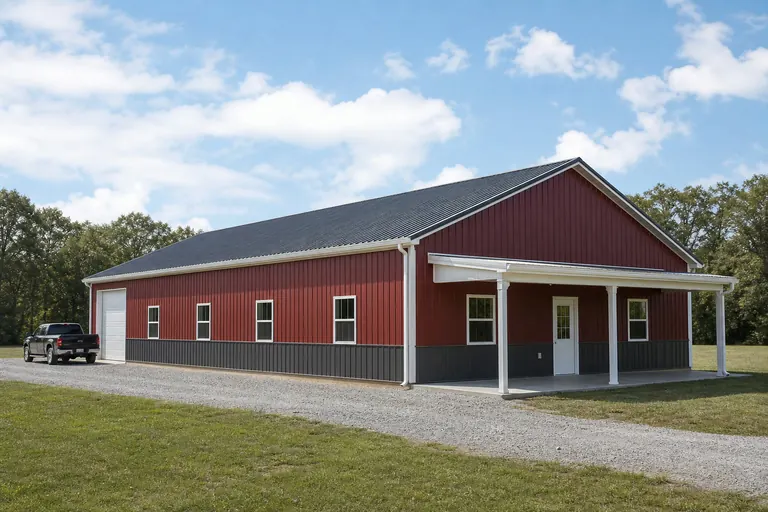 The Retiree WorkshopA 40x60 footprint with 1,200 sq ft of living space and a large shop for boat maintenance or woodworking, common in the Coastal Plain.The Working FarmsteadLarge multi-bay shop attached to a full-family home, designed to house tractors and equipment on a 201-acre average farm.The Upstate RetreatHeavy insulation and large windows to take advantage of mountain views while staying efficient in the cooler climate regime.
Example Configuration — for planning purposes only.
Storm Season & Insurance
Hurricane-season readiness and wind-mitigation credits
Because a barndominium is a full-time residence, its storm-season posture and insurance profile matter as much as its floor plan.
- Ask about wind-mitigation creditsCoastal and Midlands insurers in South Carolina frequently offer premium credits for verified roof-to-wall connections, impact-rated openings, and secondary water barriers; a barndominium's engineered steel-to-post connections should be documented for this purpose at build time.
- Plan a generator transfer switchIn hurricane-exposed counties, multi-day power outages are common after a landfalling or near-miss storm; wiring a transfer switch during construction avoids opening finished interior walls later.
- Identify moisture-prone rooms earlyIn the humid Midlands and Lowcountry, bathrooms and laundry rooms benefit from dedicated exhaust sized above code minimums; in the cooler Upstate, the bigger moisture risk shifts to condensation around single-pane or poorly sealed windows during winter heating season.
- Confirm evacuation-zone statusBarndominiums built on Lowcountry or coastal-adjacent tracts should be checked against county evacuation zone maps, since some coastal parcels carry mandatory-evacuation designations that affect both planning and insurance underwriting.
Questions
South Carolina Barndominium FAQ
Practical answers for buyers planning a residential steel building in the Palmetto State.
Most South Carolina counties allow residential steel buildings, provided they meet local residential building codes. However, some strictly residential HOAs or municipalities may have aesthetic restrictions on metal siding. Always check with your local planning department first.
In coastal areas, buildings must be designed to withstand specific wind speeds. Steel is inherently strong, but the engineering must account for the uplift and lateral forces common in hurricane zones. Your builder will use local FEMA risk data to ensure the structure is compliant.
It is generally no different than a standard custom home. You will need a set of engineered plans, a site plan, and proof of proper utilities (septic/well or city connections). Because it is a residence, it will be held to the same safety standards as a wood-frame house.
Modern steel panels are galvanized and coated with high-performance finishes (like Galvalume) that are highly resistant to corrosion. In coastal zones, a higher grade of protective coating may be recommended to combat salt spray.
Sometimes, if the local health department confirms the existing system has capacity for the added bedrooms and fixtures. On South Carolina's larger rural tracts, many owners instead install a dedicated well and septic system sized for the barndominium alone, which avoids permitting delays tied to an older system's rated capacity.
Sources for the South Carolina facts on this page
This page states no code requirement, wind speed, snow load, permit rule, price or supplier claim. The state-specific facts it does use are listed with their publisher below.
The South Carolina State Climatology Office (SC DNR) states most of the state falls within the humid subtropical (Köppen Cfa) classification, producing hot, humid summers with mild winters, while portions of the Upstate mountains have a different, cooler climate regime.
South Carolina Department of Natural Resources (SC DNR), State Climatology Office · SC DNR reference publication · Tier 2
https://www.dnr.sc.gov/climate/sco/Publications/SCClimateOverview.pdfNOAA NCEI publishes a narrative 'Climate of South Carolina' describing the state's climatic transition from coastal plain to Piedmont to mountainous Upstate terrain.
NOAA National Centers for Environmental Information (NCEI) · Historical narrative (NCEI climate normals series) · Tier 1
https://www.ncei.noaa.gov/data/climate-normals-deprecated/access/clim60/states/Clim_SC_01.pdfSouth Carolina had 22,633 farms in 2022, down 9% since 2017.
USDA National Agricultural Statistics Service (NASS) · 2022 · Tier 1
https://www.nass.usda.gov/Publications/AgCensus/2022/Online_Resources/County_Profiles/South_Carolina/cp99045.pdfSouth Carolina had 4,553,922 acres of land in farms in 2022 (down 4% since 2017), with an average farm size of 201 acres (up 5%).
USDA NASS · 2022 · Tier 1
https://www.nass.usda.gov/Publications/AgCensus/2022/Online_Resources/County_Profiles/South_Carolina/cp99045.pdfThe Census Bureau's current data profile lists South Carolina with a land area of 30,064.1 square miles and a water area of 1,959.4 square miles, ranking it the 39th largest state by area.
U.S. Census Bureau · Current Census Bureau geography data · Tier 1
https://data.census.gov/profile/South_Carolina?g=0400000US45FEMA's National Risk Index is the federal tool providing county-level natural hazard risk scoring (including hurricane, coastal flooding, tornado, and inland flooding categories) for all 46 South Carolina counties; a state-specific hazard narrative from FEMA itself was not directly retrieved in this session.
Federal Emergency Management Agency (FEMA) · Current NRI release · Tier 1
https://www.fema.gov/flood-maps/products-tools/national-risk-index