
Barndominium · KS
Barndominiums in Kansas
A barndominium in Kansas is rarely a suburban compromise; it is more often a strategic residential anchor for a farm base that averages 804 acres per operation. In a state that spans 81,758.7 square miles, the planning challenge is defined by a climatic transition: the humid conditions of the east giving way to the semi-arid plains of the west. This shift changes everything from insulation requirements to how you orient the building against prevailing winds. Whether you are building in the rocky Flint Hills or the high plains, the honest Kansas story is about balancing a high-volume living space with the environmental realities of a state where agriculture and aviation legacy meet.
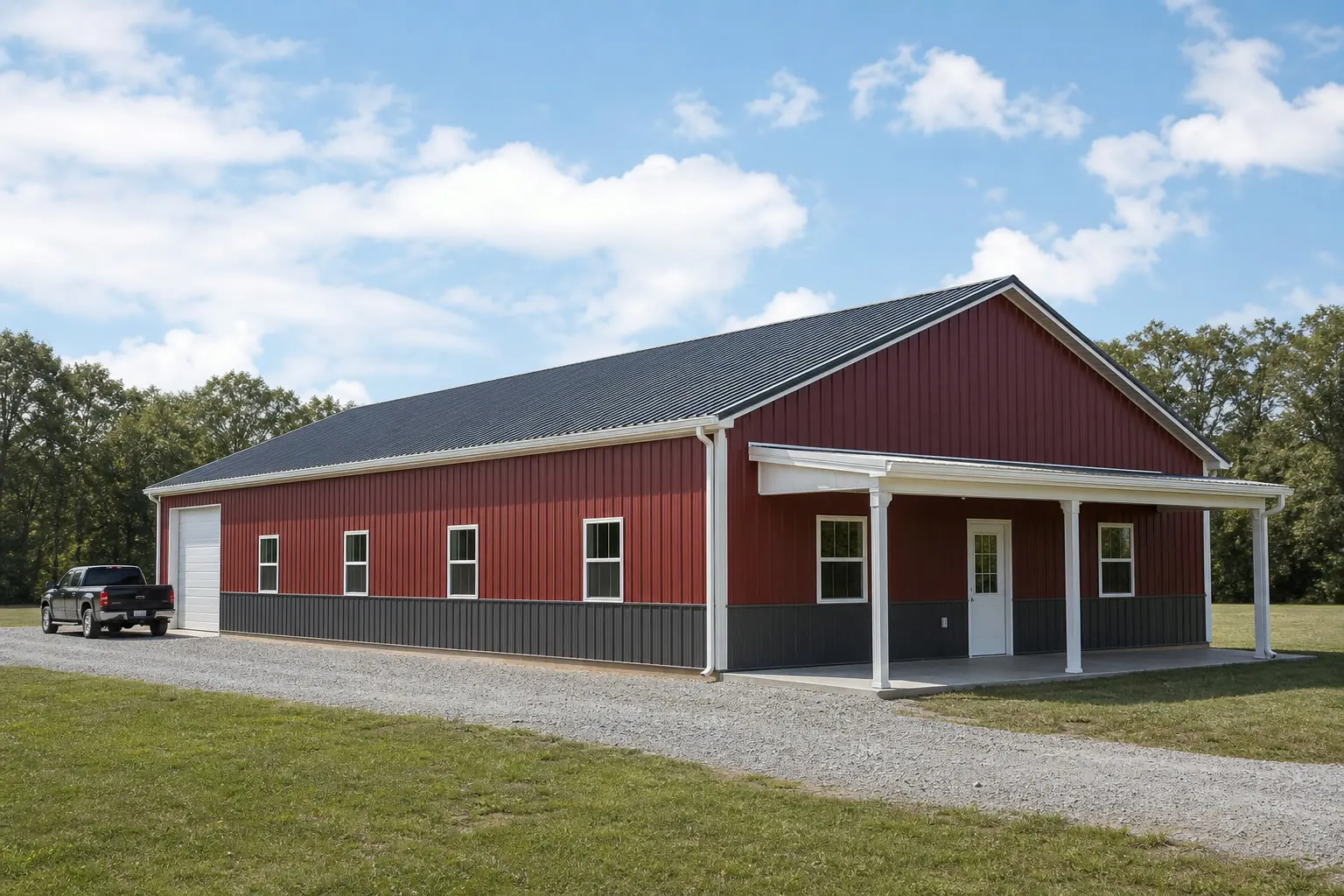
Environmental Planning
Building for the Humid-to-Semi-Arid Divide
Kansas is not a monolith of weather; it is a 400-mile-wide transition zone where the air literally dries out as you travel west.
According to the NOAA NCEI State Climate Summary, Kansas acts as a bridge between the humid conditions of the Eastern United States and the semi-arid environment of the High Plains. For a barndominium buyer, this means the design that works in Wyandotte County is fundamentally different from the one that works in Greeley County. In the east, managing humidity within a metal envelope is the primary concern, requiring robust vapor barriers and dehumidification strategies to prevent condensation against the steel skin.
As you move west, the challenge shifts toward thermal mass and extreme temperature swings. Semi-arid regions experience rapid cooling at night, which can stress a large steel structure. The 1.5°F rise in average temperature since 1900, noted by NOAA, has been most pronounced in winter and spring, meaning the 'traditional' heating and cooling loads for Kansas homes are in flux. A barndominium, with its high-volume open spaces, must account for this by prioritizing high-performance insulation—often closed-cell spray foam—that seals the residential area from the shop and the exterior environment simultaneously.
This transition also affects how you treat the exterior steel. The dry western air is less corrosive, but the intense UV exposure and wind-driven dust require higher-grade finishes than you might need in a sheltered eastern valley. When we discuss Kansas barndominiums, we are discussing buildings that must be tuned to their specific longitude to perform efficiently over a thirty-year lifespan.
Siting and Scale
The 804-Acre Context
Kansas averages 804 acres per farm, the largest in its regional peer group. This massive parcel size changes the fundamental brief for a barndominium from a 'shop-house' to an 'operational headquarters.'
In smaller-acreage states, a barndominium is often a way to fit a workshop onto a suburban lot. In Kansas, where the average farm size is 804 acres (USDA NASS 2022), the barndominium often serves as the central command for a working agricultural enterprise. This scale allows for footprints that would be impossible elsewhere. It is common to see 60x100 foot structures where 3,000 square feet are dedicated to luxury living and the remaining 3,000 square feet house combines, tractors, or aircraft.
Because these parcels are so large, siting becomes a strategic decision rather than a spatial one. Wind exposure is the dominant qualitative factor. FEMA's National Risk Index highlights severe wind as a primary hazard in Kansas. On an 800-acre tract, there are rarely enough trees or hills to act as a windbreak. Buyers must choose between siting the building for a view or siting it for protection. Orienting the residential side away from the prevailing northwesterly winter winds can significantly reduce heating costs and structural noise. Many Kansas owners resolve this tension by placing the shop or garage bay on the exposed northwest corner, letting the utility wing absorb the worst of the wind while the living quarters sit in its lee.
- Consolidated Utility
- Combining home and shop reduces the total footprint and utility trenching on large, remote Kansas parcels.
- Zoning Flexibility
- Large agricultural tracts often have fewer restrictions on mixed-use steel structures than municipal residential zones.
- Future Expansion
- With 800+ acres, siting today should account for the next three decades of grain bins, hangars, or livestock sheds.
Substrate and Soil
Kansas Ground Conditions
Kansas's 81,758.7 square miles offer a range of foundation challenges, from the rocky Flint Hills to the deep silts of the west.
The Flint Hills (East-Central)
Characterized by thin, rocky soils over Permian limestone and shale. The Kansas Geological Survey notes these soils were historically too hard to plow. For barndominiums, this means traditional trench footings may require expensive rock hammering. Slabs-on-grade with thickened edges are the common adaptation here.
High Plains (West)
Deeper, well-drained soils that are easier to excavate but prone to wind erosion. The focus here shifts to ensuring the foundation is protected from 'scour' during high-wind events.
Glaciated Region (Northeast)
Heavier clay soils that can expand and contract. Proper site drainage is critical here to prevent the metal building's rigid frame from shifting during wet-dry cycles.
Start Your Kansas Barndominium Project
Ready to plan a shop-house tuned to the Kansas climate and scale? Request a quote for a building designed for your 800-acre operation or Flint Hills retreat.
Configuration
Common Kansas Barndominium Briefs
The intersection of aviation, agriculture, and residential needs produces several distinct 'Kansas-style' configurations.
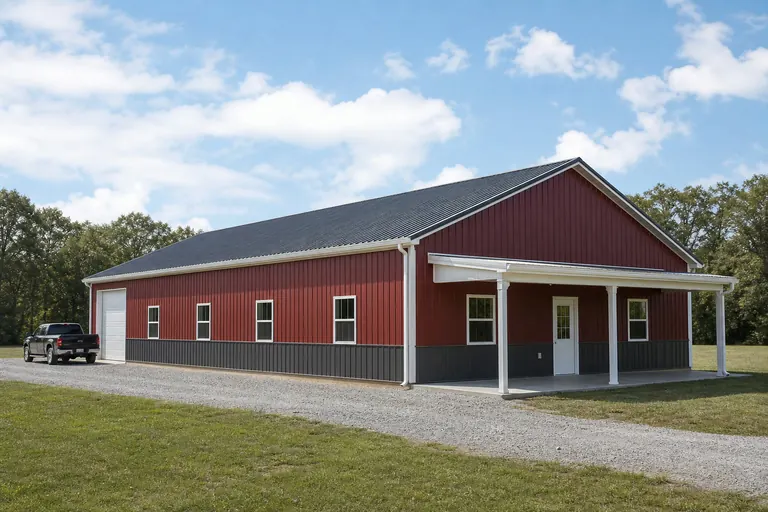 The Ag HeadquartersA large-span shop for 800-acre farm equipment with a high-end mezzanine living space for the operator.The Flint Hills RetreatA smaller footprint focused on recreational use, designed to withstand the rocky terrain and grazing context of the region.
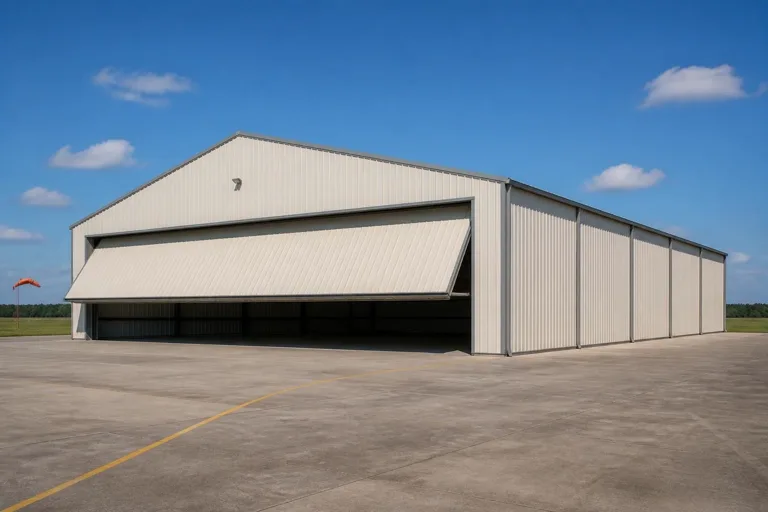 The Aviation HybridReflecting Wichita's influence, these combine a residential wing with a private hangar for light aircraft.
Example Configuration — for planning purposes only.
Footprint
Sizes for the Kansas Scale
On an 804-acre average farm, 'small' is a relative term. These footprints reflect the dual-purpose nature of Kansas builds.
40′ × 60′
2,400 sq ft
A compact 'starter' barndominium with ~1,200 sq ft of living space and a 1,200 sq ft shop.
50′ × 80′
4,000 sq ft
The 'Kansas Standard' for mixed-use, allowing for large implement storage and a 3-bedroom home.
60′ × 100′
6,000 sq ft
Common for primary residences on large operations where the shop must fit multiple tractors.
Example Configuration — for planning purposes only.
Layout specifics depend on local fire separation codes between the living and shop areas; consult your local department.
Questions
Kansas Barndominium FAQ
Honest answers for planning a shop-house in the Sunflower State.
It depends entirely on the county. In unincorporated agricultural areas where the 804-acre average is common, permitting is often straightforward for mixed-use buildings. In metro areas like Wichita or Kansas City, residential building codes are strictly enforced regardless of the building's exterior shell.
Due to the humid-to-semi-arid transition, closed-cell spray foam is generally the gold standard. It provides a vapor barrier for the humid east and a high R-value for the extreme temperature swings of the west.
Qualitative design is key. Avoid large, flat vertical surfaces facing the northwest. Using a heavier gauge steel (26-gauge vs 29-gauge) and ensuring tight screw patterns can reduce oil-canning and rattling during high-wind events.
Yes, but be prepared for the soil. The thin, rocky Permian soil may require a slab-on-grade approach or professional rock excavation. Site prep costs here can be significantly higher than in the western plains.
Yes. With no adjacent structures to shelter you, orientation becomes the main defense against wind. On large open Kansas tracts, siting the residential wing away from the prevailing northwest winter wind and using the shop wing as a windbreak is a common, no-cost strategy that a tighter suburban lot would not allow.
Sources for the Kansas facts on this page
This page states no code requirement, wind speed, snow load, permit rule, price or supplier claim. The state-specific facts it does use are listed with their publisher below.
NOAA NCEI's State Climate Summary for Kansas states the state is a region of transition between the humid conditions to the east and semi-arid conditions to the west, and that temperatures have risen about 1.5°F since the beginning of the 20th century, with greater warming in winter and spring than summer and fall.
NOAA National Centers for Environmental Information (NCEI) · State Climate Summaries series, 2022 · Tier 1
https://statesummaries.ncics.org/downloads/Kansas-StateClimateSummary2022.pdfKansas had 44,794,702 acres of land in farms in 2022, an average farm size of 804 acres — the largest average farm size figure among the four-state group reviewed here (IL, IA, KS, LA).
USDA NASS · 2022 · Tier 1
https://www.nass.usda.gov/Publications/AgCensus/2022/Full_Report/Volume_1,_Chapter_1_State_Level/Kansas/st20_1_001_001.pdfKansas's total land area was measured at 81,758.7 square miles as of the 2010 Census.
U.S. Census Bureau · 2010 Census · Tier 1
https://www.census.gov/geographies/reference-files/2010/geo/state-local-geo-guides-2010/kansas.htmlKansas had a total of 9,504 new privately-owned housing units authorized by building permits in 2023, decreasing to 9,063 units in 2024.
U.S. Census Bureau · 2023-2024 · Tier 1
https://www2.census.gov/econ/bps/State/st2024a.txtThe Flint Hills region, running north-south through east-central Kansas, is one of the few large remaining areas of unplowed tallgrass prairie in North America because the region's thin, rocky (chert-bearing) soils formed from eroded Permian-age limestones and shales were historically too hard to plow, so the land has mainly been used for cattle grazing rather than row crops.
Kansas Geological Survey, University of Kansas · KGS reference material · Tier 2
https://www.kgs.ku.edu/Physio/flinthil.htmlFEMA's National Risk Index dataset assesses 18 natural hazards (including tornado, hail, drought, and severe wind, all historically significant to Kansas) at the county and Census tract level via its interactive online tool.
Federal Emergency Management Agency (FEMA) · Current NRI release · Tier 1
https://www.fema.gov/about/openfema/data-sets/national-risk-index-dataNWS Wichita publishes official 1991-2020 annual climate normals for temperature and precipitation for the Wichita (Eisenhower National Airport) station.
National Weather Service (NOAA), Wichita KS office · 1991-2020 · Tier 1
https://www.weather.gov/ict/yearly