
Steel home · TX
Steel Homes in Texas
A steel home project in Texas divides along one line that has nothing to do with the building itself. Inside the state's designated windstorm catastrophe area — 14 coastal counties plus the part of Harris County east of Highway 146 — insurability is a documented process handled through the Texas Department of Insurance and TWIA, and the paperwork begins before the slab does. Outside it, there is no single enforced statewide building code for most construction, so the governing authority is whichever city or county your parcel sits in. Both projects can end in the same house; they do not start the same way.
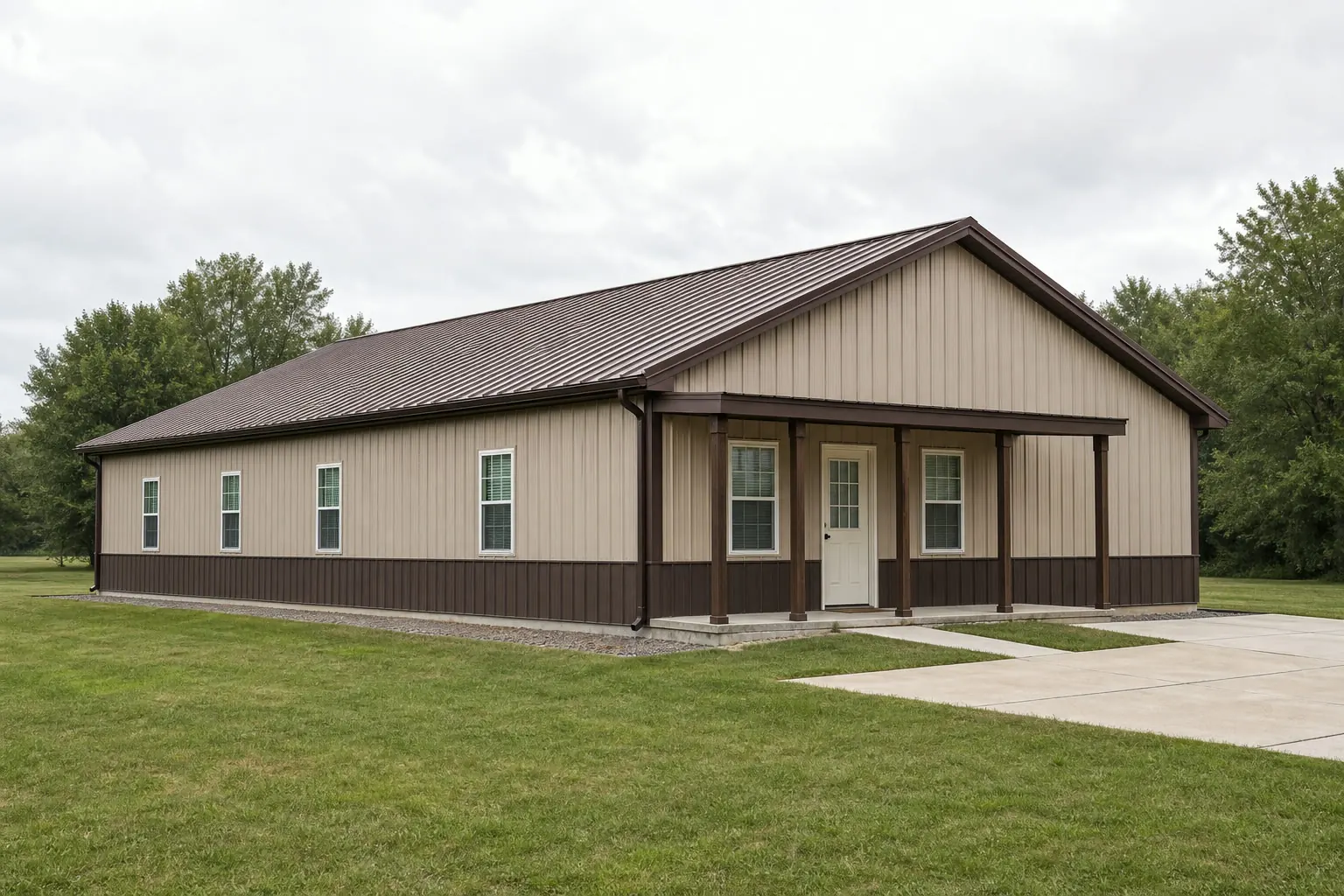
The dividing line
Coastal and inland Texas are two different projects
The single most consequential Texas fact for a residential steel building is not structural. It is whether your parcel sits inside the state's designated windstorm catastrophe area.
The Texas Department of Insurance administers a Windstorm Inspection Program for coastal construction, created by state law in 1987, and the Texas Windstorm Insurance Association requires a Windstorm Certificate of Compliance under Chapter 2210 of the Insurance Code before it will issue wind and hail coverage. TDI describes the designated catastrophe area as 14 coastal counties plus the part of Harris County east of Highway 146. What that means in practice is that on the coast, insurability is a documented sequence involving inspection, not something arranged after the fact — and the people who need to be involved need to be involved early.
This page does not state what the inspection covers or what your building will need to satisfy it, because those answers come from TDI and from the engineer and inspector working on your project. What we can say plainly is that a coastal buyer should treat certification as a project workstream with its own timeline, and should raise it with a builder in the first conversation rather than the last.
Move inland and the picture inverts. Texas has no single statewide building code authority enforcing a mandatory code for most construction; adoption and enforcement happen primarily at city and county level. A home inside a large city's limits and a home on unincorporated county land can therefore follow noticeably different processes, and neither is predicted by the state you are in. The useful first phone call inland is to your county or municipality, not to a statewide office, because there generally isn't one to call.
Process
Where the two Texas routes actually differ
Same house, different administrative path. This table compares the two starting points so you can identify yours before requesting quotes.
| Planning question | Inside the designated catastrophe area | Elsewhere in Texas |
|---|---|---|
| Who to contact first | Your insurer or agent alongside the local permitting office, because wind and hail coverage runs through a state inspection process | The city or county that has jurisdiction over the parcel |
| When documentation starts | Before construction, since certification is tied to inspection during the build | At permit application, on the local schedule |
| Who confirms what is required | TDI and TWIA for the certificate; the local authority for the permit | The local authority having jurisdiction, exclusively |
| Effect on the quote | Engineering and inspection coordination should be in scope from the start | Scope depends on what the local authority asks for |
Who to contact first
- Inside the designated catastrophe area
- Your insurer or agent alongside the local permitting office, because wind and hail coverage runs through a state inspection process
- Elsewhere in Texas
- The city or county that has jurisdiction over the parcel
When documentation starts
- Inside the designated catastrophe area
- Before construction, since certification is tied to inspection during the build
- Elsewhere in Texas
- At permit application, on the local schedule
Who confirms what is required
- Inside the designated catastrophe area
- TDI and TWIA for the certificate; the local authority for the permit
- Elsewhere in Texas
- The local authority having jurisdiction, exclusively
Effect on the quote
- Inside the designated catastrophe area
- Engineering and inspection coordination should be in scope from the start
- Elsewhere in Texas
- Scope depends on what the local authority asks for
Siting
Four Texas regions, four site conversations
The USGS-published Bureau of Economic Geology mapping identifies Gulf Coastal Plains, Interior Plains, Great Plains and Basin and Range provinces within Texas — a genuine spread across 261,226 square miles of land area.
Gulf Coastal Plains
Low relief, high humidity and the region where the windstorm catastrophe area sits. Drainage, finished floor elevation and the certification workstream dominate planning here.
Interior Plains and Blackland Prairies
The central belt through the Dallas-Fort Worth and Austin corridors. Expansive clay soils are well known in this region, which makes the foundation design conversation with a local engineer the one worth having early.
Great Plains / High Plains
The Panhandle and west: open, exposed and windy country with long haul distances. Site access and exposure to sustained wind are the practical planning items.
Basin and Range / Trans-Pecos
Far west Texas, arid and sparsely served. Utility availability, water and delivery logistics usually shape the schedule more than the building specification does.
Get Texas steel home quotes
Tell us the county, whether the site is coastal or inland, and the living area you have in mind. We pass the Texas context through with the enquiry.
Land
Most Texas steel homes are acreage projects
Texas counted 230,662 farms in the 2022 Census of Agriculture, more than any other state, across 125,471,325 acres at a 544-acre average. A great many residential steel building projects here sit on rural land rather than in a subdivision.
That changes the checklist. On acreage, the items that decide the schedule are rarely about the house: they are the driveway a delivery truck has to use, whether water is a well or a rural supply, whether waste is septic and how long that approval takes locally, and where the electrical service comes from. Buyers who plan those in parallel with the building generally avoid the stall that happens when a finished structure waits on a utility connection.
It also affects the brief. Rural sites tend to want a workshop or covered storage nearby, and that is the point at which a steel home brief often becomes a barndominium brief instead. Both are legitimate; they are simply different buildings, and it is cheaper to decide which one you are buying before the drawings than after.
- Access and turning room
- Confirm the delivery route and the turning radius at the site, not just the address.
- Water and waste
- Well and septic approvals sit on the local authority's timeline and are a frequent source of delay on rural builds.
- Service connection
- Distance to the nearest electrical service is a real cost line and worth confirming before you finalise siting.
Footprint
Footprints that suit a Texas residential brief
Single-level living on acreage, with room for covered outdoor space, is what pushes most Texas enquiries toward long rectangles rather than compact squares.
30′ × 60′
1,800 sq ft
A common single-level layout with room for three defined zones along the length.
40′ × 60′
2,400 sq ft
Adds width for a genuinely open central living area rather than a corridor plan.
30′ × 70′
2,100 sq ft
Length instead of width where the site favours a long, narrow building footprint.
40′ × 80′
3,200 sq ft
Where the brief includes an attached shop or garage bay under the same roofline.
Example Configuration — for planning purposes only.
Each footprint page carries layout detail; this page only explains why Texas briefs land in this range.
Sequence
The order to do things in Texas
Getting the order right saves more money than any single specification decision.
Step 1
Establish which authority governs your parcel
City, county or unincorporated land determines the entire permitting path, and Texas does not answer this for you at state level.
Step 2
Check whether you are in the designated catastrophe area
If so, involve your insurer and the certification process at the start, not after the structure is up.
Step 3
Resolve foundation and soils locally
Regional soil behaviour, especially across the Blackland Prairie belt, is an engineer-and-site question, never a statewide rule of thumb.
Step 4
Plan utilities alongside the building
On acreage, water, septic and service connection routinely set the schedule.
Step 5
Decide house versus shop-house before drawings
A steel home and a barndominium diverge early; choosing late is the expensive version.
Questions
Texas steel home questions
What we can answer at state level, and where the rest properly belongs.
Texas does not have a single statewide building code authority enforcing a mandatory code for most construction; adoption and enforcement happen primarily at the local level. That makes your city or county the authority on what applies to your build, and it is worth confirming before you fix a specification.
The Texas Department of Insurance administers a windstorm inspection program, and TWIA requires a Windstorm Certificate of Compliance under Insurance Code Chapter 2210 before issuing wind and hail coverage. TDI describes the designated catastrophe area as 14 coastal counties plus part of Harris County east of Highway 146. Whether it applies to your parcel, and what it involves, is a question for TDI and your insurer.
Texas exposure varies enormously across the state, and NOAA reports temperatures have risen almost 1.5°F since the early twentieth century. Rather than a blanket claim, the useful framing is that insulation, air sealing and shading decisions carry more weight in a hot climate than the frame material does, and those are specification choices you make with your builder.
We do not publish state-level home prices. A steel home's cost depends on the interior finish level far more than on the shell, which is exactly why a statewide number would mislead. Our cost pages explain the drivers; a quote reflects your specification.
Not quite. Steel-home searches and barndominium searches overlap heavily in Texas, but a barndominium brief usually combines living space with a working shop or storage area under one roof. If that describes your project, the barndominium pages are the better starting point.
Sources for the Texas facts on this page
This page states no code requirement, wind speed, snow load, permit rule, price or supplier claim. The state-specific facts it does use are listed with their publisher below.
Texas does not have a single statewide building code authority enforcing a mandatory building code for most construction; code adoption and enforcement occur primarily at the local/municipal level.
KHOU 11 (Verify) / Texas State Law Library · current · Tier 3
https://www.khou.com/article/news/verify/verify-statewide-enforced-residential-building-code-texas/285-cc7c6343-cdf1-4751-b855-713601cf6b8bThe Texas Department of Insurance (TDI) administers a Windstorm Inspection Program for coastal construction, established under a 1987 state law, to allow structures to qualify for windstorm coverage.
Texas Department of Insurance (TDI) · since 1988 · Tier 2
https://www.tdi.texas.gov/wind/generalquestio.htmlThe Texas Windstorm Insurance Association (TWIA) requires coastal properties to hold a Windstorm Certificate of Compliance under Texas Insurance Code Chapter 2210 before TWIA wind/hail coverage is issued; TDI states the designated catastrophe area covers 14 coastal counties and part of Harris County east of Highway 146.
Texas Windstorm Insurance Association (TWIA) / Texas Department of Insurance (TDI) · current · Tier 2
https://www.tdi.texas.gov/tips/need-windstorm-inspection.htmlNOAA's Hurricane Research Division data show Texas has recorded 64 direct hurricane hits (all categories) for 1851-2018, second only to Florida.
NOAA Atlantic Oceanographic and Meteorological Laboratory (AOML), Hurricane Research Division · 1851-2018 · Tier 1
https://www.aoml.noaa.gov/hrd/tcfaq/E19.htmlNOAA's NCEI State Climate Summary reports that temperatures in Texas have risen almost 1.5°F since the beginning of the 20th century.
NOAA National Centers for Environmental Information · 2022 report, covering 20th century-present · Tier 1
https://www.txdot.gov/content/dam/docs/division/env/toolkit/725-01-rpt-appendixb.pdfThe USGS-published Bureau of Economic Geology map identifies major Texas physiographic regions including the Gulf Coastal Plains, Interior Plains, Great Plains, and Basin and Range provinces.
Bureau of Economic Geology, University of Texas at Austin · 1996 · Tier 2
https://txmn.org/st/files/2022/09/BEG_PHYSIOGRAPHY_1996.pdfTexas's total land area was 261,226 square miles per the 2008 Census Bureau state area measurements, the largest of the contiguous 48 states.
U.S. Census Bureau, Statistical Abstract of the United States: 2011 · 2008 · Tier 1
https://www2.census.gov/library/publications/2010/compendia/statab/130ed/tables/11s0355.pdfTexas had 230,662 farms in 2022 per the USDA Census of Agriculture, the most of any U.S. state.
USDA National Agricultural Statistics Service (NASS) · 2022 · Tier 1
https://www.nass.usda.gov/Publications/AgCensus/2022/Full_Report/Volume_1,_Chapter_1_State_Level/Texas/