
Barndominium · PA
Barndominiums in Pennsylvania
A Pennsylvania barndominium project should start with a question that is easy to skip: which of the Commonwealth's six physiographic provinces is your parcel actually sitting in? The Department of Conservation and Natural Resources maps Pennsylvania across the Central Lowlands, Appalachian Plateaus, Ridge and Valley, Blue Ridge, Piedmont, and Atlantic Coastal Plain, and each of those landforms carries its own slope, drainage, and bedrock story. Layer that terrain question over Act 45 of 1999, the state law that lets each of Pennsylvania's municipalities individually decide whether it enforces the Uniform Construction Code itself, hires a third-party agency, or opts out of local enforcement altogether, and it becomes clear that a barndominium plan drawn for one township cannot be assumed to transfer cleanly to the next one over. Add roughly 49,000 farms still operating across the state, and a large share of Pennsylvania barndominium demand looks less like a new-construction hobby project and more like a working farm converting an outbuilding footprint into a residence.
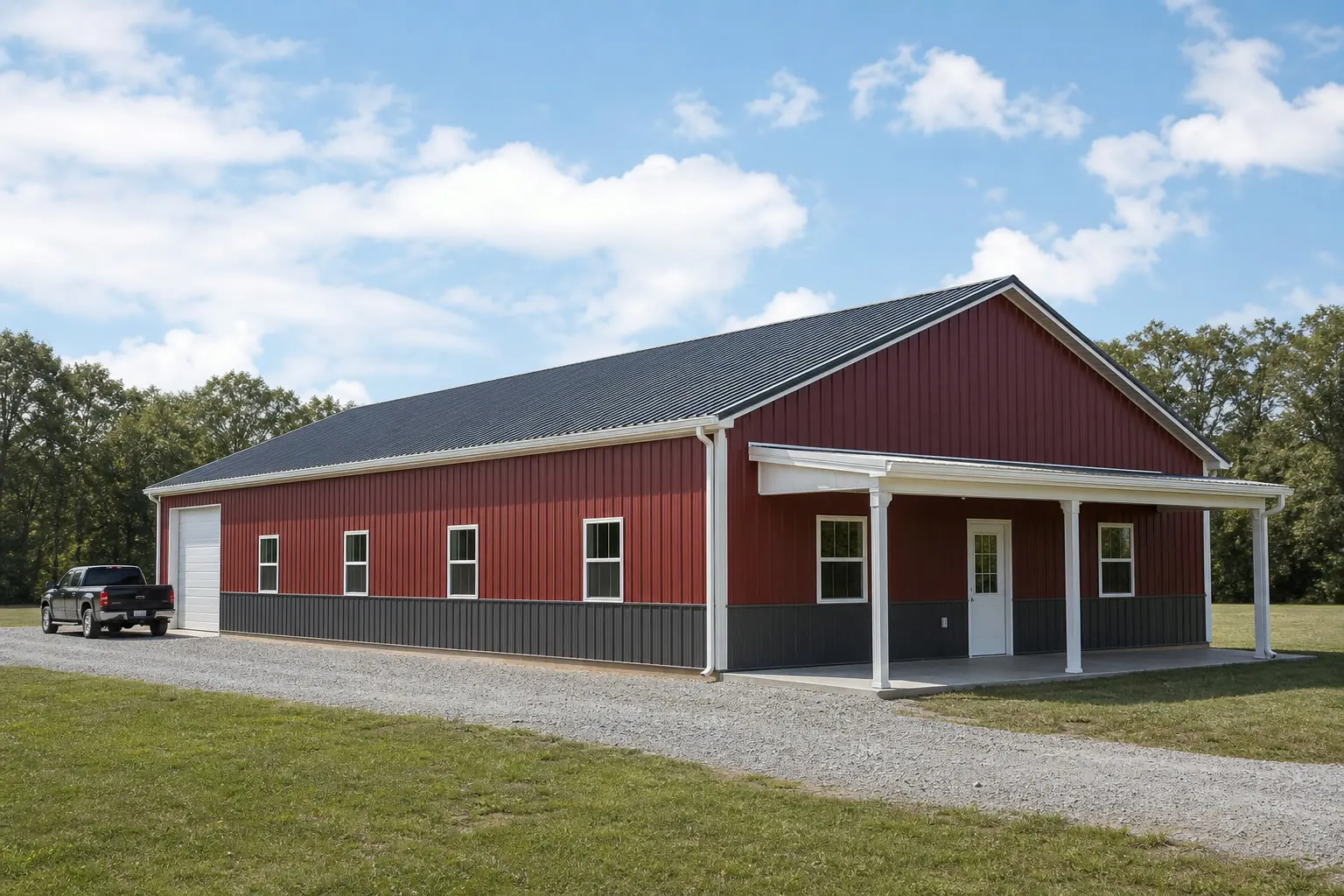
One State, Six Landforms, and 2,562 Different Permit Answers
Pennsylvania does not present a single, uniform building environment. DCNR's own landform map divides the Commonwealth into six physiographic provinces, and Act 45 of 1999 hands every municipality inside those provinces the right to decide, on its own, how the state's Uniform Construction Code gets enforced. For a barndominium buyer, that combination means the planning conversation has to start locally: which province is the parcel in, and which of the roughly 2,562 municipalities is going to review the plans? Getting those two answers first prevents a design drawn for the wrong terrain or the wrong permit process from ever reaching a plan reviewer's desk.
Site Planning
Why Your Province Changes the Foundation Conversation
DCNR names six physiographic provinces running northwest to southeast, and a barndominium's slab, grading, and drainage plan should be scoped to whichever one the site sits in.
The Central Lowlands and Appalachian Plateaus in the west and north give way to the folded Ridge and Valley province, then the small Blue Ridge section, the rolling Piedmont, and finally the flat Atlantic Coastal Plain in the southeast corner of the state. A barndominium designed for a flat coastal-plain lot — with a straightforward slab and minimal cut-and-fill — is a poor starting template for a Ridge and Valley site, where folded bedrock and steeper grades typically call for more site engineering before a foundation contractor can even quote the job. Piedmont sites bring their own rolling-terrain considerations, while Appalachian Plateau parcels can carry the steepest access-road grades of the group.
None of this replaces a geotechnical or site survey — DCNR's province map is a planning-stage orientation tool, not a substitute for soil borings. What it does is tell a buyer, before they hire anyone, whether to budget planning time for retaining structures, extended driveway grading, or drainage rerouting. A barndominium plan that assumes flat, buildable ground everywhere in Pennsylvania risks a site-work budget that balloons after groundbreaking, once the actual grading and drainage needs of the parcel's province surface.
Because Pennsylvania's total land area is 46,054 square miles spread across those six provinces, buyers comparing parcels across county lines should expect real topographic variety rather than a single representative 'Pennsylvania lot.' Treat the province as the first filter in site selection, then bring in a local surveyor to confirm the specifics.
Regulatory Path
How Act 45 Splits Enforcement Across Municipalities
Pennsylvania's Department of Labor & Industry sets the Uniform Construction Code, but enforcement is elected locally under Act 45 of 1999.
| Municipal Election | What It Means for a Barndominium Buyer | Source |
|---|---|---|
| Self-enforcing municipality | The township or borough itself performs plan review and inspections. | PA Dept. of Labor & Industry |
| Third-party agency contract | The municipality hires a private UCC-certified inspection agency to review your plans. | PA Dept. of Labor & Industry |
| Opt-out municipality | Enforcement defaults to the state's fallback arrangement rather than a local office. | PA Dept. of Labor & Industry |
| Statewide code source | The UCC itself is set once, statewide, by L&I under Act 45 of 1999. | PA Dept. of Labor & Industry |
Self-enforcing municipality
- What It Means for a Barndominium Buyer
- The township or borough itself performs plan review and inspections.
- Source
- PA Dept. of Labor & Industry
Third-party agency contract
- What It Means for a Barndominium Buyer
- The municipality hires a private UCC-certified inspection agency to review your plans.
- Source
- PA Dept. of Labor & Industry
Opt-out municipality
- What It Means for a Barndominium Buyer
- Enforcement defaults to the state's fallback arrangement rather than a local office.
- Source
- PA Dept. of Labor & Industry
Statewide code source
- What It Means for a Barndominium Buyer
- The UCC itself is set once, statewide, by L&I under Act 45 of 1999.
- Source
- PA Dept. of Labor & Industry
Plan Your Pennsylvania Barndominium
Get matched with builders who understand province-specific site work and municipal UCC enforcement across Pennsylvania.
Buyer Profile
The Farm-Conversion Barndominium
A meaningful share of Pennsylvania barndominium interest starts on land that is already a working farm, not a bare residential lot.
The Center for Rural Pennsylvania's analysis of the 2022 Census of Agriculture counted about 49,000 farms operating in the Commonwealth, roughly three percent of the nation's farm total. For a landowner already running one of those operations, a barndominium is frequently framed as adding a residence to an existing working parcel — succession planning for a family member, or converting part of an agricultural footprint into a mixed-use home-and-shop building — rather than buying raw land and starting from zero.
That framing matters for permitting, because a municipality's UCC enforcement election under Act 45 applies to the residential portion of the build regardless of the parcel's agricultural status; adding living space to what has been an agricultural structure typically triggers full residential plan review even where the land itself carries an agricultural exemption for other outbuildings. Buyers coming from a working-farm angle should confirm this distinction with their municipality's enforcement office before assuming an existing ag exemption covers the new residence.
Exact figures for land-in-farms and average farm size from the same 2022 Census table were not available at publication, so acreage-specific planning — how much of a given farm's footprint can realistically support a new residential structure — still needs a buyer-supplied survey rather than a statewide average.
Climate Planning
Ten Climate Regions, Not One Pennsylvania Average
The Pennsylvania State Climatologist reports climate as ten regional divisions, which is the right scale for envelope decisions — not a single statewide figure.
Penn State's State Climatologist Office publishes observed temperature and precipitation across ten climate regions covering the Commonwealth, with records running back to 1899. That regional structure exists because Pennsylvania's climate genuinely varies from the Lake Erie shoreline to the Piedmont valleys, and NOAA's 1991-2020 Climate Normals, which now underpin local National Weather Service reporting for Pennsylvania stations, are likewise published station by station rather than as one state number.
For a barndominium buyer, the practical takeaway is to pull the climate-normal data for the specific NWS station nearest the build site rather than searching for a single 'Pennsylvania average snowfall' figure — no such single number exists in the source data reviewed for this page, and using a borrowed number from another region risks under- or over-specifying insulation, roof pitch, and ventilation choices.
Footprint Planning
Sizing a Barndominium Around Pennsylvania's Terrain
Footprint choice should follow site access and grading reality established by the province and municipal review, not the other way around.
30′ × 40′
1,200 sq ft
A compact footprint that keeps site work manageable on steeper Ridge and Valley or Appalachian Plateau parcels.
40′ × 60′
2,400 sq ft
A common living-plus-shop split for buyers converting part of a working farm parcel.
50′ × 80′
4,000 sq ft
Larger footprints suit flatter Piedmont or Atlantic Coastal Plain sites where grading is less of a constraint.
Example Configuration — for planning purposes only.
Confirm setback and lot-coverage limits with the specific municipality's UCC enforcement office before finalizing a footprint.
Common Questions
Pennsylvania Barndominium FAQ
Direct answers to the questions Pennsylvania buyers ask before committing to a site.
No. The Department of Labor & Industry sets the Uniform Construction Code statewide, but Act 45 of 1999 lets each municipality elect to enforce it itself, hire a third-party agency, or opt out, so the review process differs by township or borough.
It can. DCNR maps six physiographic provinces across Pennsylvania with different landforms, from the flat Atlantic Coastal Plain to the folded Ridge and Valley province, and a foundation and drainage plan should be scoped to the specific province before finalizing a design.
Generally no. Agricultural exemptions typically apply to purely agricultural structures; adding livable residential space usually requires full plan review under the municipality's UCC enforcement election, even on a working farm.
No single statewide figure exists in the sources reviewed here. The state climatologist reports ten separate climate regions, and design loads should come from the local building department or a licensed engineer for the specific site.
Contact the municipality's permit office directly, or check the Department of Labor & Industry's municipal election status list, which covers all Pennsylvania municipalities' UCC enforcement choices.
Sources for the Pennsylvania facts on this page
This page states no code requirement, wind speed, snow load, permit rule, price or supplier claim. The state-specific facts it does use are listed with their publisher below.
Pennsylvania's Department of Conservation and Natural Resources states the Commonwealth contains six physiographic provinces, listed northwest to southeast as: Central Lowlands, Appalachian Plateaus, Ridge and Valley, Blue Ridge, Piedmont, and Atlantic Coastal Plain.
Pennsylvania Department of Conservation and Natural Resources (DCNR) · Current DCNR page · Tier 2
https://www.pa.gov/agencies/dcnr/conservation/geology/geology-of-pa/landformsPennsylvania total land area per US Census Bureau state area measurements.
U.S. Census Bureau · 2010 measurement basis · Tier 1
https://www.census.gov/geographies/reference-files/2010/geo/state-area.htmlPennsylvania's statewide building code, the Uniform Construction Code (UCC), is administered by the Department of Labor & Industry, and under Act 45 of 1999 each municipality elects whether to administer and enforce the UCC itself, opt out of enforcement, or use a third-party agency; opt-out municipalities' UCC enforcement is then handled per the state's default arrangement.
Pennsylvania Department of Labor & Industry · Current program page; Act 45 of 1999 framework · Tier 2
https://www.pa.gov/agencies/dli/programs-services/labor-management-relations/bureau-of-occupational-and-industrial-safety/uniform-construction-code-homeNumber of farms in Pennsylvania in 2022 and share of national total, per a Pennsylvania state-agency analysis of the Census of Agriculture.
Center for Rural Pennsylvania (state legislative agency), using USDA NASS data · 2022 Census of Agriculture, published May 2024 · Tier 1
https://www.rural.pa.gov/download.cfm?file=Resources%2FPDFs%2FAnalysis+of+2022+Ag+Census+Fact+Sheet+Web.pdfThe Pennsylvania State Climatologist Office (Penn State) publishes observed average precipitation and temperature for 10 climate regions across the state.
Pennsylvania State Climatologist, Penn State College of Earth and Mineral Sciences · 1899-present regional series · Tier 2
https://climate.met.psu.edu/data/state/regional.php