
Barndominium · NY
Barndominiums in New York
Planning a barndominium in New York means designing for two forces at once: a contracting but still sizable farm economy and a genuinely snowy climate across most of the state outside New York City. With 30,650 farms recorded in the 2022 Census of Agriculture — down 8% since 2017 — a steady stream of former agricultural acreage is being repositioned for residential-shop hybrids rather than active production. At the same time, the Albany NWS station's 1991-2020 normals show roughly 61 inches of annual snowfall, a reminder that upstate buyers are planning roof pitch, entry vestibules and equipment access around real winter loads, even though this page never assigns a design snow load itself. Every structural number belongs to your local building department and a licensed engineer; what this page covers is how New York's land-use shift and winter exposure change the planning conversation before you ever reach that stage.
Where Working Land Meets Winter Design
A New York barndominium sits at the intersection of two statewide trends: agricultural land that is contracting in farm count but still measured in hundreds of acres per operation, and a climate that, outside the immediate city, runs genuinely snowy for a large part of the year. Neither factor alone explains the New York barndominium market — it is the combination that shapes how buyers site the building, orient the entries and plan the shop-to-living split.
Land Use
A Shrinking Farm Base Creates a Growing Hybrid Market
New York's farm count fell 8% between 2017 and 2022, and the acreage left behind is a primary source of barndominium sites.
The 2022 Census of Agriculture counted 30,650 farms across New York, down from a larger base five years earlier, covering 6,502,286 acres at an average of 212 acres per operation. That combination — fewer farms, but still substantial average acreage — describes a state where consolidation and exit are both underway at once. When a family retires from active farming or a smaller operation folds into a neighboring one, the residual acreage frequently gets subdivided rather than left fully idle, and a barndominium is a natural fit for the resulting 5-to-40-acre remainder: enough land to keep a garden, pasture or small equipment operation, paired with a single structure that houses both the residence and the working shop.
This matters for planning because a New York barndominium buyer is more often working with a former agricultural parcel than a raw suburban lot. That history can bring existing outbuildings, established driveways, or agricultural zoning overlays that a straight residential build would not encounter. Confirming the parcel's current zoning classification and any residual agricultural exemptions with your town or county planning office before finalizing a footprint avoids a mid-project reclassification surprise.
It also means the shop side of the barndominium is rarely an afterthought. Buyers converting former farmland tend to want covered space for a tractor, a truck and general equipment even if they are not planning to farm commercially, which keeps clear-span widths and eave heights as central design questions from the first sketch.
Climate Planning
Designing Around a Genuinely Snowy State
The Albany station's ~61-inch annual snowfall normal is a reminder that most of New York, outside the immediate coastal city, plans for real winter accumulation.
NOAA's 1991-2020 normals for the Albany station show annual precipitation of about 40.9 inches and roughly 61 inches of snowfall. That single-station figure is not a statewide design number — actual snow exposure varies sharply between the lake-effect corridors near Buffalo, the Adirondack interior, the Hudson Valley and the milder coastal city — but it is a useful signal that a barndominium built anywhere upstate should assume a real winter season rather than an occasional dusting. That assumption shows up in choices such as covered entries between the shop and living wing, roof pitches steep enough to shed accumulation cleanly, and gutter or snow-guard planning that keeps sliding snow away from walkways and equipment doors.
None of that translates into a specific roof load or truss spec on this page — that number comes from your local building department using the code edition and ground snow load adopted for your specific jurisdiction, and it can differ meaningfully even between two towns in the same county. What a buyer can reasonably plan for in advance is layout: a mudroom or transition space between the shop and the residence keeps wet boots and equipment traffic out of living areas, and equipment doors sized and oriented to avoid prevailing drift patterns save real maintenance headaches over a New York winter.
Because NOAA's climate normals are published at the station level rather than as one statewide figure, buyers should treat the Albany numbers as a directional reference and pull the nearest station's data — or ask their local building department directly — for anything closer to their actual site.
Key Indicators
Data Shaping New York Barndominium Planning
These sourced figures frame the land-use and climate context for a New York barndominium project.
| Metric | Value | Source |
|---|---|---|
| Total Farms (2022) | 30,650, down 8% since 2017 | USDA NASS |
| Average Farm Size | 212 acres | USDA NASS |
| Albany Annual Snowfall Normal | ~61 inches (1991-2020) | NOAA / NWS Albany |
| Albany Annual Precipitation Normal | ~40.9 inches (1991-2020) | NOAA / NWS Albany |
| County-Level Hazard Data | Available for all 62 NY counties | FEMA National Risk Index |
Total Farms (2022)
- Value
- 30,650, down 8% since 2017
- Source
- USDA NASS
Average Farm Size
- Value
- 212 acres
- Source
- USDA NASS
Albany Annual Snowfall Normal
- Value
- ~61 inches (1991-2020)
- Source
- NOAA / NWS Albany
Albany Annual Precipitation Normal
- Value
- ~40.9 inches (1991-2020)
- Source
- NOAA / NWS Albany
County-Level Hazard Data
- Value
- Available for all 62 NY counties
- Source
- FEMA National Risk Index
Start Your New York Barndominium Project
Connect with builders who understand New York's converted-acreage sites and upstate winter planning requirements.
Use Cases
Common New York Barndominium Configurations
These three patterns recur across the state's converted-acreage and winter-climate context.
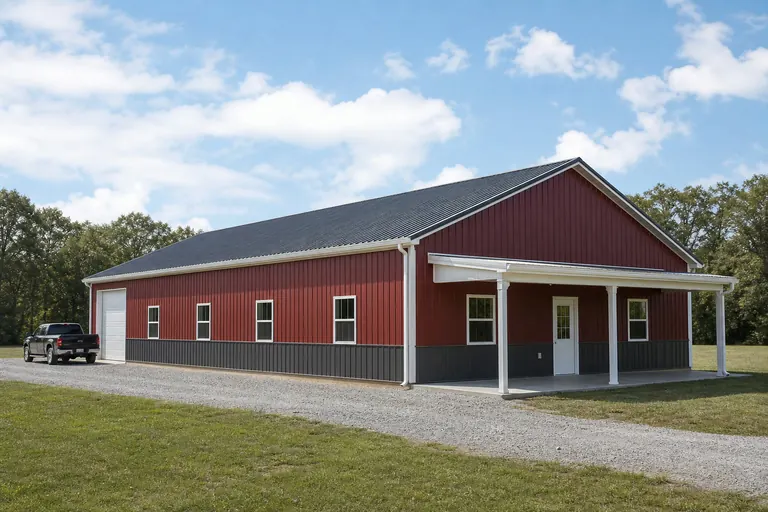 The Retired-Farm ConversionSited on the residual acreage of a scaled-back or exited farm operation, pairing a modest residence with a shop sized for a tractor and general equipment rather than commercial production.The Upstate Winter HybridBuilt with a covered breezeway between shop and living wing and a steeper roofline, prioritizing snow-shedding circulation over open exterior walkways.The Small-Acreage HomesteadA compact footprint on a 5-to-15 acre subdivided parcel, balancing living space with enough shop area for hobby equipment, a garden shed function, and vehicle storage.
Example Configuration — for planning purposes only.
Footprints
Sizing Your New York Barndominium
These footprints reflect the acreage and shop needs a buyer converting former New York farmland typically brings to a quote request.
40′ × 60′
2,400 sq ft
A common entry-level split for a subdivided parcel, balancing living space with a single-bay shop.
50′ × 80′
4,000 sq ft
Supports a larger shop bay for tractor and implement storage alongside a full residence.
60′ × 100′
6,000 sq ft
Suited to buyers retaining a working-acreage function alongside the residence.
Example Configuration — for planning purposes only.
Actual usable living area depends on interior framing, mezzanine choices and your local department's occupancy review.
Preparation
New York Planning Checklist
Steps that reflect the state's land-conversion and winter-climate realities.
- Confirm Parcel Zoning HistoryCheck with your town or county planning office for any residual agricultural exemptions or overlays on a former farm parcel.
- Pull County-Level Hazard DataUse FEMA's National Risk Index report viewer for your specific county rather than assuming a single statewide hazard profile.
- Request Station-Level Snow DataAsk your local building department for the nearest station's climate normals to understand realistic winter exposure for your site.
- Plan the Shop-Living TransitionDesign a mudroom or covered breezeway between shop and residence to manage snow, mud and equipment traffic.
Common Questions
New York Barndominium FAQ
Honest answers to the questions buyers ask when planning a steel barndominium in New York.
It can simplify site prep since existing driveways or utility runs may already exist, but you should verify current zoning and any lingering agricultural exemptions with your town or county before assuming residential use is automatically approved.
No. Snow exposure varies significantly across the state — from lake-effect areas near Buffalo to the Adirondacks to the milder coastal city — so your local building department sets the design figure for your specific site.
We do not publish price data on this page. The 8% decline in farm count since 2017 does suggest more former agricultural parcels entering the market, but local land pricing should be confirmed with a regional real estate professional.
Yes, generally. Upstate regions typically see more sustained winter accumulation, which affects roof pitch and entry planning, while downstate and coastal areas contend with different exposure factors that your local department will detail.
FEMA's National Risk Index report viewer publishes county-level reports for all 62 New York counties, giving you a citable, location-specific hazard profile rather than a generalized statewide claim.
Sources for the New York facts on this page
This page states no code requirement, wind speed, snow load, permit rule, price or supplier claim. The state-specific facts it does use are listed with their publisher below.
Albany, NY's 1991-2020 annual normal precipitation is about 40.9 inches with roughly 61 inches of annual snowfall at the Albany station.
National Weather Service (NOAA), Albany NY office · 1991-2020 · Tier 1
https://www.weather.gov/media/aly/Climate/ALB_Normals_1991-2020.pdfNew York had 30,650 farms in 2022, down 8% since 2017.
USDA National Agricultural Statistics Service (NASS) · 2022 · Tier 1
https://www.nass.usda.gov/Publications/AgCensus/2022/Online_Resources/County_Profiles/New_York/cp99036.pdfNew York had 6,502,286 acres of land in farms in 2022, an average farm size of 212 acres.
USDA NASS · 2022 · Tier 1
https://www.nass.usda.gov/Publications/AgCensus/2022/Online_Resources/County_Profiles/New_York/cp99036.pdfFEMA's National Risk Index is the authoritative source for county- and state-level natural hazard exposure ratings across 18 hazard types, viewable via FEMA's own interactive report tool.
Federal Emergency Management Agency (FEMA) · Current NRI release · Tier 1
https://www.fema.gov/flood-maps/products-tools/national-risk-indexNew York state total privately-owned housing units authorized by building permits in 2023 was tracked in the Census Bureau's Building Permits Survey annual highlights, alongside all other states.
U.S. Census Bureau · 2023 · Tier 1
https://www.census.gov/construction/bps/pdf/2023annualhighlights.pdf