
Carport · PA
Carports in Pennsylvania
A carport in Pennsylvania is decided twice: once by the terrain under it, and once by the township that will review it. The Commonwealth's Uniform Construction Code is set at the state level by the Department of Labor & Industry, but under Act 45 of 1999 each of Pennsylvania's 2,562 municipalities chooses whether to enforce that code itself, contract it to a third party, or opt out of local administration entirely. That decision changes who reviews your carport drawings and how quickly. Layered on top of that is geography: Pennsylvania's Department of Conservation and Natural Resources maps six distinct physiographic provinces running from the Atlantic Coastal Plain to the Appalachian Plateaus, so the ground a carport sits on in the Piedmont behaves nothing like a pad cut into a Ridge-and-Valley hillside. Neither fact is a footnote — both determine how a Pennsylvania carport gets planned, sited, and approved.
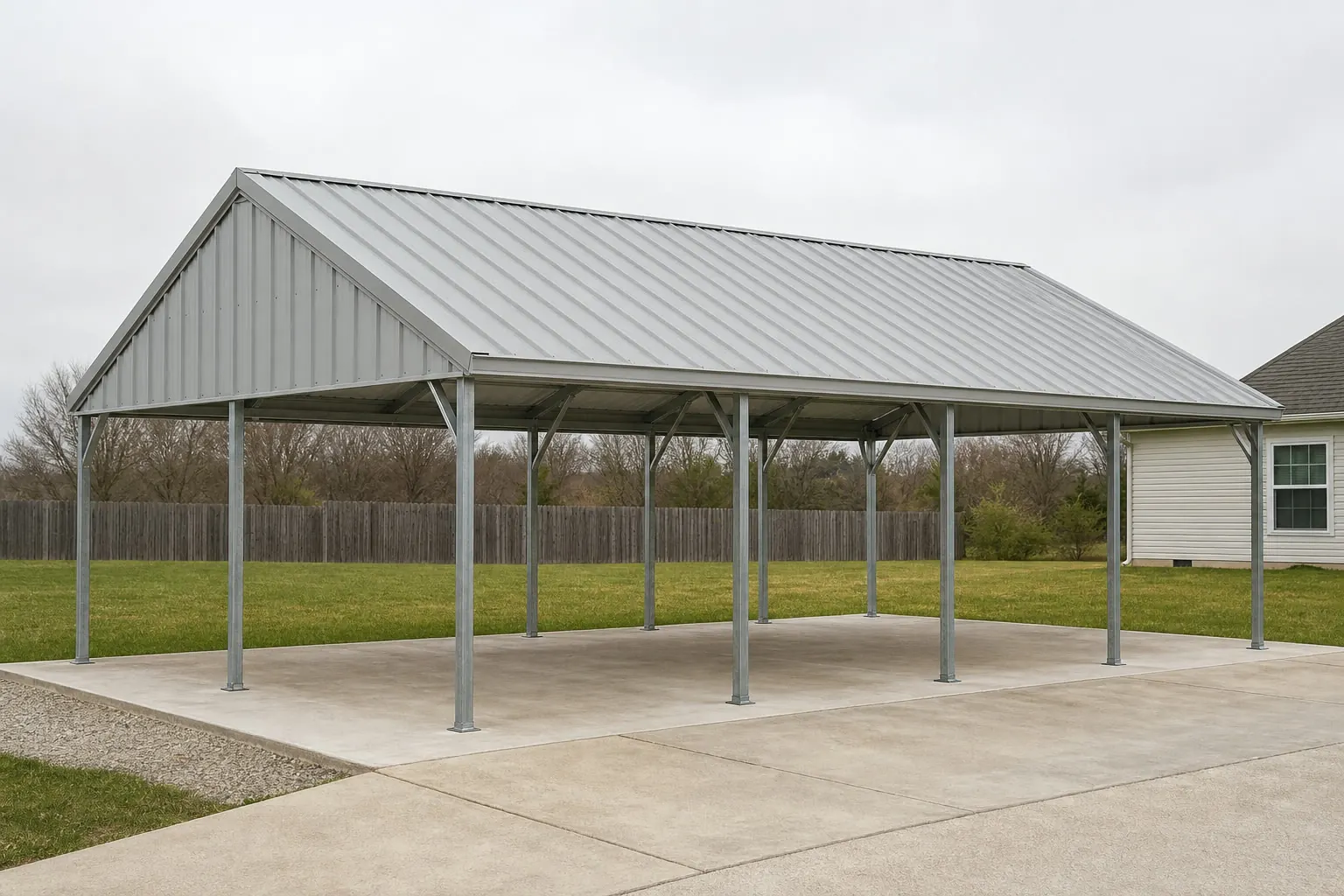
Two Layers Decide a Pennsylvania Carport
Every Pennsylvania carport plan runs through two filters before steel goes up: the township's choice of who enforces the Uniform Construction Code, and the physiographic province the pad sits in. The Department of Labor & Industry sets the UCC statewide, but Act 45 of 1999 hands each of the Commonwealth's 2,562 municipalities the choice to administer it directly, hire a third-party agency, or opt out of local enforcement. Meanwhile, DCNR's map of six physiographic provinces — Atlantic Coastal Plain, Piedmont, Blue Ridge, Ridge and Valley, Appalachian Plateaus, and a sliver of Central Lowlands — means the same 20x20 footprint calls for different grading and footing decisions depending on where in the state it lands.
Permitting Framework
Finding Who Actually Reviews Your Carport
The UCC is one code, but the reviewing office is a municipal decision, so identify it before drawing plans.
The Uniform Construction Code is Pennsylvania's single statewide building code, administered by the Department of Labor & Industry. What differs from one address to the next is enforcement: under Act 45 of 1999, each municipality independently elects to enforce the UCC with its own staff, contract enforcement to a third-party agency, or opt out of local administration altogether. For a carport owner, this means the practical first step is not reading the code itself but calling the township or borough office to find out which of those three paths applies locally.
That call determines timeline and process more than the code text does. A township that enforces UCC directly may have a familiar in-house review queue, while one that contracts to a third-party agency may route drawings through a private plan reviewer with its own submission format. A township that has opted out entirely still falls under the Commonwealth's backstop arrangement, and confirming exactly how that backstop is administered for a given address is worth doing before committing to a carport design or a contractor's timeline.
None of this is guesswork the buyer should do alone: the municipal office itself is the fastest source of truth, and it is worth asking directly whether an open-sided carport is treated as an accessory structure, a temporary structure, or a fully reviewed building under that municipality's interpretation of the UCC.
State Context
Pennsylvania Figures Relevant to Carport Planning
These sourced figures frame the planning conversation without substituting for a local determination.
| Metric | Value | Source |
|---|---|---|
| Municipalities electing UCC enforcement path | 2,562, each electing separately under Act 45 | PA Department of Labor & Industry |
| Physiographic provinces | Six, Atlantic Coastal Plain to Appalachian Plateaus | PA DCNR |
| Total land area | 46,054 sq mi | U.S. Census Bureau |
| Farms statewide (2022) | About 49,000, ~3% of the U.S. total | Center for Rural Pennsylvania / USDA NASS |
| Climate reporting basis | 10 climate divisions; no single statewide figure | Penn State Climatologist Office |
Municipalities electing UCC enforcement path
- Value
- 2,562, each electing separately under Act 45
- Source
- PA Department of Labor & Industry
Physiographic provinces
- Value
- Six, Atlantic Coastal Plain to Appalachian Plateaus
- Source
- PA DCNR
Total land area
- Value
- 46,054 sq mi
- Source
- U.S. Census Bureau
Farms statewide (2022)
- Value
- About 49,000, ~3% of the U.S. total
- Source
- Center for Rural Pennsylvania / USDA NASS
Climate reporting basis
- Value
- 10 climate divisions; no single statewide figure
- Source
- Penn State Climatologist Office
Site Planning
Siting a Carport Across Pennsylvania's Terrain
Foundation and drainage planning should follow the physiographic province, not a generic statewide assumption.
DCNR's six named provinces are not just a geology lesson — they describe real differences in what a carport pad sits on. In the Piedmont's rolling farmland, a level pad is usually a matter of modest grading. Move into the Ridge and Valley province, and the same footprint may need retaining work or a cut-and-fill approach to get a level surface for footings. The Appalachian Plateaus bring their own mix of slope and drainage patterns, and a carport sited there benefits from a site visit before a foundation type is chosen.
Because Pennsylvania's own climate reporting is organized into ten regional divisions rather than one statewide average, the same province-first logic applies to weather exposure. A carport buyer in the northwest tier and a buyer in the southeast corner are working from different regional data, and a builder should reference the division or the nearest NWS station's current 1991-2020 normals rather than a single figure for the whole Commonwealth.
For the roughly 49,000 farms operating statewide, siting decisions often add a third variable: equipment access. A carport meant to shelter a tractor and a utility trailer needs a clear approach lane and turning radius that a passenger-vehicle carport does not, and that access lane has to be planned around the same provincial terrain considerations as the pad itself.
Get Your Pennsylvania Carport Quote
Work with a team that understands how township-level UCC enforcement and Pennsylvania's terrain shape a carport build.
Configurations
Carport Layouts Common in Pennsylvania
These three configurations reflect the mix of suburban, rural, and farm use seen across the Commonwealth.
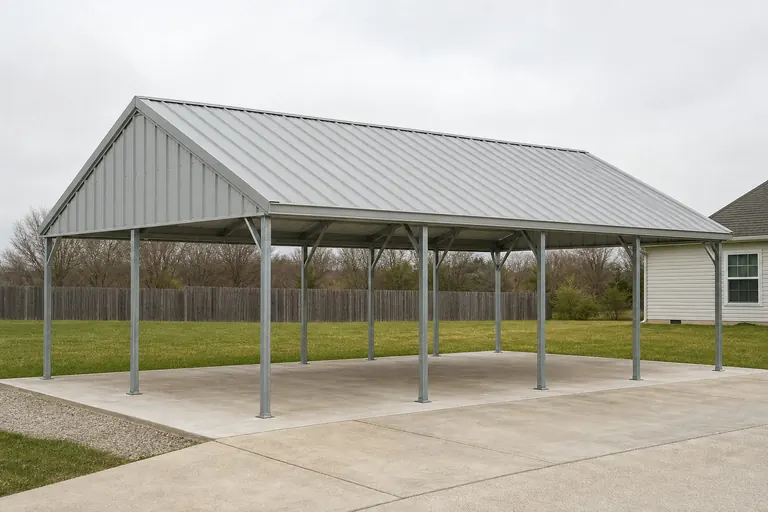 The Suburban SingleA compact single-bay carport for a residential lot in a UCC-enforcing township, sized to clear a standard driveway setback.The Farm Equipment BayA taller, wider bay serving the equipment needs of one of the state's roughly 49,000 farms, with room for a tractor or trailer.The Hillside AdaptationA carport designed around a graded or retained pad for Ridge-and-Valley or Appalachian Plateau terrain, where a level footprint takes extra sitework.
Example Configuration — for planning purposes only.
Popular Sizes
Choosing a Pennsylvania Carport Footprint
Match the footprint to the vehicle count, the equipment, and the province's grading realities.
12′ × 24′
288 sq ft
A single-vehicle shelter that fits tight suburban side yards near Philadelphia or Pittsburgh.
20′ × 30′
600 sq ft
A two-vehicle-plus-storage footprint common on rural Piedmont and Central Lowlands lots.
24′ × 40′
960 sq ft
A longer bay sized for farm trucks and trailers on larger Pennsylvania operations.
Example Configuration — for planning purposes only.
Confirm setback and lot-coverage limits with the local municipal office before finalizing a footprint.
Action Plan
Steps Before You Build in Pennsylvania
These steps address the two filters — enforcement path and terrain — before construction starts.
- Call the Township or Borough OfficeConfirm whether the municipality enforces the UCC directly, contracts it to a third party, or has opted out, and what that means for your submission.
- Ask About Accessory-Structure TreatmentFind out how the reviewing office classifies an open-sided carport under its interpretation of the UCC.
- Identify Your Physiographic ProvinceUse DCNR's provinces to anticipate whether grading, retaining, or standard footings will be needed for a level pad.
- Request Current Design ValuesAsk the local building official for wind and snow design values based on the current NOAA 1991-2020 normals for the nearest station, rather than assuming a statewide figure.
Pennsylvania FAQ
Carport FAQ
Direct answers for Pennsylvania property owners planning a steel carport.
No. Under Act 45 of 1999, each municipality separately elects to enforce the UCC itself, contract it to a third-party agency, or opt out of local administration, so the reviewing process differs by township even though the code is statewide.
Not from a single source you should rely on directly. Climate reporting is organized into ten regional divisions and by individual NWS station normals, so ask the local building official for the figure that applies to your specific parcel.
DCNR maps six distinct physiographic provinces across the Commonwealth, from the Piedmont to the Ridge and Valley, and the grading effort for a level pad differs meaningfully between them.
With roughly 49,000 farms statewide, equipment-shelter demand is a real share of carport inquiries, and those builds often need wider bays and clear access lanes for tractors and trailers.
Start with FEMA's National Risk Index portal directly; a third-party aggregator's statewide characterization uses FEMA's data but is not FEMA's own published summary, so verify county-level detail at the source.
Contact the municipal or contracted UCC office covering the property address; classification of a carport as exempt, accessory, or fully reviewed is a local determination under the statewide code.
Sources for the Pennsylvania facts on this page
This page states no code requirement, wind speed, snow load, permit rule, price or supplier claim. The state-specific facts it does use are listed with their publisher below.
Pennsylvania's statewide building code, the Uniform Construction Code (UCC), is administered by the Department of Labor & Industry, and under Act 45 of 1999 each municipality elects whether to administer and enforce the UCC itself, opt out of enforcement, or use a third-party agency; opt-out municipalities' UCC enforcement is then handled per the state's default arrangement.
Pennsylvania Department of Labor & Industry · Current program page; Act 45 of 1999 framework · Tier 2
https://www.pa.gov/agencies/dli/programs-services/labor-management-relations/bureau-of-occupational-and-industrial-safety/uniform-construction-code-homePennsylvania's Department of Conservation and Natural Resources states the Commonwealth contains six physiographic provinces, listed northwest to southeast as: Central Lowlands, Appalachian Plateaus, Ridge and Valley, Blue Ridge, Piedmont, and Atlantic Coastal Plain.
Pennsylvania Department of Conservation and Natural Resources (DCNR) · Current DCNR page · Tier 2
https://www.pa.gov/agencies/dcnr/conservation/geology/geology-of-pa/landformsPennsylvania total land area per US Census Bureau state area measurements.
U.S. Census Bureau · 2010 measurement basis · Tier 1
https://www.census.gov/geographies/reference-files/2010/geo/state-area.htmlNumber of farms in Pennsylvania in 2022 and share of national total, per a Pennsylvania state-agency analysis of the Census of Agriculture.
Center for Rural Pennsylvania (state legislative agency), using USDA NASS data · 2022 Census of Agriculture, published May 2024 · Tier 1
https://www.rural.pa.gov/download.cfm?file=Resources%2FPDFs%2FAnalysis+of+2022+Ag+Census+Fact+Sheet+Web.pdfThe Pennsylvania State Climatologist Office (Penn State) publishes observed average precipitation and temperature for 10 climate regions across the state.
Pennsylvania State Climatologist, Penn State College of Earth and Mineral Sciences · 1899-present regional series · Tier 2
https://climate.met.psu.edu/data/state/regional.php