Pole barn · PA
Pole Barns in Pennsylvania
A pole barn built on Pennsylvania's flat Atlantic Coastal Plain and one built in the folded Ridge and Valley province are answering two different site questions, even if the truss package looks identical on paper. The Department of Conservation and Natural Resources maps six physiographic provinces across the Commonwealth, and the grading, post-embedment, and access-road planning for a pole barn should follow whichever province the parcel sits in. On top of that terrain question sits Act 45 of 1999, the law that lets each Pennsylvania municipality separately decide how it enforces the Uniform Construction Code — which matters directly to a pole barn buyer because agricultural-exemption assumptions that hold in one township are not automatically true in the next. With roughly 49,000 farms still counted in the Commonwealth's 2022 agricultural census, a large share of Pennsylvania pole barn demand remains genuinely tied to working farm operations rather than general-purpose storage.
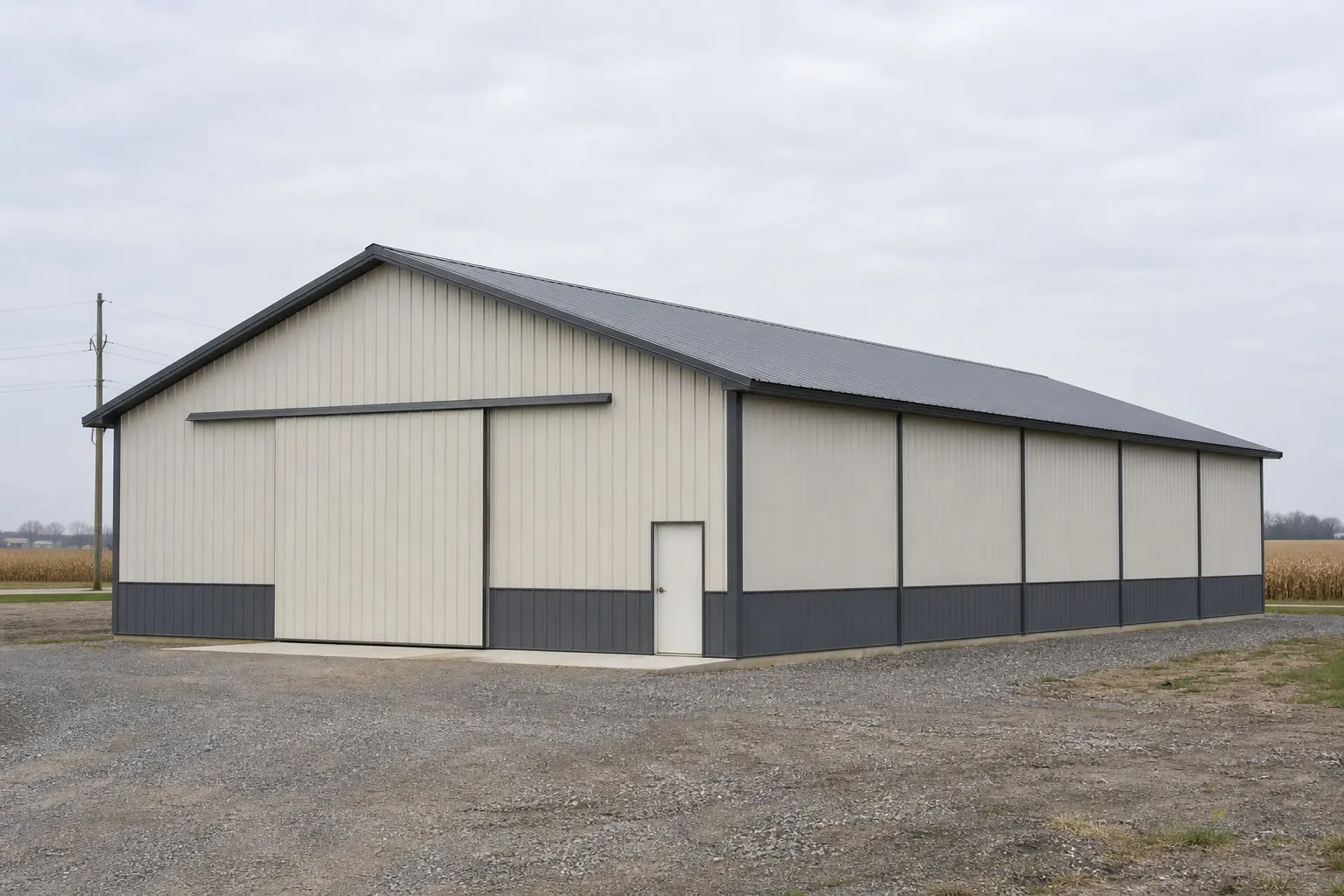
The Same Pole Barn, Six Different Site Stories
Pennsylvania's landscape is not a single backdrop for pole barn construction — it is six mapped physiographic provinces, each with its own grading, drainage, and access reality. Add Act 45 of 1999's municipal-election enforcement model, where every township or borough decides for itself how it applies the Uniform Construction Code, and a pole barn buyer's first two questions should be about location, not lumber grade: which province is this parcel in, and which municipality will review the plans?
Site Planning
Matching Post Depth and Grading to Your Province
DCNR's six physiographic provinces set very different starting conditions for a pole barn's foundation and access road.
A parcel on the Atlantic Coastal Plain in the state's far southeast typically presents flatter grading and more predictable soil conditions for post-frame construction than a site in the folded Ridge and Valley province further north and west, where bedrock ridges and steeper local relief are common. The Appalachian Plateau region carries its own steep-access-road considerations, and the Piedmont's rolling terrain sits somewhere between the two extremes.
None of this substitutes for a site-specific soil evaluation, but knowing the province ahead of a builder consultation lets a buyer budget realistically for site work — extra fill, a longer or switchback driveway, or additional drainage swales — before a quote arrives rather than after. Buyers comparing multiple candidate parcels across county lines should treat the province boundary as a real planning variable, not a footnote, given that Pennsylvania's 46,054 square miles of land area span all six of these landform types.
Because Pennsylvania has no single statewide soil or slope figure published in the sources reviewed for this page, every pole barn site plan here is routed to a local excavation contractor or geotechnical evaluation rather than a generalized state average.
Regulatory Path
Act 45 and the Agricultural-Exemption Question
Whether a pole barn needs full UCC review or qualifies for an agricultural exemption depends on the specific municipality's enforcement election.
| Municipal Election | Effect on a Pole Barn Project | Source |
|---|---|---|
| Self-enforcing municipality | Local plan reviewers apply the UCC directly, including any agricultural-exemption determination. | PA Dept. of Labor & Industry |
| Third-party agency contract | A private UCC-certified agency handles review on the municipality's behalf. | PA Dept. of Labor & Industry |
| Opt-out municipality | Enforcement follows the state's default arrangement rather than a local office. | PA Dept. of Labor & Industry |
| Statewide code basis | The UCC itself is a single statewide code set by L&I under Act 45 of 1999, even though enforcement varies locally. | PA Dept. of Labor & Industry |
Self-enforcing municipality
- Effect on a Pole Barn Project
- Local plan reviewers apply the UCC directly, including any agricultural-exemption determination.
- Source
- PA Dept. of Labor & Industry
Third-party agency contract
- Effect on a Pole Barn Project
- A private UCC-certified agency handles review on the municipality's behalf.
- Source
- PA Dept. of Labor & Industry
Opt-out municipality
- Effect on a Pole Barn Project
- Enforcement follows the state's default arrangement rather than a local office.
- Source
- PA Dept. of Labor & Industry
Statewide code basis
- Effect on a Pole Barn Project
- The UCC itself is a single statewide code set by L&I under Act 45 of 1999, even though enforcement varies locally.
- Source
- PA Dept. of Labor & Industry
Plan Your Pennsylvania Pole Barn
Connect with builders who account for provincial terrain differences and municipal ag-exemption rules across Pennsylvania.
Buyer Profile
Pole Barns as Working-Farm Infrastructure
Pennsylvania's roughly 49,000 farms mean pole barns here are frequently sized around equipment and livestock needs, not generic storage.
The Center for Rural Pennsylvania's review of the 2022 Census of Agriculture put the state's farm count at about 49,000, close to three percent of the national total. For a portion of that base, a pole barn purchase is a direct response to equipment storage, hay and feed capacity, or livestock housing needs on an already-operating farm, which is a different planning brief than a rural homeowner adding general storage space.
That distinction matters for the agricultural-exemption question raised above: a municipality's UCC enforcement office will typically look at actual use — machinery storage versus a workshop with residential-style finishes, for example — when deciding whether a structure qualifies for reduced review. Buyers should describe the intended use accurately and early in the permit conversation rather than assuming exemption status by default.
Precise land-in-farms acreage and average farm size for Pennsylvania's 2022 census were not extracted for this page, so buyers sizing a pole barn against their own operation's footprint should rely on their own farm records and a local survey rather than a state average.
Climate Planning
Reading Climate Data at the Station Level, Not the State Level
Both Penn State's regional climate divisions and NOAA's current normals are published below the statewide level, which is the right resolution for pole barn planning.
The Pennsylvania State Climatologist Office reports observed temperature and precipitation across ten climate regions rather than a single figure for the whole Commonwealth, and NOAA's 1991-2020 Climate Normals — now the basis for local National Weather Service reporting covering Pennsylvania stations — are likewise station-specific. For roof pitch, gutter sizing, and ventilation planning on a pole barn, that means pulling data for the station nearest the actual build site rather than quoting a single 'Pennsylvania' figure that does not exist in the underlying sources.
This also applies to hazard exposure: FEMA's National Risk Index scores the same 18 named hazards county by county, and while a third-party aggregator has summarized Pennsylvania's average county rating as 'Relatively Low,' that characterization is not FEMA's own published language and should be checked against FEMA's own NRI portal for the specific county before it factors into a site decision.
Footprint Planning
Sizing a Pole Barn to Pennsylvania Terrain and Use
Footprint choice should reflect both the province's grading reality and the intended agricultural or workshop use.
30′ × 40′
1,200 sq ft
A workshop-scale footprint that keeps site work manageable on Ridge and Valley or Plateau parcels.
40′ × 60′
2,400 sq ft
A common working-farm size for equipment storage across flatter Piedmont or Coastal Plain sites.
60′ × 100′
6,000 sq ft
Larger operations needing hay, feed, or multi-bay equipment storage on sizable acreage.
Example Configuration — for planning purposes only.
Confirm agricultural-exemption status and setback rules with the specific municipality before finalizing dimensions.
Common Questions
Pennsylvania Pole Barn FAQ
Straight answers for buyers comparing sites and municipalities before committing to a pole barn build.
The Uniform Construction Code is set statewide by the Department of Labor & Industry, but Act 45 of 1999 lets each municipality elect to enforce it itself, contract it out, or opt out, so the review process differs by location.
Not automatically. Whether a structure qualifies as agricultural-exempt is determined by the municipality's own UCC enforcement office based on actual use, and that determination can vary between townships.
Yes, in practice. DCNR maps six provinces with different slope and bedrock conditions across Pennsylvania, and post-embedment and grading plans should reflect the specific province before finalizing a design.
No verified single statewide figure exists in the sources reviewed here. Climate data is published regionally and by station, so design loads should come from the local building department or an engineer.
The 2022 Census of Agriculture, as summarized by the Center for Rural Pennsylvania, counted about 49,000 farms statewide, though exact acreage and farm-size figures were not verified for this page.
Sources for the Pennsylvania facts on this page
This page states no code requirement, wind speed, snow load, permit rule, price or supplier claim. The state-specific facts it does use are listed with their publisher below.
Pennsylvania's Department of Conservation and Natural Resources states the Commonwealth contains six physiographic provinces, listed northwest to southeast as: Central Lowlands, Appalachian Plateaus, Ridge and Valley, Blue Ridge, Piedmont, and Atlantic Coastal Plain.
Pennsylvania Department of Conservation and Natural Resources (DCNR) · Current DCNR page · Tier 2
https://www.pa.gov/agencies/dcnr/conservation/geology/geology-of-pa/landformsPennsylvania's statewide building code, the Uniform Construction Code (UCC), is administered by the Department of Labor & Industry, and under Act 45 of 1999 each municipality elects whether to administer and enforce the UCC itself, opt out of enforcement, or use a third-party agency; opt-out municipalities' UCC enforcement is then handled per the state's default arrangement.
Pennsylvania Department of Labor & Industry · Current program page; Act 45 of 1999 framework · Tier 2
https://www.pa.gov/agencies/dli/programs-services/labor-management-relations/bureau-of-occupational-and-industrial-safety/uniform-construction-code-homeNumber of farms in Pennsylvania in 2022 and share of national total, per a Pennsylvania state-agency analysis of the Census of Agriculture.
Center for Rural Pennsylvania (state legislative agency), using USDA NASS data · 2022 Census of Agriculture, published May 2024 · Tier 1
https://www.rural.pa.gov/download.cfm?file=Resources%2FPDFs%2FAnalysis+of+2022+Ag+Census+Fact+Sheet+Web.pdfNOAA NCEI's 1991-2020 U.S. Climate Normals are the current basis for local NWS-published normals covering Pennsylvania stations.
National Weather Service (NOAA) · 1991-2020 normals · Tier 1
https://www.weather.gov/ctp/NewNormals