
Metal garage · IN
Metal Garages in Indiana
Indiana's economy runs on moving things: 171,310 people work in transportation and warehousing, a sector benchmarked statewide as one of the fastest-growing in the country, and Conexus Indiana tracks the state's advanced manufacturing and logistics workforce against its neighbors. That backdrop shapes what an ordinary residential metal garage in Indiana is asked to do — a growing number are specified as shop-grade space for trailer, fleet or hobby-vehicle work rather than simple two-car storage. Indiana's terrain is not uniform either; the Indiana Geological Survey names distinct physiographic regions across the state, so a garage's foundation plan should reflect the ground it sits on rather than a single statewide assumption. And because the Indiana Department of Homeland Security runs plan review and code enforcement functions itself, the permit path here can differ from states that hand that job entirely to certified local offices.
State Context
A Garage Brief Shaped by a Working State
Indiana's logistics-and-manufacturing workforce means a residential metal garage is frequently asked to double as a working shop.
Indiana's transportation and warehousing sector alone employs 171,310 people — about 6% of total state employment — and was called out as the fastest-growing sector in the state over the prior decade. Layer in Conexus Indiana's ongoing benchmarking of the state's advanced manufacturing and logistics industries against its neighbors, and a picture emerges of a state where a meaningful share of households work with trucks, trailers, machinery or production equipment for a living.
That professional exposure shows up in residential garage requests. It is common for an Indiana metal garage buyer to ask for a deeper bay to fit a pickup with a trailer hitched, a dedicated 220-volt circuit for a welder or compressor, or a mezzanine for parts storage — specifications that go well beyond a simple two-car shelter. None of this means every Indiana garage is a full workshop; it means the request skews that direction more than in a state without this employment profile.
Sourced Figures
Indiana Workforce and Terrain at a Glance
These figures anchor the state-specific claims made on this page.
| Metric | Value | Source |
|---|---|---|
| Transportation & warehousing jobs | 171,310 (~6% of employment) | Indiana Business Research Center |
| Advanced manufacturing & logistics | Benchmarked vs. neighboring states | Conexus Indiana, 2023 report |
| Total land area | 36,420 sq mi | U.S. Census Bureau |
| Named physiographic regions | e.g. Northwestern Morainal, Central Till Plain | Indiana Geological Survey, Special Report 61 |
| Plan review authority | IDHS (state-run) | IDHS Building Plan Review program |
Transportation & warehousing jobs
- Value
- 171,310 (~6% of employment)
- Source
- Indiana Business Research Center
Advanced manufacturing & logistics
- Value
- Benchmarked vs. neighboring states
- Source
- Conexus Indiana, 2023 report
Total land area
- Value
- 36,420 sq mi
- Source
- U.S. Census Bureau
Named physiographic regions
- Value
- e.g. Northwestern Morainal, Central Till Plain
- Source
- Indiana Geological Survey, Special Report 61
Plan review authority
- Value
- IDHS (state-run)
- Source
- IDHS Building Plan Review program
Site Planning
Why Your Region of Indiana Changes the Slab Plan
The Indiana Geological Survey's named regions carry real drainage and soil differences that affect garage foundations.
Morainal and lake-country ground (north)
Glacial moraine and lake-adjacent terrain in the north can carry more variable soil composition; a site-specific soil check before pouring a slab is worth the cost here.
Till Plain (central)
Much of central Indiana's Central Till Plain is comparatively flat and well-suited to a standard slab approach, though local drainage still needs confirming with your site contractor.
Southern hill and karst country
Southern Indiana's more dissected terrain can mean sloped sites and different excavation needs; a garage build here often needs more site grading than a flat-plain lot.
Start Your Indiana Metal Garage Build
Connect with builders who understand Indiana's logistics workforce and its regional terrain differences.
Permitting
The Permit Conversation Runs Through a State Agency
Indiana's Department of Homeland Security performs plan review and code enforcement directly, which changes who you contact first.
In many states, a state commission adopts the building code and then hands enforcement to a network of independently certified county or municipal departments. Indiana's structure is different: the Fire Prevention and Building Safety Commission adopts the code by rule, and IDHS itself carries out building plan review and code enforcement functions statewide. For a metal garage buyer, that can mean state-level review is directly part of the process rather than only a local office.
This does not remove the local layer entirely — zoning, setbacks and site approval still typically run through your county or municipality. But it does mean a garage buyer should ask both their local zoning office and, where applicable, IDHS which agency handles which part of their specific project, rather than assuming a single local contact covers everything.
The 2026 Indiana Building Code adoption was still working through the Indiana Register at the time this evidence was gathered, so this page does not name a fixed code edition. Confirm the current edition with IDHS or your local department before finalizing garage engineering drawings.
Indiana's 53,599 working farms are a second, separate source of garage demand beyond the logistics workforce discussed above. A garage on a working farm parcel is frequently sized for a personal truck or ATV rather than the larger equipment a pole barn or storage building already covers, so it's worth confirming with your builder that the garage's door height and depth are set against that smaller vehicle list rather than duplicated equipment-storage sizing.
NWS Indianapolis publishes daily 1991-2020 climate normals rather than a single winter figure for the state, so a garage buyer weighing door seal quality or added insulation should ask for the normal covering the specific weeks the garage will see the coldest use, rather than assuming one statewide winter number applies evenly from South Bend to the Ohio River.
Configurations
Garage Profiles Indiana Buyers Request
These three profiles reflect Indiana's logistics-heavy workforce and its mixed rural-suburban land use.
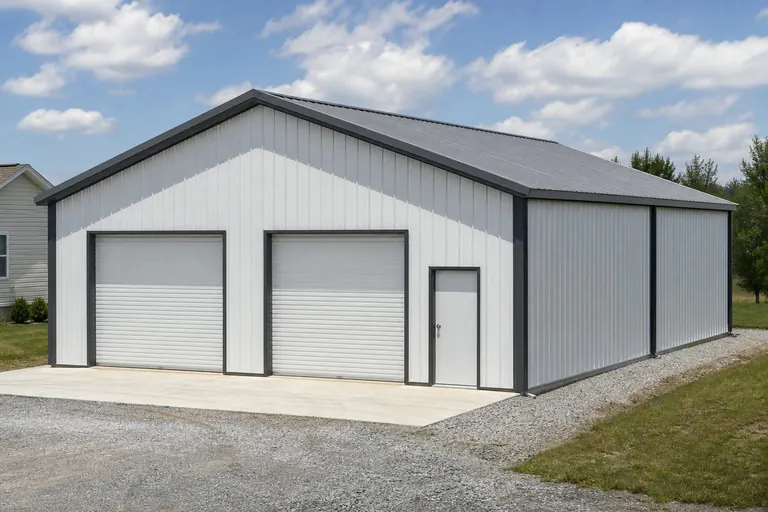 Fleet & Trailer BayDeeper bays and taller doors for a truck-and-trailer combination, aimed at owner-operators tied to Indiana's freight economy.Home Manufacturing ShopReinforced slab and dedicated power circuits for hobbyists or tradespeople whose day job is in Indiana's manufacturing base.Standard Residential StorageA straightforward two- or three-car footprint for vehicle protection on a typical suburban or small-town Indiana lot.
Example Configuration — for planning purposes only.
Popular Sizes
Sizing an Indiana Metal Garage
Choose a footprint based on whether the garage is doing vehicle storage, shop work, or both.
24′ × 30′
720 sq ft
Standard two-car storage for a suburban Indiana lot.
30′ × 40′
1,200 sq ft
Common where a workbench or small equipment bay joins vehicle storage.
40′ × 60′
2,400 sq ft
Sized for a truck-and-trailer combination plus a dedicated shop area.
Example Configuration — for planning purposes only.
Confirm door height against your tallest vehicle or trailer, not just floor footprint.
Indiana FAQ
Metal Garage Questions for Indiana Buyers
Direct answers, with unverifiable figures routed to the right office.
IDHS performs plan review and code enforcement functions statewide, but local zoning, setbacks and site approval typically still run through your county or municipality. Confirm which agency covers which step for your project.
Indiana's large transportation, warehousing, and advanced manufacturing workforce means many buyers plan to use a home garage for real vehicle or equipment work, not just parking, so dedicated circuits are a common request.
It can. The Indiana Geological Survey names distinct physiographic regions with different soil and drainage characteristics, from glacial moraine country in the north to flatter till plain ground in the center and more dissected terrain in the south.
This page does not state a specific number; no single statewide figure was confirmed. Your local building department or IDHS will supply the design values for your exact site.
The 2026 adoption cycle was still in progress in the Indiana Register when this evidence was gathered. Ask your local department or IDHS which edition currently applies to your project.
Sources for the Indiana facts on this page
This page states no code requirement, wind speed, snow load, permit rule, price or supplier claim. The state-specific facts it does use are listed with their publisher below.
Indiana's transportation and warehousing sector employment and share of total state employment, using state QCEW-derived data.
Indiana Business Research Center, Indiana University (InContext, using state/federal labor data) · 2023 article, referencing prior-decade trend · Tier 2
https://www.incontext.indiana.edu/2023/mar-apr/article1.aspIndiana's advanced manufacturing and logistics (AML) industries are benchmarked against neighboring states in a state economic development-linked report.
Conexus Indiana (in partnership with state workforce data) · August 2023 · Tier 2
https://www.conexusindiana.com/wp-content/uploads/2023/08/2023-Benchmarking-Indianas-Advanced-Manufacturing-and-Logistics-Industries-Report-1.pdfThe Indiana Geological Survey classifies the state into physiographic regions in its Special Report 61.
Indiana Geological Survey (Indiana University) · 2000 (Special Report 61) · Tier 2
https://scholarworks.iu.edu/dspace/items/6e9ea94d-c556-4629-98ea-26e0b518745dIndiana total land area per US Census Bureau state area measurements.
U.S. Census Bureau · 2010 measurement basis · Tier 1
https://www.census.gov/geographies/reference-files/2010/geo/state-area.htmlIndiana's Department of Homeland Security, through its Fire Prevention and Building Safety Commission and Code Enforcement/Building Plan Review functions, adopts and administers the state building code.
Indiana Department of Homeland Security (IDHS) · Current program pages; 2026 Indiana Building Code adoption in progress per Indiana Register filing · Tier 2
https://www.in.gov/dhs/building-plan-review/NWS Indianapolis publishes daily 1991-2020 climate normals for Indianapolis including precipitation and snowfall by date.
National Weather Service (NOAA) · 1991-2020 · Tier 1
https://preview.weather.gov/media/ind/climatenormals.pdfNumber of farms in Indiana in 2022, per the state statistician's public comments on the Census of Agriculture.
USDA NASS (data); Brownfield Ag News (reporting) · 2022 Census of Agriculture · Tier 1
https://www.nass.usda.gov/Publications/AgCensus/2022/Full_Report/Volume_1,_Chapter_2_County_Level/Indiana/st18_2_045_045.pdf