
Metal garage · OH
Metal Garages in Ohio
In Ohio, a metal garage is more than a place to park a car; it is a vital extension of the state's industrial and agricultural identity. With manufacturing accounting for 16.5% of Ohio's private-sector GDP, there is a deep-seated need for residential and commercial workshops that can support heavy-duty projects. The planning process for these buildings is governed by Ohio's unique two-layer regulatory structure, where the Board of Building Standards adopts statewide codes, but certified municipal, county, or township departments manage the actual enforcement. Whether you are building on a small suburban lot or among Ohio's 76,500 active farms, navigating this local enforcement is the key to a durable, code-compliant steel garage.
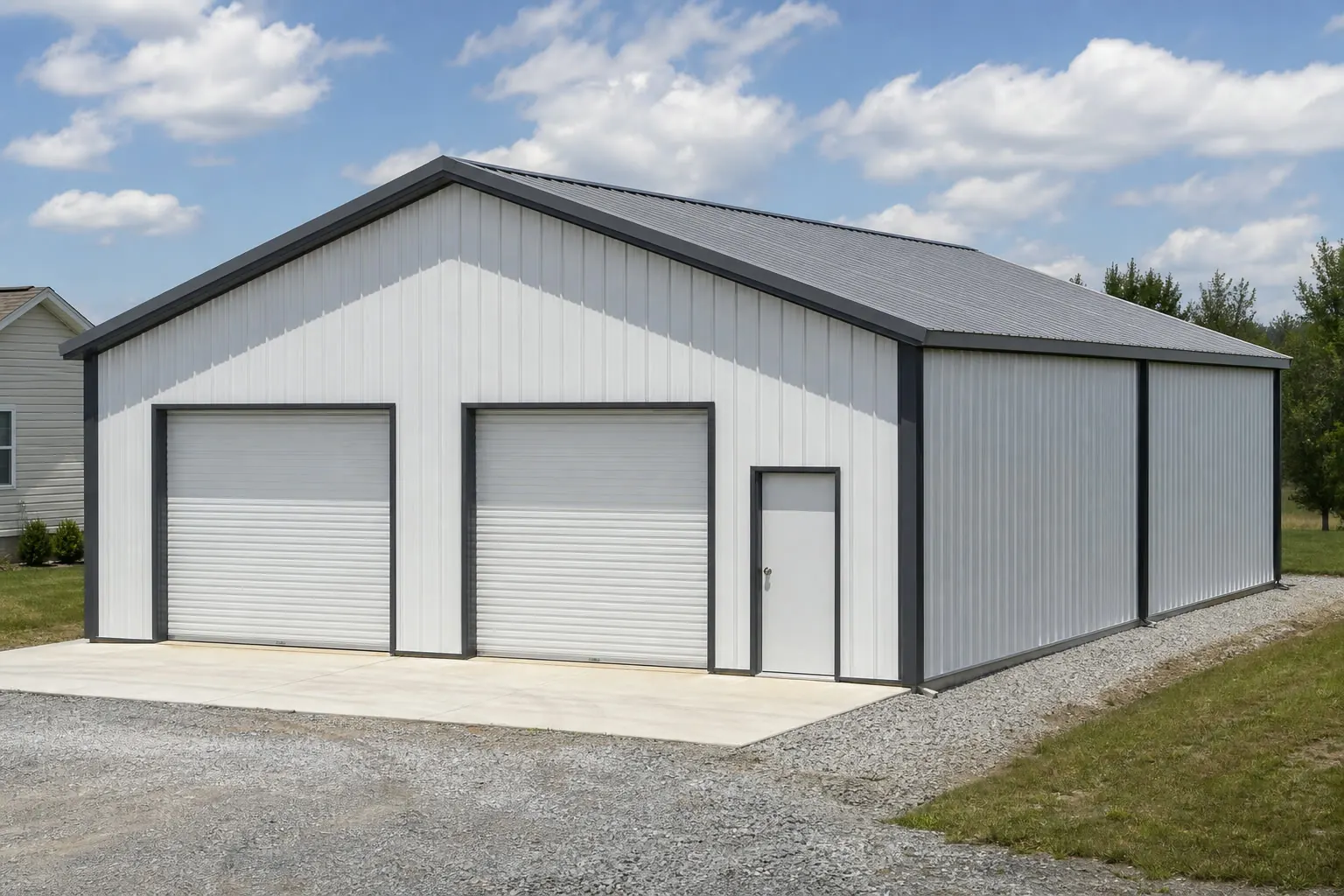
The Buckeye State's Workshop Culture
With a manufacturing sector that accounts for 16.5% of the state's private-sector GDP, Ohio has a unique 'maker' culture that transforms the humble garage into a high-utility workshop. Whether it’s supporting the needs of a working farm or providing a residential space for heavy-duty hobbies, the Ohio metal garage is designed for work. This planning process requires understanding that while the rules are set in Columbus by the Board of Building Standards, they are enforced by your neighbors at the municipal, county, or township level. This localized approach ensures that every garage is built to the specific geological and climatic needs of its 44,826-square-mile surroundings.
Permitting Logic
Navigating the Ohio Certified Department System
Your garage permit is a local conversation, even though the rules are statewide.
In Ohio, the Board of Building Standards (BBS) adopts the statewide codes, but they do not manage the day-to-day enforcement. Instead, the BBS certifies local departments—municipalities, counties, or townships—to handle the plan review and inspections. This is a critical detail for a metal garage buyer, as the building's classification as 'accessory' or 'detached' can lead to different interpretations of the code by different local departments.
Before ordering a steel garage, you must identify which certified department governs your parcel. This is especially true for the 76,500 active farms across Ohio's 13.1 million agricultural acres. While a garage for personal vehicle storage is generally a straightforward residential accessory project, a building intended for commercial-grade manufacturing work may trigger different code requirements under the state-adopted BBS rules. The local department will provide the specific roadmap for your build.
This system also handles the climatic variability of Ohio. Since we do not have a verified single statewide snowfall figure, structural design relies on station-level data from NOAA. Your local certified department will mandate specific wind and snow loads based on these local station records, ensuring that your garage is engineered for the actual weather it will face, whether in the snow-heavy north or the more temperate southern river valleys.
State Context
Ohio Economic & Land Metrics
These sourced figures provide the background for the Ohio metal building market.
| Metric | Value | Source |
|---|---|---|
| Manufacturing GDP Share | 16.5% of private sector | Ohio Manufacturers' Association |
| Manufacturing Jobs | Over 691,900 | Ohio Manufacturers' Association |
| Active Farms | 76,500 | USDA NASS |
| Total Land Area | 44,826 sq mi | U.S. Census Bureau |
| Regulatory Body | Board of Building Standards (BBS) | Ohio Dept. of Commerce |
Manufacturing GDP Share
- Value
- 16.5% of private sector
- Source
- Ohio Manufacturers' Association
Manufacturing Jobs
- Value
- Over 691,900
- Source
- Ohio Manufacturers' Association
Active Farms
- Value
- 76,500
- Source
- USDA NASS
Total Land Area
- Value
- 44,826 sq mi
- Source
- U.S. Census Bureau
Regulatory Body
- Value
- Board of Building Standards (BBS)
- Source
- Ohio Dept. of Commerce
Design Trends
Building the Ohio 'Maker' Garage, Oriented to Its Nearest Station
Ohio's industrial workforce drives higher specifications for residential garages, and the station closest to your garage — not a single Ohio figure — should guide door orientation and apron grading.
The sheer volume of manufacturing jobs in Ohio—over 691,900—means that many residential garage projects are specified with industrial-grade features. It is common to see Ohio garages with 6-inch reinforced concrete slabs designed to support car lifts, milling machines, or welding equipment. This 'shop-first' mentality is a direct result of the state's economic identity.
The shift in land use is also a factor. As farmland consolidates, many of Ohio's 13.1 million agricultural acres are being managed with fewer, larger machines. A metal garage on a modern farm is often a high-tech maintenance hub rather than just a storage shed. These buildings frequently include dedicated electrical circuits, advanced insulation to battle Ohio's humid summers and cold winters, and high-clearance doors for agricultural equipment.
Geographically, Ohio's 44,826 square miles offer diverse terrain. While we do not name the specific physiographic regions here due to evidence gaps, the state geological survey's map is a vital tool for site planning. The local certified department will often require a site-specific foundation plan to address soil conditions, especially in regions prone to shifting or clay-heavy soils.
The National Weather Service maintains distinct 1991-2020 climate normals pages for Columbus and Cleveland, and NOAA's National Centers for Environmental Information publish similar station-level normals for Toledo and other Ohio cities. There is no single number in that dataset that represents 'Ohio snowfall' or 'Ohio wind,' because the state's weather genuinely differs from the lake-effect belt along Lake Erie to the milder river valleys along the Ohio River. That is exactly why we route design-load questions to your local certified department rather than stating a number here.
For a metal garage, this station-level reality has a practical design consequence beyond structural load: door orientation. A garage sited near Cleveland or Toledo, inside the lake-effect snow band, benefits from placing the roll-up or bay door away from the prevailing northwest wind, and from grading the concrete apron to shed meltwater quickly rather than letting it refreeze against the threshold. A garage in the milder south, closer to the Ohio River, is less concerned with drift accumulation and more with humidity control for tools and equipment stored inside. Ask your builder to reference the normals page for your nearest station when discussing overhang depth, gutter placement, and apron slope — it is a five-minute conversation that prevents years of ice buildup at the door threshold.
Start Your Ohio Garage Build
Connect with local experts who understand Ohio's industrial workforce and regulatory landscape.
Configurations
Common Ohio Metal Garage Uses
The intersection of the industrial workforce and the agricultural base creates these three primary designs.
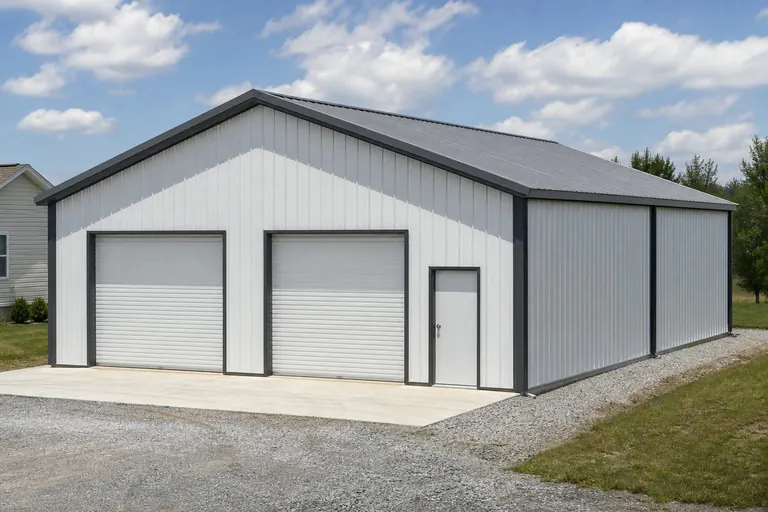 The Industrial WorkshopOptimized for manufacturing professionals; features heavy-duty slabs, 200-amp power, and climate control for year-round fabrication.The Farm Service HubBuilt for the 76,500 working farms; focuses on vehicle maintenance, small engine repair, and tool storage with a durable steel shell.The Suburban Multi-UseA compact footprint designed for vehicle protection and residential storage on typical Ohio municipal lots.
Example Configuration — for planning purposes only.
Popular Sizes
Sizing Your Ohio Metal Garage
Choose a footprint that fits your parcel and your industrial utility needs.
24′ × 30′
720 sq ft
A standard two-car garage with room for a small workbench.
30′ × 40′
1,200 sq ft
The preferred size for a dedicated home workshop or small farm repair hub.
40′ × 60′
2,400 sq ft
A heavy-duty solution for commercial storage or multi-vehicle maintenance.
Example Configuration — for planning purposes only.
Eave height is just as important as footprint; ensure your doors can accommodate your tallest vehicle.
Checklist
Ohio Garage Planning Steps
Follow these steps to ensure a code-compliant build in the Buckeye State.
- Identify Your Enforcing AgentDetermine if your project falls under municipal, county, or township jurisdiction for permit review.
- Verify Industrial Use RulesIf running a business out of your garage, check local zoning for home-based manufacturing restrictions.
- Consult Station-Level NOAA DataUse the local NWS or NOAA station data provided by your local department for wind and snow load planning.
- Address Site GeologyReview the ODNR geological survey map and plan for a foundation that suits your site's specific soil profile.
Questions
Ohio Metal Garage FAQ
Honest answers for Ohio residents planning a steel garage.
The Board of Building Standards adopts the code, but it is enforced by certified municipal, county, or township building departments.
Yes, in most cases. While some agricultural structures have exemptions, garages for personal vehicle storage or commercial use typically require a permit through the local certified department.
With a high concentration of manufacturing, Ohio has a robust network of steel fabricators, though the demand for skilled labor remains high across the state.
Design loads are determined at the station level by your local certified department. There is no single statewide wind or snow load figure.
It depends on your nearest weather station. Near Lake Erie, facing the door away from the prevailing northwest wind reduces snow infiltration; in the milder south, humidity control matters more than drift. Ask your builder to reference your nearest NWS normals page.
Sources for the Ohio facts on this page
This page states no code requirement, wind speed, snow load, permit rule, price or supplier claim. The state-specific facts it does use are listed with their publisher below.
The Ohio Board of Building Standards formulates, adopts, and amends the state's Building, Mechanical, Plumbing, Elevator, Boiler, and Pressure Piping Codes, and certifies municipal, county, and township building departments to enforce them.
Ohio Department of Commerce, Division of Industrial Compliance · Current program page · Tier 2
https://com.ohio.gov/divisions-and-programs/industrial-compliance/boards/board-of-building-standardsNumber of farms in Ohio in 2022.
USDA National Agricultural Statistics Service · 2022 Census of Agriculture (released Feb 2023 preliminary/2024 full) · Tier 1
https://www.nass.usda.gov/Statistics_by_State/Ohio/Publications/Current_News_Releases/2023/nr2311oh.pdfManufacturing is Ohio's largest private economic sector by GDP share, per an Ohio Manufacturers' Association analysis of federal data.
Ohio Manufacturers' Association (OMA), citing BLS/BEA data · 2024/2025 edition · Tier 2
https://www.ohiomfg.com/wp-content/uploads/2026/02/OMA_ManufacturingCounts2025_CMYK-FINAL-2.25.26.pdfOhio total land area per US Census Bureau state area measurements.
U.S. Census Bureau · 2010 measurement basis · Tier 1
https://www.census.gov/geographies/reference-files/2010/geo/state-area.htmlNWS Columbus and NWS Cleveland publish local climate normals pages for Ohio cities.
National Weather Service (NOAA) · 1991-2020 · Tier 1
https://www.weather.gov/iln/climate_normals_cmh