
Storage building · IN
Storage Buildings in Indiana
Indiana's storage building demand is being pulled in two directions at once. On the agricultural side, the state's farm count dropped about 4% between 2017 and 2022 to 53,599 operations while total land in farms held near 14.6 million acres — a pattern that points toward fewer, larger farms needing bigger single storage structures rather than several scattered small sheds. On the industrial side, Indiana's transportation and warehousing sector employs 171,310 people and was flagged as the fastest-growing sector in the state over the prior decade, adding demand for dry overflow and inventory storage near freight corridors. Both paths run through the same regulatory structure: Indiana's Department of Homeland Security performs building plan review and code enforcement functions directly, a more centralized model than states that certify local departments to do that work independently.
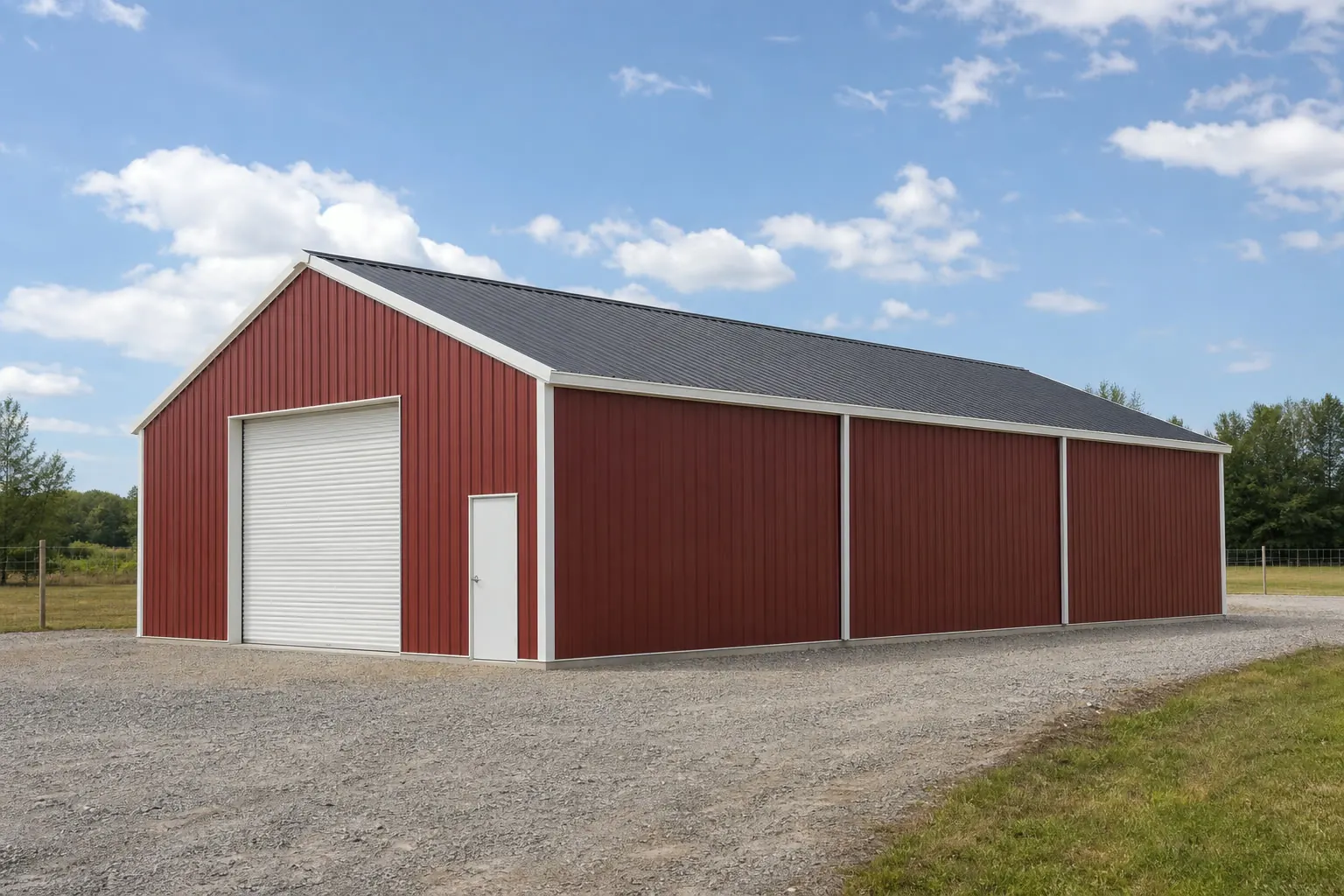
Two Different Reasons Indiana Buys Storage Buildings
Indiana's storage building demand does not come from a single source. Agricultural consolidation — a 4% drop in farm count against 14.6 million acres of stable farmland — is pushing remaining farms toward bigger single buildings for equipment and grain. Separately, a 171,310-person transportation and warehousing workforce, the fastest-growing sector in the state over the prior decade, is generating demand for dry overflow and inventory storage near freight corridors. A buyer's actual use case, not just their location, should drive the building's footprint and door configuration.
State Data
Indiana Storage Demand Drivers
These sourced figures explain the two directions Indiana's storage building demand is moving.
| Metric | Value | Source |
|---|---|---|
| Farms (2022) | 53,599, down ~4% from 2017 | USDA NASS / Census of Agriculture |
| Land in farms (2022) | 14,602,240 acres | USDA NASS |
| Transportation & warehousing jobs | 171,310 (~6% of employment) | Indiana Business Research Center |
| Plan review authority | IDHS (state-run) | IDHS Building Plan Review program |
Farms (2022)
- Value
- 53,599, down ~4% from 2017
- Source
- USDA NASS / Census of Agriculture
Land in farms (2022)
- Value
- 14,602,240 acres
- Source
- USDA NASS
Transportation & warehousing jobs
- Value
- 171,310 (~6% of employment)
- Source
- Indiana Business Research Center
Plan review authority
- Value
- IDHS (state-run)
- Source
- IDHS Building Plan Review program
Agricultural Use
Sizing for a Consolidating Farm Base
As Indiana farms consolidate, storage buildings are being asked to hold more equipment under one roof rather than spread across several small structures.
The Census of Agriculture shows Indiana's farm count fell from about 55,800 in 2017 to 53,599 in 2022, a roughly 4% decline, while total land in farms held near 14.6 million acres. That combination — fewer operations, similar total acreage — is a reasonable signal that the average Indiana farm grew in the interim, though this page does not state a specific average-size figure since it was not directly extracted from the source table.
For storage planning, the practical effect is that a single farm may now need to store a wider combine head, a longer grain cart and a second tractor that once belonged to a neighboring operation absorbed into the larger farm. That favors one larger clear-span storage building with multiple large doors over two or three smaller separate sheds, both for equipment access and for future flexibility as the operation continues to change.
Get Your Indiana Storage Building Quote
Work with builders who understand both Indiana's farm consolidation trend and its freight-sector growth.
Freight & Industrial Use
Overflow Storage Near Indiana's Freight Corridors
Indiana's growing transportation and warehousing workforce is a documented reason storage buildings are increasingly sited near interstate and rail corridors.
Indiana's transportation and warehousing sector, at 171,310 jobs and roughly 6% of total state employment, was named as the fastest-growing sector in the state over the prior decade by the Indiana Business Research Center. Property owners along major freight corridors sometimes need dry storage for palletized inventory overflow, seasonal equipment, or materials that do not require a fully staffed warehouse but still need weather protection and secure access.
A storage building serving this use typically prioritizes wide roll-up doors sized for forklift or pallet-jack access, a level concrete floor rated for point loads from racking, and enough clear height for stacked pallets. That is a different specification from an agricultural storage building, which more often prioritizes door width for equipment rather than floor load rating for racking.
Because a storage building may hold inventory or equipment that cannot tolerate standing water, FEMA's National Risk Index — which scores the same 18 named hazards, including inland flooding and hail, at the county level for every Indiana county — is worth checking before finalizing a site and slab elevation. These are relative comparison scores, not engineering values, and this page does not attach a specific number to any county.
Indiana's terrain also isn't uniform underneath the slab. The state's 36,420 square miles include named physiographic regions running from glacial moraine and lake country in the north to flatter till plain ground in the center, a variety documented by the Indiana Geological Survey rather than assumed here. A storage building sited on moraine-adjacent ground may need more site-specific soil and drainage evaluation before pouring a slab than one going up on the more uniform till plain, so this is worth raising with your site contractor before committing to a foundation plan.
Popular Sizes
Sizing an Indiana Storage Building
Match the footprint to whether the building is serving a consolidated farm or a freight-adjacent inventory use.
30′ × 50′
1,500 sq ft
A workable size for residential or light agricultural accessory storage.
40′ × 80′
3,200 sq ft
Suited to a consolidated farm storing multiple pieces of larger equipment.
60′ × 120′
7,200 sq ft
Sized for freight-adjacent inventory overflow with room for racking and pallet access.
Example Configuration — for planning purposes only.
Confirm door width and clear height against your largest piece of equipment or your tallest stacked pallet load.
Before You Order
Steps for an Indiana Storage Building Project
These steps address the parts of Indiana's process most likely to be missed.
Step 1
Identify whether IDHS or a local office reviews your plans
Because IDHS performs plan review and code enforcement functions directly in Indiana, confirm which agency handles your specific project alongside any local zoning requirements.
Step 2
Match door configuration to actual use
A racking-and-pallet inventory building needs different door width and floor spec than an equipment storage building; decide the use before finalizing dimensions.
Step 3
Check FEMA's National Risk Index for your site
Compare relative flood and wind hazard scores across candidate sites on your parcel before setting a slab elevation.
Step 4
Confirm the current adopted code edition
The 2026 Indiana Building Code adoption was still moving through the Indiana Register when this evidence was gathered; verify the current edition with IDHS or your local department.
Indiana FAQ
Storage Building Questions for Indiana Buyers
Direct answers, with unverifiable figures routed to the right authority.
Farm consolidation (a 4% drop in farm count against stable total acreage) drives one demand stream, while a fast-growing 171,310-person transportation and warehousing workforce drives a separate, freight-adjacent demand for inventory storage.
It depends on size, use and jurisdiction. Indiana's IDHS performs plan review and code enforcement functions statewide, often alongside local zoning; confirm both with the relevant offices before building.
Measure your current and near-term equipment lineup. With Indiana farms consolidating onto more acreage per operation, sizing for a smaller, older fleet can leave a building outgrown quickly.
This page does not state one. The exact average-size figure for 2022 was not directly extracted from the Census of Agriculture table reviewed for this guide, so it is declared as a gap rather than estimated.
Yes. FEMA's National Risk Index gives county-level relative hazard scores, including inland flooding, that are useful for comparing candidate sites, though your local building department still sets the actual design and elevation requirements.
Sources for the Indiana facts on this page
This page states no code requirement, wind speed, snow load, permit rule, price or supplier claim. The state-specific facts it does use are listed with their publisher below.
Number of farms in Indiana in 2022, per the state statistician's public comments on the Census of Agriculture.
USDA NASS (data); Brownfield Ag News (reporting) · 2022 Census of Agriculture · Tier 1
https://www.nass.usda.gov/Publications/AgCensus/2022/Full_Report/Volume_1,_Chapter_2_County_Level/Indiana/st18_2_045_045.pdfLand in farms in Indiana in 2022 per NASS county-level state total table.
USDA National Agricultural Statistics Service · 2022 · Tier 1
https://www.nass.usda.gov/Publications/AgCensus/2022/Full_Report/Volume_1,_Chapter_2_County_Level/Indiana/st18_2_045_045.pdfIndiana's transportation and warehousing sector employment and share of total state employment, using state QCEW-derived data.
Indiana Business Research Center, Indiana University (InContext, using state/federal labor data) · 2023 article, referencing prior-decade trend · Tier 2
https://www.incontext.indiana.edu/2023/mar-apr/article1.aspIndiana's Department of Homeland Security, through its Fire Prevention and Building Safety Commission and Code Enforcement/Building Plan Review functions, adopts and administers the state building code.
Indiana Department of Homeland Security (IDHS) · Current program pages; 2026 Indiana Building Code adoption in progress per Indiana Register filing · Tier 2
https://www.in.gov/dhs/building-plan-review/FEMA's National Risk Index scores the same 18 named natural hazards for Indiana counties as for all other states.
FEMA · Current release · Tier 1
https://www.fema.gov/flood-maps/products-tools/national-risk-indexIndiana total land area per US Census Bureau state area measurements.
U.S. Census Bureau · 2010 measurement basis · Tier 1
https://www.census.gov/geographies/reference-files/2010/geo/state-area.html