
Barndominium · IN
Barndominiums in Indiana
The measured search behind this page is 'barndominium for sale Indiana,' which is a resale phrase, not a build-it phrase. That is worth stating plainly instead of quietly steering everyone toward a new-construction pitch: some share of Indiana searchers are shopping for an existing barndominium on the resale market, and some are planning to build. This page treats both honestly. For anyone building new, two things are specifically Indiana: the state's Fire Prevention and Building Safety Commission, under the Department of Homeland Security, adopts a statewide building code by rule, and Indiana's unusually large transportation and warehousing sector — 171,310 jobs, about 6% of total state employment — means post-frame and general contractors are often scheduling around the same busy trades market that logistics construction draws on.
Search intent
Buying existing versus building new in Indiana
Most of this page's measured search volume comes from a phrase about buying, not building, so that split deserves a direct answer before anything else.
If you're searching for a barndominium for sale in Indiana, you're most likely looking at real estate listing sites and county resale inventory, not a builder's planning page. We do not operate a listings marketplace, and we're not going to pretend an inventory search and a new-build plan are the same question. What we can do is help with the second, related question that a resale search often turns into: once you've seen what's on the market, is it worth building new instead, and what would that involve in Indiana specifically.
For anyone building new, the practical starting point is different from a resale search. Indiana's Department of Homeland Security, through its Fire Prevention and Building Safety Commission, adopts a statewide building code by rule and administers plan review and code enforcement functions across the state. That gives a new-build project one state-level reference to check before talking to a local jurisdiction, distinct from a resale purchase, where the relevant questions are about the existing structure's history and condition rather than code adoption going forward.
Comparison
Resale search versus new-build planning, side by side
The two paths answer different questions, and conflating them produces a worse decision either way.
| Buying an existing barndominium | Building new in Indiana | |
|---|---|---|
| Primary source | Real estate listing sites, local MLS | A builder and, for code questions, IDHS/local jurisdiction |
| Code relevance | Only matters for renovation or additions | IDHS Fire Prevention and Building Safety Commission adoption applies from the start |
| Timeline driver | Market inventory in your target county | Design, permitting and construction scheduling |
| What this page can help with | Understanding what a barndominium is and questions to ask about an existing one | Planning size, configuration and the Indiana-specific code and labor-market context below |
Primary source
- Buying an existing barndominium
- Real estate listing sites, local MLS
- Building new in Indiana
- A builder and, for code questions, IDHS/local jurisdiction
Code relevance
- Buying an existing barndominium
- Only matters for renovation or additions
- Building new in Indiana
- IDHS Fire Prevention and Building Safety Commission adoption applies from the start
Timeline driver
- Buying an existing barndominium
- Market inventory in your target county
- Building new in Indiana
- Design, permitting and construction scheduling
What this page can help with
- Buying an existing barndominium
- Understanding what a barndominium is and questions to ask about an existing one
- Building new in Indiana
- Planning size, configuration and the Indiana-specific code and labor-market context below
Labor market
Indiana's logistics boom and your build schedule
Indiana's transportation and warehousing sector employs 171,310 people, about 6% of total state employment, and has grown faster than almost any other sector in the state over the past decade.
That growth has been concentrated in and around large distribution and warehouse construction, which draws on many of the same trades — framing crews, concrete, electrical, site work — that a residential post-frame build also needs. This is not a claim about pricing or timelines specific to your project; it is a labor-market condition worth raising with your builder directly, particularly in counties where large logistics facilities are actively under construction.
The practical response is scheduling flexibility rather than a workaround: asking a builder about their current crew availability and being realistic about lead time in a county with active warehouse construction nearby is more useful than assuming Indiana trade availability behaves like a quieter state's.
That conversation is worth having in specifics rather than generalities. Ask which parts of the build the builder self-performs and which are subcontracted, because the subcontracted trades are the ones exposed to competing demand. Ask what the current gap is between contract and site start, and ask whether that figure has moved over the past year. A builder who answers those three questions concretely is giving you a schedule you can plan around; one who will not is giving you a number that may not survive contact with the calendar.
The other Indiana-specific planning item is seasonal. A post-frame residential build involves concrete work and exterior envelope stages that behave differently in an Indiana winter than in a Gulf-state one, which is a reason to be clear about which season the site work is expected to fall in. That is not a warning about feasibility — winter building happens routinely — but the sequence and the contingency in the schedule should reflect it rather than assume an unbroken run of good weather.
- Ask about crew availability directly
- A builder actively competing with logistics-sector projects for labor will know their own schedule better than a general statewide estimate could.
- Build in schedule buffer near active logistics corridors
- Counties with large distribution-center construction underway are the ones most likely to see trade availability affected.
Site context
Indiana's glacial landscape, region by region
The Indiana Geological Survey's physiographic divisions, and the related Natural Regions classification, describe genuinely different glacial landforms across a 36,420-square-mile state.
Northwestern Morainal
Glacial moraine terrain in the northwest, where rolling ridges and low wetland areas can both appear on the same parcel.
Central Till Plain
Flat to gently rolling till-plain ground covering much of central Indiana, generally the more straightforward pad-prep condition of the state's named regions.
Grand Prairie / southern regions
Varied terrain further from the till plain core, where local drainage and soil conditions are worth confirming with your site contractor rather than assumed from a statewide description.
Planning a new-build barndominium in Indiana
Tell us your target footprint, whether you need an attached garage or shop, and your general area of the state. We route it with the Indiana and barndominium context already attached.
Configuration
How Indiana barndominium builds are typically configured
With a smaller average land-in-farms base than Missouri or Oklahoma, Indiana barndominium builds more often sit on modest acreage rather than large working farms.
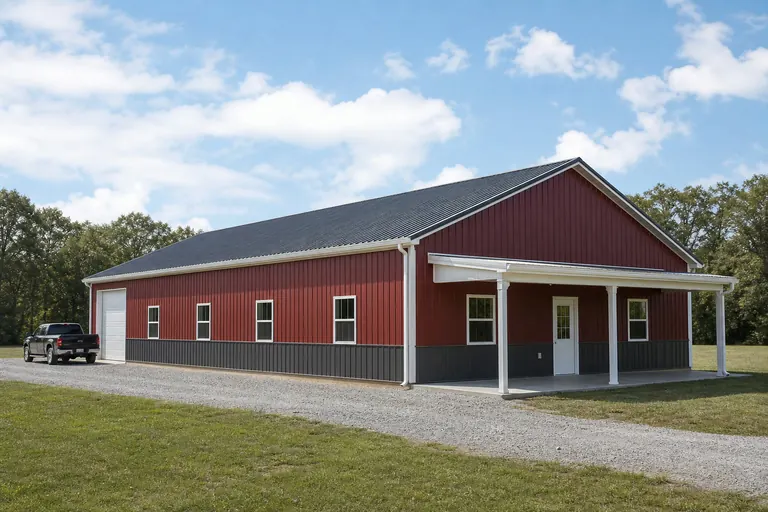 Primary residence on a rural lotA standalone home on a few acres, closer in scale to a rural residential build than a large working-farm program.Residence with a small attached garage or shopA modest workspace addition for hobby or light trade use, sized to the lot rather than to farm equipment.Acreage residence near a logistics corridorWhere proximity to distribution employment is part of the site choice, scheduling around local trade demand becomes a real planning factor.
Example Configuration — for planning purposes only.
Footprint
Sizes common for a new-build Indiana barndominium
With more modest average acreage than Missouri or Oklahoma, Indiana new-build sizes cluster closer to the residential-only end of the range.
30′ × 30′
900 sq ft
A minimal footprint suited to a compact primary residence on a smaller lot.
30′ × 40′
1,200 sq ft
A frequent starting size for a residential-only Indiana build.
30′ × 50′
1,500 sq ft
Added length for an extra bedroom or bonus room without a workspace addition.
40′ × 60′
2,400 sq ft
Where a modest attached garage or shop is part of the plan.
Example Configuration — for planning purposes only.
Footprint pages carry layout and room-count detail; this page explains why Indiana new-build sizes skew smaller than a large-acreage state's.
Local example
Indianapolis area context
Indiana's published city guide sits in the Indianapolis area, a useful local reference point given the metro's own significant logistics and warehousing activity.
Indianapolis metro
A hub for the state's transportation and warehousing growth, so the trade-scheduling considerations on this page are especially relevant to builds near this metro.
Questions
Indiana barndominium questions
Answered honestly for both resale searchers and new-build planners.
No. We don't operate a real estate listings marketplace. If you're specifically shopping existing inventory, a local MLS or real estate site is the right tool. This page is for understanding the building type and what changes if you decide to build new in Indiana instead.
Indiana's Department of Homeland Security, through its Fire Prevention and Building Safety Commission, adopts a state building code by rule and IDHS carries out plan review and code enforcement functions statewide. Local jurisdictions apply that framework; ask your local building department how it applies to your parcel.
We can't predict your specific timeline, but Indiana's transportation and warehousing sector employs 171,310 people, about 6% of total state employment, and has grown quickly, drawing on some of the same trades a residential build needs. It's worth asking your builder directly about current crew availability.
There is no official typical size. Indiana's smaller average land-in-farms base compared with Missouri or Oklahoma is consistent with new-build sizes clustering from a compact 30x30 up to about 40x60 for a residence with a modest attached garage or shop.
We do not publish state-level prices, because a credible number depends on your specification, site work, labor availability in your area and current material pricing. Our cost pages cover what drives the number; a builder quote covers your project.
Sources for the Indiana facts on this page
This page states no code requirement, wind speed, snow load, permit rule, price or supplier claim. The state-specific facts it does use are listed with their publisher below.
Indiana's Department of Homeland Security, through its Fire Prevention and Building Safety Commission and Code Enforcement/Building Plan Review functions, adopts and administers the state building code.
Indiana Department of Homeland Security (IDHS) · Current program pages; 2026 Indiana Building Code adoption in progress per Indiana Register filing · Tier 2
https://www.in.gov/dhs/building-plan-review/Indiana's transportation and warehousing sector employment and share of total state employment, using state QCEW-derived data.
Indiana Business Research Center, Indiana University (InContext, using state/federal labor data) · 2023 article, referencing prior-decade trend · Tier 2
https://www.incontext.indiana.edu/2023/mar-apr/article1.aspLand in farms in Indiana in 2022 per NASS county-level state total table.
USDA National Agricultural Statistics Service · 2022 · Tier 1
https://www.nass.usda.gov/Publications/AgCensus/2022/Full_Report/Volume_1,_Chapter_2_County_Level/Indiana/st18_2_045_045.pdfNumber of farms in Indiana in 2022, per the state statistician's public comments on the Census of Agriculture.
USDA NASS (data); Brownfield Ag News (reporting) · 2022 Census of Agriculture · Tier 1
https://www.nass.usda.gov/Publications/AgCensus/2022/Full_Report/Volume_1,_Chapter_2_County_Level/Indiana/st18_2_045_045.pdfThe Indiana Geological Survey classifies the state into physiographic regions in its Special Report 61.
Indiana Geological Survey (Indiana University) · 2000 (Special Report 61) · Tier 2
https://scholarworks.iu.edu/dspace/items/6e9ea94d-c556-4629-98ea-26e0b518745dIndiana total land area per US Census Bureau state area measurements.
U.S. Census Bureau · 2010 measurement basis · Tier 1
https://www.census.gov/geographies/reference-files/2010/geo/state-area.html