
Pole barn · IN
Pole Barns in Indiana
Indiana lost roughly 4% of its farms between 2017 and 2022, yet 14.6 million acres remain in agricultural production — a sign that the pole barns going up today are serving fewer but larger operations. Layer onto that Indiana's role as a national freight crossroads, with 171,310 people working in transportation and warehousing, and the pole barn brief in this state increasingly splits between consolidated farm equipment storage and trailer or fleet cover near the interstate network. Unlike states that certify a web of local building departments to enforce their code, Indiana's Department of Homeland Security runs plan review and code enforcement functions directly, which changes who you actually talk to before pouring a slab.
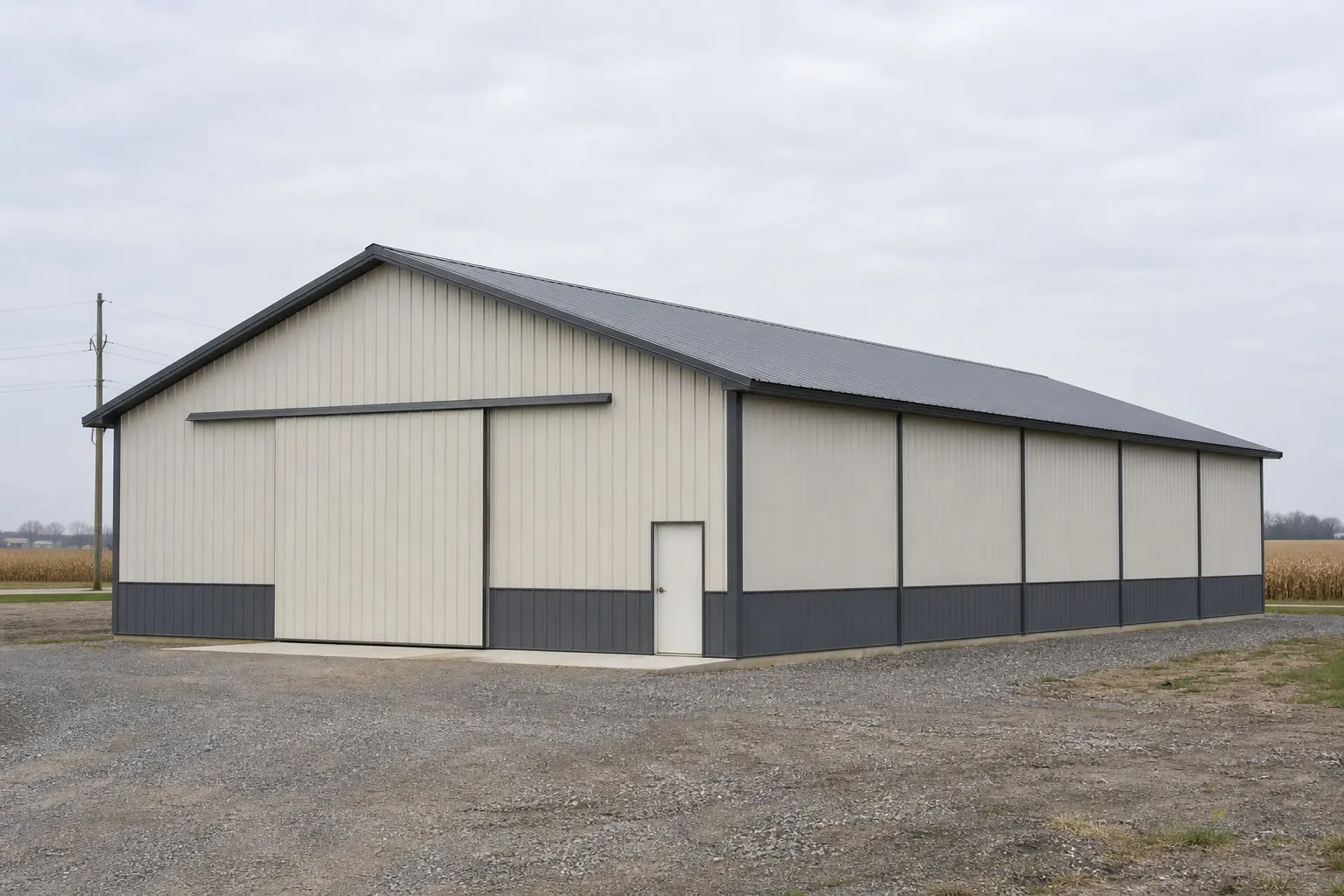
A State With Fewer, Bigger Farms
Between the 2017 and 2022 Census of Agriculture, Indiana's farm count fell to 53,599 — about a 4% decline — while the state still holds 14.6 million acres in farmland. Read together, those two figures point to consolidation: the operations still farming Indiana ground are managing more acreage per farm than they were five years earlier. For a pole barn buyer, that shift shows up as a request for wider bays that can hold a second combine or a longer grain cart, rather than a request for another small standalone shed.
Regulatory Path
Who Actually Reviews Your Indiana Pole Barn Plans
Indiana runs plan review and code enforcement through its Department of Homeland Security rather than certifying a network of independent local agencies.
Indiana's Fire Prevention and Building Safety Commission adopts the state building code by rule, and the Indiana Department of Homeland Security carries out building plan review and code enforcement functions statewide. That is a materially different structure from a state where the code is adopted centrally but enforced by dozens of independently certified county or township departments: in Indiana, a state program is a direct part of the review chain for many projects, alongside whatever local permit office also has jurisdiction over your parcel.
For a pole barn, that matters because agricultural-exemption questions and plan-review timing both run through this state-level structure. As of this evidence pack's period, the 2026 Indiana Building Code adoption was still moving through the Indiana Register — meaning the exact edition in force for a given build date is not something this page states as fixed. Confirm the current adopted edition and any local supplement with your building department before finalizing engineering drawings.
This state-level involvement does not remove the local layer. Zoning, setbacks and site-specific soil or drainage requirements are still handled locally in most Indiana counties. The practical takeaway is to expect two points of contact rather than one, and to start both conversations before you commit to a footprint.
State Data
Indiana Farm and Freight Metrics
These sourced figures frame why Indiana pole barns split between agricultural and freight-adjacent uses.
| Metric | Value | Source |
|---|---|---|
| Farms (2022) | 53,599, down ~4% from 2017 | USDA NASS / Census of Agriculture |
| Land in farms (2022) | 14,602,240 acres | USDA NASS |
| Transportation & warehousing jobs | 171,310 (~6% of state employment) | Indiana Business Research Center |
| Total land area | 36,420 sq mi | U.S. Census Bureau |
| Plan review authority | Indiana Dept. of Homeland Security (IDHS) | IDHS Building Plan Review program |
Farms (2022)
- Value
- 53,599, down ~4% from 2017
- Source
- USDA NASS / Census of Agriculture
Land in farms (2022)
- Value
- 14,602,240 acres
- Source
- USDA NASS
Transportation & warehousing jobs
- Value
- 171,310 (~6% of state employment)
- Source
- Indiana Business Research Center
Total land area
- Value
- 36,420 sq mi
- Source
- U.S. Census Bureau
Plan review authority
- Value
- Indiana Dept. of Homeland Security (IDHS)
- Source
- IDHS Building Plan Review program
Get Your Indiana Pole Barn Quote
Talk to builders who understand Indiana's consolidating farm base and its freight-corridor growth.
Emerging Use
The Freight-Corridor Pole Barn
Indiana's fast-growing transportation and warehousing sector is pushing some pole barns toward covered trailer and fleet-service space instead of hay and livestock storage.
Indiana is frequently described as a crossroads state, and the employment numbers back that framing: 171,310 people work in transportation and warehousing, roughly 6% of total state employment, and that sector was identified as the fastest-growing in Indiana over the prior decade. Property owners near major interstate corridors and rail-adjacent land are increasingly specifying pole barns as covered parking for trailers, light maintenance bays for a small owner-operator fleet, or dry storage for palletized freight overflow rather than as a purely agricultural structure.
That shift changes the planning brief in concrete ways. A trailer-cover pole barn typically wants taller eave heights and a longer, narrower footprint than a livestock barn, plus a gravel or paved apron sized for tractor-trailer turning radii rather than farm equipment. A fleet-maintenance bay adds electrical and lighting requirements that a hay barn never needed.
None of this is a claim that most Indiana pole barns serve freight uses — the agricultural base, at 14.6 million acres, remains the larger context. It is a documented growth pressure worth naming when a buyer's brief mentions a location near an interstate interchange or a logistics park rather than a traditional farmstead.
The Indiana Geological Survey's physiographic classification (Special Report 61) and the related Natural Regions of Indiana scheme name distinct zones such as the Northwestern Morainal, Grand Prairie, Northern Lakes and Central Till Plain. Site grading and foundation prep differ across these regions, so a pole barn planned for the flatter till-plain country should not assume the same drainage approach as one planned for more variable morainal ground.
Common Footprints
Footprints Indiana Buyers Ask About
These sizes reflect the two directions Indiana's pole barn demand is pulling: consolidated ag storage and freight-adjacent cover.
40′ × 60′
2,400 sq ft
A workable middle ground for a consolidated farm running larger equipment on fewer acres of buildings.
40′ × 80′
3,200 sq ft
Enough length to separate grain equipment from a livestock or hay bay.
60′ × 120′
7,200 sq ft
Sized for multi-trailer cover or a combined equipment and light-fleet-maintenance use.
Example Configuration — for planning purposes only.
These are outer dimensions; confirm interior clear height against your tallest vehicle or equipment before finalizing.
Before You Order
Steps for an Indiana Pole Barn Project
These four steps address the parts of Indiana's process that are easy to miss.
Step 1
Confirm the current adopted code edition
Ask IDHS or your local department which building code edition and amendments currently apply, since the 2026 adoption cycle was in progress when this evidence was gathered.
Step 2
Clarify your agricultural-exemption status
If the barn serves a working farm, confirm in writing whether it qualifies for any agricultural exemption before you assume one applies.
Step 3
Match the footprint to your actual equipment lineup
With Indiana farms consolidating, measure your current and near-term equipment rather than defaulting to a size that fit a smaller prior operation.
Step 4
Check FEMA's National Risk Index for your county
If the barn will shelter livestock, look at the relative hazard scores for your county before fixing a site, then let your local department set the actual structural design values.
Indiana FAQ
Pole Barn Questions From Indiana Buyers
Straight answers, with anything unverifiable routed to the right authority.
There is no single statewide blanket exemption stated here. Confirm agricultural-use exemption status with IDHS or your local building department for your specific project and parcel.
The Indiana Department of Homeland Security performs plan review and code enforcement functions statewide, often alongside a local permit office with jurisdiction over your site.
Total farmland acreage has stayed broad while the number of farms dropped about 4% between 2017 and 2022, which points to consolidation onto larger operations that need wider equipment storage.
Yes, and Indiana's fast-growing transportation and warehousing sector is a documented reason this use is becoming more common; the design brief for trailer cover differs from a livestock barn in eave height and apron sizing.
This page does not state a number. No single statewide figure exists in the sources reviewed; your local building department or IDHS will supply the design values for your specific site.
Sources for the Indiana facts on this page
This page states no code requirement, wind speed, snow load, permit rule, price or supplier claim. The state-specific facts it does use are listed with their publisher below.
Number of farms in Indiana in 2022, per the state statistician's public comments on the Census of Agriculture.
USDA NASS (data); Brownfield Ag News (reporting) · 2022 Census of Agriculture · Tier 1
https://www.nass.usda.gov/Publications/AgCensus/2022/Full_Report/Volume_1,_Chapter_2_County_Level/Indiana/st18_2_045_045.pdfLand in farms in Indiana in 2022 per NASS county-level state total table.
USDA National Agricultural Statistics Service · 2022 · Tier 1
https://www.nass.usda.gov/Publications/AgCensus/2022/Full_Report/Volume_1,_Chapter_2_County_Level/Indiana/st18_2_045_045.pdfIndiana's transportation and warehousing sector employment and share of total state employment, using state QCEW-derived data.
Indiana Business Research Center, Indiana University (InContext, using state/federal labor data) · 2023 article, referencing prior-decade trend · Tier 2
https://www.incontext.indiana.edu/2023/mar-apr/article1.aspIndiana's Department of Homeland Security, through its Fire Prevention and Building Safety Commission and Code Enforcement/Building Plan Review functions, adopts and administers the state building code.
Indiana Department of Homeland Security (IDHS) · Current program pages; 2026 Indiana Building Code adoption in progress per Indiana Register filing · Tier 2
https://www.in.gov/dhs/building-plan-review/Indiana total land area per US Census Bureau state area measurements.
U.S. Census Bureau · 2010 measurement basis · Tier 1
https://www.census.gov/geographies/reference-files/2010/geo/state-area.htmlFEMA's National Risk Index scores the same 18 named natural hazards for Indiana counties as for all other states.
FEMA · Current release · Tier 1
https://www.fema.gov/flood-maps/products-tools/national-risk-index