
Horse barn · NY
Horse Barns in New York
New York's 30,650 farms in 2022 averaged 212 acres across 6,502,286 acres of farmland, a working-farm base that is smaller in count than a decade earlier but still substantial in scale — a real mid-size parcel, not a suburban lot and not an open Midwestern spread. A horse barn planned for that kind of parcel has to answer to New York's winter directly: the Albany station's 1991-2020 normal records roughly 61 inches of annual snowfall alongside about 40.9 inches of precipitation, and while that single upstate reading is not a statewide figure, it signals a barn roof, ventilation system and paddock layout that all have to work through a genuine cold season. Add a permitting system run town by town rather than from a single state office, and the New York horse barn question becomes less about a generic stall count and more about how a specific parcel handles winter and local approval together.
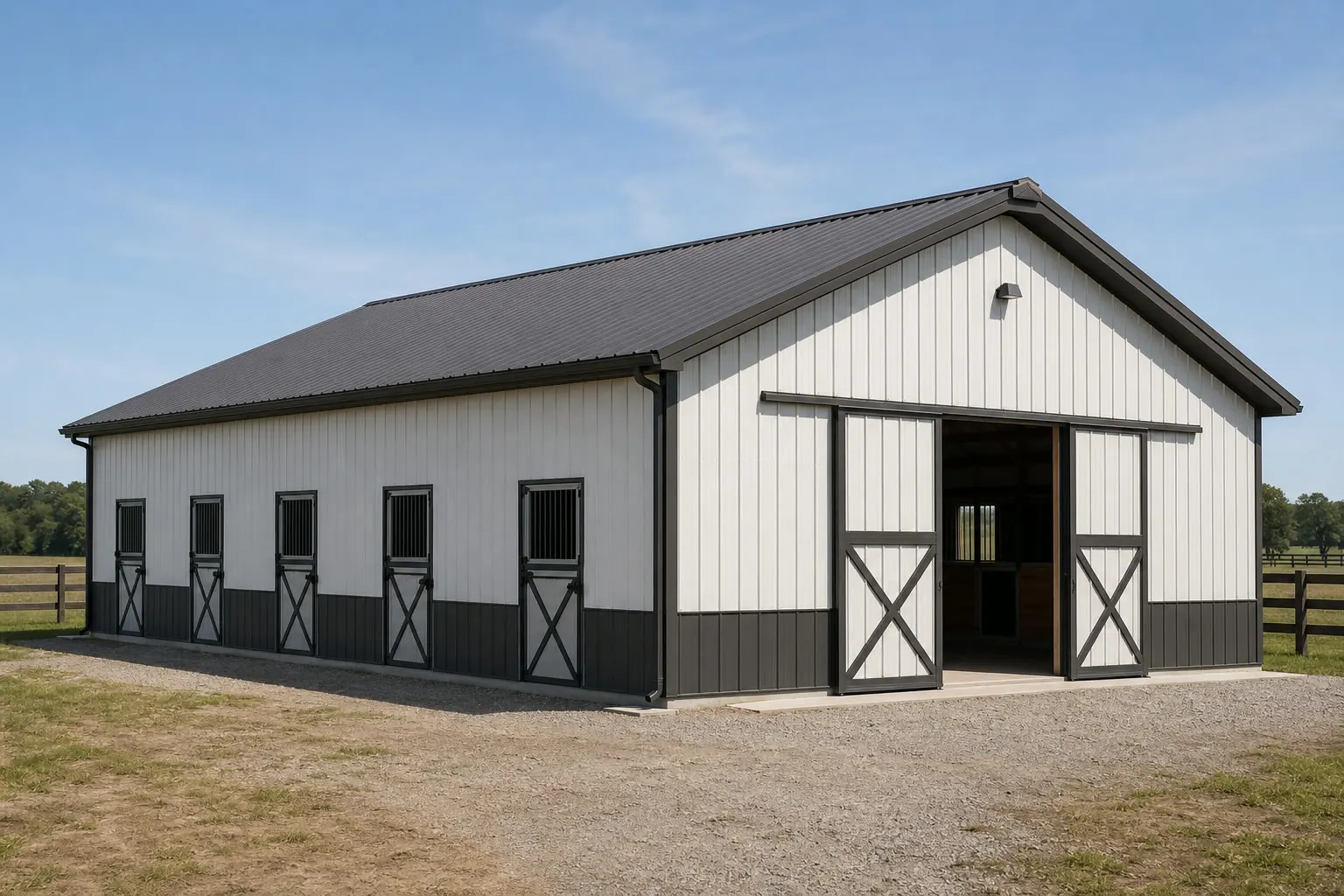
A Working Parcel, a Real Winter
New York's typical horse barn site is a working farm parcel averaging 212 acres, not a suburban acre and not an open, mild-climate spread. Layered onto that parcel size is a genuine winter, signaled by an upstate station's normal of roughly 61 inches of annual snowfall. This page is built around what those two facts change about siting, ventilation and layout, not around a single statewide climate claim.
The intersection
Why New York's Winter Changes the Barn Plan
The Albany, NY station's 1991-2020 normals put annual snowfall near 61 inches, a signal that a New York horse barn is managing snow load and cold-season ventilation together, not just one or the other.
A horse barn's ventilation has to remove moisture and ammonia from stalls year-round, but in a New York winter that ventilation also has to avoid chilling animals or freezing water lines. The usual answer is a ridge vent or cupola paired with eave intake that keeps air moving without creating a direct draft at stall height, sized to the barn's specific stall count rather than borrowed from a warmer-climate plan.
Roof and paddock siting need the same winter thought as a garage, but at farm scale: a barn roof shedding a real snow load needs a landing zone that does not bury a paddock gate, feed alley or the path between the barn and the house. On a 212-acre-average parcel there is usually room to solve this, but only if it is planned before the pad is poured, not discovered the first heavy snow.
Water supply is a New York-specific winter risk too. Frost depth varies by region and is set by the local building department, and a horse barn's water lines, whether run underground or heat-taped along an exposed run, need to be specified to that local frost depth rather than a generic assumption.
Because NOAA publishes New York's climate normals station by station — Albany in the east, Albion in the west, and others across the state — a barn buyer in the Adirondacks, the Southern Tier or western New York's snowbelt should ask for a nearby station's figures rather than defaulting to Albany's. Snow accumulation in a lake-effect zone can run well beyond what an eastern New York station records.
None of this replaces a site visit or a conversation with the local building department. The station data and farm-scale figures here tell a buyer what kind of problem to expect; the specific numbers for a given parcel come from the office that actually enforces them.
Quick reference
New York numbers this page actually relies on
Every figure below carries a named publisher and a period; nothing here is a design value or a requirement.
| Measure | Figure | Source |
|---|---|---|
| Farms (2022) | 30,650, down 8% since 2017 | USDA NASS |
| Average farm size (2022) | 212 acres | USDA NASS |
| Farmland acreage (2022) | 6,502,286 acres | USDA NASS |
| Snowfall (Albany station) | ~61 in/yr, 1991-2020 normal | NOAA / NWS Albany |
| Precipitation (Albany station) | ~40.9 in/yr, 1991-2020 normal | NOAA / NWS Albany |
| FEMA NRI hazard types tracked | 18, at county level statewide | FEMA |
Farms (2022)
- Figure
- 30,650, down 8% since 2017
- Source
- USDA NASS
Average farm size (2022)
- Figure
- 212 acres
- Source
- USDA NASS
Farmland acreage (2022)
- Figure
- 6,502,286 acres
- Source
- USDA NASS
Snowfall (Albany station)
- Figure
- ~61 in/yr, 1991-2020 normal
- Source
- NOAA / NWS Albany
Precipitation (Albany station)
- Figure
- ~40.9 in/yr, 1991-2020 normal
- Source
- NOAA / NWS Albany
FEMA NRI hazard types tracked
- Figure
- 18, at county level statewide
- Source
- FEMA
Get New York horse barn quotes
Tell us your region of the state, how many stalls you need, and your rough footprint. We route it with the New York and horse barn context already attached.
Configuration
What a New York Horse Barn Is Usually Being Asked to Do
Given a mid-size working parcel and a real winter, the practical New York brief tends to center on cold-season usability as much as stall count.
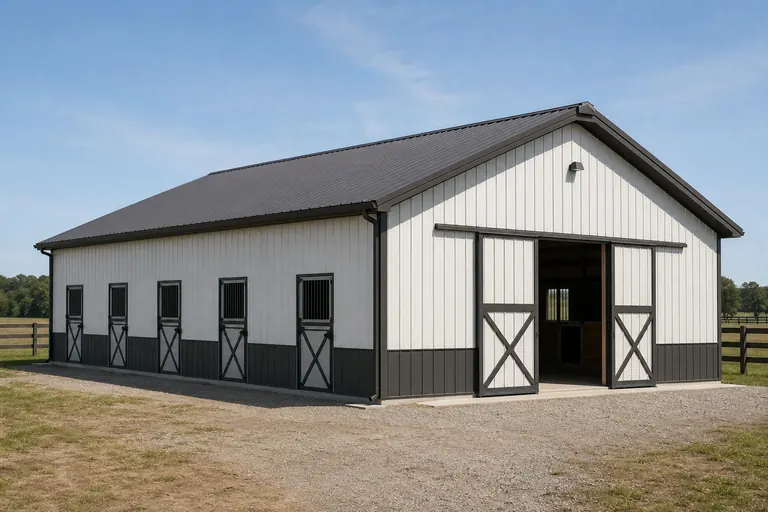 Winter-ready stall barnVentilation and water-line specification built around a genuine cold season, sited so shed snow does not block gates or alleys.Working-farm center-aisle barnSized to a 212-acre-average parcel with room for hay and equipment storage alongside stalls.Snowbelt-region barnBuilt around heavier lake-effect or upstate snowfall than an eastern New York station alone would suggest, with a roof and drift plan checked against a nearby station.
Example Configuration — for planning purposes only.
Footprint
Sizes That Fit a New York Working Parcel
These reflect what a mid-size New York farm parcel commonly supports; your program and site should set the final number.
30′ × 40′
1,200 sq ft
A compact starting point for a small stall count plus a feed or tack area.
36′ × 48′
1,728 sq ft
Center-aisle room with space for winter hay storage.
40′ × 60′
2,400 sq ft
Stalls plus a genuine equipment or hay bay, suited to a larger working parcel.
Example Configuration — for planning purposes only.
Footprint-level layout and door detail live on the size pages; this page only explains why New York briefs tend to land in this range.
Preparation
Before You Request a New York Horse Barn Quote
Steps that reflect New York's specific winter-load and local-permitting structure rather than generic advice.
Step 1
Identify your local approval authority
New York permits are issued town by town, city by city, or village by village, so confirm the correct office before drawing a plan.
Step 2
Get a nearby station's snow and precipitation normals
NOAA publishes New York normals station by station; use a reading close to your actual site rather than the Albany or Albion figures by default.
Step 3
Plan ventilation for a real winter
Size intake and exhaust to your stall count and confirm the design keeps air moving without chilling animals in cold-season use.
Step 4
Check your county's FEMA NRI hazard profile
New York counties are scored across 18 hazard types, and snowbelt, coastal and inland counties carry different mixes worth checking individually.
Step 5
Size the barn to your actual parcel
At a 212-acre state average, most New York sites have real room to work with, but plan paddock, drive and snow-shed space around your specific parcel.
Questions
New York Horse Barn Questions
Answered honestly at the state level, with anything requiring local or regional judgment routed to the people who actually own that answer.
No. NOAA publishes New York normals station by station. The Albany station's 1991-2020 normal of roughly 61 inches of annual snowfall is a useful upstate reference, not a statewide figure, and a Long Island or snowbelt site should be checked against a nearer station.
USDA's 2022 Census of Agriculture puts New York's average farm size at 212 acres across 30,650 farms, a working-scale parcel that most horse barn plans can be sited on without treating acreage as the limiting factor.
It depends on where the parcel sits. New York permitting runs through the local town, city or village, so confirm the correct office for your address before finalizing plans.
A New York horse barn has to remove stall moisture and ammonia year-round while avoiding chilling animals or freezing water lines in a genuine cold season, which usually means sizing intake and exhaust to the specific stall count rather than using a warmer-climate template.
There is no official typical size. Given the state's mid-size average parcel, briefs commonly land between 30x40 and 40x60, but your program and specific parcel should set the number.
We do not publish state-level prices; the real number depends on specification, site work, winter-related detailing and current material costs. Our cost pages explain what drives the number, and a quote covers your specific building.
Enforcement runs through the local town, city or village building department. Confirm requirements with that office before finalizing a plan, since New York administers permitting locally rather than from one state desk.
Sources for the New York facts on this page
This page states no code requirement, wind speed, snow load, permit rule, price or supplier claim. The state-specific facts it does use are listed with their publisher below.
New York had 30,650 farms in 2022, down 8% since 2017.
USDA National Agricultural Statistics Service (NASS) · 2022 · Tier 1
https://www.nass.usda.gov/Publications/AgCensus/2022/Online_Resources/County_Profiles/New_York/cp99036.pdfNew York had 6,502,286 acres of land in farms in 2022, an average farm size of 212 acres.
USDA NASS · 2022 · Tier 1
https://www.nass.usda.gov/Publications/AgCensus/2022/Online_Resources/County_Profiles/New_York/cp99036.pdfAlbany, NY's 1991-2020 annual normal precipitation is about 40.9 inches with roughly 61 inches of annual snowfall at the Albany station.
National Weather Service (NOAA), Albany NY office · 1991-2020 · Tier 1
https://www.weather.gov/media/aly/Climate/ALB_Normals_1991-2020.pdfFEMA's National Risk Index is the authoritative source for county- and state-level natural hazard exposure ratings across 18 hazard types, viewable via FEMA's own interactive report tool.
Federal Emergency Management Agency (FEMA) · Current NRI release · Tier 1
https://www.fema.gov/flood-maps/products-tools/national-risk-indexThe Census Bureau publishes New York's annual and monthly housing units authorized by building permits, state and place level, through the ongoing Building Permits Survey program.
U.S. Census Bureau · Ongoing, updated annually · Tier 1
https://www.census.gov/construction/bps/stateannual.html