Storage building · TX
Storage Buildings in Texas
A personal storage building in Texas is usually a small, single-owner structure on a residential or small-acreage lot — a scale and purpose entirely different from a working farm pole barn or a commercial mini-storage facility. What changes it from one Texas site to the next is moisture and heat: NOAA's 1991-2020 Climate Normals are tracked by individual station across the state, and the Gulf Coastal Plains, High Plains and Trans-Pecos physiographic regions mapped by the Bureau of Economic Geology carry meaningfully different humidity conditions for whatever you plan to store. Because Texas has no single statewide building code authority enforcing a mandatory code for most construction, whether your storage building needs a permit and how far it must sit from your property line are questions for your specific city or county.
The intersection
In Texas, region and local rules shape a personal storage building
A small storage building's main planning variables in Texas are moisture control by region and how the local jurisdiction treats a modest accessory structure.
NOAA's National Centers for Environmental Information maintain official 1991-2020 U.S. Climate Normals for Texas station by station rather than as one statewide average. That distinction matters for a personal storage building because whatever you plan to keep in it — furniture, seasonal equipment, documents, tools — is exposed to the humidity and temperature pattern of your specific area, not a single 'Texas climate.' A storage building near the Gulf Coast is managing different moisture conditions than one on the arid High Plains or in the Trans-Pecos, even though both are inside the same state.
The Bureau of Economic Geology's mapping of Texas physiographic regions and USGS's detailed studies of the Gulf Coastal Plain's geology both point to the same practical conclusion: ground moisture, drainage and humidity vary enough across Texas that ventilation and vapor-barrier decisions for a small storage building are a regional question, not a statewide one. That is a modest, low-cost decision at this building's scale, but it is worth getting right before the structure is built rather than after something inside it takes moisture damage.
On administration, Texas's lack of a single statewide building code authority enforcing a mandatory code for most construction means that whether your storage building even requires a permit is decided locally. Many jurisdictions apply size-based thresholds under which a small accessory structure needs no permit at all, but that threshold is set by the city or county, not by the state, so the only reliable way to know is to ask your local building department before you build.
Site context
Regional moisture conditions for a Texas storage building
The same small structure faces different humidity and ventilation needs depending on where in Texas it sits.
| Region | Typical condition | Storage building implication |
|---|---|---|
| Gulf Coastal Plains | High humidity, documented aquifer and drainage complexity | Prioritize ventilation and a moisture barrier for stored goods |
| Blackland Prairies / Interior | Moderate humidity, expansive clay soils | Standard ventilation; consider a raised or well-drained pad |
| High Plains | Arid, lower humidity | Moisture is less of a concern than dust and wind-driven debris |
| Trans-Pecos | Arid with wide temperature swings | Ventilation for daytime heat buildup matters more than humidity control |
Gulf Coastal Plains
- Typical condition
- High humidity, documented aquifer and drainage complexity
- Storage building implication
- Prioritize ventilation and a moisture barrier for stored goods
Blackland Prairies / Interior
- Typical condition
- Moderate humidity, expansive clay soils
- Storage building implication
- Standard ventilation; consider a raised or well-drained pad
High Plains
- Typical condition
- Arid, lower humidity
- Storage building implication
- Moisture is less of a concern than dust and wind-driven debris
Trans-Pecos
- Typical condition
- Arid with wide temperature swings
- Storage building implication
- Ventilation for daytime heat buildup matters more than humidity control
Site context
How Texas region changes storage building siting
The Bureau of Economic Geology's physiographic regions frame what a small storage building's pad and drainage should account for.
Gulf Coastal Plains
Flat, humid ground where a raised pad and roof drainage away from the door are worth planning before the slab is poured.
Blackland Prairies / Interior
Expansive clay soils in parts of this belt, which is a reasonable thing to mention to whoever prepares the pad.
High Plains
Arid, wind-exposed ground where dust and wind-driven debris matter more than moisture.
Trans-Pecos
Arid with wide day-night temperature swings, where ventilation for daytime heat buildup is the more relevant planning detail.
Get Texas storage building quotes
Tell us your region and what you plan to store, and we route it with the Texas moisture and permitting context already attached.
Configuration
What a Texas personal storage building is usually asked to do
Most personal storage briefs in Texas fall into a few recurring uses, and the use shapes ventilation and shelving more than the region does.
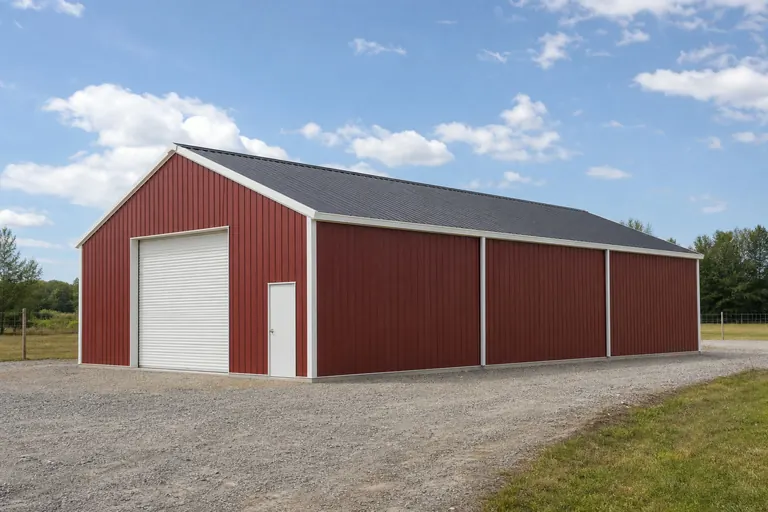 Seasonal and yard equipmentThe simplest use case, where basic ventilation is usually enough regardless of region.Tools and light workshopAdds a workbench or shelving, which benefits from a raised pad in humid regions to protect stored metal tools from corrosion.Household overflow storageFurniture, documents and electronics are more moisture-sensitive, which is where regional humidity differences matter most.
Example Configuration — for planning purposes only.
Preparation
Before you request a Texas storage building quote
A handful of details resolved up front keep a small storage project simple.
- Ask your local building department if a permit is requiredMany jurisdictions exempt small accessory structures below a size threshold, but that threshold is set locally.
- Confirm setback distance from your property lineLocal zoning rules, not a statewide rule, govern how close the structure can sit to a boundary or your home.
- Plan ventilation for your regionGulf Coastal humidity calls for different ventilation than High Plains or Trans-Pecos aridity.
- Decide on a floor or pad type before orderingA raised pad matters more in humid or poorly drained areas than in arid ones.
- List what you intend to storeDocuments, electronics and furniture are more moisture-sensitive than tools or outdoor equipment, and that should inform ventilation choices.
Footprint
Common Texas personal storage building sizes
Personal storage buildings in Texas are typically sized to what a single household needs to keep, which keeps most projects modest regardless of region.
10′ × 12′
120 sq ft
A common small footprint for seasonal items and yard equipment.
12′ × 20′
240 sq ft
Room for larger tools, a small workbench, or overflow household storage.
16′ × 24′
384 sq ft
Suited to combined storage and light workshop use on a residential or small-acreage lot.
Example Configuration — for planning purposes only.
Footprint pages carry layout detail for each size; this page explains only why Texas regional moisture matters for these dimensions.
Questions
Texas storage building questions
Honest answers at the state level, with permitting and pricing questions routed to whoever actually owns them.
It depends on your local jurisdiction. Many cities and counties exempt small accessory structures below a size threshold, but Texas has no single statewide code authority setting that threshold, so ask your local building department.
Regional humidity varies significantly across Texas. Gulf Coastal areas are markedly more humid than the High Plains or Trans-Pecos, which is a reasonable factor in ventilation planning for whatever you intend to store.
Setback rules are set by your local zoning authority, not by the state. Confirm with your city or county before finalizing placement.
There is no official typical size. Most personal storage buildings run from about 10x12 up to 16x24 depending on what a household needs to store.
We do not publish state-level prices, since cost depends on size, specification and site work. Our cost pages explain what drives the number; a builder quote covers your specific project.
No. A storage building here means a small single-owner structure on a residential or small-acreage lot. A commercial multi-tenant self-storage facility is a different project with different zoning and development considerations.
Sources for the Texas facts on this page
This page states no code requirement, wind speed, snow load, permit rule, price or supplier claim. The state-specific facts it does use are listed with their publisher below.
NOAA maintains official 1991-2020 U.S. Climate Normals (temperature, precipitation) for Texas stations statewide.
NOAA National Centers for Environmental Information (NCEI) · 1991-2020 · Tier 1
https://www.ncei.noaa.gov/products/land-based-station/us-climate-normalsTexas does not have a single statewide building code authority enforcing a mandatory building code for most construction; code adoption and enforcement occur primarily at the local/municipal level.
KHOU 11 (Verify) / Texas State Law Library · current · Tier 3
https://www.khou.com/article/news/verify/verify-statewide-enforced-residential-building-code-texas/285-cc7c6343-cdf1-4751-b855-713601cf6b8bThe USGS-published Bureau of Economic Geology map identifies major Texas physiographic regions including the Gulf Coastal Plains, Interior Plains, Great Plains, and Basin and Range provinces.
Bureau of Economic Geology, University of Texas at Austin · 1996 · Tier 2
https://txmn.org/st/files/2022/09/BEG_PHYSIOGRAPHY_1996.pdfUSGS has published detailed geologic studies of the Gulf Coastal Plain of Texas, describing its stratigraphy and aquifer systems.
U.S. Geological Survey · 1994/1995 · Tier 2
https://pubs.usgs.gov/of/1994/0461/report.pdfTexas's total land area was 261,226 square miles per the 2008 Census Bureau state area measurements, the largest of the contiguous 48 states.
U.S. Census Bureau, Statistical Abstract of the United States: 2011 · 2008 · Tier 1
https://www2.census.gov/library/publications/2010/compendia/statab/130ed/tables/11s0355.pdf