
Storage building · KY
Storage Buildings in Kentucky
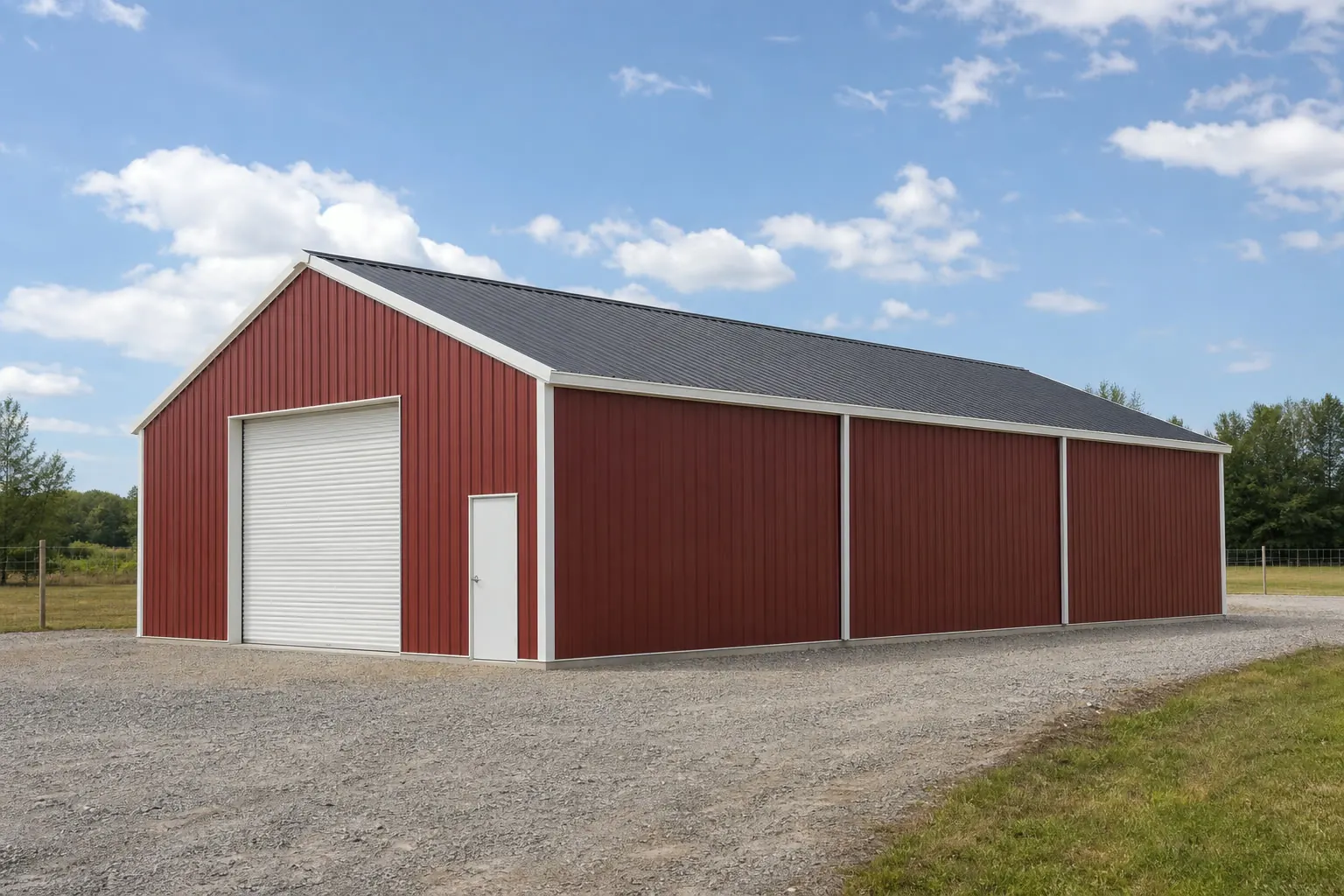
In Kentucky, a storage building is a vital component for the state's 69,425 farms, providing a dry haven in a climate that sees 45.2 inches of annual precipitation. Unlike states with fragmented building codes, Kentucky's mandatory uniform statewide building code, managed by the Department of Housing, Buildings and Construction, ensures a consistent structural standard for storage facilities. Whether you need a simple shed for tools in the Bluegrass or a large equipment barn in the Western Coalfields, Kentucky storage planning starts with moisture management and regional site awareness.
Asset Protection
Building Durable Storage in the Bluegrass State
A storage building in Kentucky is a front-line defense against the state's 45.2 inches of annual rainfall and high humidity.
Kentucky's 69,425 farms rely on efficient storage for everything from seed and feed to high-value equipment. The planning process is anchored by the Department of Housing, Buildings and Construction (DHBC), which administers a mandatory uniform statewide building code. This central oversight ensures that even secondary storage buildings meet the necessary structural standards for the region's wind and snow loads. This administrative consistency is a boon for Kentucky owners, as it provides a clear set of rules that apply across all physiographic regions.
However, the technical challenge is always water. With 45.2 inches of annual precipitation at Louisville, a storage building without proper drainage is a liability. The combination of wet ground and high humidity can lead to mold in feed and corrosion in equipment. Designing a Kentucky storage building requires a focus on elevation—ensuring the building sits high enough to shed water—and ventilation to ensure that the interior air remains dry during the humid transition climate of the summer months.
The 179-acre average farm size also influences how Kentucky owners design their storage. Many choose buildings that can be expanded or modified, such as adding a lean-to for additional equipment cover. This 'future-proofing' is a smart strategy in a state where agricultural needs can shift between equestrian, livestock, and crop-based operations.
Regional Site Prep
Siting Your Storage Building Across Kentucky
The Kentucky Geological Survey's regions present unique site preparation requirements for storage facilities.
Bluegrass Region
Rolling hills offer beautiful sites but require leveling. The fertile soil can become saturated during the 45-inch rain seasons, so a deep gravel base is necessary for any storage building not placed on a concrete slab.
Cumberland Plateau
The eastern mountains present the greatest challenge for large storage buildings. Level ground is scarce, often requiring extensive cut-and-fill work. Access for delivery of steel components must be verified before the order is placed.
Western Coalfields
Similar to the Bluegrass, but with varying soil types. Site preparation focuses on ensuring the pad is stable and well-drained, especially for buildings storing heavy machinery.
Mississippian Plateau (Pennyroyal)
Karst topography is a major factor. Sinkholes and underground drainage paths must be avoided. A storage building full of heavy equipment can exacerbate soil instability if placed over a hidden karst feature.
Environmental Control
Combating Humidity in Kentucky Storage
Kentucky's climate requires active moisture management to protect stored goods.
Condensation in a metal storage building can lead to significant losses. When warm, humid air hits a cold metal roof, it turns into water. In a state with 45.2 inches of annual rain, this cycle is frequent. The solution is a two-pronged approach: insulation and airflow.
Adding a basic vapour barrier or a thin layer of insulation to the roof and walls can significantly reduce condensation. This should be paired with ridge vents and possibly even a powered exhaust fan for buildings storing sensitive items like dry feed or electronics. Ensuring the building is tightly sealed against ground moisture by using a poly-vapour barrier under the gravel or slab is equally important.
- Elevated Pads
- Building the storage pad at least 6-12 inches above the surrounding grade helps prevent water intrusion during heavy Kentucky rains.
- Vertical Roof Ribs
- Preferable for shedding debris and 45.2 inches of rain, vertical ribs are less prone to the minor leaks that horizontal ribs can develop in humid climates.
- Sealed Doors
- High-quality weather stripping on roll-up or sliding doors keeps driving rain and humidity out of the storage environment.
Get Your Kentucky Storage Building Quote
Secure your equipment and supplies with a durable metal storage building designed for Kentucky's climate.
Dimensions
Common Kentucky Storage Building Sizes
Footprints designed for Kentucky residential and agricultural storage needs.
12′ × 24′
288 sq ft
A large residential shed size, ideal for lawn equipment and seasonal storage.
24′ × 30′
720 sq ft
A standard two-bay storage building, popular for small farms needing to house a tractor and tools.
30′ × 50′
1,500 sq ft
A larger equipment barn footprint, providing ample space for hay and machinery on a 179-acre farm.
Example Configuration — for planning purposes only.
Measure your largest equipment—including any attachments like loaders or trailers—before selecting a final building width.
Foundation Planning
Matching the Foundation to the Storage Job
Kentucky's uniform code applies the same anchoring standard to every foundation type, so the real decision is which base best resists this state's rainfall and regional ground conditions.
| Foundation type | Best suited for | Kentucky-specific consideration |
|---|---|---|
| Compacted gravel pad | Light equipment, tools, seasonal storage | The cheapest option, but it needs a crowned surface and an edge drainage swale to keep 45.2 inches of annual rain from softening the ground under skids. |
| Reinforced concrete slab | Heavy machinery, mixed workshop-storage use | The most resilient choice on Pennyroyal ground where karst-related settling is a possibility, and it gives a washable surface for feed or chemical storage. |
| Post-frame on treated skids | Elevated hay or feed storage kept off damp ground | Common on Bluegrass sites, where keeping stored feed above a damp slab matters more than year-round vehicle access. |
Compacted gravel pad
- Best suited for
- Light equipment, tools, seasonal storage
- Kentucky-specific consideration
- The cheapest option, but it needs a crowned surface and an edge drainage swale to keep 45.2 inches of annual rain from softening the ground under skids.
Reinforced concrete slab
- Best suited for
- Heavy machinery, mixed workshop-storage use
- Kentucky-specific consideration
- The most resilient choice on Pennyroyal ground where karst-related settling is a possibility, and it gives a washable surface for feed or chemical storage.
Post-frame on treated skids
- Best suited for
- Elevated hay or feed storage kept off damp ground
- Kentucky-specific consideration
- Common on Bluegrass sites, where keeping stored feed above a damp slab matters more than year-round vehicle access.
Questions
Kentucky Storage Building FAQ
Direct answers for Kentucky storage projects.
Permit requirements vary by size and jurisdiction, but Kentucky's mandatory uniform statewide building code provides the framework. Generally, larger structures and those on permanent foundations require permits. Always check with your local building department.
Choosing a building with a high-quality galvanised or Galvalume finish is the first step. Ensuring proper drainage so water doesn't pool at the base of the walls is also critical in our 45-inch rain environment.
A compacted gravel pad is cost-effective and provides good drainage. For heavy equipment, a reinforced concrete slab is the superior choice for stability.
Yes, many metal building designs are modular. A lean-to is an excellent way to add extra cover for equipment without the cost of a full enclosed bay.
The anchoring and wind-resistance expectations set under KRS 198B.040(7) apply regardless of whether you choose gravel, slab, or skids; what changes is how well that foundation performs against this state's rainfall and regional soil conditions, which is a durability question your local building department can help you think through.
There is no separate rule, but Western Coalfields and Pennyroyal operations often run larger working yards than a compact Bluegrass residential lot, so it is worth measuring your actual equipment lineup and near-term growth before fixing a footprint rather than defaulting to a common size.
Sources for the Kentucky facts on this page
This page states no code requirement, wind speed, snow load, permit rule, price or supplier claim. The state-specific facts it does use are listed with their publisher below.
Kentucky's Department of Housing, Buildings and Construction (Division of Building Code Enforcement) promulgates a mandatory uniform statewide building code under KRS 198B.040(7) and 198B.050.
Kentucky Public Protection Cabinet / Legislative Research Commission · Current regulation (accessed 2026) · Tier 2
https://apps.legislature.ky.gov/law/kar/titles/815/007/120/Kentucky's Department of Housing, Buildings and Construction (Division of Building Code Enforcement) promulgates a mandatory uniform statewide building code under KRS 198B.040(7) and 198B.050.
Kentucky Public Protection Cabinet / Legislative Research Commission · Current regulation (accessed 2026) · Tier 2
https://apps.legislature.ky.gov/law/kar/titles/815/007/120/Louisville's 1991-2020 annual normal precipitation is about 45.2 inches with roughly 12 inches of annual snowfall.
National Weather Service (NOAA), Louisville KY office · 1991-2020 · Tier 1
https://www.weather.gov/media/lmk/climate/clisdf/monthly_seasonal_annual_sdf_lou_1991_2020.pdfKentucky Geological Survey divides the state into named physiographic regions including the Cumberland Plateau and Mountains (Eastern Coalfields, ~10,500 sq mi across 35 counties), the Bluegrass, the Western Coalfields, and the Mississippian Plateau/Pennyroyal.
Kentucky Geological Survey (University of Kentucky) · KGS reference material · Tier 2
https://www.uky.edu/KGS/geoky/physiographic.htmKentucky had 69,425 farms in 2022.
USDA National Agricultural Statistics Service (NASS) · 2022 · Tier 1
https://www.nass.usda.gov/Publications/AgCensus/2022/Online_Resources/County_Profiles/Kentucky/cp99021.pdfKentucky had 12,431,190 acres of land in farms in 2022, an average farm size of 179 acres.
USDA NASS · 2022 · Tier 1
https://www.nass.usda.gov/Publications/AgCensus/2022/Online_Resources/County_Profiles/Kentucky/cp99021.pdfKentucky's Department of Housing, Buildings and Construction (Division of Building Code Enforcement) promulgates a mandatory uniform statewide building code under KRS 198B.040(7) and 198B.050.
Kentucky Public Protection Cabinet / Legislative Research Commission · Current regulation (accessed 2026) · Tier 2
https://apps.legislature.ky.gov/law/kar/titles/815/007/120/Kentucky's total land area was measured at 39,486.3 square miles as of the 2010 Census.
U.S. Census Bureau · 2010 Census · Tier 1
https://www.census.gov/geographies/reference-files/2010/geo/state-local-geo-guides-2010/kentucky.html