
Storage building · SC
Storage Buildings in South Carolina
A storage building in South Carolina is a defensive structure. Across 30,064.1 square miles of diverse terrain—from the sandy soils of the Coastal Plain to the red clay of the Upstate—owners must navigate a humid subtropical climate (Köppen Cfa) that is notoriously hard on stored goods. Whether you are managing inventory for one of South Carolina's 22,633 farms or overflow storage for a growing business, the honest challenge is preventing the Palmetto State's heat and moisture from compromising your assets.
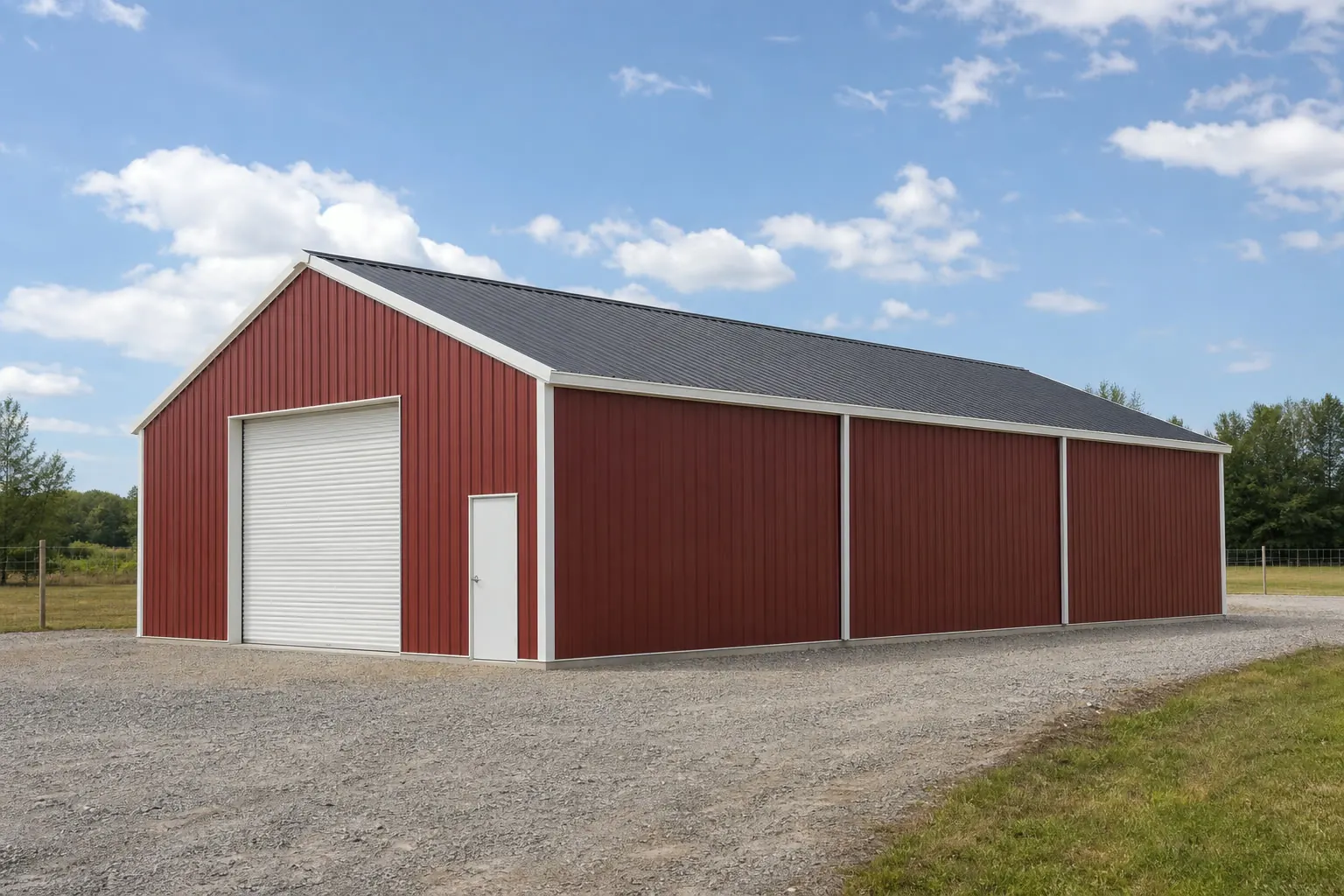
Asset Management
Storing in the South Carolina climate
Humidity is the silent enemy of every storage project in South Carolina.
In the Midlands and Lowcountry, the air is often saturated with moisture. For a steel storage building, this creates a unique challenge. If the building is uninsulated, the temperature difference between day and night can cause water to bead on the ceiling and drip onto your inventory—a phenomenon often called 'building sweat.' This is why South Carolina storage buildings should never be 'dead air' spaces; they must have constant airflow through ridge vents, louvers, or active fans.
For those storing moisture-sensitive items like documents, furniture, or electronics, a basic metal shell is often not enough. South Carolina owners frequently choose a 'drip-stop' coating on the roof panels or move to a fully insulated 'barndominium-style' shell that can be climate-controlled. With temperatures having risen more than 1°F since the early 1900s, the heat load is also a growing factor in how you protect your stored assets.
The state's 30,064.1 square miles also feature varied drainage challenges. On a 201-acre farm, finding a high, dry spot for a storage building is easier than on a tight commercial lot in Charleston. Regardless of the size of the property, the foundation must be built to handle heavy rain events and prevent water from seeping under the walls and into the storage area. A few extra inches of compacted gravel or a slightly crowned slab edge is a small upfront cost compared to replacing water-damaged inventory after a single heavy storm.
Usage Patterns
Typical SC storage building roles
How South Carolina businesses and farms utilize steel storage.
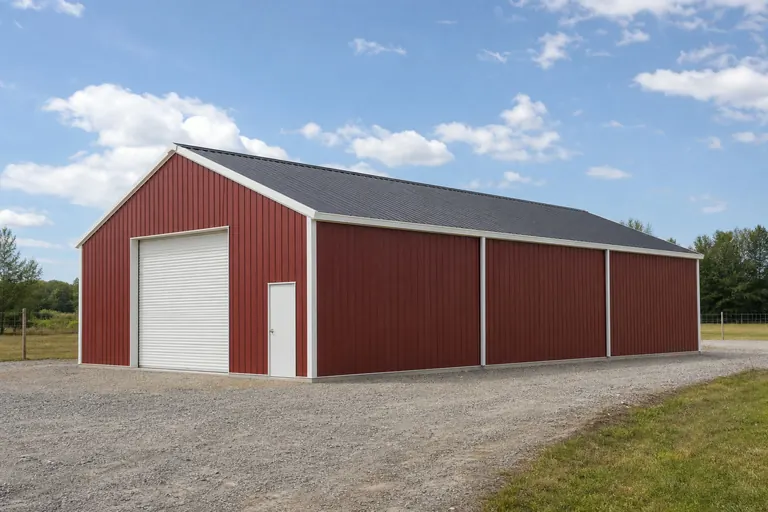 Agri-Bulk StorageLarge clear-span buildings for seed, fertilizer, or harvest storage on SC's 22,633 farms.Commercial WarehouseSecure metal buildings for inventory management in growing hubs like Rock Hill or Spartanburg.Personal Mini-WarehouseA 30x40 footprint for multi-purpose storage, from seasonal gear to household overflow.
Example Configuration — for planning purposes only.
Capacity
Choosing the right storage footprint
Matching the building size to the scale of South Carolina operations.
30′ × 40′
1,200 sq ft
A popular size for personal storage and small business inventory.
40′ × 60′
2,400 sq ft
Commonly used for agricultural equipment and bulk feed storage.
50′ × 100′
5,000 sq ft
A commercial-grade warehouse footprint suitable for larger inventories.
Example Configuration — for planning purposes only.
Footprints should account for the turning radius of trucks or tractors if they are required for loading.
Secure your storage in South Carolina
Get a quote on a professional metal storage building designed for Palmetto State conditions.
Resilience
Anchoring for South Carolina storms
A storage building is only as secure as its foundation and anchoring system.
FEMA NRI data highlights that all 46 counties in South Carolina face risks from tornadoes and inland flooding, with coastal counties facing additional hurricane threats. For a storage building, this means the 'standard' anchoring package may not be sufficient. In coastal areas like Myrtle Beach or Beaufort, specific wind-load certifications are a common requirement for any new steel structure.
Beyond wind, you must consider the ground. In the sandy soils of the Lowcountry, deep-driven anchors are necessary to reach stable soil. In the red clay of the Upstate, anchors must be placed in a way that accounts for the soil's tendency to hold water and shift. Protecting your storage means starting with a site that is properly graded and a building that is physically tied to the earth to withstand the Palmetto State's most severe weather.
- High-Wind Anchoring
- Essential for meeting safety standards in SC's hurricane and tornado-prone regions.
- Elevated Slab
- Prevents water ingress during the heavy rain events common in the Midlands.
- Rodent and Pest Proofing
- Steel construction provides an inherent advantage against SC's significant termite pressure.
Regional Planning
What changes in a storage building brief by region
The same steel storage shell needs a different specification sheet depending on where in South Carolina it sits.
Lowcountry & Coastal Plain
Salt air and hurricane exposure push owners toward corrosion-resistant fasteners and heavier anchor kits, plus elevated slabs where coastal flooding risk is scored highest.
The Midlands
Peak summer humidity makes ventilation and moisture control the priority; ridge vents and a vapor barrier under the slab do more for long-term storage safety than extra square footage.
The Upstate
Clay soil expansion and occasional winter ice load matter more here than salt exposure, so a well-compacted gravel base and attention to slab reinforcement pay off over time.
Business Continuity
Storm-season readiness for commercial storage
For a business relying on a South Carolina storage building, hurricane season is a continuity-planning event, not just a weather event.
Step 1
Elevate inventory racking
In coastal and Midlands counties where FEMA NRI scores inland and coastal flooding, pallet racking that lifts goods a foot or more off the slab reduces loss if water intrudes during a tropical rain event.
Step 2
Confirm door and panel fasteners
Salt-laden air along the Grand Strand and Lowcountry accelerates fastener corrosion on roll-up doors; a pre-season torque check on hardware prevents a door from failing under wind load.
Step 3
Upstate: check gutter and drainage lines
In the Piedmont and Upstate, clay soil sheds water slowly; clearing gutters and grading swales away from the storage building before winter storms prevents standing water at the foundation.
Step 4
Plan for extended outages
Commercial storage tied to refrigeration, security systems, or climate control should have a generator transfer switch specified at build time, since outages after a South Carolina hurricane can run into days.
Questions
South Carolina Storage Building FAQ
Addressing common storage concerns in the Palmetto State.
The most effective method is a combination of a vapor barrier under the slab and high-quality ventilation. For high-value storage, adding closed-cell spray foam insulation will prevent condensation entirely by creating a thermal break.
If the building is for a business, yes. Requirements for fire suppression, setbacks, and parking will be determined by your local county or city zoning office.
Yes. Unlike wood-frame buildings, steel is completely immune to termites, which are a major concern for property owners across South Carolina.
Generally yes. Salt-laden air along the coast accelerates corrosion on standard fasteners and roll-up door tracks, so many coastal owners upgrade to corrosion-resistant hardware even when the base building package is otherwise identical to an inland order.
It depends on use: farm operations moving tractors or trailers typically need wider door openings and turning radius than a commercial tenant using pallet racking, so match the door width and eave height to the specific equipment you expect to store, not just the floor area.
Sources for the South Carolina facts on this page
This page states no code requirement, wind speed, snow load, permit rule, price or supplier claim. The state-specific facts it does use are listed with their publisher below.
The South Carolina State Climatology Office (SC DNR) states most of the state falls within the humid subtropical (Köppen Cfa) classification, producing hot, humid summers with mild winters, while portions of the Upstate mountains have a different, cooler climate regime.
South Carolina Department of Natural Resources (SC DNR), State Climatology Office · SC DNR reference publication · Tier 2
https://www.dnr.sc.gov/climate/sco/Publications/SCClimateOverview.pdfSouth Carolina had 4,553,922 acres of land in farms in 2022 (down 4% since 2017), with an average farm size of 201 acres (up 5%).
USDA NASS · 2022 · Tier 1
https://www.nass.usda.gov/Publications/AgCensus/2022/Online_Resources/County_Profiles/South_Carolina/cp99045.pdfThe Census Bureau's current data profile lists South Carolina with a land area of 30,064.1 square miles and a water area of 1,959.4 square miles, ranking it the 39th largest state by area.
U.S. Census Bureau · Current Census Bureau geography data · Tier 1
https://data.census.gov/profile/South_Carolina?g=0400000US45FEMA's National Risk Index is the federal tool providing county-level natural hazard risk scoring (including hurricane, coastal flooding, tornado, and inland flooding categories) for all 46 South Carolina counties; a state-specific hazard narrative from FEMA itself was not directly retrieved in this session.
Federal Emergency Management Agency (FEMA) · Current NRI release · Tier 1
https://www.fema.gov/flood-maps/products-tools/national-risk-index