Mini-storage building · TX
Mini-Storage Buildings in Texas
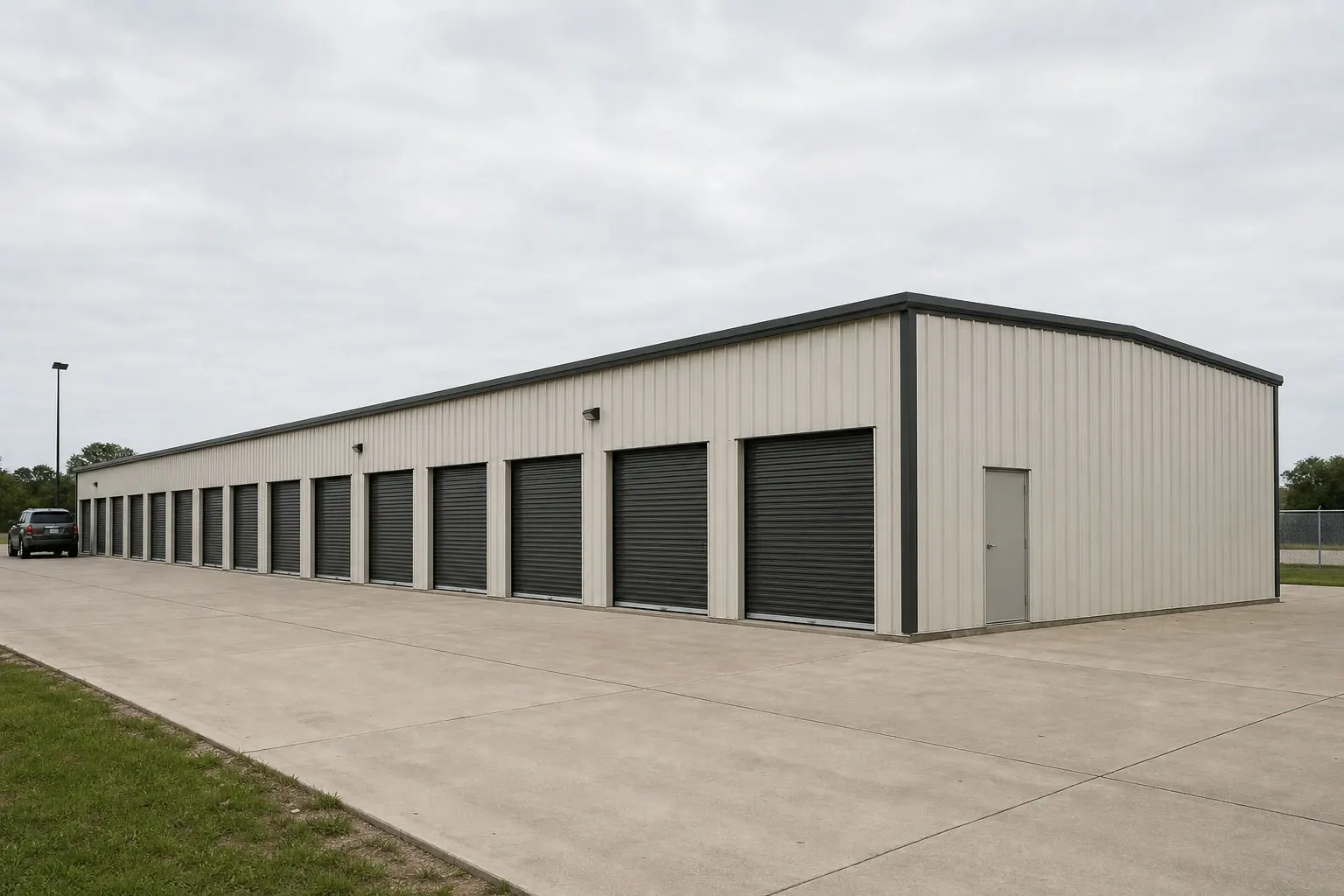
A mini-storage building in Texas is a commercial, multi-tenant self-storage development, and it is planned very differently from a personal backyard storage shed or a working farm building. The state's scale — 261,226 square miles of land, the largest of the contiguous 48 states — means site selection has to account for real regional variation: a facility near the Gulf Coast contends with humidity and, close to the coast, the windstorm insurance track through TDI and TWIA, while a facility on the arid High Plains or in a Blackland Prairie market faces different site and drainage conditions. Because Texas has no single statewide building code authority enforcing a mandatory code for most construction, commercial zoning, site-plan review and permitting for a multi-unit facility are entirely local processes, run by the city or county where the site sits.
The intersection
Texas scale and local zoning drive mini-storage site selection
A commercial mini-storage development in Texas is planned around where in a large, regionally varied state the site sits, and around a purely local zoning and permitting process.
Texas's 261,226 square miles of land area — the largest of the contiguous 48 states — is not a marketing statistic for a storage developer; it is the reason site selection genuinely differs by region rather than following one statewide playbook. A coastal Gulf site, a Blackland Prairie site near the interior, a High Plains site, and a Trans-Pecos site each present different drainage, humidity and access conditions for a multi-building facility with a large paved footprint and drive-up access requirements.
Commercial zoning is entirely local. Texas has no single statewide building code authority enforcing a mandatory code for most construction, and for a multi-tenant facility that means site-plan review, fire-access lane requirements, and use classification are all handled by the city or county planning and building departments where the site sits. A developer evaluating multiple candidate sites across Texas should expect a genuinely different process at each one, not a uniform statewide checklist.
Coastal sites carry an additional, well-documented layer. Inside the state's designated windstorm catastrophe area — 14 coastal counties plus the part of Harris County east of Highway 146 — the Texas Department of Insurance administers a windstorm inspection program, and the Texas Windstorm Insurance Association requires a Windstorm Certificate of Compliance under Insurance Code Chapter 2210 before it will issue wind and hail coverage. For a commercial facility holding other people's property, that insurance track is a real part of site due diligence and project timeline, not an afterthought to raise after construction starts.
Site context
Regional site factors for a Texas mini-storage facility
The same multi-unit facility design meets different regional and administrative conditions depending on where in Texas it is developed.
| Region | Site consideration | Administrative note |
|---|---|---|
| Gulf Coastal (inside windstorm area) | Humidity, drainage, coastal wind exposure | TDI/TWIA windstorm certification required before wind/hail coverage |
| Gulf Coastal (outside windstorm area) | Humidity and drainage still relevant | Standard commercial underwriting; local zoning still applies |
| Blackland Prairie / Interior | Expansive clay soils, moderate humidity | Local zoning and site-plan review, foundation design a local engineering question |
| High Plains / Trans-Pecos | Aridity, wind exposure, longer delivery distances | Local zoning; confirm fire-access requirements with the jurisdiction |
Gulf Coastal (inside windstorm area)
- Site consideration
- Humidity, drainage, coastal wind exposure
- Administrative note
- TDI/TWIA windstorm certification required before wind/hail coverage
Gulf Coastal (outside windstorm area)
- Site consideration
- Humidity and drainage still relevant
- Administrative note
- Standard commercial underwriting; local zoning still applies
Blackland Prairie / Interior
- Site consideration
- Expansive clay soils, moderate humidity
- Administrative note
- Local zoning and site-plan review, foundation design a local engineering question
High Plains / Trans-Pecos
- Site consideration
- Aridity, wind exposure, longer delivery distances
- Administrative note
- Local zoning; confirm fire-access requirements with the jurisdiction
Site context
How candidate sites differ across Texas regions
The Bureau of Economic Geology's physiographic regions frame the site-selection conversation for a multi-building commercial footprint.
Gulf Coastal Plains
Flat, often humid ground close to the coast, where drainage design for a large paved lot and, near the shoreline, windstorm certification are the recurring due-diligence items.
Blackland Prairies / Interior
Central Texas clay soils that expand and contract with moisture, a foundation and paving design factor for a multi-unit building footprint.
High Plains
Flatter, more arid ground where wind exposure during construction and water availability for the site are the practical planning variables.
Trans-Pecos
More remote, higher-relief terrain where access road quality and delivery distance for materials tend to shape the development timeline.
Get Texas mini-storage development quotes
Tell us your candidate site, region and whether it's inside the coastal windstorm area, and we route it with the Texas commercial context already attached.
Configuration
Common Texas mini-storage facility formats
Operators typically choose between a small number of unit formats, and the choice interacts with the regional site conditions above.
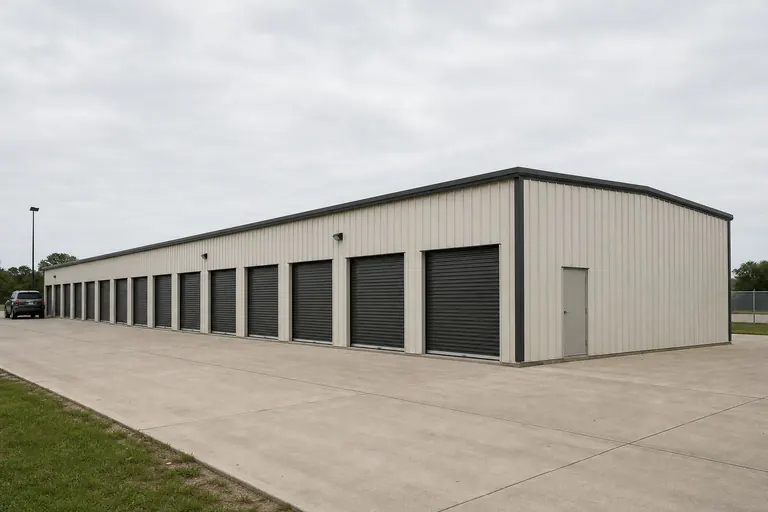 Drive-up unit rowsSingle-story buildings with exterior access to each unit, a common format on larger, flatter parcels where paved drive aisles are straightforward to lay out.Climate-controlled interior corridorsEnclosed buildings with interior hallways, more common where humidity control is a selling point, particularly near the Gulf Coast.Boat and RV storage baysTaller, deeper bays for large vehicles, often developed alongside standard unit rows on the same parcel.
Example Configuration — for planning purposes only.
Preparation
Before you evaluate a Texas mini-storage site
A handful of due-diligence steps matter more in Texas than in a smaller or more uniform state.
- Confirm commercial zoning and site-plan review requirements locallyThere is no statewide commercial zoning standard; each city or county runs its own review process.
- Check whether the site sits inside the windstorm catastrophe areaTDI and TWIA can confirm coverage-area status; factor certification timeline into your development schedule if so.
- Evaluate regional soil and drainage conditionsBlackland clay soils, coastal drainage, and High Plains aridity each affect foundation and paving design differently.
- Confirm fire-access lane requirements with the local jurisdictionMulti-building facilities typically face specific access requirements that vary by municipality.
- Factor delivery and construction logistics for remote sitesOn Texas's largest-in-the-lower-48 land area, some candidate sites carry meaningfully longer haul distances.
Questions
Texas mini-storage building questions
Honest answers at the state level, with zoning, insurance and pricing questions routed to whoever actually owns them.
Permit and site-plan review requirements are set locally, since Texas has no single statewide building code authority enforcing a mandatory code for most construction. Your city or county planning department is the authority for your site.
Inside the state's designated windstorm catastrophe area, the Texas Windstorm Insurance Association requires a Windstorm Certificate of Compliance, tied to a Texas Department of Insurance inspection process, before it will issue wind and hail coverage. Outside that area, standard commercial underwriting applies.
That depends on market and site-specific factors we don't assess here. Regionally, expect different soil, drainage and zoning conditions across the Gulf Coast, Blackland Prairie, High Plains and Trans-Pecos, and confirm details with local planning staff and a site engineer.
We do not publish state-level prices, since development cost depends on site work, size, specification and market conditions. Our cost pages explain what drives the number; a builder or contractor quote covers your specific project.
No. A mini-storage building is a commercial, multi-tenant facility with its own zoning and site-plan review process. A personal storage building is a small, single-owner accessory structure with different, typically simpler local requirements.
FEMA's National Risk Index scores Texas communities across 18 hazard types, which can be a useful due-diligence input, but a site-specific hazard and insurance assessment from a qualified professional is the reliable source for a specific parcel.
Sources for the Texas facts on this page
This page states no code requirement, wind speed, snow load, permit rule, price or supplier claim. The state-specific facts it does use are listed with their publisher below.
Texas's total land area was 261,226 square miles per the 2008 Census Bureau state area measurements, the largest of the contiguous 48 states.
U.S. Census Bureau, Statistical Abstract of the United States: 2011 · 2008 · Tier 1
https://www2.census.gov/library/publications/2010/compendia/statab/130ed/tables/11s0355.pdfTexas does not have a single statewide building code authority enforcing a mandatory building code for most construction; code adoption and enforcement occur primarily at the local/municipal level.
KHOU 11 (Verify) / Texas State Law Library · current · Tier 3
https://www.khou.com/article/news/verify/verify-statewide-enforced-residential-building-code-texas/285-cc7c6343-cdf1-4751-b855-713601cf6b8bThe Texas Department of Insurance (TDI) administers a Windstorm Inspection Program for coastal construction, established under a 1987 state law, to allow structures to qualify for windstorm coverage.
Texas Department of Insurance (TDI) · since 1988 · Tier 2
https://www.tdi.texas.gov/wind/generalquestio.htmlThe Texas Windstorm Insurance Association (TWIA) requires coastal properties to hold a Windstorm Certificate of Compliance under Texas Insurance Code Chapter 2210 before TWIA wind/hail coverage is issued; TDI states the designated catastrophe area covers 14 coastal counties and part of Harris County east of Highway 146.
Texas Windstorm Insurance Association (TWIA) / Texas Department of Insurance (TDI) · current · Tier 2
https://www.tdi.texas.gov/tips/need-windstorm-inspection.htmlThe USGS-published Bureau of Economic Geology map identifies major Texas physiographic regions including the Gulf Coastal Plains, Interior Plains, Great Plains, and Basin and Range provinces.
Bureau of Economic Geology, University of Texas at Austin · 1996 · Tier 2
https://txmn.org/st/files/2022/09/BEG_PHYSIOGRAPHY_1996.pdfFEMA's National Risk Index scores U.S. communities, including Texas counties, across 18 defined natural hazard types.
FEMA · current dataset · Tier 1
https://www.fema.gov/about/openfema/data-sets/national-risk-index-data