Pole barn · LA
Pole Barns in Louisiana
Louisiana's 2022 Census of Agriculture counted 25,006 farms, down 9% since 2017, spread across 7,986,381 acres, an amount that grew 9% — meaning the state has fewer farms working more land each, averaging 319 acres apiece. Combine that consolidation with a climate NOAA describes as being struck by a hurricane roughly once every three years, and the honest Louisiana pole-barn story is about protecting equipment and stored inputs on larger working parcels through a recurring storm cycle, not about a single dramatic weather event.
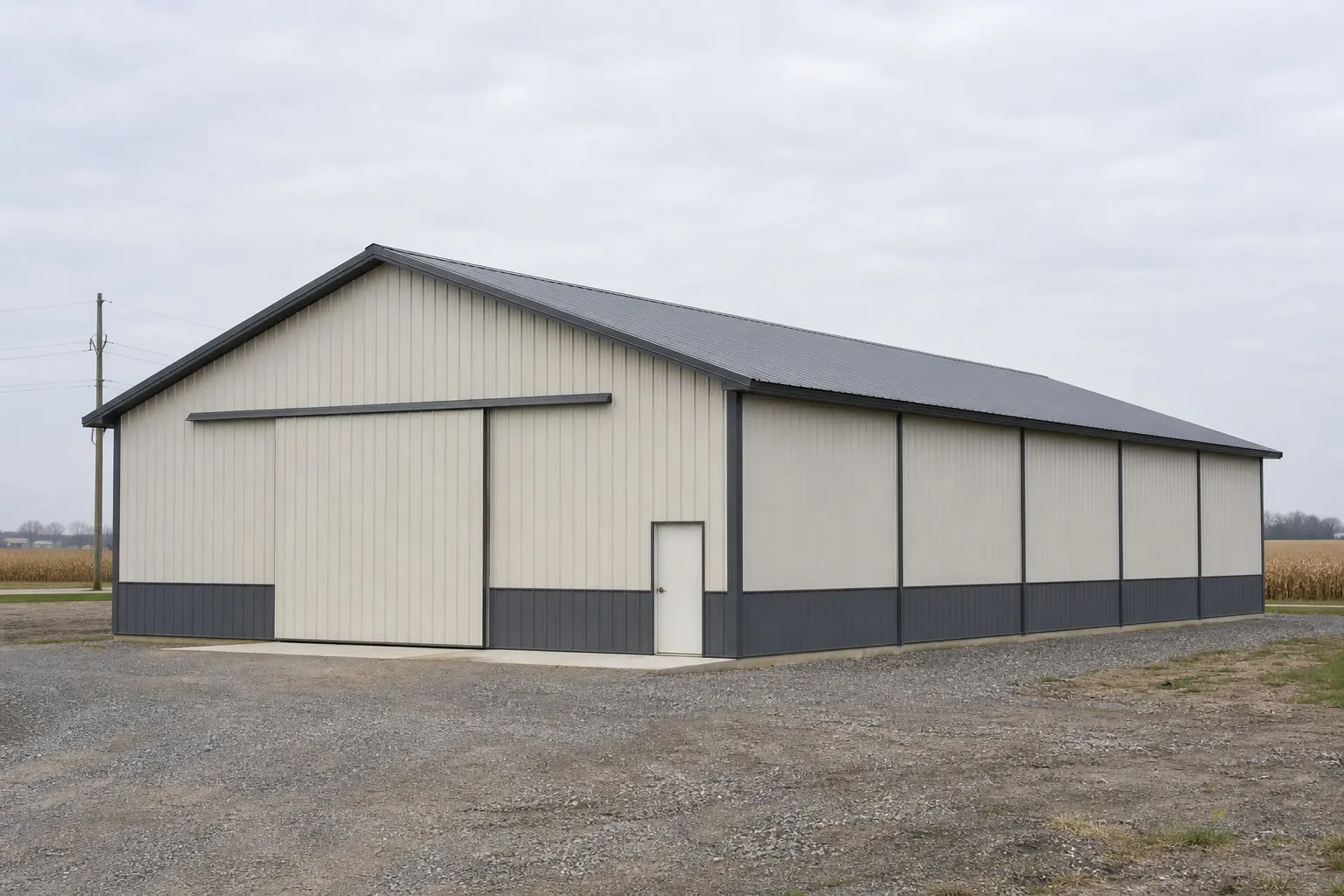
The intersection
What a Louisiana site actually changes about a pole barn
The post-frame building method does not change here. What changes is the scale of the operation it usually serves and the storm cycle it has to sit through.
The 2022 Census of Agriculture recorded 25,006 farms in Louisiana, a 9% decrease since 2017, working 7,986,381 acres of farmland, up 9% over the same period. Put together, that is consolidation: fewer operations, each working more ground, averaging 319 acres. For a pole barn buyer, that generally means the building is asked to do more per structure — equipment, feed, and general storage under one roof — rather than a scattering of small single-purpose sheds.
NOAA NCEI's state climate summary states that hurricanes strike Louisiana on average once every three years. That is a documented recurrence pattern, not a one-off risk, and it reframes storm planning from an occasional concern into a routine part of siting and detailing a pole barn here. NOAA also publishes a broader narrative, 'Climate of Louisiana', describing the state's subtropical, Gulf-influenced climate, which is the backdrop for humidity and rainfall as everyday concerns for anything stored under a post-frame roof.
This page does not convert any of that into a wind rating, an anchoring spec or a required detail — those come from your building's engineering and your local building department. What it changes is the questions worth asking before you finalize a plan: how the building's doors and openings are oriented, how contents are protected during the recurring storm season, and how much single-building capacity the operation actually needs given its acreage.
Site context
How siting considerations differ across Louisiana
FEMA's National Risk Index data and Louisiana's own geography point to real differences in what a pole-barn siting conversation should cover depending on location.
Southern and coastal parishes
Closest to the Gulf hazard profile FEMA's dataset highlights for hurricane and coastal flooding. Elevation and drainage around the pad are worth confirming against current data before pouring.
Central Louisiana
Inland of direct coastal flood exposure but still inside the statewide hurricane-recurrence pattern NOAA describes; wind exposure and rainfall drainage remain first-order siting questions.
Northern Louisiana
Furthest from the immediate coastal hazard profile, but the same subtropical rainfall pattern NOAA's climate narrative describes still makes drainage planning worthwhile for any pole barn floor.
Exposure
Planning around a recurring storm cycle, not a single event
A once-every-three-years recurrence means the details that protect a pole barn's contents are worth building in from the start rather than retrofitting after a near miss.
This page does not assert a wind speed, an anchoring requirement or an insurance recommendation; those depend on your engineering, your jurisdiction and your insurer. What is reasonable to plan around, using NOAA's own recurrence framing, is that a Louisiana pole barn will very likely experience at least one significant storm cycle within a typical ownership period.
That makes door and opening placement, how loose materials are stored, and how quickly the building can be secured before a storm worth discussing with your builder at the design stage, alongside the drainage and pad-height questions common to any Gulf Coast site.
- Opening orientation
- Discuss door and window placement relative to prevailing storm direction with your builder before finalizing the plan.
- Loose-material storage
- Plan interior storage so contents can be secured quickly ahead of a forecast storm, rather than improvised each time.
- Pad drainage
- Subtropical rainfall volumes make finished-floor elevation and roof-water routing worth resolving before the slab is poured.
Get Louisiana pole barn quotes
Tell us your parish, your acreage and the full list of what the building needs to store. We route it with the Louisiana and pole barn context already attached.
Configuration
What Louisiana pole barns are usually asked to do
Farm consolidation toward fewer, larger operations changes the brief toward a single capable building rather than several small ones.
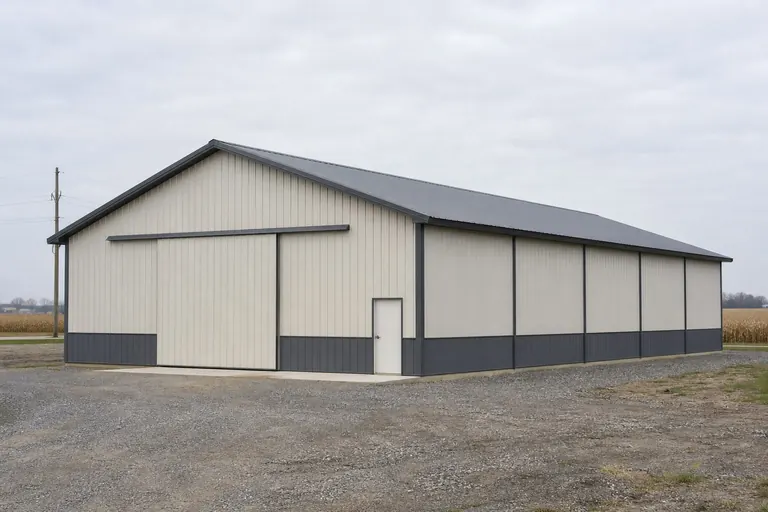 Equipment and input storageA clear-span bay sized for larger equipment fleets that come with consolidated acreage, plus dry storage for feed or inputs.Combined hay and equipmentLarger average acreage supports a building that separates hay storage from equipment bays within one structure rather than two separate sheds.
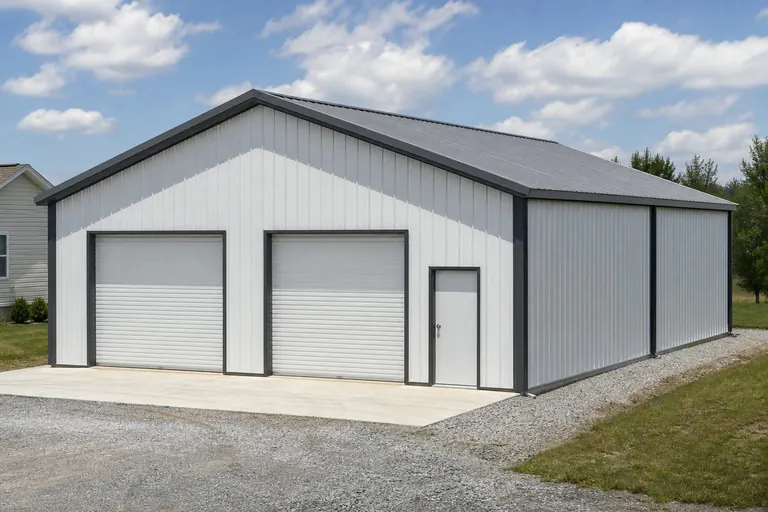 Workshop additionA partitioned, better-finished end for equipment maintenance, common where a single building has to do double duty on a working parcel.
Example Configuration — for planning purposes only.
Footprint
Sizes that suit a consolidated Louisiana farm operation
Fewer, larger farms with more acreage each tend to justify a bigger single pole barn rather than several small structures.
30′ × 50′
1,500 sq ft
A workable entry size for equipment storage plus limited dry storage.
40′ × 60′
2,400 sq ft
The common mid-range choice for a combined equipment-and-hay operation.
40′ × 80′
3,200 sq ft
Where larger equipment fleets and separate storage zones both need to fit under one roof.
60′ × 100′
6,000 sq ft
For consolidated operations needing substantial single-building capacity.
Example Configuration — for planning purposes only.
Footprint pages carry the layout and door detail for each of these; this page only explains why the Louisiana brief lands in this range.
Preparation
Before you request a Louisiana pole barn quote
Four things resolved in advance make the difference between a comparable quote and a re-quote.
Step 1
Contact your local building department
Ask what your parish and parcel require before you fix the specification; requirements vary by jurisdiction.
Step 2
Check FEMA's National Risk Index for the parcel
Confirm hurricane and flood exposure at the county and tract level before siting the building.
Step 3
State the full storage program
List everything the building needs to hold; a mixed-use brief priced as single-use is a common cause of a second round of quoting.
Step 4
Discuss opening protection with your builder
Door and window placement relative to storm exposure is worth deciding at design stage.
Questions
Louisiana pole barn questions
Questions we can answer honestly at state level, with the ones we cannot routed to whoever actually owns them.
NOAA's state summary notes hurricanes strike Louisiana on average once every three years, a real recurrence pattern worth planning around. What that means for wind rating, anchoring or engineering on your specific building is a question for your local building department and your builder's engineer; we do not state those requirements here.
Permit requirements depend on your parish, your parcel and its use, including agricultural exemptions that vary locally. Your local building department is the only reliable source for that answer.
There is no official typical size. Louisiana's farm consolidation toward larger average acreage (319 acres) does favor larger single-building capacity, commonly in the 40x60 to 40x80 range, but your operation's specific storage needs should drive the number.
We do not publish state-level prices, because a credible number depends on your specification, site work and current material pricing. Our cost pages cover what drives the number; a quote covers your building.
NOAA NCEI's Climate of Louisiana narrative describes a subtropical, Gulf-influenced climate with significant humidity and rainfall. That makes ventilation and drainage worth planning for, but the specific detailing for your building depends on your builder's recommendations and your site conditions.
Sources for the Louisiana facts on this page
This page states no code requirement, wind speed, snow load, permit rule, price or supplier claim. The state-specific facts it does use are listed with their publisher below.
Louisiana had 25,006 farms in 2022, a decrease of 9% since 2017.
USDA National Agricultural Statistics Service (NASS) · 2022 · Tier 1
https://www.nass.usda.gov/Publications/AgCensus/2022/Online_Resources/County_Profiles/Louisiana/cp99022.pdfLouisiana had 7,986,381 acres of land in farms in 2022, an average farm size of 319 acres (up 9% since 2017).
USDA NASS · 2022 · Tier 1
https://www.nass.usda.gov/Publications/AgCensus/2022/Online_Resources/County_Profiles/Louisiana/cp99022.pdfNOAA NCEI's State Climate Summary for Louisiana states hurricanes strike Louisiana on average once every three years, and that Louisiana's temperatures have risen about 0.5°F since the beginning of the 20th century — less than a third of the warming for the contiguous United States as a whole.
NOAA National Centers for Environmental Information (NCEI) · State Climate Summaries series, 2022 · Tier 1
https://statesummaries.ncics.org/downloads/Louisiana-StateClimateSummary2022.pdfNOAA NCEI publishes a narrative 'Climate of Louisiana' describing the state's principal climatic features and providing climatological summaries for stations across its geographic regions.
NOAA National Centers for Environmental Information (NCEI) · Historical narrative (NCEI climate normals series) · Tier 1
https://www.ncei.noaa.gov/data/climate-normals-deprecated/access/clim60/states/Clim_LA_01.pdfLouisiana's total land area was measured at 43,203.9 square miles as of the 2010 Census.
U.S. Census Bureau · 2010 Census · Tier 1
https://www.census.gov/geographies/reference-files/2010/geo/state-local-geo-guides-2010/louisiana.htmlFEMA's National Risk Index dataset assesses 18 natural hazards, including hurricane, coastal flooding, and inland flooding, which are especially relevant to Louisiana's Gulf Coast exposure, at the county and Census tract level via its interactive online tool.
Federal Emergency Management Agency (FEMA) · Current NRI release · Tier 1
https://www.fema.gov/flood-maps/products-tools/national-risk-index