
Pole barn · KS
Pole Barns in Kansas
In Kansas, a pole barn is the primary tool for managing a farm base that averages 804 acres per operation—the largest in the central plains. Across the state's 81,758.7 square miles, post-frame construction must adapt to a geological and climatic divide. In the east-central Flint Hills, thin rocky soils formed from Permian limestones challenge traditional post-hole digging, while the shift from humid to semi-arid air toward the west changes how we approach ventilation and moisture control. Building here isn't just about square footage; it's about anchoring a structure to a landscape that demands resilience against high winds, hail, and extreme thermal swings.
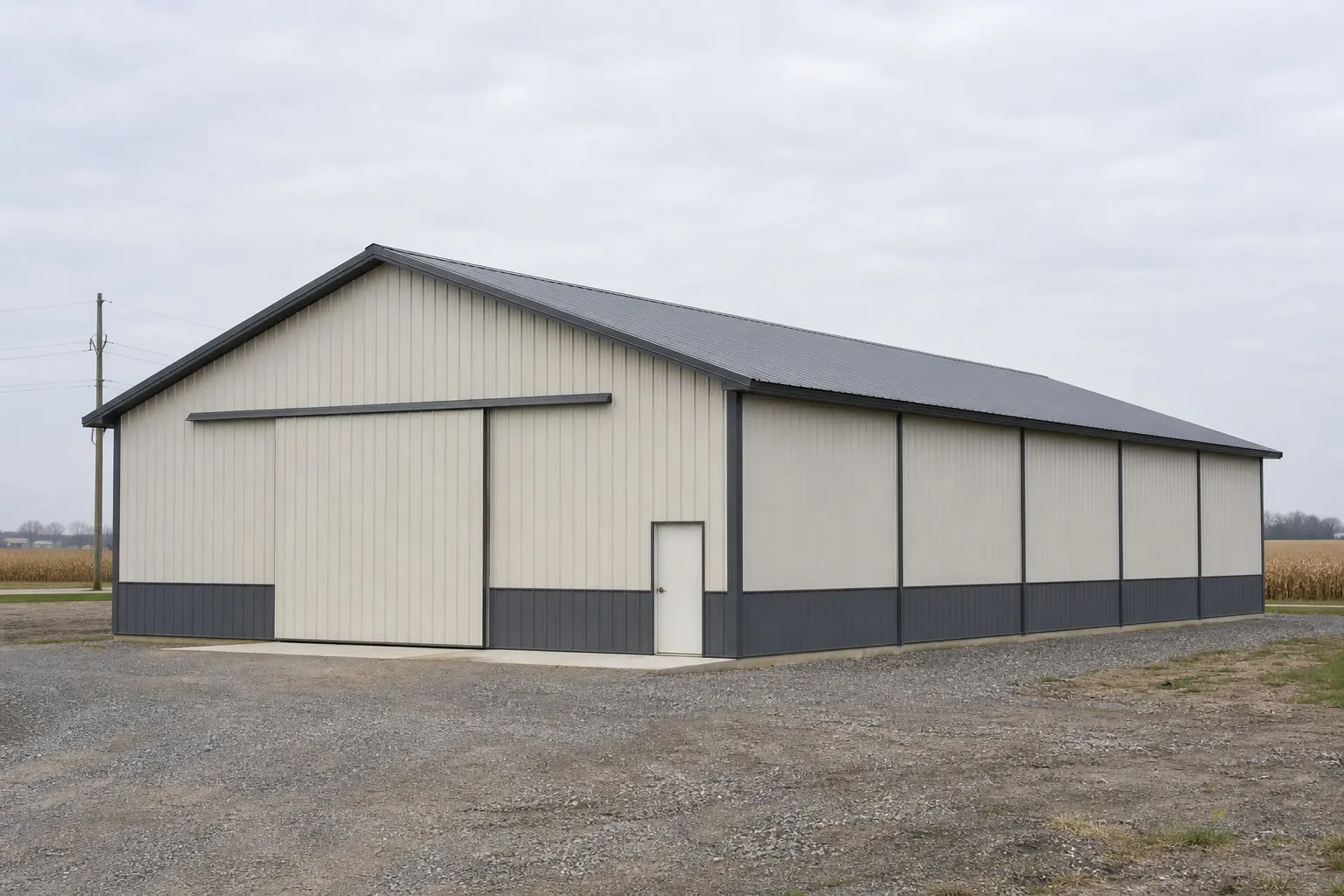
Foundation Planning
The Flint Hills Rock Challenge
Building a pole barn in east-central Kansas means dealing with the thin, rocky soils of the Flint Hills—a region where the ground itself prevented the plow.
The Kansas Geological Survey describes the Flint Hills as a north-south band of unplowed tallgrass prairie. The reason this land was never cultivated is the same reason it challenges post-frame construction: thin, rocky soils formed from Permian limestones and chert. For a pole barn buyer, this means that the 'standard' post-hole digger may fail within the first two feet of depth. In this region, anchoring a building requires either rock-auguring equipment or a transition to wet-set brackets on a thickened slab.
While these rocky conditions are localized to the Flint Hills, they define the site preparation costs for a significant portion of the state's grazing land. If your site sits in this corridor, the conversation with your builder must start with the substrate. Failing to account for Permian limestone early in the process can lead to significant delays when the foundation crew hits bedrock where the plans called for a four-foot hole.
Usage and Sizing
Sizing for the 804-Acre Operation
With a 44.7-million-acre farm base and an average size of 804 acres, Kansas pole barns are built for a different scale than those in the eastern Midwest.
The 2022 USDA NASS census highlights Kansas's massive agricultural scale. At 804 acres per farm, equipment is larger, grain storage is more intensive, and the need for clear-span space is absolute. A 30x40 pole barn, which might be a standard workshop in Missouri, is often too small for a Kansas operation that needs to house high-clearance sprayers or wide headers. The 'Kansas brief' typically starts at 40-foot widths and moves upward quickly.
This scale also impacts site selection. On a property of this size, you have the luxury of space but the burden of exposure. With severe wind and hail identified by FEMA as top-tier hazards, siting a large-span pole barn requires looking for natural windbreaks or orienting the smallest profile of the building toward the prevailing winds. The goal is to minimize the 'sail' effect that high-plains gusts can exert on a large metal structure. In practice that means treating the gable end, not the eave wall, as the side to point into the prevailing northwest winter wind wherever the site allows it, since a narrow gable profile sheds a gust that a broad eave wall would catch directly. On open ground with no windbreak within sight, that orientation decision is one of the few no-cost mitigations available before construction begins.
- Equipment Clearance
- Prioritize 14-foot to 16-foot eave heights to accommodate modern agricultural implements.
- Ventilation Gradient
- Eastern Kansas sites need vented ridges and soffits for humidity; Western sites need dust-tight closures.
- Drainage Siting
- On flat plains, create a positive grade away from the barn to prevent water pooling on the vast 800-acre landscape.
Data Point
Kansas Climate & Land Snapshot
These figures represent the environment where Kansas pole barns must perform over decades.
| Factor | Value | Source |
|---|---|---|
| Total Land in Farms | 44,794,702 Acres | USDA NASS 2022 |
| Average Farm Size | 804 Acres | USDA NASS 2022 |
| State Land Area | 81,758.7 Sq Mi | U.S. Census 2010 |
| Climate Type | Humid-to-Semi-Arid Transition | NOAA NCEI |
| Major Soil Region | Flint Hills (Permian Limestone) | Kansas Geological Survey |
Total Land in Farms
- Value
- 44,794,702 Acres
- Source
- USDA NASS 2022
Average Farm Size
- Value
- 804 Acres
- Source
- USDA NASS 2022
State Land Area
- Value
- 81,758.7 Sq Mi
- Source
- U.S. Census 2010
Climate Type
- Value
- Humid-to-Semi-Arid Transition
- Source
- NOAA NCEI
Major Soil Region
- Value
- Flint Hills (Permian Limestone)
- Source
- Kansas Geological Survey
Protect Your Equipment with a Kansas Pole Barn
Built for the scale of an 800-acre farm and the reality of Flint Hills rock. Get a quote for a post-frame building today.
Buyer Decision
Insulated Shop or Open Equipment Storage?
The humid-to-semi-arid split also shapes whether an insulated, conditioned shop or a simple open-sided storage bay makes more sense for a given Kansas site.
In the eastern third of the state, where humidity swings are larger, an uninsulated pole barn used for equipment storage can develop condensation on the underside of the roof steel, which drips onto machinery and accelerates rust. Buyers who plan to store combines or planters over the winter in this zone often find that a modest layer of roof insulation, even without full climate control, pays for itself by cutting down on moisture-related maintenance.
In the semi-arid west, the condensation risk is lower, but the swing between hot afternoons and cool nights is larger. A fully open, ventilated bay is often adequate for equipment storage there, reserving the cost of insulation for spaces where people actually work, such as an attached shop bay. The practical rule for a Kansas buyer is to insulate where machinery sits idle in the humid east, and reserve insulation for occupied work areas in the drier west, rather than defaulting to the same spec statewide.
Application
Primary Kansas Post-Frame Uses
The Kansas landscape dictates a few specific configurations for post-frame buildings.
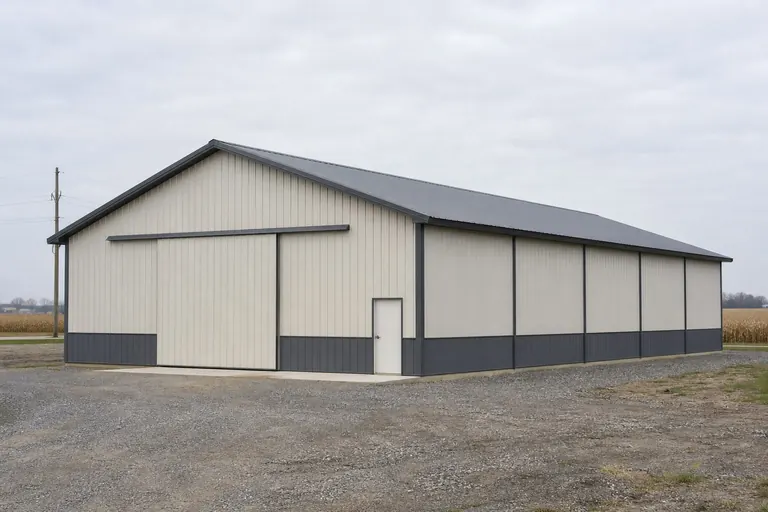 Implement StorageWide clear-span bays with high clearances for modern tillage and harvesting equipment.
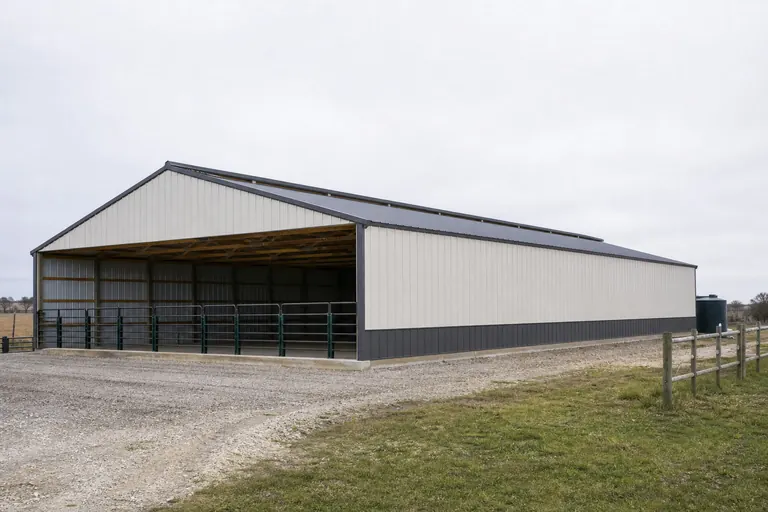 Livestock Run-InsThree-sided structures common in the Flint Hills grazing lands, providing shelter from wind and hail.Grain Support ShopsInsulated shops located near grain bin batteries for winter equipment maintenance.
Example Configuration — for planning purposes only.
Dimensions
Common Kansas Footprints
Reflecting the 804-acre average, these sizes prioritize the equipment volume necessary for Kansas operations.
40′ × 60′
2,400 sq ft
The entry-level size for a modern farm shop on a Kansas operation.
60′ × 80′
4,800 sq ft
Common for dedicated equipment storage where clear-span depth is required.
60′ × 120′
7,200 sq ft
A professional-scale barn for housing multiple large implements and a service bay.
Example Configuration — for planning purposes only.
Kansas wind exposure often makes 60-foot spans more economical than narrower, longer buildings that catch more cross-wind.
Questions
Kansas Pole Barn FAQ
Honest answers for builders in the Sunflower State.
The thin rocky soil over Permian limestone can make digging post-holes extremely difficult. If you are in this region, you need to verify your soil depth before finalize your foundation plan, as it may require specialized rock-drilling equipment.
Yes. It means Kansas operations generally use larger equipment than neighboring states, which dictates higher eave heights and wider doors. A barn sized for an Ohio farm is often undersized for a Kansas one.
In the east, focus on preventing interior condensation with vapor barriers. In the west, prioritize sealing against blowing dust and managing the extreme day-to-night temperature changes.
FEMA NRI data highlights severe wind and hail. Qualitatively, this means choosing a roof pitch that can shed hail efficiently and ensuring your building is anchored to withstand high-velocity plains gusts.
It depends on use and region. In humid eastern Kansas, even a storage-only barn benefits from roof insulation to cut down on condensation dripping onto equipment. In the drier west, insulation matters most in bays where people actually work, since idle equipment storage can usually get by with ventilation alone.
Sources for the Kansas facts on this page
This page states no code requirement, wind speed, snow load, permit rule, price or supplier claim. The state-specific facts it does use are listed with their publisher below.
Kansas had 44,794,702 acres of land in farms in 2022, an average farm size of 804 acres — the largest average farm size figure among the four-state group reviewed here (IL, IA, KS, LA).
USDA NASS · 2022 · Tier 1
https://www.nass.usda.gov/Publications/AgCensus/2022/Full_Report/Volume_1,_Chapter_1_State_Level/Kansas/st20_1_001_001.pdfKansas had 44,794,702 acres of land in farms in 2022, an average farm size of 804 acres — the largest average farm size figure among the four-state group reviewed here (IL, IA, KS, LA).
USDA NASS · 2022 · Tier 1
https://www.nass.usda.gov/Publications/AgCensus/2022/Full_Report/Volume_1,_Chapter_1_State_Level/Kansas/st20_1_001_001.pdfThe Flint Hills region, running north-south through east-central Kansas, is one of the few large remaining areas of unplowed tallgrass prairie in North America because the region's thin, rocky (chert-bearing) soils formed from eroded Permian-age limestones and shales were historically too hard to plow, so the land has mainly been used for cattle grazing rather than row crops.
Kansas Geological Survey, University of Kansas · KGS reference material · Tier 2
https://www.kgs.ku.edu/Physio/flinthil.htmlThe Flint Hills region, running north-south through east-central Kansas, is one of the few large remaining areas of unplowed tallgrass prairie in North America because the region's thin, rocky (chert-bearing) soils formed from eroded Permian-age limestones and shales were historically too hard to plow, so the land has mainly been used for cattle grazing rather than row crops.
Kansas Geological Survey, University of Kansas · KGS reference material · Tier 2
https://www.kgs.ku.edu/Physio/flinthil.htmlNOAA NCEI's State Climate Summary for Kansas states the state is a region of transition between the humid conditions to the east and semi-arid conditions to the west, and that temperatures have risen about 1.5°F since the beginning of the 20th century, with greater warming in winter and spring than summer and fall.
NOAA National Centers for Environmental Information (NCEI) · State Climate Summaries series, 2022 · Tier 1
https://statesummaries.ncics.org/downloads/Kansas-StateClimateSummary2022.pdfFEMA's National Risk Index dataset assesses 18 natural hazards (including tornado, hail, drought, and severe wind, all historically significant to Kansas) at the county and Census tract level via its interactive online tool.
Federal Emergency Management Agency (FEMA) · Current NRI release · Tier 1
https://www.fema.gov/about/openfema/data-sets/national-risk-index-dataKansas had 55,734 farms in 2022, down from 58,569 in 2017.
USDA National Agricultural Statistics Service (NASS) · 2022 (with historical comparison back to 1992) · Tier 1
https://www.nass.usda.gov/Publications/AgCensus/2022/Full_Report/Volume_1,_Chapter_1_State_Level/Kansas/st20_1_001_001.pdf