Pole barn · OH
Pole Barns in Ohio
In a state with 76,500 farms and 13.1 million acres of agricultural land, the pole barn remains a fundamental tool for Ohio's rural economy. However, the Ohio pole barn is increasingly serving a dual purpose. With manufacturing providing 16.5% of the state's private-sector GDP, these structures are frequently specified as heavy-duty workshops rather than traditional hay sheds. The planning process is unique due to Ohio's regulatory split: the Board of Building Standards adopts the codes, while certified municipal, county, or township departments handle the enforcement. Whether you are supporting a working farm or building a secondary workshop, understanding this local enforcement structure is key to a successful Ohio build.
Building for a State in Transition
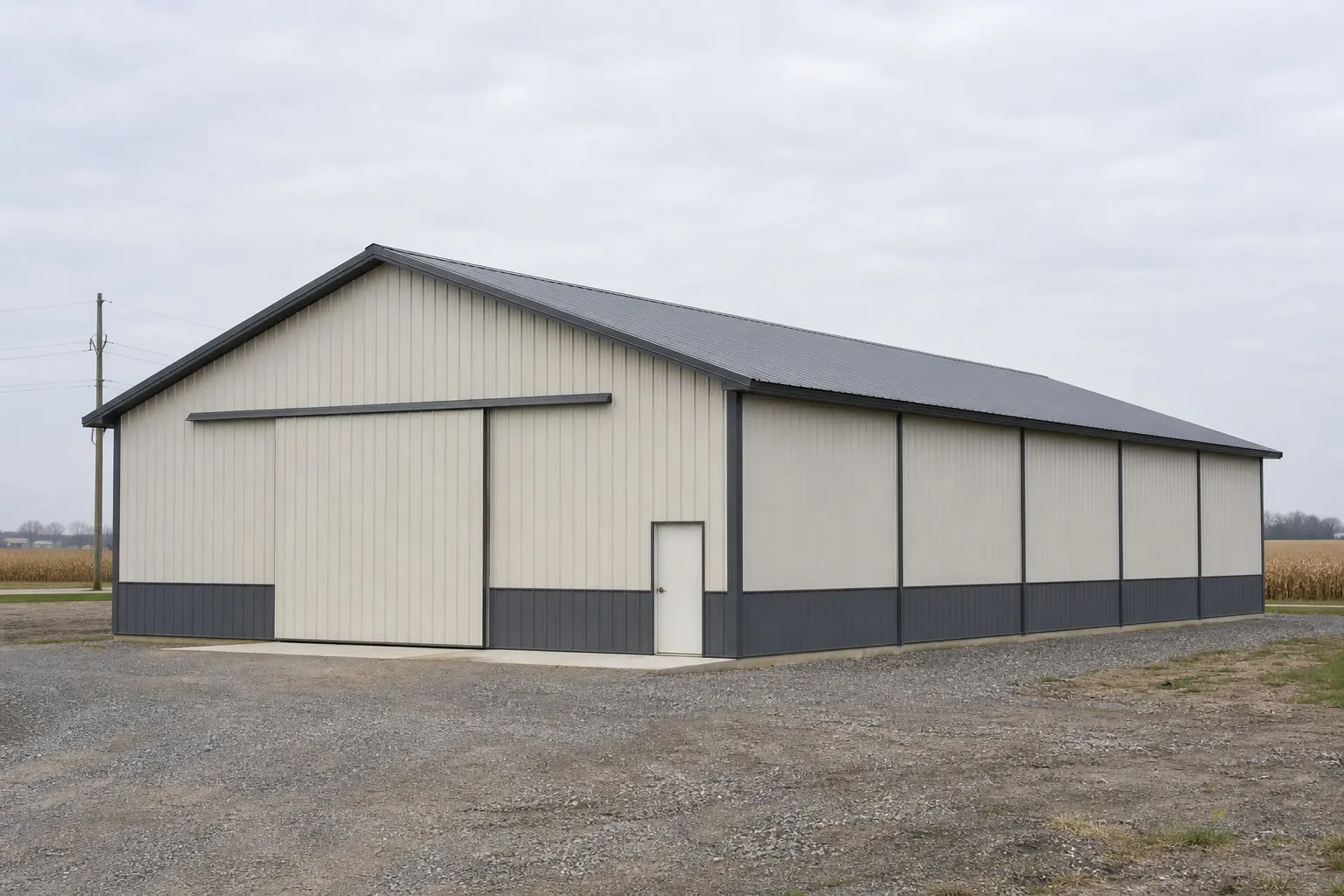
Ohio's landscape is defined by its 76,500 farms, but the nature of these properties is changing. As farmland acreage contracts—down by 400,000 acres in the latest census cycle—the traditional pole barn is evolving into a high-utility, multi-purpose structure. In Ohio, a pole barn is as likely to house a CNC machine or a vehicle restoration shop as it is to store hay or livestock. This transition is backed by a state economy where manufacturing accounts for 16.5% of private-sector GDP, creating a demand for buildings that offer industrial-grade performance within a rural or suburban footprint.
Regulatory Framework
Why 'Local' Matters More Than 'State' in Ohio
The Ohio Board of Building Standards sets the rules, but your local certified department decides how they apply to your barn.
In many states, agricultural buildings are governed by a single, simple statewide exemption. Ohio’s system is more nuanced. The state Board of Building Standards adopts the codes, but they certify separate municipal, county, and township departments to handle the actual enforcement. This means the process for getting a 'barn' permit in one county may be significantly different from the process in the next, even if the building design is identical.
For the 76,500 farm owners in Ohio, this requires identifying the specific certified department that governs their parcel before finalizing a plan. If you are building a pole barn for strictly agricultural use on working farmland (part of the 13.1 million acres in production), you may qualify for specific exemptions, but the local department is the only authority that can grant that status. If the building is intended for manufacturing, commercial storage, or a workshop, it will likely be held to a different standard under the state-adopted code.
This two-layer system also affects how climate risks are managed. Because Ohio station-level data varies significantly—from the lake-effect zones in the north to the river valleys in the south—the state does not mandate a single snowfall or wind speed figure. Instead, we route you to your local certified department, which will provide the specific design values required for your exact location, ensuring the structural integrity of your steel barn.
State Statistics
Ohio Agriculture & Land Metrics
These sourced figures highlight the scale and changing nature of the Ohio agricultural market.
| Metric | Value | Source |
|---|---|---|
| Total Active Farms | 76,500 | USDA NASS |
| Land in Farms | 13.1 million acres | USDA NASS |
| Acreage Trend | -400,000 acres since 2017 | USDA NASS |
| Manufacturing GDP Share | 16.5% | Ohio Manufacturers' Association |
| Land Area | 44,826 sq mi | U.S. Census Bureau |
Total Active Farms
- Value
- 76,500
- Source
- USDA NASS
Land in Farms
- Value
- 13.1 million acres
- Source
- USDA NASS
Acreage Trend
- Value
- -400,000 acres since 2017
- Source
- USDA NASS
Manufacturing GDP Share
- Value
- 16.5%
- Source
- Ohio Manufacturers' Association
Land Area
- Value
- 44,826 sq mi
- Source
- U.S. Census Bureau
Construction Focus
The 'Industrial Pole Barn' Phenomenon, and Siting It for Livestock Safety
Ohio's manufacturing workforce is repurposing the pole barn for high-output workspace, and FEMA's National Risk Index gives farms sheltering livestock a way to compare site risk.
With manufacturing representing 16.5% of the private-sector GDP and providing over 691,900 jobs, there is a massive population of workers in Ohio with the skills and desire for home-based industrial space. This has led to the rise of the 'industrial pole barn'—a steel-framed structure that maintains the cost-efficiency of a barn but incorporates features like heavy-duty 6-inch concrete slabs, 200-amp electrical service, and high-efficiency insulation packages.
The shift is also visible in sizing. While a traditional hay barn might prioritize volume and ventilation, an Ohio workshop barn focuses on clear-span width and door height. Owners are increasingly requesting footprints that allow for large vehicle bays and separate, climate-controlled clean rooms for machining or assembly. This is a direct reflection of Ohio's economic identity as a maker state.
On the 13.1 million acres of farmland still in operation, the pole barn remains a workhorse for equipment storage. However, as farms consolidate or transition to smaller acreage, these buildings are being asked to do more. A single structure might store a tractor, a combine, and a high-end truck, requiring a plan that prioritizes accessibility and security over simple square footage.
When a pole barn is sheltering livestock rather than only machinery, the stakes of a severe-weather event change. FEMA's National Risk Index scores 18 named hazards — including tornado, hail, strong wind, and winter weather — at the county and census-tract level for every county in Ohio. These are relative comparison scores rather than design values, and this page does not attach a number to any specific Ohio county, but the tool is genuinely worth a look during site planning for a livestock-holding barn.
In practical terms, a farm owner comparing two possible barn locations on the same property can use the relative severe-wind and tornado ratings, alongside basic observation of which direction storms typically track across the parcel, to decide where a run-in shelter or safe corner should sit relative to the main structure. As with structural wind and snow loads, the NRI's county-level hazard scores are a planning input, not a substitute for your local certified department's requirements — use it to inform where on the property the barn sits, then let the certified department's station-level data drive the actual structural specification.
Get Your Ohio Pole Barn Quote
Work with builders who understand Ohio's agricultural history and industrial future.
Configurations
Typical Ohio Pole Barn Applications
The intersection of agriculture and industry creates these three common project types.
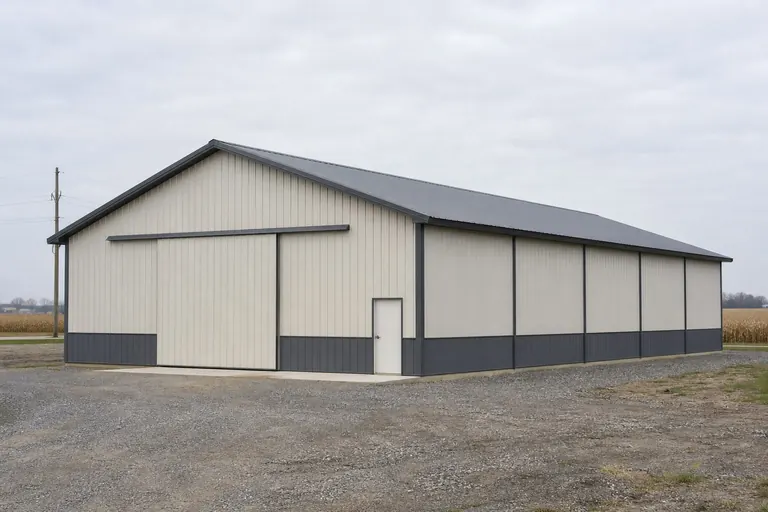 Traditional Ag StorageOptimized for the 76,500 working farms; focuses on large equipment storage, hay protection, and livestock shelter with a focus on durability.Manufacturing WorkshopTailored to Ohio's industrial workforce; features heavy-duty slabs, specialized power, and superior insulation for year-round work.Lifestyle Multi-ToolBuilt for the shrinking acreage lots; a single building for residential storage, property maintenance equipment, and hobby space.
Example Configuration — for planning purposes only.
Common Footprints
Ohio Pole Barn Sizing Guide
These sizes are frequently chosen to balance utility and cost on typical Ohio parcels.
30′ × 40′
1,200 sq ft
Perfect for a residential workshop or small farm equipment storage.
40′ × 60′
2,400 sq ft
The most versatile size for multi-use agricultural and workshop needs.
60′ × 100′
6,000 sq ft
A large-scale solution for commercial agriculture or light manufacturing.
Example Configuration — for planning purposes only.
Width and length are the outer dimensions; always plan for interior clearance requirements.
Action Plan
Steps to Your Ohio Pole Barn
Ensure your project is ready for the Ohio regulatory and economic environment.
- Consult Local Certified OfficialsConfirm if your township or county department handles permits for your specific barn type.
- Determine Ag StatusCheck if your project qualifies for agricultural building exemptions based on your farm's production status.
- Plan for Industrial LoadsIf using the barn as a workshop, specify floor slab thickness to accommodate heavy machinery.
- Obtain Station-Specific LoadsRequest wind and snow design values from the nearest NOAA weather station through your local department.
Ohio FAQ
Frequently Asked Questions
Honest answers for Ohio pole barn buyers.
It depends entirely on your local certified building department and the intended use. Purely agricultural structures on working farms often have different requirements than residential or commercial buildings.
It drives a demand for higher specifications—better insulation, stronger slabs, and more complex electrical systems—than are typically found in purely agricultural states.
As acreage lots become smaller, owners are opting for more efficient, multi-purpose buildings that combine storage and workspace into a single footprint.
Your municipal, county, or township building department. The state BBS adopts the code, but the local department is your primary point of contact for enforcement.
Yes. FEMA's National Risk Index gives relative, county-level hazard comparisons that are useful for choosing where on a parcel to place a livestock-holding barn, though it does not replace the station-level wind and snow loads your local certified department will require.
Sources for the Ohio facts on this page
This page states no code requirement, wind speed, snow load, permit rule, price or supplier claim. The state-specific facts it does use are listed with their publisher below.
The Ohio Board of Building Standards formulates, adopts, and amends the state's Building, Mechanical, Plumbing, Elevator, Boiler, and Pressure Piping Codes, and certifies municipal, county, and township building departments to enforce them.
Ohio Department of Commerce, Division of Industrial Compliance · Current program page · Tier 2
https://com.ohio.gov/divisions-and-programs/industrial-compliance/boards/board-of-building-standardsNumber of farms in Ohio in 2022.
USDA National Agricultural Statistics Service · 2022 Census of Agriculture (released Feb 2023 preliminary/2024 full) · Tier 1
https://www.nass.usda.gov/Statistics_by_State/Ohio/Publications/Current_News_Releases/2023/nr2311oh.pdfLand in farms in Ohio in 2022.
USDA National Agricultural Statistics Service · 2022 Census of Agriculture · Tier 1
https://www.nass.usda.gov/Statistics_by_State/Ohio/Publications/Current_News_Releases/2023/nr2311oh.pdfManufacturing is Ohio's largest private economic sector by GDP share, per an Ohio Manufacturers' Association analysis of federal data.
Ohio Manufacturers' Association (OMA), citing BLS/BEA data · 2024/2025 edition · Tier 2
https://www.ohiomfg.com/wp-content/uploads/2026/02/OMA_ManufacturingCounts2025_CMYK-FINAL-2.25.26.pdfOhio total land area per US Census Bureau state area measurements.
U.S. Census Bureau · 2010 measurement basis · Tier 1
https://www.census.gov/geographies/reference-files/2010/geo/state-area.htmlFEMA's National Risk Index tool scores 18 named natural hazards (avalanche, coastal flooding, cold wave, drought, earthquake, hail, heat wave, hurricane, ice storm, inland flooding, landslide, lightning, strong wind, tornado, tsunami, volcanic activity, wildfire, winter weather) at county/tract level for every state including Ohio.
FEMA · Current release (NRI dataset, updated periodically) · Tier 1
https://www.fema.gov/flood-maps/products-tools/national-risk-index