
Carport · OH
Carports in Ohio
Planning a carport in Ohio is a direct response to the state's variable climate and its mobile industrial workforce. With manufacturing providing roughly 16.5% of Ohio's private-sector GDP, personal vehicle reliability is a cornerstone of the state's economy. A steel carport provides essential protection for cars, trucks, and the specialized equipment found on Ohio's 76,500 active farms. However, the project is governed by a unique regulatory structure: the Ohio Board of Building Standards adopts the code, but the actual enforcement and classification of your carport fall to your certified local municipal, county, or township department. Whether you are battling lake-effect weather or the humid summers of the river valleys, navigating this local enforcement is the first step in protecting your investment.
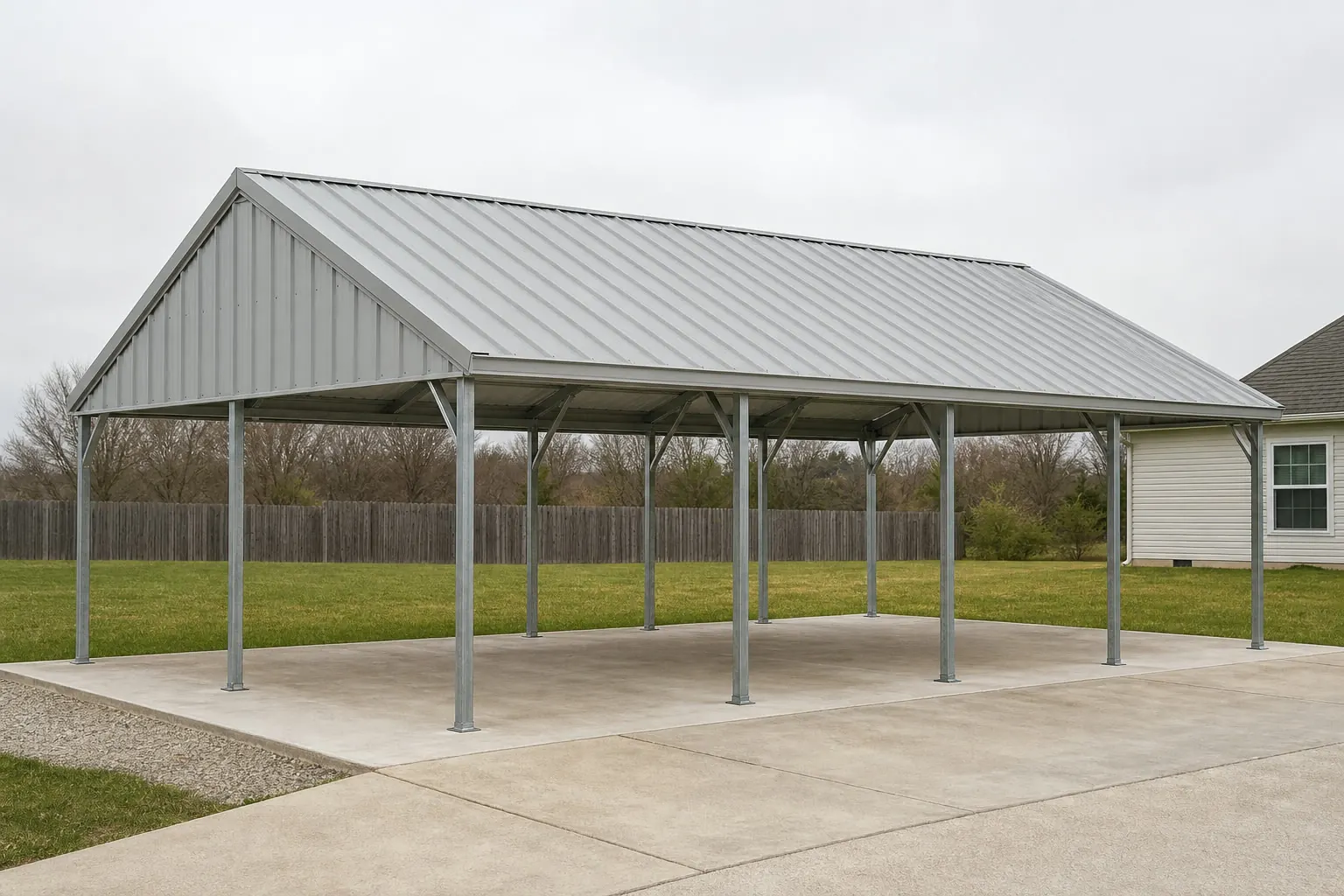
Protecting Ohio's Transportation Foundation
In a state where manufacturing is the largest private economic sector (16.5% of GDP), the ability to keep vehicles operational through diverse weather is a necessity. Ohio's 76,500 farms and its massive industrial workforce of over 691,900 people require reliable vehicle and equipment protection. A steel carport is a high-utility solution for this need, but its planning is governed by Ohio's specialized two-layer regulatory system. While the state Board of Building Standards sets the baseline code, the actual enforcement—and the critical decision of whether your carport is an accessory or a permanent structure—happens at the municipal, county, or township level.
Planning Framework
Navigating Local Carport Permits in Ohio
Your carport's permit status is a local decision rooted in state-adopted codes.
In Ohio, the Board of Building Standards (BBS) adopts and amends the statewide Building codes, but they do not manage the day-to-day inspections. Instead, the BBS certifies separate municipal, county, and township building departments to handle enforcement. For a carport, this means your first step is identifying which certified department governs your parcel. The local official will determine if your carport requires a permit, a zoning certificate, or if it qualifies as an exempt accessory structure.
This distinction is especially important for the 76,500 active farms across Ohio's 13.1 million acres. A carport used strictly for agricultural equipment may face different regulatory hurdles than one used for residential vehicles in a suburban Columbus or Cleveland neighborhood. The local certified department will apply the state-adopted code to your specific use case, ensuring the structure meets safety standards without unnecessary procedural delays.
Climatically, Ohio is a state of extremes. Because we do not have a verified single statewide snowfall figure, structural design relies on station-level data from NOAA. Your local certified department will mandate specific wind and snow loads based on the records from the nearest weather station, ensuring that your steel carport is engineered to withstand the specific conditions of your 44,826-square-mile surroundings.
State Statistics
Ohio Economic & Geographic Context
These sourced figures provide the background for planning a carport in Ohio.
| Metric | Value | Source |
|---|---|---|
| Manufacturing GDP Share | 16.5% of private sector | Ohio Manufacturers' Association |
| Manufacturing Jobs | Over 691,900 | Ohio Manufacturers' Association |
| Active Farms (2022) | 76,500 | USDA NASS |
| Total Land Area | 44,826 sq mi | U.S. Census Bureau |
| Regulatory Body | Board of Building Standards (State Code Adoption) | Ohio Dept. of Commerce |
Manufacturing GDP Share
- Value
- 16.5% of private sector
- Source
- Ohio Manufacturers' Association
Manufacturing Jobs
- Value
- Over 691,900
- Source
- Ohio Manufacturers' Association
Active Farms (2022)
- Value
- 76,500
- Source
- USDA NASS
Total Land Area
- Value
- 44,826 sq mi
- Source
- U.S. Census Bureau
Regulatory Body
- Value
- Board of Building Standards (State Code Adoption)
- Source
- Ohio Dept. of Commerce
Design Logic
Why Ohio's Economy and Open-Sided Design Drive Carport Choices
The needs of the industrial workforce and the agricultural base dictate carport design, and the open-sided structure itself changes how orientation and station-level weather data should be used.
With manufacturing providing over 691,900 jobs in Ohio, many residents rely on heavy-duty personal trucks and commuter vehicles for their livelihood. A steel carport is a cost-effective way to protect these assets from the corrosive effects of Ohio's winters and the intense sun of its humid summers. This 'utility-first' mindset often leads to carport designs with higher clearance and heavy-duty steel gauges, ensuring the structure lasts as long as the vehicles it protects.
On Ohio's 76,500 farms, the carport serves a different purpose. As farmland consolidates—with a 400,000-acre loss since 2017—the need for efficient, low-cost equipment storage has increased. A steel carport allows farmers to shelter utility vehicles, tractors, and implements without the expense of a full enclosed building, providing a vital tool for property management across the state's 13.1 million agricultural acres.
Geographically, Ohio's terrain is mapped into physiographic regions by the state geological survey. While we do not name these regions here due to evidence gaps, your local certified department will require an anchoring plan that accounts for your site's specific geology. Whether you are building on the flat plains or in the hilly river valleys, ensuring your carport is properly secured to the ground is a fundamental structural requirement.
An enclosed garage or storage building only has to resist wind loads on its walls and roof. A carport, by definition, is open on at least one side, which means wind-driven snow, rain, and hail can travel underneath the roofline and reach a parked vehicle regardless of the structure's rated capacity. NWS Columbus and NWS Cleveland maintain separate 1991-2020 climate normals for their stations, and the prevailing wind direction embedded in that station data is worth discussing with your builder even though this page does not restate specific figures.
For a carport sited in the lake-effect zone near Cleveland or Toledo, orienting the open side away from the northwest — the direction lake-effect snow bands typically approach from — meaningfully reduces the amount of snow that accumulates on parked vehicles. In the milder south, closer to the Ohio River, wind-driven rain during spring storm systems is the more common concern, which argues for a similar orientation logic but for a different season. This is a zero-cost design decision if it is made before the slab is poured and the posts are set: ask your local certified department or builder which direction storms typically approach from at your specific address, and orient the open face of the carport accordingly rather than defaulting to whichever side faces the driveway.
Get Your Ohio Carport Quote
Work with experts who understand the needs of Ohio's industrial workforce and agricultural base.
Configurations
Common Ohio Carport Applications
These three designs reflect the primary needs of Ohio residents and farmers.
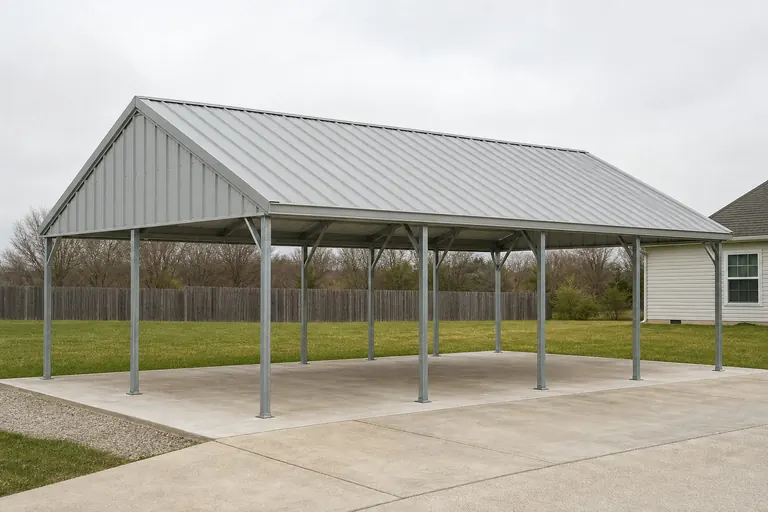 The Industrial CommuterOptimized for Ohio's manufacturing workforce; features a durable steel roof and open sides for easy daily access and vehicle protection.The Farm Utility ShelterDesigned for the 76,500 active farms; focuses on high-clearance protection for tractors, UTVs, and agricultural implements.The Lifestyle Multi-UseBuilt for the shrinking acreage lots; a versatile solution for boat storage, RV protection, and residential utility.
Example Configuration — for planning purposes only.
Popular Sizes
Sizing Your Ohio Carport
Select a footprint that fits your vehicle and your parcel's zoning requirements.
12′ × 20′
240 sq ft
A standard single-vehicle shelter for compact commuters.
24′ × 25′
600 sq ft
The preferred size for two full-sized trucks or farm utility vehicles.
30′ × 40′
1,200 sq ft
A heavy-duty solution for RV storage or multi-vehicle protection.
Example Configuration — for planning purposes only.
Always verify setbacks and lot coverage limits with your local certified department.
Action Plan
Steps to Your Ohio Carport Build
Follow these steps to ensure a successful, code-compliant carport project.
- Identify Your Local Building DepartmentConfirm if your municipal, county, or township department requires a permit or zoning certificate for a carport.
- Verify ClassificationsAsk if your local department considers a carport a permanent structure or a temporary accessory.
- Ask For Your Parcel's Design ValuesConfirm the wind and snow design values that apply to your parcel with your local certified building department rather than assuming a statewide figure.
- Determine Anchoring NeedsConsult with your builder to ensure the anchoring system is appropriate for your site's soil type and terrain.
Ohio FAQ
Carport FAQ
Honest answers for Ohio residents planning a steel carport.
It depends entirely on your local certified department. Some jurisdictions require a full permit, others only a zoning certificate, and some may exempt carports below a certain size.
The Board of Building Standards adopts the code statewide, but enforcement is handled by certified local municipal, county, or township departments.
Ohio has a strong supply chain for steel components due to its manufacturing base, ensuring high-quality materials are readily available for carport construction.
Design loads are set at the station level by your local certified building department, not by a single statewide average.
Yes. Because a carport has no walls to block wind-driven precipitation, orientation relative to prevailing storm direction matters more than it does for an enclosed structure. Discuss orientation with your builder using your nearest NWS station's normals as a reference point.
Sources for the Ohio facts on this page
This page states no code requirement, wind speed, snow load, permit rule, price or supplier claim. The state-specific facts it does use are listed with their publisher below.
The Ohio Board of Building Standards formulates, adopts, and amends the state's Building, Mechanical, Plumbing, Elevator, Boiler, and Pressure Piping Codes, and certifies municipal, county, and township building departments to enforce them.
Ohio Department of Commerce, Division of Industrial Compliance · Current program page · Tier 2
https://com.ohio.gov/divisions-and-programs/industrial-compliance/boards/board-of-building-standardsNumber of farms in Ohio in 2022.
USDA National Agricultural Statistics Service · 2022 Census of Agriculture (released Feb 2023 preliminary/2024 full) · Tier 1
https://www.nass.usda.gov/Statistics_by_State/Ohio/Publications/Current_News_Releases/2023/nr2311oh.pdfManufacturing is Ohio's largest private economic sector by GDP share, per an Ohio Manufacturers' Association analysis of federal data.
Ohio Manufacturers' Association (OMA), citing BLS/BEA data · 2024/2025 edition · Tier 2
https://www.ohiomfg.com/wp-content/uploads/2026/02/OMA_ManufacturingCounts2025_CMYK-FINAL-2.25.26.pdfOhio total land area per US Census Bureau state area measurements.
U.S. Census Bureau · 2010 measurement basis · Tier 1
https://www.census.gov/geographies/reference-files/2010/geo/state-area.htmlNWS Columbus and NWS Cleveland publish local climate normals pages for Ohio cities.
National Weather Service (NOAA) · 1991-2020 · Tier 1
https://www.weather.gov/iln/climate_normals_cmh