
Metal garage · PA
Metal Garages in Pennsylvania
Pennsylvania has one statewide building code, the Uniform Construction Code, administered by the Department of Labor & Industry. What most garage buyers don't know is that under Act 45 of 1999, each of the state's individual municipalities separately elects whether to administer and enforce that code itself, opt out of enforcement entirely, or hand the job to a third-party agency. That election, specific to your municipality, is the single most useful thing to find out before you finalize a metal garage plan. Layer in a state genuinely split into six named physiographic provinces and a farm base of 49,000 operations, and the honest Pennsylvania story is about who reviews your project locally and how differently the ground behaves across the state, not about a single statewide rule.
The intersection
The one Pennsylvania fact worth knowing before you plan a garage
Pennsylvania has a single statewide Uniform Construction Code, but who actually reviews your garage depends on a decision your specific municipality already made.
The Department of Labor & Industry administers the UCC statewide, so the rulebook itself does not vary town to town. What does vary is enforcement: under Act 45 of 1999, each of Pennsylvania's roughly 2,562 municipalities elected whether to administer and enforce the UCC itself, opt out of enforcement, or hand the job to a third-party agency. A buyer in a self-enforcing municipality deals with that municipality's own building department. A buyer in an opted-out or third-party municipality is dealing with a private inspection agency working under state rules. Neither path is better or worse on this page's terms; the point is that you should find out which one applies to your parcel before you commit to a plan, because it changes who you call with a plan-review question.
That single administrative fact is more useful to a Pennsylvania garage buyer than any generic code description could be, and it is also something this page cannot resolve for you: only your municipality's own records, or a call to Labor & Industry's UCC program, can tell you which election your town made.
Once you know which path applies, the follow-up questions are short and worth asking in one call. Find out what triggers a permit for a detached accessory structure at your intended size, what documentation is expected at application, whether stamped drawings are required, and which inspections happen during construction. Those four answers let a supplier quote the right scope instead of quoting a shell and leaving the paperwork to you.
The second Pennsylvania planning item is the site rather than the statute. Much of the state is hilly, and a garage pad on sloping ground brings excavation, retaining and drainage into the budget in a way a flat lot does not. Access matters as well: a narrow or steep driveway limits what can be delivered in one load, and it is far better to discover that during the site visit than on delivery day.
None of this changes the building you end up with. It changes how accurate the first quote is, and how few surprises sit between that quote and a finished garage.
If the garage is intended as a workshop rather than pure storage, say so at the quote stage. Insulation, a heated slab, additional door height and the electrical provision are all easier to design in than to add, and they are the items that most often separate two quotes that look identical on dimensions alone.
Site context
Pennsylvania's six physiographic provinces change how a garage site behaves
The Department of Conservation and Natural Resources names six provinces running northwest to southeast, and the difference between them is a real siting variable for a garage slab and approach.
Central Lowlands and Appalachian Plateaus
Covering much of western and north-central Pennsylvania, this is rolling, often hilly plateau country where grading and drainage planning around a garage pad deserve early attention.
Ridge and Valley
A band of long, parallel ridges and valleys through the center of the state; the valley floor a garage sits on can be very different from the ridge slope a few miles away.
Blue Ridge
A small southern-Pennsylvania province where terrain transitions sharply; site verification matters more than assumptions carried from a neighboring province.
Piedmont and Atlantic Coastal Plain
The gentler, lower-lying southeastern provinces, generally the easiest of the six for straightforward pad preparation and vehicle access.
Quick reference
Pennsylvania numbers this page relies on
Every figure below carries a named publisher and period; none of it is a design value or a code requirement.
| Measure | Figure | Source |
|---|---|---|
| Municipal code enforcement | Elected per municipality under Act 45 of 1999 | PA Department of Labor & Industry |
| Farms (2022) | 49,000, about 3% of the U.S. total | Center for Rural Pennsylvania, using USDA NASS |
| Physiographic provinces | Six, named by DCNR | PA Dept. of Conservation & Natural Resources |
| Total land area | 46,054 sq mi | U.S. Census Bureau |
| Climate reporting | 10 regional divisions, no single statewide normal | Pennsylvania State Climatologist, Penn State |
Municipal code enforcement
- Figure
- Elected per municipality under Act 45 of 1999
- Source
- PA Department of Labor & Industry
Farms (2022)
- Figure
- 49,000, about 3% of the U.S. total
- Source
- Center for Rural Pennsylvania, using USDA NASS
Physiographic provinces
- Figure
- Six, named by DCNR
- Source
- PA Dept. of Conservation & Natural Resources
Total land area
- Figure
- 46,054 sq mi
- Source
- U.S. Census Bureau
Climate reporting
- Figure
- 10 regional divisions, no single statewide normal
- Source
- Pennsylvania State Climatologist, Penn State
Get Pennsylvania metal garage quotes
Tell us your municipality, how many vehicles or bays you need, and your rough footprint. We route it with the Pennsylvania and metal garage context already attached.
Configuration
What a Pennsylvania metal garage is usually asked to do
With farms making up a small share of the state and most of the population concentrated outside large working acreages, Pennsylvania garage briefs skew toward vehicle and workshop use over agricultural equipment storage.
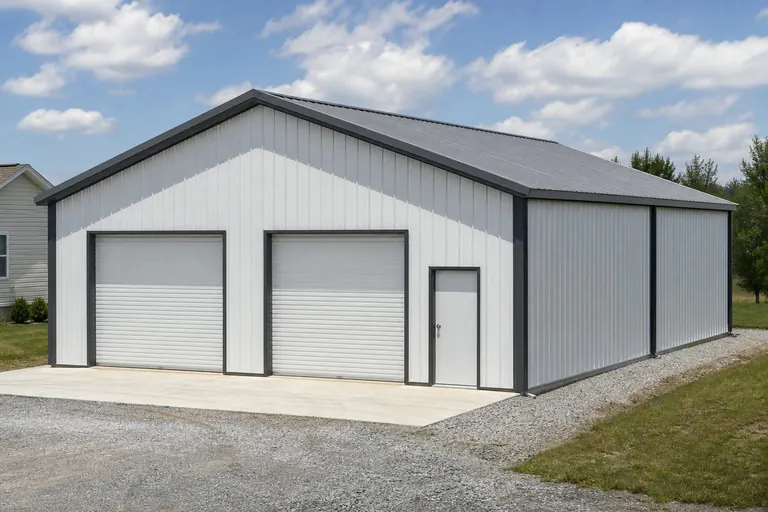 Multi-vehicle storageA frequent Pennsylvania brief: covered parking for personal vehicles, sized around door width and turning room rather than agricultural spans.Workshop plus storageA garage split between a finished workshop end and open vehicle storage, common on smaller suburban and exurban lots.RV and equipment bayTaller door and eave requirements for RV or larger equipment storage, more often seen outside the state's denser southeastern province.
Example Configuration — for planning purposes only.
Footprint
Sizes that fit a Pennsylvania garage brief
These are the footprints that recur once vehicle count and a secondary workshop or storage function are both factored in; none replaces a site-specific plan.
12′ × 20′
240 sq ft
The smallest single-vehicle footprint, useful on tight suburban lots.
18′ × 26′
468 sq ft
A step up for a vehicle plus modest workshop space.
20′ × 30′
600 sq ft
A common two-vehicle configuration on a typical exurban parcel.
24′ × 30′
720 sq ft
Adds width for easier door clearance and turning room.
30′ × 30′
900 sq ft
A square footprint suited to mixed vehicle and equipment storage.
30′ × 40′
1,200 sq ft
Room for multiple vehicles plus a dedicated shop bay.
40′ × 40′
1,600 sq ft
A larger multi-bay configuration for several vehicles or larger equipment.
40′ × 60′
2,400 sq ft
The upper end of this cluster, suited to fleet-style or combined equipment and vehicle storage.
Example Configuration — for planning purposes only.
Footprint-level layout and door detail live on the size pages; this page only explains why Pennsylvania briefs cluster here.
Preparation
Before you request a Pennsylvania garage quote
Four steps specific to how Pennsylvania actually administers construction.
Step 1
Find your municipality's Act 45 election
Ask your municipal office, or the Department of Labor & Industry's UCC program, whether your municipality self-enforces, opts out, or uses a third-party agency.
Step 2
Name your physiographic province
Ridge and Valley, Piedmont and the other DCNR provinces behave differently underfoot; telling your builder which one you're in helps the site conversation start correctly.
Step 3
Confirm vehicle and equipment mix up front
Door height and width decisions depend on exactly what will be stored, not just how many bays are wanted.
Step 4
Don't assume statewide climate figures apply to your site
Pennsylvania's own climatologist reports by region, not by one statewide number; ask locally about site-specific exposure rather than relying on a state average that does not exist.
Questions
Pennsylvania metal garage questions
Answered honestly at the state level, with anything requiring local judgment routed to the people who own that answer.
Pennsylvania administers a single statewide Uniform Construction Code through the Department of Labor & Industry. Enforcement, however, is elected by each municipality under Act 45 of 1999: your municipality self-enforces, opts out, or uses a third-party agency, and that election is what determines who reviews your project.
Your municipal office or the Department of Labor & Industry's Uniform Construction Code program maintains the municipal election records. We do not have that municipality-level detail on this page; it has to be confirmed locally.
Permit requirements depend on your specific municipality and its enforcement election. That is a question for your local building department or third-party agency, not something this page can answer generically.
There is no official typical size. Pennsylvania's small farm share relative to the national total points toward vehicle and workshop-focused briefs, which commonly land between 20x30 and 30x40, but your vehicle count and use should set the number.
We do not publish state-level prices; the real number depends on your specification, site work and current material costs. Our cost pages explain what drives the number, and a quote covers your specific building.
Sources for the Pennsylvania facts on this page
This page states no code requirement, wind speed, snow load, permit rule, price or supplier claim. The state-specific facts it does use are listed with their publisher below.
Pennsylvania's statewide building code, the Uniform Construction Code (UCC), is administered by the Department of Labor & Industry, and under Act 45 of 1999 each municipality elects whether to administer and enforce the UCC itself, opt out of enforcement, or use a third-party agency; opt-out municipalities' UCC enforcement is then handled per the state's default arrangement.
Pennsylvania Department of Labor & Industry · Current program page; Act 45 of 1999 framework · Tier 2
https://www.pa.gov/agencies/dli/programs-services/labor-management-relations/bureau-of-occupational-and-industrial-safety/uniform-construction-code-homePennsylvania's statewide building code, the Uniform Construction Code (UCC), is administered by the Department of Labor & Industry, and under Act 45 of 1999 each municipality elects whether to administer and enforce the UCC itself, opt out of enforcement, or use a third-party agency; opt-out municipalities' UCC enforcement is then handled per the state's default arrangement.
Pennsylvania Department of Labor & Industry · Current program page; Act 45 of 1999 framework · Tier 2
https://www.pa.gov/agencies/dli/programs-services/labor-management-relations/bureau-of-occupational-and-industrial-safety/uniform-construction-code-homeNumber of farms in Pennsylvania in 2022 and share of national total, per a Pennsylvania state-agency analysis of the Census of Agriculture.
Center for Rural Pennsylvania (state legislative agency), using USDA NASS data · 2022 Census of Agriculture, published May 2024 · Tier 1
https://www.rural.pa.gov/download.cfm?file=Resources%2FPDFs%2FAnalysis+of+2022+Ag+Census+Fact+Sheet+Web.pdfPennsylvania's Department of Conservation and Natural Resources states the Commonwealth contains six physiographic provinces, listed northwest to southeast as: Central Lowlands, Appalachian Plateaus, Ridge and Valley, Blue Ridge, Piedmont, and Atlantic Coastal Plain.
Pennsylvania Department of Conservation and Natural Resources (DCNR) · Current DCNR page · Tier 2
https://www.pa.gov/agencies/dcnr/conservation/geology/geology-of-pa/landformsPennsylvania total land area per US Census Bureau state area measurements.
U.S. Census Bureau · 2010 measurement basis · Tier 1
https://www.census.gov/geographies/reference-files/2010/geo/state-area.htmlThe Pennsylvania State Climatologist Office (Penn State) publishes observed average precipitation and temperature for 10 climate regions across the state.
Pennsylvania State Climatologist, Penn State College of Earth and Mineral Sciences · 1899-present regional series · Tier 2
https://climate.met.psu.edu/data/state/regional.php