
Metal garage · NJ
Metal Garages in New Jersey
A metal garage is fully enclosed, so the climate conversation shifts from open-air drainage to what happens to trapped air inside a sealed steel box. In New Jersey that box usually sits on a lot shaped by a housing market where 53.2% of 2023's authorized units were five-plus-unit multifamily buildings, which leaves many single-family properties without generous off-street storage of their own. At the same time, the state's 9,998 farms — averaging only 71 acres each but with product sales up 36% since 2017 — create a separate, genuine demand for enclosed equipment storage rather than simple vehicle parking.
The intersection
Why a sealed building changes what New Jersey's density and climate mean
An enclosed metal garage traps air rather than passing it through, which turns New Jersey's housing density and wet climate into a ventilation and site-fit question.
New Jersey's 2023 housing permits show 53.2% of the 32,840 authorized units were five-plus-unit multifamily construction, one of the highest shares among states. That pattern means a large and growing share of New Jersey households live in buildings without a private garage or driveway at all, which concentrates metal garage demand on the state's remaining single-family and small-multifamily properties — properties where enclosed storage is often the single most valuable accessory structure a homeowner can add.
New Jersey's farm sector adds a second, distinct demand line. The state counted 9,998 farms in 2022, averaging only 71 acres each, yet total farm product sales rose 36% from 2017. That combination of small acreage and rising output points to intensive, equipment-dependent operations that need secure, weather-tight storage for tractors, implements and seasonal supplies, a need that is different in scale and purpose from a suburban household's second vehicle.
Site prep itself is usually straightforward because New Jersey's land area is small — 7,354.2 square miles at the 2010 Census — so a metal garage builder is rarely contending with the dramatic terrain range a larger state would require covering. The binding constraint is almost always the municipal setback, lot-coverage or height rule rather than the ground itself.
Exposure
Ventilation planning and hazard checks for a New Jersey garage
A sealed steel structure benefits from planned airflow in New Jersey's wet climate, and coastal or floodplain properties need a separate hazard check.
Newark's 1991-2020 climate normal runs about 46.60 inches of annual precipitation, a persistently wet pattern that keeps ambient humidity elevated much of the year across much of the state. Inside a sealed metal garage without deliberate airflow, that humid air can condense on cool steel surfaces overnight, a slow but real threat to stored vehicles, tools and equipment. Static roof vents, gable vents or a small powered fan address this more reliably than relying on the door being opened occasionally.
For properties near New Jersey's Atlantic coast, the Hackensack Meadowlands, or other low-lying river corridors, a separate check is worth making: FEMA's National Risk Index (hazards.fema.gov/nri) is the appropriate county- and tract-level source for flood and wind hazard exposure. This page does not assert a specific statewide hazard score, because a direct FEMA-hosted narrative for New Jersey could not be confirmed in this evidence cycle; checking the NRI for your specific municipality before finalizing anchoring and floor elevation is the right next step.
Anchoring itself should be planned around the surface the garage sits on. Slab, gravel and existing pavement each call for a different approach, and a municipality in a mapped flood zone may require a specific floor elevation or anchoring method that this page cannot generalize.
- Add ventilation by default
- Static or powered vents reduce condensation risk inside a sealed garage in New Jersey's persistently wet climate.
- Check hazard exposure by municipality
- Coastal and low-lying river-corridor properties should consult FEMA's National Risk Index for their specific county or tract.
- Confirm anchoring and floor elevation locally
- Requirements vary by municipality and are stricter in mapped flood zones.
Configuration
What New Jersey metal garages are usually used for
Enclosed, secure storage draws a few recurring uses across New Jersey's dense suburban and small-farm properties.
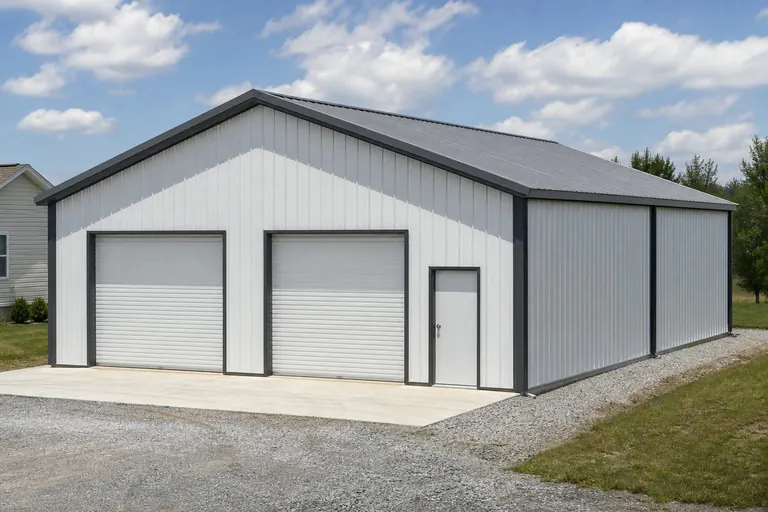 Vehicle storage where off-street parking is scarceOn properties without dedicated garage space, an enclosed metal garage provides secure, weather-tight vehicle storage.Small-farm equipment storageOn the state's smaller, intensively worked farms, enclosed storage protects tractors, implements and supplies from New Jersey's wet climate.Workshop and tool storageA partitioned bay for tools and hobby work alongside vehicle storage, common on established suburban lots.
Example Configuration — for planning purposes only.
Get New Jersey metal garage quotes
Tell us your vehicle or equipment storage needs and rough size. We route it with the New Jersey and metal garage context already attached.
Footprint
Sizes that suit a New Jersey metal garage
Lot coverage and setback rules usually cap the footprint before demand for space does, so most New Jersey buyers size to fit rather than to a maximum.
24′ × 30′
720 sq ft
A standard two-vehicle enclosed footprint for a suburban New Jersey lot.
30′ × 40′
1,200 sq ft
Common where equipment or tool storage is added alongside vehicles.
40′ × 60′
2,400 sq ft
A larger option for farm equipment storage on the state's working-farm acreage.
Example Configuration — for planning purposes only.
Footprint pages carry the door and bay layout for each of these; this page explains why New Jersey buyers land in this range.
Preparation
Before you place a New Jersey metal garage order
A short list resolved in advance keeps a sealed structure performing as intended.
- Confirm zoning, setbacks and anchoring locallyNew Jersey construction and zoning enforcement is municipal; confirm requirements before finalizing placement.
- Decide on ventilation before deliverySpecify ridge, gable or powered venting up front rather than retrofitting it into a sealed steel shell later.
- Measure the tallest and widest item that will use itEspecially relevant for New Jersey buyers storing farm equipment alongside vehicles.
- Check flood-zone status if near the coast or a river corridorReference FEMA's National Risk Index by county or tract before setting floor elevation and anchoring.
Questions
New Jersey metal garage questions
Questions we can answer honestly at state level, with jurisdiction-specific items routed to the right office.
Permit requirements depend on footprint, foundation type and local zoning, all set by your municipality's construction office. There is no single statewide threshold we can publish.
Newark's 1991-2020 climate normal shows about 46.60 inches of annual precipitation, a persistently wet pattern. That makes ventilation, such as ridge or gable vents, a worthwhile addition to reduce condensation on stored vehicles and equipment inside a sealed garage.
The state's 9,998 farms averaged just 71 acres in 2022 but saw product sales rise 36% since 2017 — a sign of intensive, equipment-dependent operations that benefit from secure, weather-tight storage beyond what a household garage provides.
It depends on the parcel. FEMA's National Risk Index (hazards.fema.gov/nri) provides county- and tract-level hazard scores; check yours, especially near the coast or a river corridor, before finalizing floor elevation and anchoring.
We do not publish state-level prices, since cost depends on size, doors, ventilation and site work. Our cost pages cover what drives the number; a quote covers your specific project.
Sources for the New Jersey facts on this page
This page states no code requirement, wind speed, snow load, permit rule, price or supplier claim. The state-specific facts it does use are listed with their publisher below.
The Census Bureau's 2023 annual building permits report notes that multifamily units (5+ units) made up 53.2% of New Jersey's 32,840 total authorized housing units that year, one of the highest multifamily shares among states.
U.S. Census Bureau · 2023 · Tier 1
https://www.census.gov/construction/bps/pdf/2023annualhighlights.pdfNew Jersey had 9,998 farms in 2022, up 1% from 2017.
USDA National Agricultural Statistics Service (NASS) · 2022 · Tier 1
https://www.nass.usda.gov/Publications/AgCensus/2022/Online_Resources/County_Profiles/New_Jersey/cp99034.pdfNew Jersey's 2022 Census of Agriculture total market value of products sold was $1,487,751,000, up 36% from 2017.
USDA NASS · 2022 · Tier 1
https://www.nass.usda.gov/Publications/AgCensus/2022/Online_Resources/County_Profiles/New_Jersey/cp99034.pdfNewark Liberty International Airport's 1991-2020 annual normal precipitation is 46.60 inches with 31.5 inches of annual snowfall.
NOAA National Centers for Environmental Information (NCEI) · 1991-2020 · Tier 1
https://www.ncei.noaa.gov/access/services/data/v1?dataset=normals-annualseasonal-1991-2020&dataTypes=ANN-PRCP-NORMAL,ANN-SNOW-NORMAL&stations=USW00014734&format=jsonNew Jersey's total land area was measured at 7,354.2 square miles as of the 2010 Census.
U.S. Census Bureau · 2010 Census · Tier 1
https://www.census.gov/geographies/reference-files/2010/geo/state-local-geo-guides-2010/new-jersey.html