
Carport · NJ
Carports in New Jersey
A carport is an open structure, so it lives or dies on two things: whether it fits the driveway it is meant to cover, and whether it is built for the weather that lands on it. New Jersey complicates both. The state packs its housing into just 7,354.2 square miles of land, and Census figures show 53.2% of the 32,840 units authorized in 2023 were five-plus-unit multifamily buildings — one of the highest multifamily shares in the country — which keeps single-family driveways and side yards comparatively tight. On top of that, the state's two long-term climate stations diverge: Newark in the north runs measurably wetter and snowier than the Philadelphia airport station that anchors the Mt. Holly forecast office covering southern New Jersey.
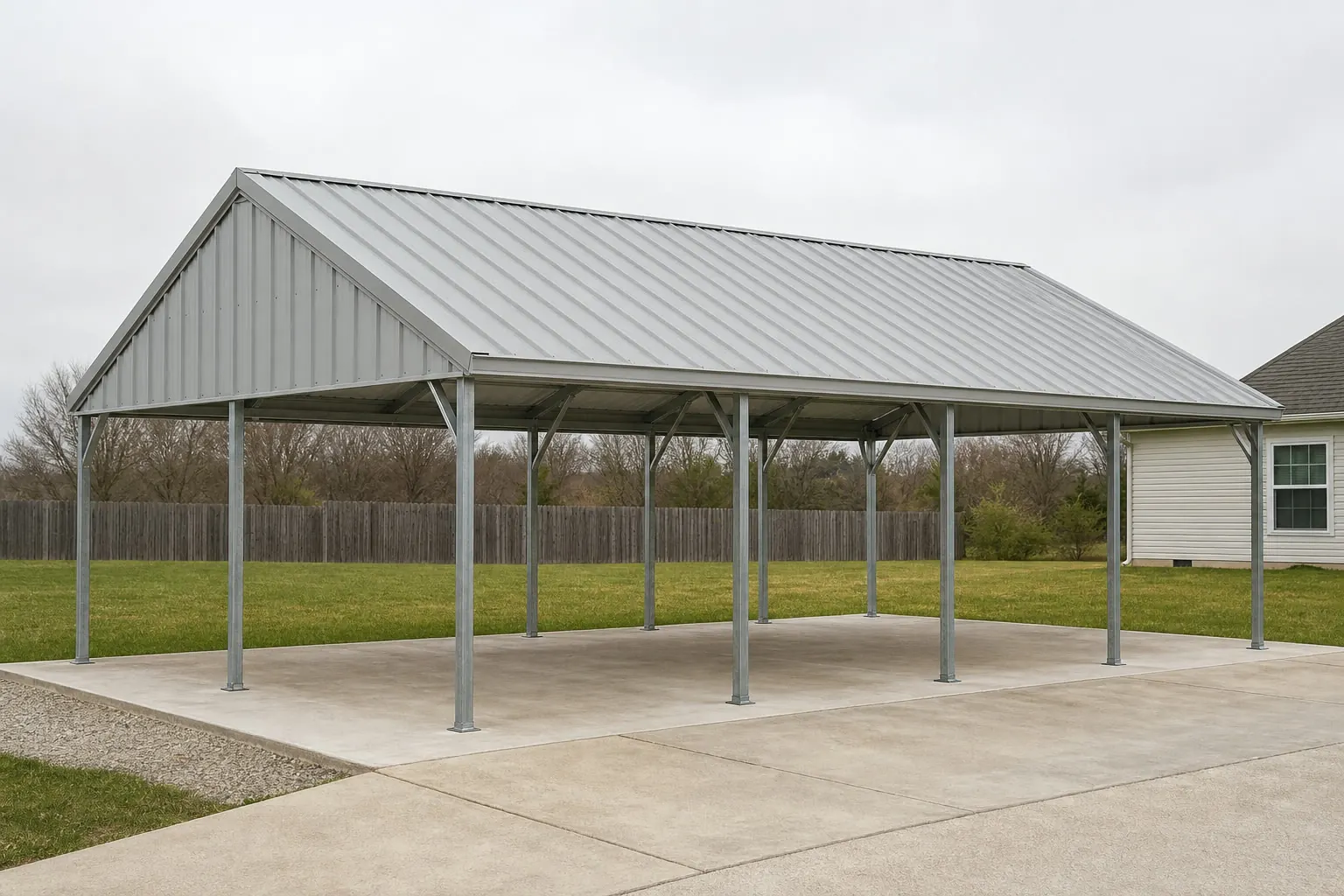
Fit and Weather, Both Working Against a Small Footprint
A carport in New Jersey is usually squeezed between two forces at once. The state's land area is only 7,354.2 square miles, and its recent housing pattern leans heavily toward multifamily construction — 53.2% of the 32,840 units authorized in 2023 — which keeps the single-family lots that host carports comparatively tight. At the same time, the weather a carport has to shed is not uniform: Newark's climate normal runs wetter and snowier than the Philadelphia-area normal that covers the southern half of the state. Getting a carport right here means solving the driveway-fit question and the regional weather question separately, not assuming one answer covers both.
Siting
Why Driveway Width Decides More Than the Catalogue Does
In much of New Jersey, the carport width you can build is set by your existing driveway and side-yard setback, not by what a supplier offers.
Because New Jersey's 2023 housing mix skewed heavily toward multifamily construction, the state's single-family stock includes a large share of older, established lots where the driveway, garage and side-yard setback were fixed decades ago. A carport almost always has to slot into that existing geometry rather than define a new one, which makes confirming your municipality's setback and lot-coverage rules the first step, not an afterthought.
New Jersey's local building and zoning departments hold these numbers; the state does not publish one statewide setback or coverage figure. Ask specifically whether an open, unenclosed carport is treated differently from an enclosed garage for setback and permit purposes — some municipalities draw that line, and it can change what fits.
With 34,932 housing units authorized across the state in 2024, new-construction driveways are also a live category. On a new build, sizing the driveway and the carport together from the start avoids the retrofit fit problems that older New Jersey lots often present.
Specification
Building for Two Different New Jersey Climates
A carport specified for Newark's climate normal is not automatically right for the Philadelphia/Mt. Holly area's normal, and vice versa.
- Know which climate normal is closer to your siteNewark's 1991-2020 normal runs about 46.60 inches of annual precipitation; the Philadelphia airport station serving the Mt. Holly forecast area over southern New Jersey runs about 44.11 inches. Neither is a design value, but they signal which end of the state sees more moisture to shed.
- Get your municipality's actual design numbersNew Jersey has no single statewide snow load or wind speed figure published for carports. Your local construction office holds the numbers that apply to your specific lot.
- Treat anchoring as structural, not optionalAn open carport roof behaves like a wing under wind load. Confirm the anchoring method with your supplier before assuming a standard base will hold.
- Match the anchor to the surfaceExisting asphalt driveways, new concrete pads and bare ground each need a different anchoring approach; New Jersey's older housing stock makes retrofitting into an existing driveway a common scenario.
- Decide the roof shed line on purposeRoof runoff has to land somewhere other than a walkway, foundation or a neighboring property line; plan the pitch and gutter decision before the frame is fixed.
- Ask about open-vs-enclosed classificationSome New Jersey municipalities treat an unenclosed carport differently from an enclosed structure for permit and coverage purposes — confirming this can change what size is actually approvable.
Get carport quotes for your New Jersey property
Tell suppliers your municipality, your setback and height limits, and what surface the carport will stand on. Those answers make New Jersey quotes comparable.
Footprints
Carport Footprints for New Jersey Lots
On the state's tighter parcels, the practical range is narrower than the full catalogue, and the setback line usually decides it.
12′ × 24′
288 sq ft
A single-vehicle footprint that fits beside many New Jersey homes without crowding a side-yard setback.
20′ × 24′
480 sq ft
Two vehicles side by side where the driveway is wide enough, a common upgrade on established suburban lots.
24′ × 30′
720 sq ft
Two vehicles plus working room or a boat, where lot coverage and the municipality's rules allow the added footprint.
Example Configuration — for planning purposes only.
Confirm setback, height and coverage limits with your municipality before selecting a footprint.
Site Context
North Jersey and South Jersey Carport Conditions
New Jersey is small, but the carport brief still shifts between the wetter, snowier north and the milder south.
Northern New Jersey
Newark's benchmark station shows the higher end of the state's precipitation and snowfall normals. A carport here benefits from a roof pitch and eave detail that sheds cleanly onto a planned drainage path rather than the driveway itself.
Central New Jersey
Sits between the two benchmark stations climatically; local design numbers from your municipality remain the reference rather than either coastal station alone.
Southern New Jersey
The Philadelphia airport station serving the Mt. Holly forecast office shows a somewhat lower precipitation and snowfall normal, but anchoring against wind still matters, and local construction officials hold the specific design values.
Evidence Position
What This Page Does Not Claim
No New Jersey snow load, wind speed, permit threshold, code edition or price appears here.
The New Jersey facts used above are the ones we can source: NOAA NCEI 1991-2020 normals for the Newark and Philadelphia airport stations, the Census land-area measurement of 7,354.2 square miles, and Census Bureau building permit figures for 2023 and 2024.
We also record what we could not verify. A single official statewide NOAA precipitation or snowfall normal for New Jersey as a whole was not located; the Newark and Philadelphia-area station normals are used here as representative regional citations rather than a statewide figure.
Questions
New Jersey Carport Questions
The New Jersey-specific answers a general carport page cannot give.
That is decided by your municipality's construction and zoning offices, not by a statewide rule we can publish. Ask whether an open, unenclosed structure of your intended size and height needs a permit and whether it counts toward lot coverage.
No single statewide figure is published. NOAA's climate normals show Newark running snowier than the Philadelphia-area station serving southern New Jersey, but the actual design value comes from your local construction office.
Because 53.2% of the state's 2023 authorized housing units were five-plus-unit multifamily buildings, the remaining single-family lots tend to be established and comparatively tight, which makes setback and driveway width the usual limiting factor for carport size.
The structure is the same, but the climate context differs. Newark's normal runs wetter and snowier than the Philadelphia-area normal covering the south, which is worth reflecting in roof pitch and eave planning even though neither figure is a design load.
Often, but it depends on the driveway's condition and the anchor system your supplier uses. Given how much of New Jersey's housing stock is established rather than new, this is a common scenario worth discussing before you order.
Pricing sits with the cost silo. The New Jersey-variable costs are typically the pad or driveway work, anchoring for your specific surface, and any municipal requirements affecting the roof profile.
Sources for the New Jersey facts on this page
This page states no code requirement, wind speed, snow load, permit rule, price or supplier claim. The state-specific facts it does use are listed with their publisher below.
New Jersey's total land area was measured at 7,354.2 square miles as of the 2010 Census.
U.S. Census Bureau · 2010 Census · Tier 1
https://www.census.gov/geographies/reference-files/2010/geo/state-local-geo-guides-2010/new-jersey.htmlThe Census Bureau's 2023 annual building permits report notes that multifamily units (5+ units) made up 53.2% of New Jersey's 32,840 total authorized housing units that year, one of the highest multifamily shares among states.
U.S. Census Bureau · 2023 · Tier 1
https://www.census.gov/construction/bps/pdf/2023annualhighlights.pdfLocal building permit offices in New Jersey authorized 34,932 new privately-owned housing units in 2024.
U.S. Census Bureau · 2024 (full calendar year) · Tier 1
https://www.census.gov/construction/bps/stateannual.htmlNewark Liberty International Airport's 1991-2020 annual normal precipitation is 46.60 inches with 31.5 inches of annual snowfall.
NOAA National Centers for Environmental Information (NCEI) · 1991-2020 · Tier 1
https://www.ncei.noaa.gov/access/services/data/v1?dataset=normals-annualseasonal-1991-2020&dataTypes=ANN-PRCP-NORMAL,ANN-SNOW-NORMAL&stations=USW00014734&format=jsonPhiladelphia/Mt. Holly NWS forecast office area's 1991-2020 annual normal precipitation is 44.11 inches with 23.1 inches of annual snowfall, using the co-located Philadelphia airport station as the primary long-term reference.
NOAA National Centers for Environmental Information (NCEI) · 1991-2020 · Tier 1
https://www.ncei.noaa.gov/access/services/data/v1?dataset=normals-annualseasonal-1991-2020&dataTypes=ANN-PRCP-NORMAL,ANN-SNOW-NORMAL&stations=USW00013739&format=json