
Garden shed · NJ
Garden Sheds in New Jersey
New Jersey squeezes two very different garden shed buyers into 7,354.2 square miles of land: a suburban household whose lot was shaped by a housing market where multifamily construction made up 53.2% of 2023's authorized units, and a small grower working one of the state's 9,998 farms, which averaged just 71 acres apiece in 2022 — one of the smallest average farm sizes of any state. Neither buyer needs an engineering review for a shed, but both need a plan that respects a genuinely tight parcel, and the state's snowfall differs enough north to south that the roof and pad decision is not the same everywhere.
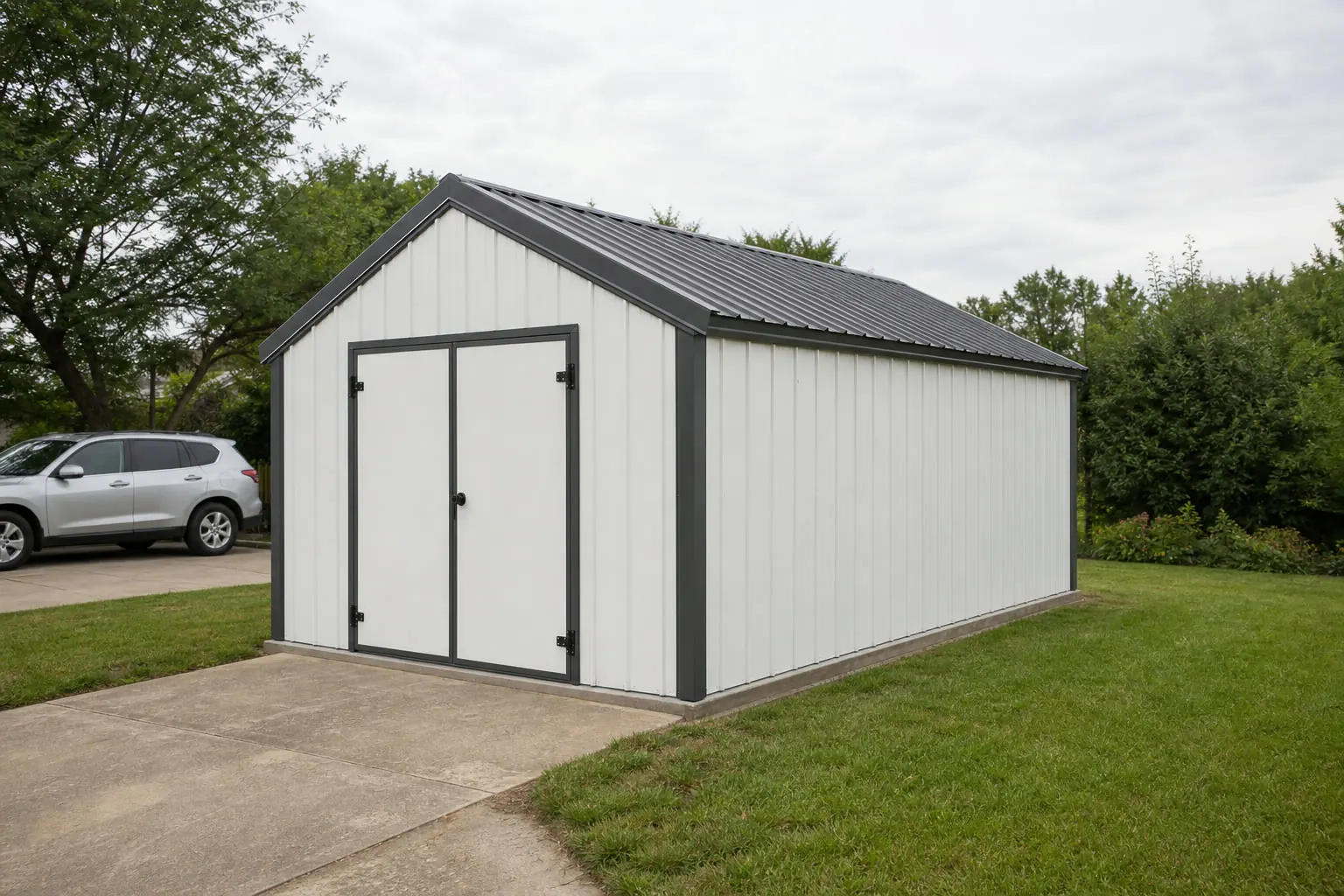
The intersection
Two very different New Jersey shed buyers, one small state
A garden shed brief in New Jersey depends heavily on whether the property is a suburban parcel or a working small farm, because the state has an unusually large share of both.
New Jersey is a small state — 7,354.2 square miles of land as of the 2010 Census — but it is not a uniform one. On one side sits a housing market where Census figures show 53.2% of the 32,840 housing units authorized in 2023 were five-plus-unit multifamily buildings, one of the highest multifamily shares of any state. That construction pattern leaves the single-family lots that remain comparatively tight, so a shed frequently has to fit a modest side or back yard rather than an open rural spread.
On the other side, New Jersey counted 9,998 farms in 2022, up 1% from 2017, averaging just 71 acres each — one of the smallest average farm sizes in the country. Those are not large commercial operations; many are the kind of small, intensive holdings where a garden shed doubles as tool storage, seed and supply space, or overflow for equipment that does not need a full pole barn. The state's farm market value rose 36% over the same period even as farm size held flat, which points to intensification on small acreage rather than expansion, a pattern that favors a compact, well-organized shed over a larger structure.
Because both buyer types are working with limited space — one from suburban density, the other from a genuinely small parcel — the New Jersey shed conversation starts with layout and use, not with square footage for its own sake.
Exposure
A north-south snowfall split worth planning around
Newark's climate normal and the Philadelphia/Mt. Holly area's normal diverge enough on snowfall that a shed's roof clearance and pad choice can differ by region within the same small state.
NOAA's 1991-2020 normals for Newark Liberty International Airport show about 46.60 inches of annual precipitation and 31.5 inches of annual snowfall. The Philadelphia airport station, which serves the National Weather Service's Mt. Holly forecast office covering much of southern New Jersey, shows roughly 44.11 inches of precipitation and 23.1 inches of snowfall over the same period. That is a meaningful difference in snowfall between the state's north and south, even though the two areas are only a few hours apart by car.
For a shed, the practical consequence is roof shed clearance and eave-side spacing. In the higher-snowfall north, leaving extra room along the eave for slide-off snow, and choosing a roof pitch that sheds cleanly, is a more consistent habit than it needs to be near the southern part of the state. Neither figure is a design load — a statewide or single-station normal is a climate average, not an engineering value — so specific structural numbers still belong with the municipal construction office.
The Rutgers University Office of the State Climatologist also publishes daily station normals for the Mt. Holly service area, a useful second reference if you want more granular seasonal detail for a specific New Jersey county before finalizing a shed's placement and drainage.
- North Jersey eave clearance
- Near the higher end of the state's snowfall range, leave clearance along the eave side for snow sliding off a metal roof.
- South Jersey drainage focus
- With comparatively less snowfall but still nearly 44 inches of annual precipitation, rain drainage from the pad matters more than snow load.
- Confirm locally
- Neither station normal is a substitute for the municipal snow-load or drainage requirement that actually applies to your lot.
Configuration
What New Jersey garden sheds are usually used for
The state's suburban-and-small-farm split shows up directly in how a shed gets used.
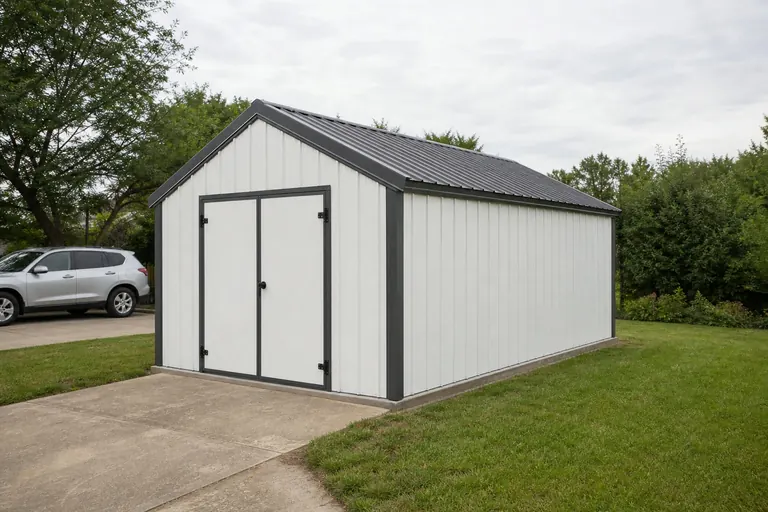 Suburban lawn and garden storageMowers, tools and seasonal items kept off a compact suburban lot's driveway or patio.Small-farm tool and supply storageOn the state's smaller working farms, a shed holds hand tools, seed, irrigation parts and supplies without the cost of a full outbuilding.Seasonal and yard equipmentOverflow storage for households whose garage space is already committed to vehicles.
Example Configuration — for planning purposes only.
Get New Jersey garden shed quotes
Tell us your municipality, lot type and intended use. We route it with the New Jersey and garden shed context already attached.
Footprint
Sizes that suit a New Jersey lot
Most New Jersey sheds are sized to a specific yard constraint rather than a maximum the site could technically hold.
8′ × 10′
80 sq ft
A compact footprint that fits a tight suburban side yard without crowding a setback line.
10′ × 12′
120 sq ft
Common where the shed needs to hold both lawn equipment and general household overflow.
12′ × 16′
192 sq ft
A larger option for small-farm tool and supply storage where the lot has more room.
Example Configuration — for planning purposes only.
This page explains why New Jersey buyers land in this range; municipal setback rules decide what actually fits your parcel.
Preparation
Before you place a New Jersey garden shed order
A short list resolved in advance keeps a small, low-stakes project simple.
- Check your municipality's setback and permit rulesNew Jersey construction and zoning enforcement is local; ask your town's construction office before finalizing size or placement.
- Match roof and eave planning to your regionNorth Jersey's higher snowfall normal favors extra eave clearance; south Jersey's lower snowfall shifts the focus to rain drainage.
- Plan the pad for your use caseA tool-and-supply shed on a small farm may need a different floor than a suburban lawn-equipment shed on a paved or landscaped lot.
- Confirm any farm-related exemptions with your municipalitySome New Jersey towns treat farm-use accessory structures differently from residential accessory structures; do not assume the exemption without asking.
Questions
New Jersey garden shed questions
State-level answers where we have sourced facts, and a route to the right office where we do not.
Permit thresholds and setback distances are set by your municipality's construction office, not by the state as a single figure. Ask locally before finalizing a size or placement.
Yes. Newark's 1991-2020 normal is about 31.5 inches of annual snowfall, while the Philadelphia airport station serving the Mt. Holly forecast area over southern New Jersey shows roughly 23.1 inches. That is a real regional difference worth reflecting in eave clearance and roof planning.
Often, yes. The state's farms averaged just 71 acres in 2022, one of the smallest average sizes nationally, and a garden shed is a low-cost way to store hand tools and supplies without the expense of a larger outbuilding.
Not usually, but suburban lots are often tighter than in less densely built states, partly because 53.2% of the state's 2023 authorized housing was multifamily. Confirm your lot's usable side or back-yard space and your town's setback rule before choosing a size.
We do not publish state-level prices, since cost depends on size, materials and site work. Our cost pages cover what drives the number; a quote covers your specific project.
Sources for the New Jersey facts on this page
This page states no code requirement, wind speed, snow load, permit rule, price or supplier claim. The state-specific facts it does use are listed with their publisher below.
New Jersey's total land area was measured at 7,354.2 square miles as of the 2010 Census.
U.S. Census Bureau · 2010 Census · Tier 1
https://www.census.gov/geographies/reference-files/2010/geo/state-local-geo-guides-2010/new-jersey.htmlNew Jersey had 9,998 farms in 2022, up 1% from 2017.
USDA National Agricultural Statistics Service (NASS) · 2022 · Tier 1
https://www.nass.usda.gov/Publications/AgCensus/2022/Online_Resources/County_Profiles/New_Jersey/cp99034.pdfNew Jersey had 711,502 acres of land in farms in 2022, an average farm size of 71 acres, one of the smallest average farm sizes among U.S. states.
USDA NASS · 2022 · Tier 1
https://www.nass.usda.gov/Publications/AgCensus/2022/Online_Resources/County_Profiles/New_Jersey/cp99034.pdfThe Census Bureau's 2023 annual building permits report notes that multifamily units (5+ units) made up 53.2% of New Jersey's 32,840 total authorized housing units that year, one of the highest multifamily shares among states.
U.S. Census Bureau · 2023 · Tier 1
https://www.census.gov/construction/bps/pdf/2023annualhighlights.pdfNewark Liberty International Airport's 1991-2020 annual normal precipitation is 46.60 inches with 31.5 inches of annual snowfall.
NOAA National Centers for Environmental Information (NCEI) · 1991-2020 · Tier 1
https://www.ncei.noaa.gov/access/services/data/v1?dataset=normals-annualseasonal-1991-2020&dataTypes=ANN-PRCP-NORMAL,ANN-SNOW-NORMAL&stations=USW00014734&format=jsonPhiladelphia/Mt. Holly NWS forecast office area's 1991-2020 annual normal precipitation is 44.11 inches with 23.1 inches of annual snowfall, using the co-located Philadelphia airport station as the primary long-term reference.
NOAA National Centers for Environmental Information (NCEI) · 1991-2020 · Tier 1
https://www.ncei.noaa.gov/access/services/data/v1?dataset=normals-annualseasonal-1991-2020&dataTypes=ANN-PRCP-NORMAL,ANN-SNOW-NORMAL&stations=USW00013739&format=json