
Metal garage · CT
Metal Garages in Connecticut
A detached metal garage in Connecticut is an infill project. The state's land area was measured at 4,842.4 square miles at the 2010 Census — the third smallest in the country — and on a typical residential parcel a new garage has to coexist with a driveway turn, a septic field or well, mature trees and a town coverage limit. Once siting is resolved, the building's real enemy is moisture: the Hartford Brainard Field station normals put annual precipitation near 43 inches, and an unheated steel garage in that climate condenses unless it is specified not to. This page covers those two Connecticut-conditioned problems and routes everything else to the authority that owns it.
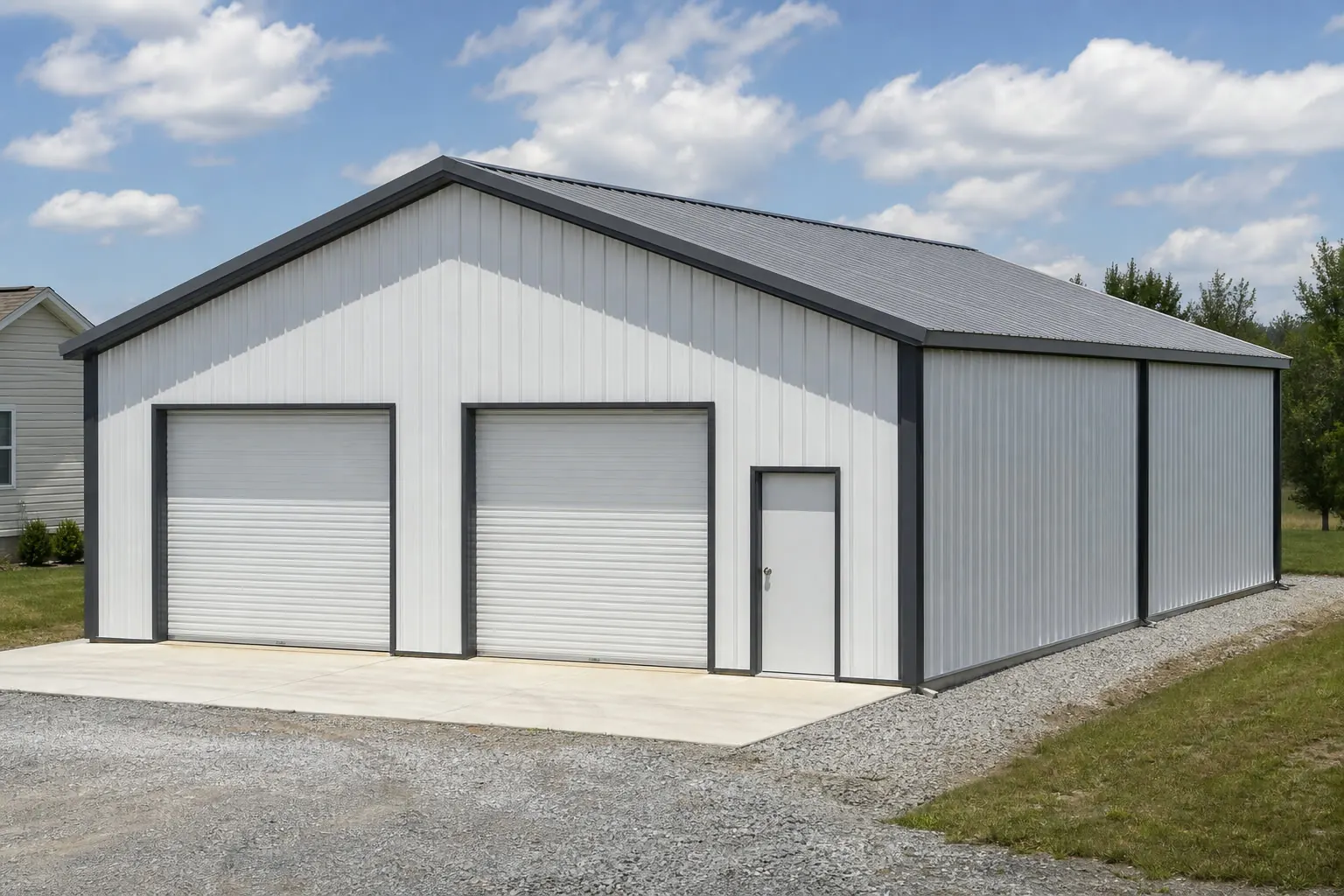
The Garage Has to Fit Before It Has to Perform
Connecticut garage projects almost always begin with a site problem. In a state of 4,842.4 square miles of land area, residential parcels are modest, and the garage has to be threaded between a driveway that must still turn, a septic field that must not be driven on, a well that needs clearance, and a lot line that the town measures from. Buyers who start by choosing a size and then look for somewhere to put it usually end up redesigning. Start with the town's setback and coverage rules and the location of your underground services, and the workable footprint reveals itself — often larger than expected once you know where the constraints actually are.
Envelope
Keeping a Connecticut Garage Dry
The Connecticut garage failure mode is moisture, not structure: a cold steel roof over a damp slab drips onto whatever is stored below.
Connecticut's climate is wet and cold enough for long enough that condensation is a routine outcome rather than an occasional nuisance. The Hartford Brainard Field station normals put annual precipitation near 43 inches, spread across a full four-season cycle. Park a snow-covered car in an unheated steel garage, close the door, and the moisture has nowhere to go except onto the coldest surface — the underside of the roof panel. It then falls back onto the vehicle you were trying to protect.
There are three levers, and Connecticut buyers usually need at least two: a condensation-control layer or insulation on the roof deck, ventilation that lets humid air leave, and a slab or base detail that does not wick ground moisture upward. A vapour barrier under a new slab is inexpensive during construction and impossible afterwards. If the garage will be used as a workspace rather than pure storage, the insulation conversation moves from optional to central, because heating an uninsulated shell in a Connecticut January is both expensive and counterproductive.
Finish and fastener specification deserve a Connecticut sentence too, especially near the shoreline where salt-laden air is a factor. Coastal flooding and hurricane are among the hazards FEMA scores for the state's counties, and the same maritime exposure that drives those scores also accelerates corrosion at fasteners, door tracks and the base of the structure.
Order of Operations
The Connecticut Garage Sequence
Getting these in the right order avoids the two expensive Connecticut outcomes: a redesign after zoning review, or a building that has to be re-sited around a septic field.
- Locate septic, well and utilities before anything elseOn small Connecticut lots these routinely dictate where a garage can go and how the drive reaches it. Your local health district is the authority on clearances, not the building supplier.
- Get setback, height and coverage limits from the townConnecticut administers zoning at the town level, so the numbers are specific to your municipality. Ask whether a detached accessory structure has different limits from an addition.
- Ask for the design values in writingSnow load, wind speed and frost depth for your parcel. NOAA publishes Connecticut normals by station, so avoid applying a Hartford figure to a northwest-hills or shoreline site.
- Decide heated or unheated nowThis single answer drives insulation, ventilation, slab detail and door choice. Changing your mind after the slab is poured is a costly and entirely avoidable mistake in this category.
- Plan drainage and the snow-shed lineA new roof concentrates runoff on a lot that already has established grading. Decide where roof water and shed snow go before the pad location is fixed.
- Check the streetscape expectationWith few new-build lots — 6,272 units authorised statewide in 2023 — most Connecticut garages sit beside an existing house, and towns often care about pitch, colour and how the structure reads from the road.
Get garage quotes for your Connecticut lot
Give suppliers your town's setback and coverage limits, your intended footprint, and whether the garage will be heated. That turns a generic quote into a comparable one.
Footprints
Garage Footprints That Fit Connecticut Lots
The Connecticut range is compressed by coverage rules, and the useful question is how much depth you can gain rather than how much width.
20′ × 24′
480 sq ft
A two-car detached garage at the size most Connecticut lots can accommodate without pressing a side-yard setback.
24′ × 30′
720 sq ft
Two vehicles plus storage or a bench wall — usually the point where coverage limits start to bind.
24′ × 36′
864 sq ft
Adds depth rather than width, which is often the only direction available on a narrow parcel with a long drive.
Example Configuration — for planning purposes only.
Confirm coverage, setback and height limits with your town before committing to a footprint.
Site Context
Three Connecticut Contexts
Connecticut is compact, but shoreline, valley and hill sites give a garage three different problems.
Shoreline
Wind loading and salt-laden air lead the specification. FEMA scores coastal flooding and hurricane among the hazards for Connecticut counties, and shoreline towns may add local requirements. Anchoring, fastener choice and coating are where the money is best spent here.
Central valley and suburbs
The state's benchmark precipitation figure comes from this area, and it is where infill pressure is highest: established grading, mature trees, tight drives. Drainage and manoeuvring room are the recurring design constraints.
Northwest hills
Colder and snowier, with the sharpest snow-loading questions in the state and more sites where frost depth genuinely governs the foundation. NOAA's station-by-station normals exist precisely because these conditions differ from the shoreline.
Evidence Position
What We Do Not Assert
No Connecticut permit threshold, setback, code edition, snow load, frost depth or price appears on this page.
The sourced Connecticut material here is: NOAA NCEI 1991-2020 normals for the Hartford Brainard Field station and for individual Connecticut stations, the Census land-area figure of 4,842.4 square miles, Census authorisation of 6,272 housing units in 2023, and FEMA's National Risk Index as the federal county-level hazard tool for the state.
Our evidence base also records that a Tier 1 statewide Connecticut precipitation or snowfall normal could not be retrieved in this cycle, which is why the Hartford figure is presented as a station-level value rather than a design number. A garage engineered from a marketing figure instead of the town's value is a risk that no amount of steel gauge compensates for.
Questions
Connecticut Metal Garage Questions
The Connecticut answers a general metal garage page cannot provide.
That is a town answer and we will not publish a number. Connecticut zoning is administered municipally, so ask your town's zoning official for the side and rear setbacks that apply to a detached accessory structure on your parcel.
It very likely will without a condensation-control strategy. With around 43 inches of annual precipitation at the state's benchmark station and a full freeze-thaw winter, warm moist air meeting a cold roof panel is a routine condition. Plan a control layer, ventilation and a slab vapour barrier together.
Frequently, yes. On Connecticut's small lots the septic field and its reserve area often occupy the most obvious garage location, and driving over a field is not an option. Your local health district sets the clearances.
The structure is the same, but exposure differs: higher wind loading and salt-laden air argue for a more considered anchoring, fastener and coating specification. Coastal flooding and hurricane are among the hazards FEMA scores for Connecticut counties.
Physically often yes, but decide before the slab. Heating, insulation, ventilation, electrical capacity and possibly the way the town classifies the use all change, and retrofitting insulation and power costs far more than including them.
Pricing is delegated to the cost silo. The Connecticut-variable drivers are site access on a tight lot, the foundation detail your frost depth requires, and whether the building is insulated.
Sources for the Connecticut facts on this page
This page states no code requirement, wind speed, snow load, permit rule, price or supplier claim. The state-specific facts it does use are listed with their publisher below.
NOAA NCEI-sourced 1991-2020 normals for the Hartford Brainard Field station show about 43 inches of average annual precipitation.
NOAA National Centers for Environmental Information (NCEI) station normals, via GeoStat.org compilation · 1991-2020 · Tier 2
https://www.geostat.org/data/hartford-ct/climateConnecticut's total land area was measured at 4,842.4 square miles as of the 2010 Census, the third-smallest of any US state.
U.S. Census Bureau · 2010 Census · Tier 1
https://www.census.gov/geographies/reference-files/2010/geo/state-local-geo-guides-2010/connecticut.htmlConnecticut had 6,272 total housing units authorized by building permits in 2023, up 5.8% from 5,926 in 2022.
U.S. Census Bureau · 2023 (annual) · Tier 1
https://www.census.gov/construction/bps/pdf/2023annualhighlights.pdfFEMA's National Risk Index is an interactive county/tract-level tool covering 18 natural hazards, including winter weather, coastal flooding, and hurricane, that can be queried for Connecticut's counties.
Federal Emergency Management Agency (FEMA) · Current NRI release · Tier 1
https://www.fema.gov/flood-maps/products-tools/national-risk-indexNOAA NCEI publishes 1991-2020 monthly climate normals (temperature, precipitation, snowfall, degree days) for individual Connecticut stations such as Bakersville, CT.
NOAA National Centers for Environmental Information (NCEI) · 1991-2020 · Tier 1
https://www.ncei.noaa.gov/access/services/data/v1?dataTypes=MLY-TMAX-NORMAL%2CMLY-TMIN-NORMAL%2CMLY-TAVG-NORMAL%2CMLY-PRCP-NORMAL%2CMLY-SNOW-NORMAL&dataset=normals-monthly-1991-2020&format=pdf&stations=USC00060227