
Metal garage · MO
Metal Garages in Missouri
A metal garage in Missouri is usually an enclosed accessory structure next to an existing home, and the two things that change the project across the state are jurisdiction and ground. Missouri Revised Statutes give county commissions their own authority to control construction and issue building permits, with no single mandatory statewide building code sitting above them, and cities apply their own rules inside their limits. On top of that, the Missouri Geological Survey describes an Ozark Plateau covering roughly 33,000 of the state's 68,746.3 square miles, mostly south of the Missouri River, which is a real factor in how a garage pad gets graded and drained before the shell ever goes up.
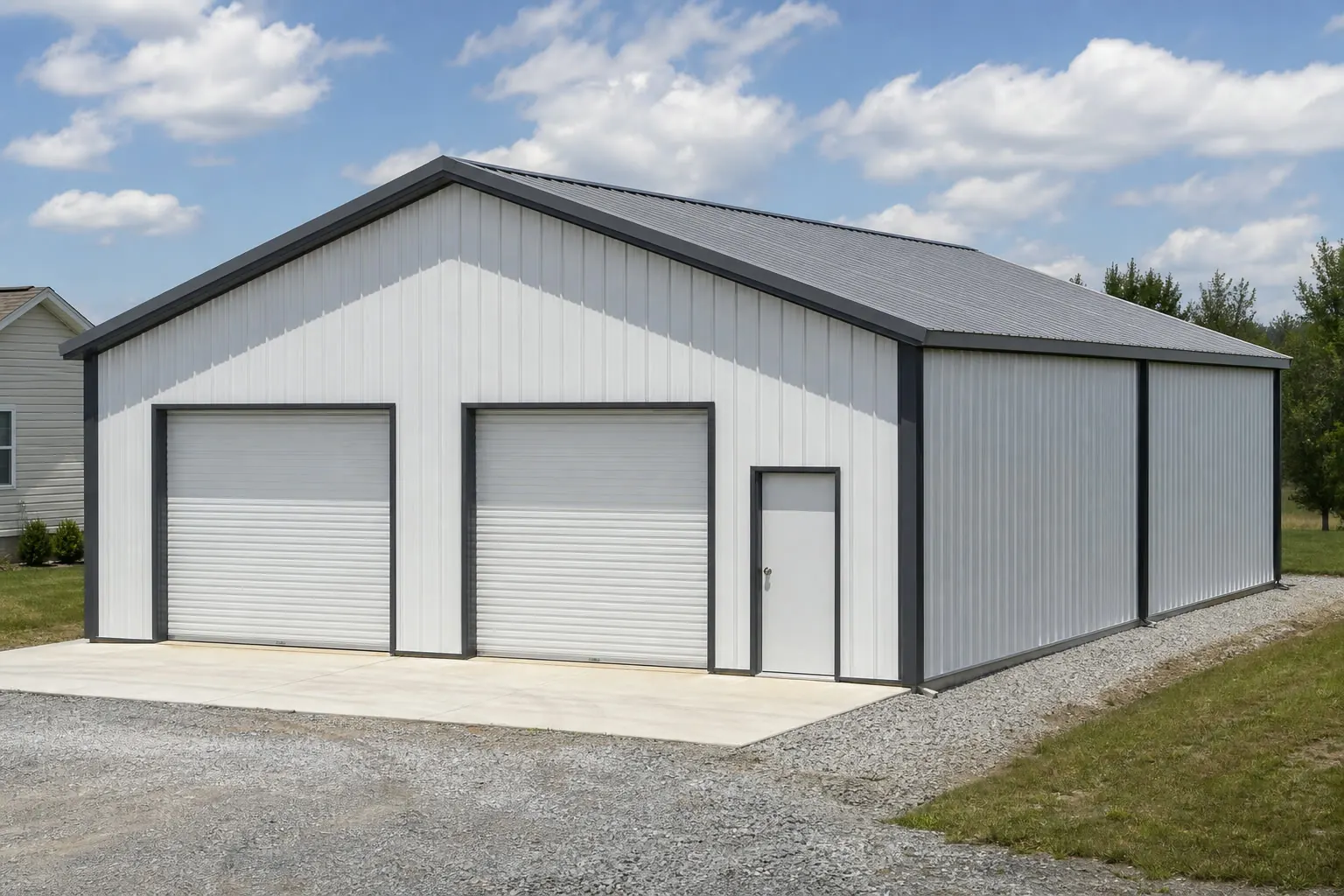
The intersection
In Missouri, jurisdiction and terrain shape the metal garage brief
An enclosed metal garage in Missouri is planned around who actually regulates the parcel and which side of the state's terrain split the site sits on.
Missouri Revised Statutes give county commissions their own statutory authority to control construction and issue building permits, and there is no single mandatory statewide building code above them. Cities apply their own separate zoning and building rules within their limits. That structure means a straightforward question like 'do I need a permit for this garage' does not have a single Missouri-wide answer; it has a county answer and a city answer that can differ from each other even a few miles apart.
The Missouri Geological Survey's description of the Ozark Plateau — rugged terrain with lofty hills and deep valleys covering roughly 33,000 of the state's 68,746.3 square miles, mostly south of the Missouri River — is a practical siting factor for anyone pouring a garage slab in that region. A pad graded near Springfield or in the Ozark interior is a different site-prep conversation than one graded on the flatter plains north of the Missouri River, and that difference shows up in grading cost and drainage design before the garage shell is ever priced.
The Missouri Division of Fire Safety, created by statute within the Department of Public Safety, does real rulemaking work, but its authority is scoped to fire safety. It does not set the permit rule or setback distance for an enclosed accessory garage, so a buyer's first call should go to the county commission or city building department for the specific parcel, not to a state fire-safety office.
Site context
Missouri's terrain split, garage by garage
Missouri's 68,746.3 square miles are not one terrain, and a garage pad plan should reflect which part of the state it sits in.
Ozark Plateau (south of the Missouri River)
Rugged terrain per the Missouri Geological Survey, with lofty hills and deep valleys; expect more grading and drainage planning for a level pad.
Glaciated plains (north Missouri)
Flatter ground shaped by past glaciation; garage pad grading is typically simpler here.
River valley bottomland
Sites near the Missouri and Mississippi corridors carry their own drainage and flood-exposure questions worth confirming with the local building department before finalizing a pad location.
Building envelope
Building the envelope for a Missouri winter and a Missouri summer
NOAA's continental-climate description of Missouri — cold winters, hot and humid summers — means an enclosed garage's insulation and seals have to work through both extremes every year, not just one.
A garage sealed tightly for winter cold but under-ventilated can trap summer humidity against vehicles and stored equipment, contributing to condensation and rust. A garage vented well for summer but under-insulated will underperform through a Missouri winter's cold stretches. The practical middle ground most Missouri buyers land on pairs a vapor-barrier insulation package with at least one form of adjustable ventilation, whether a ridge vent, a gable vent, or an operable window, so the same enclosed space can be tuned across both seasons.
This seasonal planning interacts with siting, too. A garage built into or near sloped Ozark ground needs its drainage solved before insulation choices matter much, since standing water at the foundation undermines any envelope decision made above it. On the flatter northern plains, drainage is typically a smaller factor, and more of the design conversation can move directly to insulation and door specification.
- Plan the envelope for both seasons
- Specify insulation and at least one adjustable ventilation option rather than a single fixed configuration.
- Solve drainage before insulation on Ozark ground
- Foundation-level water management should be settled before envelope specification on sloped sites.
Get Missouri metal garage quotes
Tell us your county or city, your lot, and your terrain. We route your project with the Missouri siting and permitting context already attached.
Configuration
Common Missouri metal garage configurations
Most Missouri metal garage projects fall into a small number of recurring configurations, driven by what the enclosed space protects and where it sits.
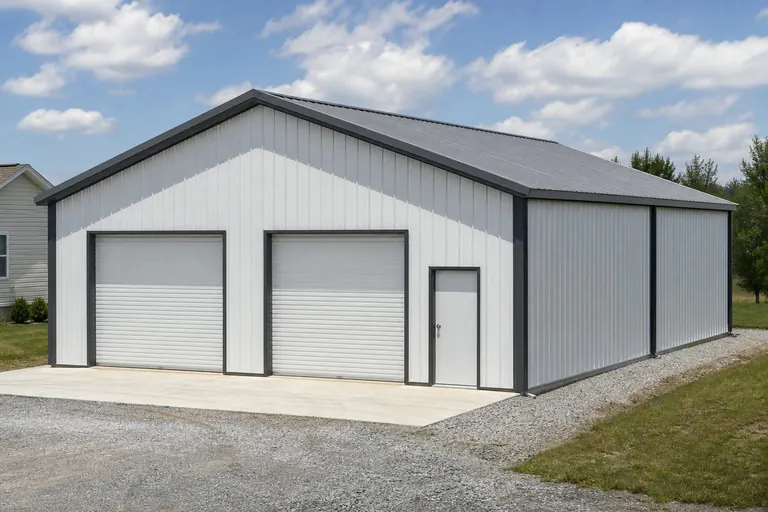 Single or double vehicle bayAn enclosed bay for one or two vehicles, suited to a residential-adjacent garage on flat or gently sloped ground.
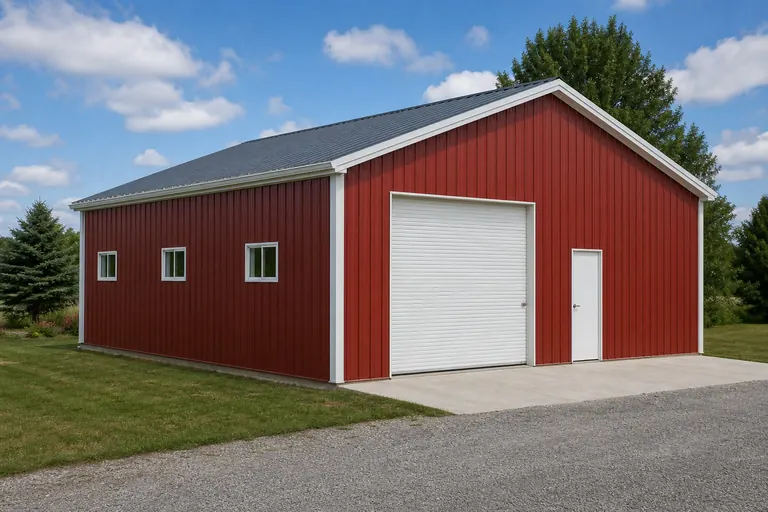 Vehicle bay plus workshopA combined vehicle and workbench space, where a well-graded pad matters more on Ozark hillside sites.
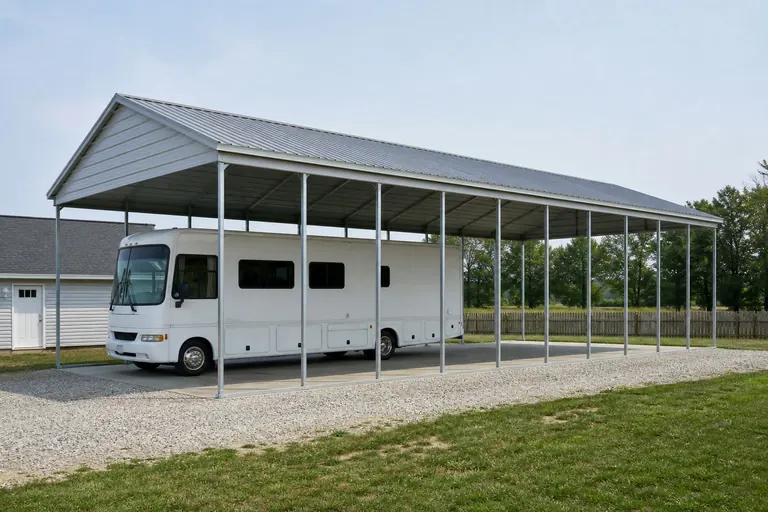 Equipment or larger-vehicle bayA taller enclosed bay for a truck, trailer or equipment rather than a standard passenger vehicle.
Example Configuration — for planning purposes only.
Preparation
Before you request a Missouri metal garage quote
A short list of details resolved locally keeps an enclosed garage project from stalling mid-quote.
Step 1
Confirm permit and setback rules with your county or city
Ask specifically whether your parcel falls under county or city jurisdiction, since the two can differ within the same area.
Step 2
Have your site graded with your regional terrain in mind
A pad near the Ozark Plateau faces different drainage conditions than one on the northern plains.
Step 3
State every intended use up front
A garage priced for vehicle storage alone that later needs workshop power or extra ventilation is a common cause of re-quoting.
Step 4
Contact fire safety only when the question is fire-specific
The Missouri Division of Fire Safety covers fire-safety rulemaking, not general construction or setback review.
Footprint
Sizes common for a Missouri residential-lot metal garage
Because most Missouri metal garages sit next to an existing home rather than on open acreage, footprints tend to be set by vehicle count and lot space, with terrain deciding how much site prep the pad needs.
24′ × 30′
720 sq ft
A common footprint for a two-vehicle enclosed garage on a standard residential lot.
30′ × 40′
1,200 sq ft
Adds room for a workbench or extra storage alongside vehicle bays.
40′ × 60′
2,400 sq ft
Suited to combined vehicle, equipment and workshop use on a larger lot.
Example Configuration — for planning purposes only.
Footprint pages carry bay and door allocation for each size; this page explains only why Missouri jurisdiction and terrain matter for siting these dimensions.
Questions
Missouri metal garage questions
Honest answers at the state level, with permitting and pricing questions routed to whoever actually owns them.
This page cannot state a single answer, because Missouri has no statewide mandatory building code. County commissions hold their own statutory authority under RSMo 64.170, and cities apply separate rules within their limits. Contact your local building department before finalizing your plan.
Setback rules are set locally, not by a statewide standard. Your county commission or city building department can confirm the rule for your specific parcel.
Yes. The Missouri Geological Survey describes the Ozark Plateau, covering roughly 33,000 of the state's 68,746.3 square miles, as rugged terrain. Sites there generally need more grading and drainage attention than the flatter northern plains.
Only for questions specifically about fire safety. Its statutory authority is fire-safety rulemaking, not general construction or setback review, so most garage permitting questions still route to your county or city.
There is no official typical size. On a standard residential lot, 24x30 through 40x60 are common ranges depending on vehicle count and whether the garage also serves as a workshop.
We do not publish state-level prices, since cost depends on size, specification, site work and current material pricing. A builder quote covers your specific project and site.
Sources for the Missouri facts on this page
This page states no code requirement, wind speed, snow load, permit rule, price or supplier claim. The state-specific facts it does use are listed with their publisher below.
Missouri has no single statewide mandatory building code; the Missouri Division of Fire Safety administers state fire-safety-related rules while county commissions are separately empowered by statute to control construction and issue building permits.
Missouri General Assembly / Justia (statute text) · 2025 Missouri Revised Statutes · Tier 2
https://law.justia.com/codes/missouri/title-vi/chapter-64/section-64-170/The Missouri Division of Fire Safety (within the Department of Public Safety) is created and given fire-safety rulemaking authority by statute.
Missouri General Assembly / Justia (statute text) · 2025 Missouri Revised Statutes · Tier 2
https://law.justia.com/codes/missouri/title-xxi/chapter-320/section-320-202/The Missouri Geological Survey (part of Missouri DNR) describes the Ozarks region — covering about 33,000 of the region's 50,000 square miles within Missouri — as rugged, with lofty hills, deep valleys, and cold clear springs and streams south of the Missouri River.
Missouri Geological Survey, Missouri Department of Natural Resources · Fact sheet, rev. 2016 (orig. 2002) · Tier 2
https://dnr.mo.gov/print/document-search/pub0655Missouri's total land area is 68,746.3 square miles.
U.S. Census Bureau · Current Census Bureau geography data · Tier 1
https://data.census.gov/profile/Missouri?g=0400000US29NOAA NCEI publishes a narrative 'Climate of Missouri' describing the state's continental climate with cold winters and hot, humid summers.
NOAA National Centers for Environmental Information (NCEI) · Historical narrative (NCEI climate normals series) · Tier 1
https://www.ncei.noaa.gov/data/climate-normals-deprecated/access/clim60/states/Clim_MO_01.pdf