
Pole barn · MO
Pole Barns in Missouri
Missouri does not run one statewide building code the way some neighboring states do. County commissions are given their own statutory authority to regulate construction and issue building permits, and the state's Division of Fire Safety is scoped to fire safety rather than general construction rules. In practice that means the first real question on a Missouri pole barn project is which county the site sits in and whether that county regulates ag buildings at all, not what a single state office says. Add a farm base that averages 308 acres and a state where roughly half the land area is Ozark Plateau, and the honest planning story is about local variation, not a uniform rulebook.
The intersection
Who actually decides, in Missouri
Missouri splits authority in a way that a single-agency state does not, and knowing which line applies to your project saves a wasted phone call.
| Question | Who answers it in Missouri | Source |
|---|---|---|
| General building/construction rules for my ag building | Your county commission, under its own statutory authority | RSMo 64.170 |
| Fire-safety-related rules | Missouri Division of Fire Safety | RSMo 320.202 |
| Whether my county regulates ag buildings at all | Varies; some counties have limited or no building code enforcement outside city limits | County commission office |
| Post-frame construction method | Not state-specific — see the pole barn type page | Type parent page |
General building/construction rules for my ag building
- Who answers it in Missouri
- Your county commission, under its own statutory authority
- Source
- RSMo 64.170
Fire-safety-related rules
- Who answers it in Missouri
- Missouri Division of Fire Safety
- Source
- RSMo 320.202
Whether my county regulates ag buildings at all
- Who answers it in Missouri
- Varies; some counties have limited or no building code enforcement outside city limits
- Source
- County commission office
Post-frame construction method
- Who answers it in Missouri
- Not state-specific — see the pole barn type page
- Source
- Type parent page
Permitting
Why 'call the state' is the wrong first move here
In a state that runs a single uniform code, there is a state office to call first. Missouri does not work that way.
Missouri Revised Statutes give county commissions their own authority to control construction and issue building permits; there is no single mandatory statewide building code sitting above them. The Missouri Division of Fire Safety is a real state body created by statute, but its scope is fire safety, not general construction review — it is not a fallback answer for 'what does my pole barn need to meet.' The practical upshot is that a Missouri buyer who calls a state office first is likely to be redirected, and a buyer who calls the county first gets to the real answer sooner.
This matters more for a rural pole barn than it might for an in-town project, because unincorporated county land is exactly where many counties' enforcement is thinnest. Some Missouri counties actively review ag-building plans; others do very little outside city limits. Neither position is stated on this page as a rule, because it is not one — it is a reason to ask your specific county commission before you finalize a site plan, not after.
None of this changes what a post-frame building physically needs to do its job. It changes the order of operations: in Missouri, confirming authority comes before confirming specification, because the specification conversation depends on who, if anyone, is reviewing it.
Site context
Ozark ground versus the rest of the state
Missouri's 68,746.3 square miles are not one terrain. The Ozark Plateau alone covers about 33,000 of the roughly 50,000-square-mile Ozarks region that spills into Missouri, and it behaves nothing like the state's northern plains.
Ozark Plateau (south of the Missouri River)
Described by the Missouri Geological Survey as rugged, with lofty hills, deep valleys, and springs and streams. Grading, cut-and-fill and delivery access are the recurring planning items here, well before floor plan.
Glaciated plains (north Missouri)
Flatter ground shaped by past glaciation, generally the easier pad-prep condition of the two, where budget more often goes into the building rather than the earthwork.
River bottomland
Sites near the Missouri and Mississippi corridors carry their own drainage and flood-exposure questions that are worth raising with your county and site contractor, not assumed away.
Program
A 308-acre average farm changes the building program
Missouri counted 87,887 farms in 2022 across 27,026,243 acres, an average of 308 acres per farm — notably larger than the small-acreage pattern that pushes some neighboring states toward one combined building.
At that scale, a single mixed-use pole barn is not usually the only structure on the property; it is common for a Missouri operation to run separate buildings for equipment, hay and livestock rather than folding all three into one envelope. That does not mean bigger for its own sake — it means the planning conversation is about which function this particular building is for, since the property may already have or plan for others.
It also means comparison shopping across Missouri sizes should account for whether you are pricing one flexible building or the first of several. A buyer replicating a Kentucky-style single combined building on a 308-acre Missouri operation is often under-building for the operation's actual equipment count.
There is a second consequence that buyers usually discover late. When a property is likely to gain a second or third building over time, the position of this one on the site stops being a matter of taste. Access lanes, turning room for a truck and trailer, drainage away from the pad and where the electrical service enters all become decisions that either leave room for the next structure or quietly rule it out. Missouri's mix of rolling Ozark ground and flatter northern and western farmland means the site itself often makes that call for you, which is a reason to walk the ground with a builder before settling on dimensions.
None of that requires a bigger budget today. It requires deciding, in one sitting, whether this building is the whole plan or the first phase of one, and then telling every supplier you contact which of those two you are pricing. Quotes for those two projects look similar on paper and are not the same purchase.
- State the building's one job
- On a larger operation, naming a single primary use produces a tighter, more comparable quote than a catch-all brief.
- Plan for future buildings
- If this is the first of several structures, site the pad and access road with that sequence in mind.
Get Missouri post-frame quotes
Tell us your county, which single job the building needs to do, and your rough footprint. We route it with the Missouri and pole barn context already attached.
Configuration
What Missouri pole barns are typically built to do
The larger average parcel size and split terrain push Missouri briefs toward purpose-built structures more often than combined ones.
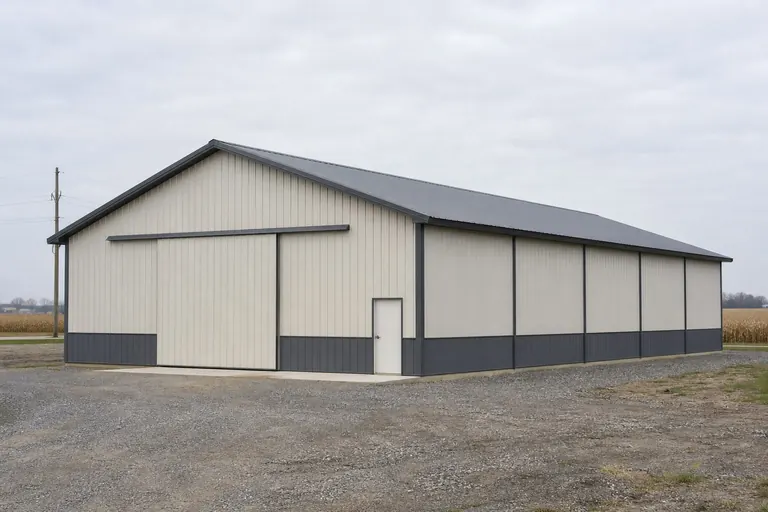 Equipment storageA clear-span bay sized to the largest implement, sited where a truck and trailer can turn without backing across sloped ground.Hay and feed storageVentilation and a raised, well-drained floor matter more than square footage on Ozark sites where water needs somewhere obvious to go.
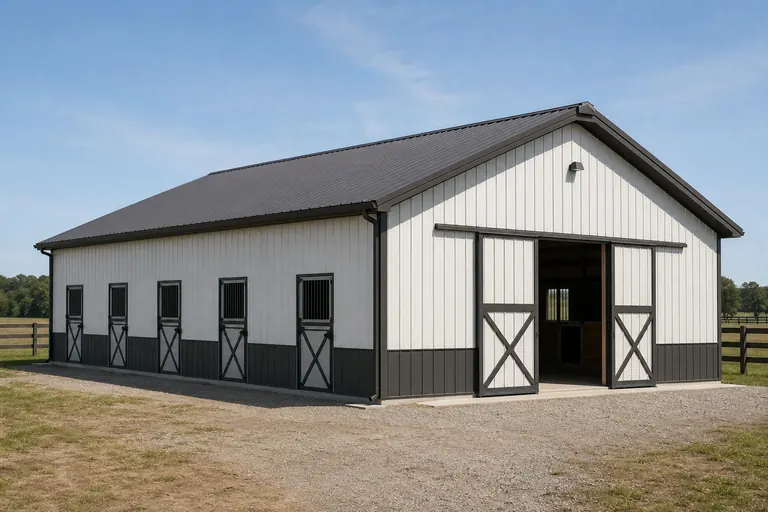 Livestock shelterOpen-sided or partially enclosed configurations are common; door and opening placement should account for prevailing wind on the specific parcel.
Example Configuration — for planning purposes only.
Footprint
Sizes that fit a larger, purpose-built Missouri program
Because Missouri briefs skew toward one building per function rather than one combined building, the common range runs wider than a small-acreage state's.
30′ × 40′
1,200 sq ft
A reasonable single-purpose equipment building on a smaller parcel or as a first structure.
40′ × 50′
2,000 sq ft
Common where one building still needs to flex between two related uses.
40′ × 80′
3,200 sq ft
Fits a dedicated hay or equipment building on a larger operation without doubling as anything else.
40′ × 60′
2,400 sq ft
A frequent middle ground for buyers replacing an aging single-purpose structure.
Example Configuration — for planning purposes only.
Footprint pages carry layout and door detail; this page explains why the Missouri brief tends toward purpose-built rather than combined buildings.
Local example
Kansas City area context
Missouri's only published city guide today sits in the Kansas City area, useful mainly as a reference for how the terrain and permitting questions play out around a specific metro edge.
Kansas City metro edge
Where rural and suburban jurisdictions meet, so the county-versus-city permitting question in this guide is worth confirming precisely for your address rather than assumed from the surrounding area.
Questions
Missouri pole barn questions
Answered honestly at state level; anything county-specific is routed to the county.
No. Missouri has no single mandatory statewide building code. County commissions have their own statutory authority (RSMo 64.170) to control construction and issue permits, and requirements vary by county.
It depends on your county. Some Missouri counties actively regulate ag buildings; others do very little outside incorporated city limits. Your county commission is the only reliable source for your specific parcel.
Only if your question is specifically about fire safety. The Division's authority under state statute is fire-safety rulemaking, not general construction review, so most pole barn permitting questions still route to the county.
There is no official typical size. Missouri's 308-acre average farm size and split Ozark/plains terrain support purpose-built structures more often than one combined building, which is why sizes on this page run from 30x40 up through 40x80 depending on the single job the building is meant to do.
Sloped, rugged ground generally requires more site preparation than level ground, which is a real cost factor, but the amount depends on your specific parcel. We do not publish state-level prices; a site visit from your builder is what produces an actual number.
Sources for the Missouri facts on this page
This page states no code requirement, wind speed, snow load, permit rule, price or supplier claim. The state-specific facts it does use are listed with their publisher below.
Missouri has no single statewide mandatory building code; the Missouri Division of Fire Safety administers state fire-safety-related rules while county commissions are separately empowered by statute to control construction and issue building permits.
Missouri General Assembly / Justia (statute text) · 2025 Missouri Revised Statutes · Tier 2
https://law.justia.com/codes/missouri/title-vi/chapter-64/section-64-170/The Missouri Division of Fire Safety (within the Department of Public Safety) is created and given fire-safety rulemaking authority by statute.
Missouri General Assembly / Justia (statute text) · 2025 Missouri Revised Statutes · Tier 2
https://law.justia.com/codes/missouri/title-xxi/chapter-320/section-320-202/Missouri had 27,026,243 acres of land in farms in 2022, an average farm size of 308 acres.
USDA NASS · 2022 · Tier 1
https://www.nass.usda.gov/Publications/AgCensus/2022/Online_Resources/County_Profiles/Missouri/cp99029.pdfMissouri had 87,887 farms in 2022.
USDA NASS · 2022 · Tier 1
https://www.nass.usda.gov/Publications/AgCensus/2022/Online_Resources/County_Profiles/Missouri/cp99029.pdfThe Missouri Geological Survey (part of Missouri DNR) describes the Ozarks region — covering about 33,000 of the region's 50,000 square miles within Missouri — as rugged, with lofty hills, deep valleys, and cold clear springs and streams south of the Missouri River.
Missouri Geological Survey, Missouri Department of Natural Resources · Fact sheet, rev. 2016 (orig. 2002) · Tier 2
https://dnr.mo.gov/print/document-search/pub0655Missouri's total land area is 68,746.3 square miles.
U.S. Census Bureau · Current Census Bureau geography data · Tier 1
https://data.census.gov/profile/Missouri?g=0400000US29NOAA NCEI publishes a narrative 'Climate of Missouri' describing the state's continental climate with cold winters and hot, humid summers.
NOAA National Centers for Environmental Information (NCEI) · Historical narrative (NCEI climate normals series) · Tier 1
https://www.ncei.noaa.gov/data/climate-normals-deprecated/access/clim60/states/Clim_MO_01.pdf