
Metal garage · IL
Metal Garages in Illinois
Illinois's residential construction market is moving faster than it was two years ago: statewide new privately-owned housing units authorized by permit rose from 16,863 in 2023 to 20,326 in 2024, a 20.5% jump. That is not a metal-garage-specific figure, but it is a real demand signal worth raising with a builder before assuming last year's schedule still applies. The other Illinois-specific factor is terrain, not weather drama: the Illinois State Geological Survey names twelve distinct physiographic divisions across the state's 55,518.9 square miles, and a garage slab near the Chicago Lake Plain sits on different ground than one in the state's central till plain or its southern hill country. Neither of these facts determines your specific permit path or design loads — those still run through your local building department — but both change what's worth asking before you finalize a plan.
Demand signal
A statewide construction market that's picked up pace
Illinois's new housing permits jumped 20.5% in a single year, a general signal worth raising with your garage builder.
Statewide new privately-owned housing units authorized by building permit rose from 16,863 in 2023 to 20,326 in 2024, a 20.5% increase, according to U.S. Census Bureau figures. That is a broad residential-construction indicator, not a metal-garage-specific count, and it does not tell you anything about your specific county's trade availability. What it does support is a direct, practical question for your builder: has their lead time moved in the past year, and what is currently driving their schedule.
This matters more for a metal garage build than it might seem, because a garage project often shares concrete, site work and sometimes framing trades with the broader residential market a builder is scheduling against. A builder who can answer specifically about their current backlog is giving you a number you can plan around; a builder who only offers a generic statewide estimate is not.
That question is worth asking early, before a design is finalized, because concrete crews and framing trades booked out further than expected can shift a garage's start date by months even after permitting is settled. A specific answer about current backlog, rather than a general statement that things are 'busy,' is what actually lets you plan a realistic delivery window.
Sourced figures
Illinois construction and geography at a glance
These sourced figures anchor the state-specific claims made on this page.
| Metric | Value | Source |
|---|---|---|
| New housing permits, 2023 | 16,863 units | U.S. Census Bureau |
| New housing permits, 2024 | 20,326 units (+20.5%) | U.S. Census Bureau |
| Total land area | 55,518.9 sq mi | U.S. Census Bureau |
| Named physiographic divisions | 12 sections | Illinois State Geological Survey |
| Total farms, 2022 | 71,123 | USDA NASS |
New housing permits, 2023
- Value
- 16,863 units
- Source
- U.S. Census Bureau
New housing permits, 2024
- Value
- 20,326 units (+20.5%)
- Source
- U.S. Census Bureau
Total land area
- Value
- 55,518.9 sq mi
- Source
- U.S. Census Bureau
Named physiographic divisions
- Value
- 12 sections
- Source
- Illinois State Geological Survey
Total farms, 2022
- Value
- 71,123
- Source
- USDA NASS
Site planning
Why your region of Illinois changes the slab plan
The Illinois State Geological Survey's twelve named divisions carry real drainage and soil differences relevant to a garage foundation.
Chicago Lake Plain and northeast lowland
Lake-influenced ground where drainage planning and the region's own station-specific snowfall data deserve early attention before a slab is poured.
Northern hill and driftless country
Rock River Hill Country and the Wisconsin Driftless Section carry more varied, rolling terrain than the state's central plains, which can mean extra grading before a level pad is possible.
Central plains
The state's most extensive flat-to-gently-rolling ground, generally the more straightforward slab condition among Illinois's named sections, though local drainage still deserves a direct check.
Southern hill country
The Mt. Vernon Hill Country, Shawnee Hills Section and Lincoln Hills toward the state's southern tip, where slope can mean more site grading than a flat-plain build and where a leveled platform is often part of the plan.
Start your Illinois metal garage build
Tell us your target footprint, primary use and general area of the state. We route it with the Illinois and metal-garage context already attached.
Use case and climate
Two distinct buyer profiles behind an Illinois garage search
Illinois metal garage demand comes from both general residential buyers and the state's 71,123-farm agricultural base, and its continental climate needs a local, not statewide, reading.
Illinois's garage buyers are not one uniform group. General residential buyers in the state's growing suburban and exurban housing market are the group most directly connected to the 20.5% permit increase discussed above. A second, distinct group comes from Illinois's 71,123 working farms: a household on an active operation often wants a garage-scale building for a personal truck, car or ATV, separate from the larger equipment storage a pole barn or grain-handling structure already covers. Confirming which use case applies helps set realistic expectations for door height and depth rather than duplicating equipment-storage sizing in a smaller structure.
Scale matters here too. USDA NASS reports Illinois's 71,123 farms cover 26,292,041 acres in farms, an average of 370 acres per operation. At that size, a garage-scale building is almost never the primary storage structure on the property; it is a smaller, personal-vehicle addition sited near the house rather than near the working fields, which is a useful distinction when a builder asks what the structure is actually for.
On climate, NOAA NCEI's narrative description of Illinois calls out a continental climate with cold winters, warm summers and frequent short-term weather fluctuations — a general pattern, not a specific design number. Because the state spans more than 55,000 square miles from a Great Lakes shoreline to the Ohio River, that continental description plays out differently by region, and a garage buyer weighing door seal quality or added insulation should ask for climate data covering their specific area rather than assume one statewide winter figure applies evenly from the Chicago suburbs to the state's southern tip.
The Illinois State Climatologist Office also maintains station-level normals for Chicago O'Hare, a useful reminder that Illinois climate planning is genuinely a station-by-station exercise rather than a single number a garage buyer can borrow from a different part of the state. Pulling the normal for the station nearest your actual build site is a more reliable starting point than any statewide average.
Configurations
Garage profiles Illinois buyers request
These profiles reflect Illinois's mix of general residential demand and its working-farm household base.
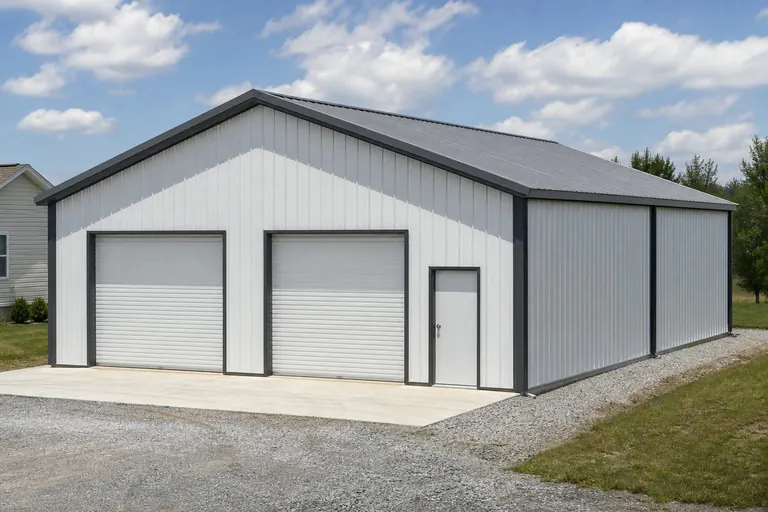 Standard residential storageA straightforward two- or three-car footprint for vehicle protection on a suburban or small-town Illinois lot.Farm household vehicle garageA garage-scale building for a personal truck or ATV, kept distinct from a farm's larger equipment-storage pole barn.Workshop or hobby bayA garage with a workbench or small equipment bay added alongside vehicle storage.
Example Configuration — for planning purposes only.
Popular sizes
Sizing an Illinois metal garage
Choose a footprint based on whether the garage is doing vehicle storage, workshop use, or both.
24′ × 30′
720 sq ft
Standard two-car storage for a suburban Illinois lot.
30′ × 40′
1,200 sq ft
Common where a workbench or small equipment bay joins vehicle storage.
40′ × 60′
2,400 sq ft
Sized for a larger vehicle or trailer plus a dedicated shop area.
Example Configuration — for planning purposes only.
Confirm door height against your tallest vehicle or trailer, not just floor footprint, and check your county's setback rules before finalizing a spot on the lot.
Illinois FAQ
Metal garage questions for Illinois buyers
Direct answers, with unverifiable figures routed to the right office.
Statewide new housing permits rose 20.5% from 2023 to 2024. That's a general residential-construction signal, not a garage-specific figure, but it's a reasonable reason to ask your builder directly about current lead times.
It can. The Illinois State Geological Survey names twelve physiographic divisions with different terrain characteristics, from lake-influenced lowland near Chicago to hill country in the north and south and flatter central plains in between.
This page does not state a specific figure; no single statewide value applies evenly across a state this large and this varied. Your local building department will supply the design values for your exact site.
Often, yes, by intended use. Many Illinois farm households size a garage for a personal truck or ATV separately from a larger pole barn or grain-handling structure that covers bigger equipment.
We do not publish state-level prices, because the number depends on size, specification, site work and current material and labor pricing. Our cost pages cover what drives the number; a builder quote covers your specific project.
Sources for the Illinois facts on this page
This page states no code requirement, wind speed, snow load, permit rule, price or supplier claim. The state-specific facts it does use are listed with their publisher below.
Illinois had a total of 16,863 new privately-owned housing units authorized by building permits in 2023, rising to 20,326 units in 2024 (a 20.5% increase).
U.S. Census Bureau · 2023-2024 · Tier 1
https://www.census.gov/construction/bps/pdf/2024annualhighlights.pdfIllinois had a total of 16,863 new privately-owned housing units authorized by building permits in 2023, rising to 20,326 units in 2024 (a 20.5% increase).
U.S. Census Bureau · 2023-2024 · Tier 1
https://www.census.gov/construction/bps/pdf/2024annualhighlights.pdfThe Illinois State Geological Survey maps the state into named physiographic divisions including the Till Plains, Wisconsin Driftless Section, Rock River Hill Country, Green River Lowland, Great Lake Section (Chicago Lake Plain), Kankakee Plain, Springfield Plain, Galesburg Plain, Bloomington Ridged Plain, Mt. Vernon Hill Country, Shawnee Hills Section, and Lincoln Hills.
Illinois State Geological Survey, University of Illinois · ISGS reference map, 1993 (revised 1998), originally based on Leighton et al. 1948 · Tier 2
https://clearinghouse.isgs.illinois.edu/data/geology/physiographic-divisionsIllinois's total land area was measured at 55,518.9 square miles as of the 2010 Census.
U.S. Census Bureau · 2010 Census · Tier 1
https://www.census.gov/geographies/reference-files/2010/geo/state-local-geo-guides-2010/illinois.htmlNOAA NCEI publishes a narrative 'Climate of Illinois' describing the state's location midway between the Continental Divide and the Atlantic Ocean and its continental climate of cold winters, warm summers, and frequent short-term fluctuations in weather.
NOAA National Centers for Environmental Information (NCEI) · Historical narrative (NCEI climate normals series) · Tier 1
https://www.ncei.noaa.gov/data/climate-normals-deprecated/access/clim60/states/Clim_IL_01.pdfIllinois had 71,123 farms in 2022, a decrease of 2% since 2017.
USDA National Agricultural Statistics Service (NASS) · 2022 · Tier 1
https://www.nass.usda.gov/Publications/AgCensus/2022/Online_Resources/County_Profiles/Illinois/cp99017.pdfIllinois had 26,292,041 acres of land in farms in 2022, an average farm size of 370 acres.
USDA NASS · 2022 · Tier 1
https://www.nass.usda.gov/Publications/AgCensus/2022/Online_Resources/County_Profiles/Illinois/cp99017.pdf