
Livestock barn · MO
Livestock Barns in Missouri
A livestock barn in Missouri answers to whoever actually regulates construction on that parcel, and that is rarely a single state office. Missouri Revised Statutes give county commissions their own authority to control construction and issue permits, while the state's Division of Fire Safety is scoped to fire safety, not barn design. Layer on a state where the Missouri Geological Survey describes an Ozark Plateau region covering roughly 33,000 of its 50,000 square miles inside Missouri's 68,746.3-square-mile total, against 87,887 farms averaging 308 acres apiece, and a livestock barn project turns into two separate conversations: who governs this site, and what does this specific ground require.
Permitting reality
In Missouri, the county decides — not one state office
Missouri does not run a single mandatory statewide building code, so the question of what your livestock barn must meet is answered locally, county by county.
County commissions hold their own statutory authority under Missouri Revised Statutes to control construction and issue permits. That is a structural difference from states where a single building-code commission sets one baseline that every jurisdiction inherits. In Missouri, one county might actively review agricultural building plans, setbacks and drainage, while a neighboring county enforces very little outside its incorporated towns. Neither approach is described here as typical of the state, because it would not be an honest statement — it is a reason to call your specific county commission before you draw a site plan.
The Missouri Division of Fire Safety is a real state agency, created by statute within the Department of Public Safety, but its rulemaking authority is scoped to fire safety. It is not a general construction-code office, so it will not answer a setback question or a foundation question for a livestock shelter. Treat it as the right call only when the question is specifically about fire-related rules, and treat your county commission as the right call for everything else about whether and how your barn can be built.
Site context
Ozark ground and northern plains behave differently under a livestock barn pad
Missouri's terrain is not one condition. The Missouri Geological Survey places roughly 33,000 of Missouri's 68,746.3 square miles inside the rugged Ozark Plateau, mostly south of the Missouri River.
Ozark Plateau (south of the Missouri River)
Described by the Missouri Geological Survey as rugged, with lofty hills, deep valleys, springs and streams. A livestock barn pad here usually needs cut-and-fill grading and a drainage plan worked out before foundation type is decided.
Glaciated plains (north Missouri)
Flatter ground shaped by past glaciation. Pad prep is typically simpler here, which shifts more of the budget toward the building itself rather than earthwork.
River valley bottomland
Parcels near the Missouri and Mississippi corridors raise separate flood-exposure and drainage questions worth confirming with the county before siting animal housing near a floodplain.
Climate and scale
Cold winters, humid summers, and a 308-acre average farm
NOAA describes Missouri's climate as continental — cold winters paired with hot, humid summers — which pushes livestock barn ventilation design in two directions rather than one.
A livestock shelter built only for winter wind-blocking will trap heat and humidity badly in a Missouri summer, and one built only for summer airflow will underperform in a Missouri winter. The practical answer most Missouri operations land on is adjustable ventilation — ridge vents, opening side panels, or orientation choices that can be tuned seasonally — rather than a single fixed configuration that only serves half the year well.
Scale plays into the same decision. Missouri's 2022 Census of Agriculture counted 87,887 farms averaging 308 acres across 27,026,243 acres in farms. On operations at or above that average, a single centralized livestock barn can leave animals a long walk from shelter during a sudden storm. Several producers running rotational grazing across split Ozark-and-plains ground find that two or three smaller shelters positioned near existing water points get animals under cover faster than one large barn ever could, even though the combined material cost usually runs higher than a single structure.
Neither the terrain split nor the farm-scale question has a universal right answer for Missouri; both are decisions that depend on your specific parcel's water layout, grazing rotation and which side of the state's terrain divide the property sits on.
- Design for both seasons
- Specify ventilation that can be closed down for winter wind and opened up for summer humidity, not one fixed setting.
- Map water before barn count
- On a 308-acre-average parcel, existing water points usually decide whether one barn or several shelters serves the herd better.
Get Missouri livestock barn quotes
Tell us your county, your terrain, and your herd size. We route your project with the Missouri permitting and siting context already attached.
Configuration
Common Missouri livestock barn configurations
Missouri livestock projects tend to fall into a handful of recurring shapes, driven by terrain and herd movement rather than a fixed template.
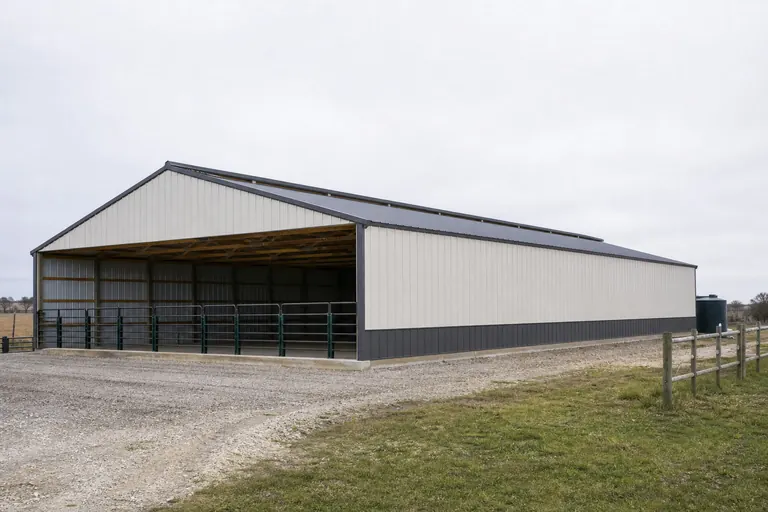 Open-front run-in shelterA three-sided structure oriented to block prevailing winter wind, suited to rotational grazing on either terrain type.Ozark hillside barnA structure sited and graded specifically for sloped ground, with drainage routed away from the animal area.
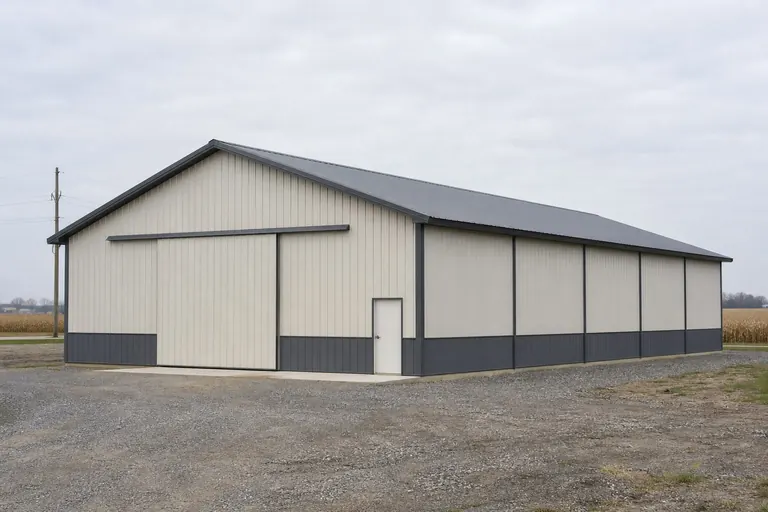 Combined hay and shelter buildingPairs feed storage with animal cover on a single-building parcel, more common on smaller acreage.
Example Configuration — for planning purposes only.
Preparation
Before you site a Missouri livestock barn
A short list that keeps a Missouri livestock project from stalling between the permit call and the first grading estimate.
Step 1
Call your county commission first
Confirm whether your county reviews agricultural building plans and what, if anything, it requires before you finalize a site plan.
Step 2
Confirm which side of the terrain split you're on
Ozark ground south of the Missouri River usually needs more grading and drainage planning than the flatter north.
Step 3
Map existing water and grazing rotation
Barn count and placement should follow how your herd actually moves, not just where construction access is easiest.
Step 4
Specify seasonal ventilation, not a single setting
Cold winters and hot, humid summers both need to be designed for in the same building.
Dimensions
Sizing a Missouri livestock barn
Reflecting the state's 308-acre average farm size, these footprints suit either a single centralized barn or one of several distributed shelters.
30′ × 40′
1,200 sq ft
A distributed shelter suited to rotational grazing on a larger Missouri parcel.
40′ × 60′
2,400 sq ft
A common size for a single primary livestock barn on a mid-sized operation.
50′ × 80′
4,000 sq ft
Sized for larger herds or a combined hay-and-shelter program.
Example Configuration — for planning purposes only.
Herd size and grazing pattern determine actual square footage needs; confirm with a livestock specialist before finalizing dimensions.
Questions
Missouri livestock barn questions
Answered honestly at the state level, with anything county-specific routed to the county.
No. Missouri has no single mandatory statewide building code. County commissions hold their own statutory authority under RSMo 64.170 to control construction and issue permits, so requirements vary by county.
Only if your question is specifically about fire-safety rules. The Division's statutory authority is fire-safety rulemaking, not general construction review, so most livestock barn permitting questions still route to your county commission.
It can. The Missouri Geological Survey describes the Ozark Plateau, which covers roughly 33,000 of Missouri's 68,746.3 square miles, as rugged with lofty hills and deep valleys. Sites there generally need more grading and drainage planning than the flatter northern plains.
It depends on your water layout and grazing rotation. On operations at or above Missouri's 308-acre average, several smaller shelters near existing water points often get animals under cover faster than a single central barn, though the combined cost is usually higher.
There is no official typical size. 30x40 through 50x80 covers most single shelters and combined hay-and-shelter buildings, but actual sizing should follow herd count, not a fixed rule.
Yes, in practice. NOAA describes Missouri's climate as cold in winter and hot and humid in summer, so a barn designed with adjustable ventilation performs better year-round than one built for only one season.
Sources for the Missouri facts on this page
This page states no code requirement, wind speed, snow load, permit rule, price or supplier claim. The state-specific facts it does use are listed with their publisher below.
Missouri has no single statewide mandatory building code; the Missouri Division of Fire Safety administers state fire-safety-related rules while county commissions are separately empowered by statute to control construction and issue building permits.
Missouri General Assembly / Justia (statute text) · 2025 Missouri Revised Statutes · Tier 2
https://law.justia.com/codes/missouri/title-vi/chapter-64/section-64-170/The Missouri Division of Fire Safety (within the Department of Public Safety) is created and given fire-safety rulemaking authority by statute.
Missouri General Assembly / Justia (statute text) · 2025 Missouri Revised Statutes · Tier 2
https://law.justia.com/codes/missouri/title-xxi/chapter-320/section-320-202/The Missouri Geological Survey (part of Missouri DNR) describes the Ozarks region — covering about 33,000 of the region's 50,000 square miles within Missouri — as rugged, with lofty hills, deep valleys, and cold clear springs and streams south of the Missouri River.
Missouri Geological Survey, Missouri Department of Natural Resources · Fact sheet, rev. 2016 (orig. 2002) · Tier 2
https://dnr.mo.gov/print/document-search/pub0655Missouri's total land area is 68,746.3 square miles.
U.S. Census Bureau · Current Census Bureau geography data · Tier 1
https://data.census.gov/profile/Missouri?g=0400000US29Missouri had 87,887 farms in 2022.
USDA NASS · 2022 · Tier 1
https://www.nass.usda.gov/Publications/AgCensus/2022/Online_Resources/County_Profiles/Missouri/cp99029.pdfMissouri had 27,026,243 acres of land in farms in 2022, an average farm size of 308 acres.
USDA NASS · 2022 · Tier 1
https://www.nass.usda.gov/Publications/AgCensus/2022/Online_Resources/County_Profiles/Missouri/cp99029.pdfNOAA NCEI publishes a narrative 'Climate of Missouri' describing the state's continental climate with cold winters and hot, humid summers.
NOAA National Centers for Environmental Information (NCEI) · Historical narrative (NCEI climate normals series) · Tier 1
https://www.ncei.noaa.gov/data/climate-normals-deprecated/access/clim60/states/Clim_MO_01.pdf