
Carport · CT
Carports in Connecticut
Connecticut is the third-smallest state by land area — 4,842.4 square miles at the 2010 Census — and that single fact governs most carport projects here. The structure usually has to fit between a driveway and a lot line, which makes setbacks, height and the neighbour's sightline the practical design constraints rather than span. The weather then decides the specification: the Hartford Brainard Field station normals put annual precipitation near 43 inches, and FEMA's National Risk Index covers winter weather, coastal flooding and hurricane among the 18 hazards it scores for Connecticut's counties. An open structure has to handle both a snow load and an uplift event, which is a different brief from a carport in a dry, mild state.
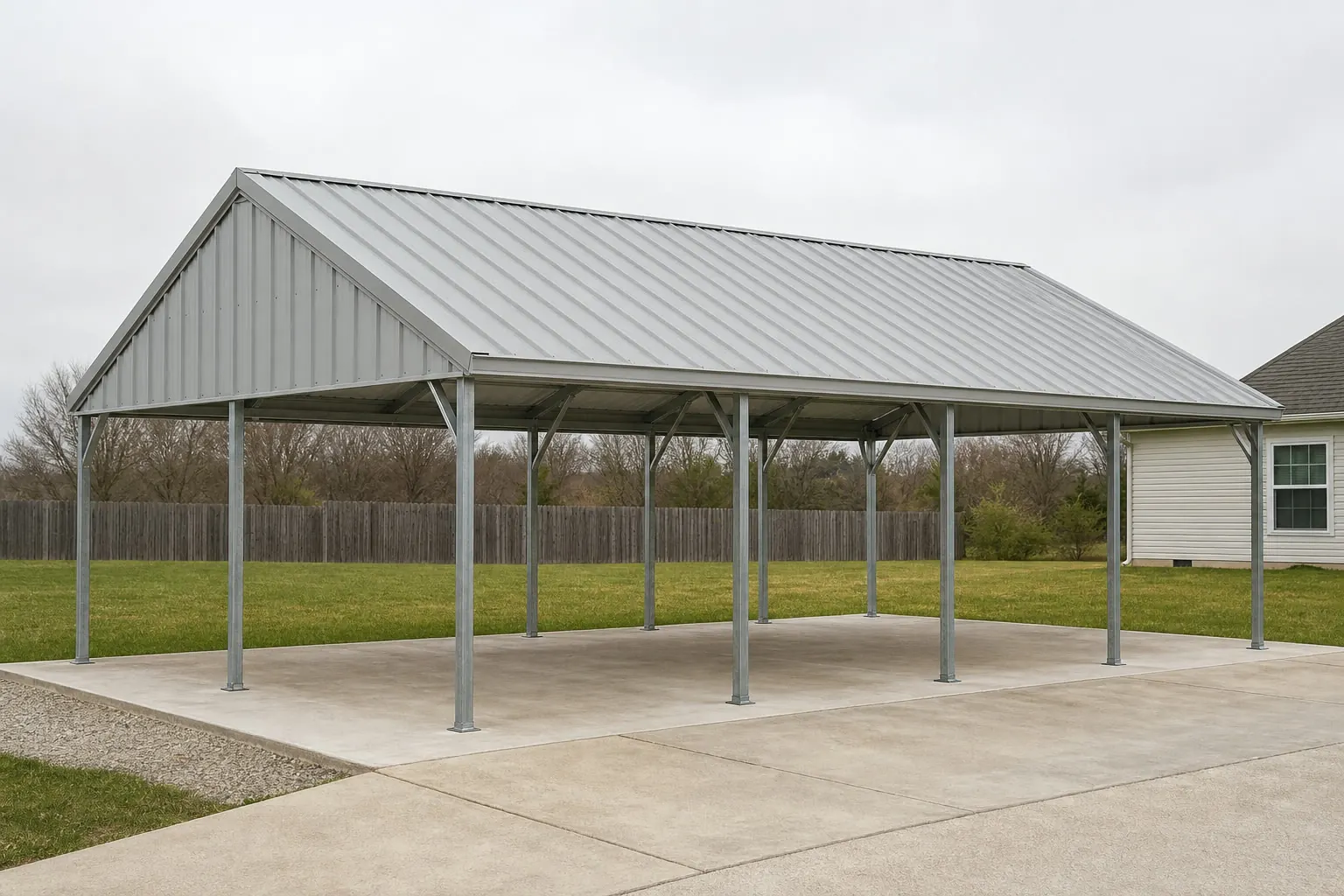
A Small-Lot Structure in a Two-Season Load Case
Most carport advice assumes an open yard and one governing load. Connecticut offers neither. The state's land area was measured at 4,842.4 square miles at the 2010 Census, third smallest in the country, and the practical result is that carports go into gaps: alongside a house, at the end of a shared drive, between a garage and a boundary. Meanwhile the structure has to work in a climate where the Hartford Brainard Field station normals sit near 43 inches of annual precipitation and where FEMA's National Risk Index scores winter weather alongside coastal flooding and hurricane exposure. A canopy that is well anchored against uplift and well shaped for snow is the Connecticut answer; a light frame chosen on price is not.
Siting
Fit Comes Before Size in Connecticut
On Connecticut lots the carport dimension you can build is usually set by the town's setback and coverage rules, so confirm those before choosing a width.
Land scarcity shows up in the details of a carport project here. A structure that would sit comfortably in the middle of a rural parcel elsewhere has to respect a side-yard setback, a lot-coverage limit and often a height rule that affects the roof profile you can use. Because Connecticut administers building and zoning locally, those numbers belong to your town and can differ from the next town over. Ask for them in writing before you configure anything, and ask specifically whether an open, unenclosed structure is treated differently from an enclosed one — that distinction changes the answer in many jurisdictions.
The second Connecticut fit question is the neighbour and the streetscape. On a small lot the carport is visible from the road and from adjacent properties, and towns with design review or historic districts will care about roof pitch, colour and whether the structure reads as an addition or an outbuilding. This is not an aesthetic aside; it is frequently the thing that determines whether an application is straightforward or lengthy.
Finally, think about what the carport does to the site's drainage. Connecticut properties are often modest in size with mature landscaping and established grading. Adding a roof means concentrating roughly 43 inches of annual precipitation, per the state's benchmark station normals, into a shed line that has to go somewhere other than a foundation, a walkway or a neighbour's yard.
Specification
The Two-Load Connecticut Carport
An open canopy in Connecticut has to be specified for downward snow loading and upward wind loading. Neither can be assumed away.
- Get the town's design values firstAsk for the snow load and wind speed used on your parcel, plus the frost depth. NOAA publishes 1991-2020 normals station by station in Connecticut rather than a single statewide design figure, so the town's numbers are the operative ones.
- Treat anchoring as structural, not optionalAn open carport is a wing. Coastal flooding and hurricane exposure are among the hazards FEMA scores for Connecticut counties, and uplift resistance depends entirely on how the frame is tied to the ground.
- Match the anchor to the surfaceAsphalt, an existing slab, a new pad and bare ground each require a different anchoring approach. Retrofitting anchors into an existing driveway is a common Connecticut situation and should be discussed with the supplier before order.
- Decide the shed line deliberatelyRoof snow and rain will land on the drive, a path or the boundary. Choose which, and grade the pad accordingly.
- Consider partial enclosure carefullyAdding one wall to block prevailing weather changes both the wind behaviour of the structure and, in many towns, how the structure is classified. Ask before assuming a windbreak is a free upgrade.
- Confirm what an open structure means for approvalSome towns treat an unenclosed canopy differently from an enclosed garage for setback, coverage and permit purposes. This is worth a direct question, because it can unlock a larger structure than you expected.
Get carport quotes for your Connecticut property
Tell suppliers your town, your setback and height limits, and what surface the carport will stand on. Those three answers make Connecticut quotes comparable.
Footprints
Carport Footprints for Connecticut Lots
On tight Connecticut parcels the practical range is narrower than the catalogue, and the deciding factor is usually the setback line.
12′ × 24′
288 sq ft
Single-vehicle cover that fits beside many Connecticut houses without crowding a side-yard setback.
20′ × 24′
480 sq ft
Two vehicles side by side where the drive is wide enough — a frequent upgrade request on established suburban lots.
24′ × 30′
720 sq ft
Two vehicles plus working room or a boat, where lot coverage and the town's rules allow the additional footprint.
Example Configuration — for planning purposes only.
Confirm setback, height and coverage limits with your town before selecting a footprint.
Site Context
Shoreline and Inland Connecticut
Connecticut is small, but the carport brief still differs between the shoreline and the inland north-west.
Shoreline towns
Coastal flooding and hurricane exposure are explicitly among the hazards FEMA scores for Connecticut, and shoreline properties carry the highest sensitivity to wind uplift and to salt-laden air affecting finishes and fasteners. Anchoring and coating specification deserve extra attention here, and some sites carry additional local requirements.
Central valley and Hartford area
This is where the state's benchmark station normals come from — near 43 inches of annual precipitation. Sites here are typically suburban with mature grading, so the drainage consequence of a new roof surface is the recurring issue rather than exposure.
Northwest hills
Higher, colder and snowier than the shoreline, with the state's snow-loading questions at their sharpest. NOAA publishes station-level normals for Connecticut locations such as Bakersville precisely because the state is not climatically uniform, so use local data rather than a Hartford figure here.
Evidence Position
What This Page Does Not Claim
No Connecticut snow load, wind speed, permit threshold, code edition or price appears here. Those come from your town.
The Connecticut facts used above are the ones we can source: NOAA NCEI 1991-2020 normals for the Hartford Brainard Field station and for individual Connecticut stations, the Census land-area measurement of 4,842.4 square miles, Census authorisation of 6,272 housing units in 2023, and FEMA's National Risk Index as the federal tool covering the state's counties.
We also record what we could not verify. A Tier 1 statewide precipitation or snowfall normal for Connecticut was not located in this evidence cycle, so the Hartford figure is carried as a station-level, third-party-compiled value and labelled accordingly rather than presented as a statewide design number.
Questions
Connecticut Carport Questions
The Connecticut-specific answers a general carport page cannot give.
That is answered by your town, not by the state, and we do not publish a threshold. Ask your town's building and zoning officials whether an open, unenclosed structure of your intended size and height requires a permit on your parcel, and whether it counts toward lot coverage.
Ask your town for the design values used on your parcel. NOAA publishes 1991-2020 normals station by station in Connecticut rather than one statewide figure, and the northwest hills differ materially from the shoreline.
It is the most important part. An open canopy generates uplift, and coastal flooding and hurricane are among the hazards FEMA scores for Connecticut counties. The anchoring method must suit the surface — asphalt, existing slab, new pad or ground — and should be agreed before you order.
Sometimes, but it depends on the driveway's condition and construction and on the anchor system your supplier uses. Raise it early; it frequently changes the recommended base.
The structure is the same but the exposure is not. Shoreline sites see higher wind loading and salt-laden air, so finishes, fasteners and anchoring specification should reflect that, and some towns add local requirements.
Pricing sits with the cost silo. The Connecticut-variable costs are the base or pad work, anchoring for your specific surface, and any town requirements that affect the roof profile or finish.
Sources for the Connecticut facts on this page
This page states no code requirement, wind speed, snow load, permit rule, price or supplier claim. The state-specific facts it does use are listed with their publisher below.
NOAA NCEI-sourced 1991-2020 normals for the Hartford Brainard Field station show about 43 inches of average annual precipitation.
NOAA National Centers for Environmental Information (NCEI) station normals, via GeoStat.org compilation · 1991-2020 · Tier 2
https://www.geostat.org/data/hartford-ct/climateNOAA NCEI publishes 1991-2020 monthly climate normals (temperature, precipitation, snowfall, degree days) for individual Connecticut stations such as Bakersville, CT.
NOAA National Centers for Environmental Information (NCEI) · 1991-2020 · Tier 1
https://www.ncei.noaa.gov/access/services/data/v1?dataTypes=MLY-TMAX-NORMAL%2CMLY-TMIN-NORMAL%2CMLY-TAVG-NORMAL%2CMLY-PRCP-NORMAL%2CMLY-SNOW-NORMAL&dataset=normals-monthly-1991-2020&format=pdf&stations=USC00060227Connecticut's total land area was measured at 4,842.4 square miles as of the 2010 Census, the third-smallest of any US state.
U.S. Census Bureau · 2010 Census · Tier 1
https://www.census.gov/geographies/reference-files/2010/geo/state-local-geo-guides-2010/connecticut.htmlFEMA's National Risk Index is an interactive county/tract-level tool covering 18 natural hazards, including winter weather, coastal flooding, and hurricane, that can be queried for Connecticut's counties.
Federal Emergency Management Agency (FEMA) · Current NRI release · Tier 1
https://www.fema.gov/flood-maps/products-tools/national-risk-indexConnecticut had 6,272 total housing units authorized by building permits in 2023, up 5.8% from 5,926 in 2022.
U.S. Census Bureau · 2023 (annual) · Tier 1
https://www.census.gov/construction/bps/pdf/2023annualhighlights.pdf