
Hobby shop · CT
Hobby Shops in Connecticut
A hobby shop is only worth building if you use it in February. That is the Connecticut framing for this building type: an unheated shell in a state with a full four-season winter and roughly 43 inches of annual precipitation at the Hartford Brainard Field station becomes a cold, damp storage box for five months of the year. Layered on top is siting. Connecticut's land area was measured at 4,842.4 square miles at the 2010 Census — third smallest in the country — so the shop goes close to the house and close to the neighbours, which brings town coverage rules, height limits and sometimes noise expectations into the design.
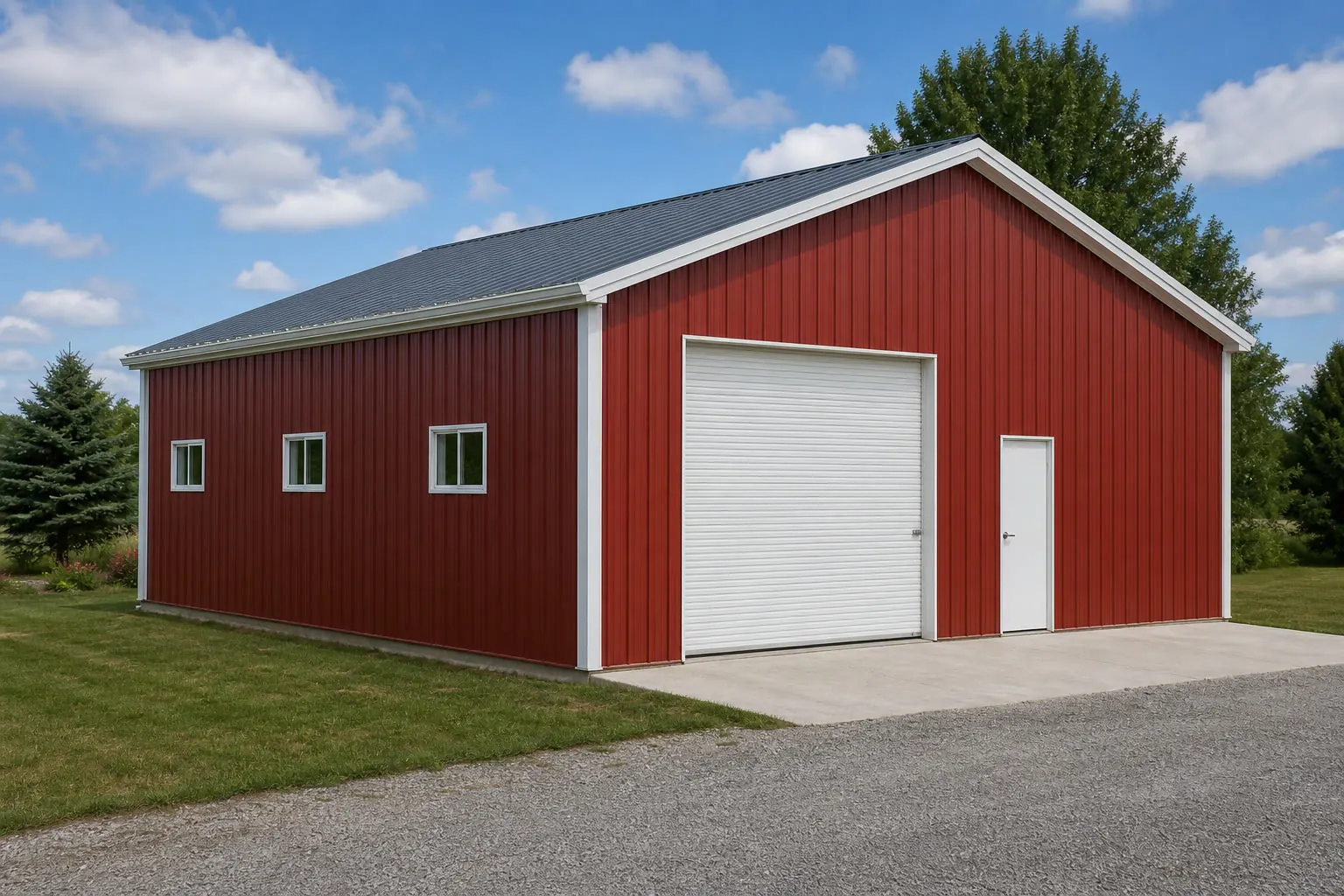
Build for February, Not for July
Every hobby shop is pleasant in September. The Connecticut test is whether you will walk out to it on a wet January evening, turn on the heat and be working within twenty minutes. That outcome is decided almost entirely by choices made before the building arrives: how the slab is detailed, whether there is a vapour barrier under it, how the walls and roof are insulated, how the building is sealed, and what heat source the space can actually support. Buyers who defer those decisions to save on the initial quote generally end up paying more to retrofit them, and in the meantime use the building as storage.
Envelope
The Connecticut Envelope Decision
In Connecticut, insulation, air sealing and a slab vapour barrier are what turn a steel shell into a usable year-round shop.
Connecticut's climate does two things to an uninsulated shop. In winter it drains heat as fast as you can add it, so a space heater fights the building rather than warming it. In shoulder seasons it condenses: warm humid air meets a cold steel roof panel, and the moisture falls onto benches, tools and stored material. With annual precipitation near 43 inches at the state's benchmark station, humidity is not a rare condition here.
The countermeasures are well understood and they interlock. A vapour barrier under the slab stops ground moisture rising into the space — cheap during construction and effectively impossible afterwards. Insulation on the roof and walls raises interior surface temperatures above the dew point and cuts the heating load at the same time. Controlled ventilation, whether passive or a small mechanical unit, gives the remaining moisture somewhere to go. Skip any one of the three and the other two work harder for less result.
The heat source follows the envelope, not the other way round. A well-sealed, insulated Connecticut shop can be held at a comfortable working temperature by a modest unit; a bare shell of the same size cannot be heated economically by anything. Decide the envelope, then size the heat, then confirm the electrical service can support both the heat and the tools you plan to run.
Siting and Approval
Placing a Shop on a Small Connecticut Lot
The neighbours are close and the town has the final word, so approval planning belongs at the start of the project.
- Confirm accessory-structure limits with the townSize, height and coverage limits for a detached accessory building are municipal in Connecticut. Ask before you configure, and ask how the town treats a building used as a workshop rather than for storage.
- Ask about use, not just structureA hobby shop is occupied space. Whether that changes the classification, and whether any home-occupation rules apply if you ever sell what you make, is worth clarifying at the outset.
- Plan the electrical run earlyTrenching from an existing house panel across an established Connecticut yard is often a bigger cost than expected, and the panel may need capacity added for heat plus tools.
- Think about noise and hoursWith houses close together in the third-smallest state, a compressor or dust collector on a Sunday morning is a neighbour issue. Insulation helps with sound as well as heat.
- Get the design values in writingSnow load, wind speed and frost depth for your parcel. NOAA publishes Connecticut normals by station, so hill-country and shoreline sites differ.
- Route roof water deliberatelyA new roof surface on an established, mature lot changes where water goes. Gutters and a defined discharge path prevent an argument with a neighbour or a wet foundation.
Get hobby shop quotes for your Connecticut property
Tell suppliers your town, your intended footprint, and that the building must be usable through the winter. The insulation and heating brief is what separates comparable Connecticut quotes.
Footprints
Hobby Shop Footprints for Connecticut Yards
Coverage limits usually cap the footprint before the budget does, so most Connecticut shops land in a narrow band.
20′ × 24′
480 sq ft
A genuine one-person shop with bench, storage and floor space, sized to sit comfortably within common accessory-structure limits.
24′ × 30′
720 sq ft
Adds a second work zone or a vehicle bay while remaining insulable at reasonable cost.
30′ × 40′
1,200 sq ft
For larger projects or a vehicle plus fabrication, where the parcel and coverage rules permit it.
Example Configuration — for planning purposes only.
Confirm accessory-structure size, height and coverage limits with your town before selecting a footprint.
Site Context
Where the Shop Sits Changes the Spec
Connecticut's compact geography still produces three different envelope conversations.
Northwest hills
The coldest and snowiest part of the state, where the heating load and the snow-loading question are both at their most serious. Insulation depth pays back fastest here, and design values should come from the town rather than a Hartford figure.
Central valley suburbs
Where the benchmark precipitation normal of about 43 inches is recorded, and where lots are established with mature grading. The recurring issues are drainage, electrical routing and neighbour proximity.
Shoreline
Milder winters but a corrosive, humid environment, with coastal flooding and hurricane among the hazards FEMA scores for Connecticut counties. Fastener and coating specification and anchoring matter more here than insulation depth.
Evidence Position
What Is Sourced and What Is Withheld
Climate, geography and construction figures are federal; every regulatory number is left to your town.
Sourced above: NOAA NCEI 1991-2020 normals for the Hartford Brainard Field station and for individual Connecticut stations, the Census land-area measurement of 4,842.4 square miles, Census authorisation of 6,272 housing units in 2023, and FEMA's National Risk Index as the federal county-level hazard tool for the state.
Withheld deliberately: permit thresholds, accessory-structure dimensions, occupancy classifications, adopted code editions, snow loads, frost depths and prices. Our evidence record also notes that a Tier 1 statewide Connecticut climate normal was not retrievable in this cycle, which is why the Hartford value is described as a station figure.
Questions
Connecticut Hobby Shop Questions
Connecticut-specific answers for backyard workshop buyers.
If you intend to use it through the winter, effectively yes. Connecticut's four-season climate means an uninsulated steel shell cannot be heated economically, and the same building condenses in shoulder seasons, which rusts tools. Insulation, air sealing and a slab vapour barrier work together.
That depends on your town's accessory-structure and coverage limits, which we do not publish. Many buyers here land between a 20x24 and a 30x40 once those limits are known.
Often it needs at least a dedicated sub-panel. Heat plus power tools is a real load, and on established Connecticut properties the trenching distance from the house panel is a meaningful cost item. Get an electrician's view before finalising the location.
Combine three measures: a vapour barrier under the slab, insulation that keeps interior surfaces above the dew point, and ventilation to remove residual moisture. With around 43 inches of annual precipitation at the state's benchmark station, humidity is a persistent condition here.
Ask your town. Connecticut administers building and zoning municipally, and because a hobby shop is occupied working space rather than storage, it is worth asking specifically how your town classifies that use.
Pricing is handled by the cost silo. The Connecticut-variable drivers are the insulation package, the electrical run from the house, and the foundation detail required for your local frost depth.
Sources for the Connecticut facts on this page
This page states no code requirement, wind speed, snow load, permit rule, price or supplier claim. The state-specific facts it does use are listed with their publisher below.
NOAA NCEI-sourced 1991-2020 normals for the Hartford Brainard Field station show about 43 inches of average annual precipitation.
NOAA National Centers for Environmental Information (NCEI) station normals, via GeoStat.org compilation · 1991-2020 · Tier 2
https://www.geostat.org/data/hartford-ct/climateConnecticut's total land area was measured at 4,842.4 square miles as of the 2010 Census, the third-smallest of any US state.
U.S. Census Bureau · 2010 Census · Tier 1
https://www.census.gov/geographies/reference-files/2010/geo/state-local-geo-guides-2010/connecticut.htmlNOAA NCEI publishes 1991-2020 monthly climate normals (temperature, precipitation, snowfall, degree days) for individual Connecticut stations such as Bakersville, CT.
NOAA National Centers for Environmental Information (NCEI) · 1991-2020 · Tier 1
https://www.ncei.noaa.gov/access/services/data/v1?dataTypes=MLY-TMAX-NORMAL%2CMLY-TMIN-NORMAL%2CMLY-TAVG-NORMAL%2CMLY-PRCP-NORMAL%2CMLY-SNOW-NORMAL&dataset=normals-monthly-1991-2020&format=pdf&stations=USC00060227Connecticut had 6,272 total housing units authorized by building permits in 2023, up 5.8% from 5,926 in 2022.
U.S. Census Bureau · 2023 (annual) · Tier 1
https://www.census.gov/construction/bps/pdf/2023annualhighlights.pdfFEMA's National Risk Index is an interactive county/tract-level tool covering 18 natural hazards, including winter weather, coastal flooding, and hurricane, that can be queried for Connecticut's counties.
Federal Emergency Management Agency (FEMA) · Current NRI release · Tier 1
https://www.fema.gov/flood-maps/products-tools/national-risk-index