
Barndominium · NJ
Barndominiums in New Jersey
A barndominium proposal in New Jersey lands on a desk that mostly reviews something else. The state's 2023 annual building permits data shows that 5+ unit multifamily buildings made up 53.2% of the 32,840 housing units authorized that year, one of the highest multifamily shares of any state, so a single detached residence built inside a post-frame or steel shell is a comparatively unusual application for many local reviewers to size up. Layered onto that is New Jersey's small-farm geography: the 2022 Census of Agriculture counted 9,998 farms averaging just 71 acres, among the smallest average holdings nationally. A New Jersey barndominium plan is therefore built around a modest parcel and a review process calibrated for denser housing types, not around abundant acreage.
The intersection
Why a barndominium is an unfamiliar file in a New Jersey permit office
In a state where most new housing units are counted in multifamily buildings, a detached barndominium application is genuinely uncommon paperwork, not a routine rural filing.
The U.S. Census Bureau's 2023 annual building permits data shows that 5+ unit multifamily structures accounted for 53.2% of New Jersey's 32,840 total authorized housing units that year, one of the highest multifamily shares recorded among the states. That statistic describes the shape of the whole state's housing pipeline, and it matters here because it means the reviewers processing a single detached residence in a post-frame or steel shell are, statistically, spending most of their working hours on a different category of building entirely.
That does not make a barndominium harder to permit in a formal sense, but it does change the practical sequencing of the project. A reviewer who mostly evaluates multifamily site plans may not have a ready template for a hybrid residential/shop structure, so plan sets that clearly separate the living-space square footage from any attached shop or storage bay, and that state the intended residential use plainly, tend to move through review with fewer clarification rounds.
New Jersey's local building departments authorized 34,932 new housing units statewide in 2024, distributed across many independent municipal offices rather than a single centralized agency. Because each office sets its own pace and documentation preferences, the honest first step on any New Jersey barndominium project is a direct conversation with the specific municipal construction office covering the parcel, not an assumption carried over from another state's process.
Site planning
Designing around a 71-acre-average parcel, not an open range
New Jersey's average farm size of 71 acres, among the smallest in the country, means most barndominium sites are modest working parcels rather than sprawling acreage.
The 2022 Census of Agriculture counted 9,998 farms in New Jersey covering 711,502 acres, for an average farm size of 71 acres — a fraction of the scale common in Midwestern or Plains states. That figure is a useful corrective for anyone approaching a New Jersey barndominium project with the open-range imagery often used in generic barndominium marketing: the realistic New Jersey parcel is compact, and setbacks, septic-field placement and any accessory structures need to be laid out with that footprint in mind from the first sketch.
A compact parcel also raises the stakes on placement decisions that a larger property could absorb without much thought. Where the driveway enters, how far the structure sits from a property line, and whether an attached shop bay pushes the total building coverage past a municipality's lot-coverage limit are all questions worth resolving with the local zoning office before a design is finalized, rather than after.
The state's Census of Agriculture also recorded a 36% increase in the total market value of products sold between 2017 and 2022. That growth suggests many of these smaller New Jersey parcels are being farmed more intensively, not left fallow, which is relevant to a barndominium buyer planning a shop bay: the working space may need to accommodate active equipment and storage needs rather than serving as an occasional-use garage.
- Confirm lot coverage early
- Ask the municipal zoning office how much of your specific parcel can be covered by structures before finalizing a footprint.
- Size the shop to actual use
- If the parcel supports active farming, plan the attached bay for real equipment rather than incidental storage.
- Sequence septic and site-plan review
- On a compact New Jersey parcel, septic and site-plan approvals often need to be resolved before a building permit is issued.
Data points
The New Jersey numbers behind this guide
These sourced figures describe the state context a New Jersey barndominium plan has to work within.
| Metric | Value | Source |
|---|---|---|
| Average farm size | 71 acres | USDA NASS, 2022 Census of Agriculture |
| Farms statewide | 9,998 | USDA NASS, 2022 Census of Agriculture |
| Multifamily share of 2023 permits | 53.2% | U.S. Census Bureau |
| Housing units authorized (2024) | 34,932 | U.S. Census Bureau |
| Total land area | 7,354.2 sq mi | U.S. Census Bureau, 2010 |
| Newark annual snowfall normal | 31.5 in (1991-2020) | NOAA NCEI |
Average farm size
- Value
- 71 acres
- Source
- USDA NASS, 2022 Census of Agriculture
Farms statewide
- Value
- 9,998
- Source
- USDA NASS, 2022 Census of Agriculture
Multifamily share of 2023 permits
- Value
- 53.2%
- Source
- U.S. Census Bureau
Housing units authorized (2024)
- Value
- 34,932
- Source
- U.S. Census Bureau
Total land area
- Value
- 7,354.2 sq mi
- Source
- U.S. Census Bureau, 2010
Newark annual snowfall normal
- Value
- 31.5 in (1991-2020)
- Source
- NOAA NCEI
Start your New Jersey barndominium project
Tell us your municipality, your parcel size and whether you need an attached shop bay. We route it with the New Jersey and barndominium context already attached.
Configurations
Barndominium layouts that fit a New Jersey parcel
Given a compact average parcel and a mixed suburban/farm-county context, these configurations come up most often.
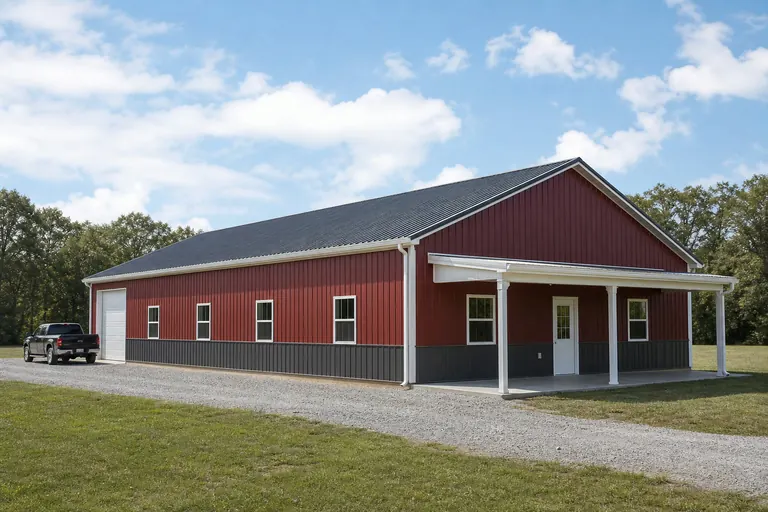 Compact suburban residenceA modest single-story or two-story shell sized to fit within a small lot's coverage limits, common in central and northern counties.Working farm residenceA larger footprint pairing living space with an attached equipment or shop bay, suited to an intensively farmed 71-acre-class parcel.Two-story loft designVertical living space that keeps the ground-floor footprint small on a constrained lot while still meeting a household's square-footage needs.
Example Configuration — for planning purposes only.
Preparation
Before you file a New Jersey barndominium application
These steps address the specific friction points of building a hybrid residence in a multifamily-heavy, small-parcel state.
- Call the municipal construction office firstAsk specifically whether the office has previously reviewed a detached post-frame or steel-frame residence, since it is a less common file type in this market.
- Get a lot-coverage number in writingConfirm the maximum building coverage allowed on your parcel before finalizing square footage for the house and any shop bay.
- Line up septic or sewer confirmation earlyOn a small parcel, septic-system sizing can constrain the building footprint more than zoning does.
- Document the residential-use intent clearlyA plan set that separates living space from shop space in writing reduces back-and-forth with a reviewer unfamiliar with the hybrid format.
Evidence position
What this page will not tell you about New Jersey
We publish the sourced figures we hold and route the rest to the office that actually owns it. Wind speeds, snow loads, adopted code editions, permit fees and construction pricing are never asserted here.
The figures above come from the U.S. Census Bureau's building permits survey and 2010 geography reference, USDA NASS's 2022 Census of Agriculture county profile, and NOAA NCEI's 1991-2020 climate normals for the Newark station. We do not hold a verified single statewide precipitation or snowfall figure for New Jersey as a whole; the Newark and Philadelphia/Mt. Holly area normals used here are representative station data, not a state average, and we say so rather than blending them into one number.
We also do not hold a FEMA National Risk Index narrative for New Jersey verified directly from a primary FEMA source in this pass, so we route buyers who want a hazard-exposure summary to hazards.fema.gov's state-level listing rather than paraphrasing a secondary source as if it were the agency's own text.
No statewide structural load values, seismic category or adopted residential code edition are stated on this page, because those figures are set by the specific code edition your municipality has adopted and applied by your local construction official to your parcel's exposure category — not by a single number that holds across all 565 New Jersey municipalities.
Guidance
New Jersey barndominium questions
Honest answers for planning a hybrid residence in a small-parcel, multifamily-heavy housing market.
Legality depends on your specific municipality's zoning ordinance and its definition of a permitted residential use. With 565 municipalities each setting local rules, confirm directly with your local construction office rather than assuming a statewide answer.
Census Bureau data shows 53.2% of New Jersey's 2023 authorized housing units were 5+ unit multifamily buildings, so a detached hybrid residence is a comparatively uncommon file for many reviewers to have seen before.
There is no minimum tied to the building type itself; New Jersey's average farm size is 71 acres, among the smallest nationally, so most projects are planned around a modest parcel rather than open acreage. Your municipality's lot-coverage and setback rules set the real constraint.
Newark's NOAA 1991-2020 normal records 31.5 inches of annual snowfall, which supports planning a residential-grade roof and insulation package. Specific structural snow-load requirements are set by your municipality's adopted code edition, not stated here.
Many buyers do, especially on parcels tied to active farming; New Jersey's Census of Agriculture recorded a 36% rise in the market value of products sold between 2017 and 2022. Size the bay to your actual equipment and confirm it fits your lot's coverage allowance.
We do not publish a statewide timeline because each of New Jersey's municipal construction offices sets its own review pace and workload; ask the specific office covering your parcel for a realistic estimate.
Sources for the New Jersey facts on this page
This page states no code requirement, wind speed, snow load, permit rule, price or supplier claim. The state-specific facts it does use are listed with their publisher below.
New Jersey had 9,998 farms in 2022, up 1% from 2017.
USDA National Agricultural Statistics Service (NASS) · 2022 · Tier 1
https://www.nass.usda.gov/Publications/AgCensus/2022/Online_Resources/County_Profiles/New_Jersey/cp99034.pdfNew Jersey had 711,502 acres of land in farms in 2022, an average farm size of 71 acres, one of the smallest average farm sizes among U.S. states.
USDA NASS · 2022 · Tier 1
https://www.nass.usda.gov/Publications/AgCensus/2022/Online_Resources/County_Profiles/New_Jersey/cp99034.pdfThe Census Bureau's 2023 annual building permits report notes that multifamily units (5+ units) made up 53.2% of New Jersey's 32,840 total authorized housing units that year, one of the highest multifamily shares among states.
U.S. Census Bureau · 2023 · Tier 1
https://www.census.gov/construction/bps/pdf/2023annualhighlights.pdfLocal building permit offices in New Jersey authorized 34,932 new privately-owned housing units in 2024.
U.S. Census Bureau · 2024 (full calendar year) · Tier 1
https://www.census.gov/construction/bps/stateannual.htmlNew Jersey's total land area was measured at 7,354.2 square miles as of the 2010 Census.
U.S. Census Bureau · 2010 Census · Tier 1
https://www.census.gov/geographies/reference-files/2010/geo/state-local-geo-guides-2010/new-jersey.htmlNewark Liberty International Airport's 1991-2020 annual normal precipitation is 46.60 inches with 31.5 inches of annual snowfall.
NOAA National Centers for Environmental Information (NCEI) · 1991-2020 · Tier 1
https://www.ncei.noaa.gov/access/services/data/v1?dataset=normals-annualseasonal-1991-2020&dataTypes=ANN-PRCP-NORMAL,ANN-SNOW-NORMAL&stations=USW00014734&format=json