
Pole barn · NJ
Pole Barns in New Jersey
A pole barn brief in New Jersey starts from a fact that shapes the whole picture: the state's 9,998 farms in 2022 averaged only 71 acres apiece, one of the smallest average farm sizes in the country, even as the total market value of what those farms sold rose 36% since 2017. That combination — small acreage, intensifying production — means a New Jersey pole barn is usually a tightly sited structure justified by real output, not a wide-open building dropped onto acreage with room to spare. Add a state land area of only 7,354.2 square miles and a construction market where 53.2% of 2023's authorized housing was five-plus-unit multifamily, and the practical question becomes how much barn actually fits, and how close it will sit to a house next door.
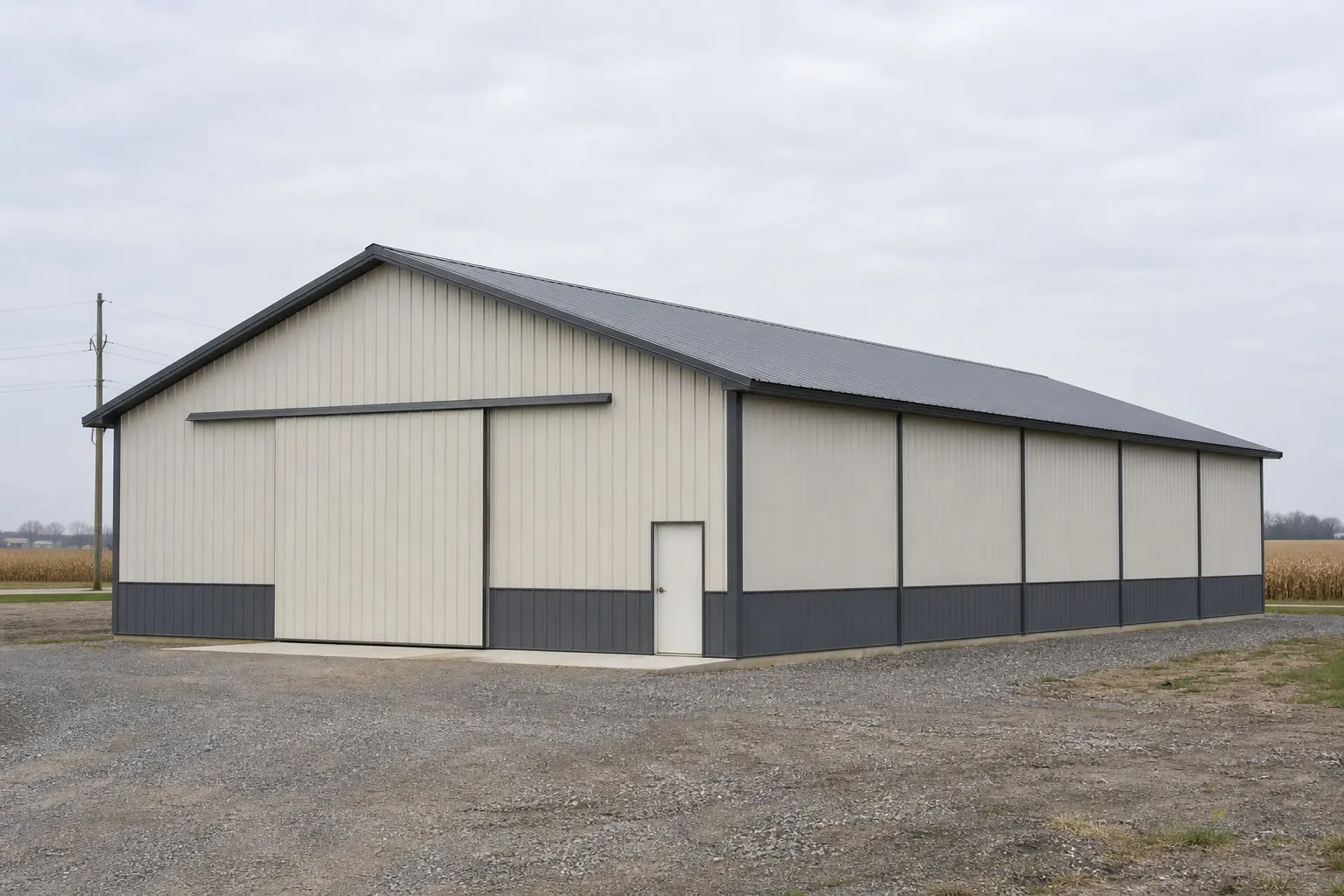
The intersection
Why a New Jersey pole barn is a small-parcel decision
The barn itself is a standard post-frame steel-clad building. What's different is how little uncommitted acreage most New Jersey sites actually have around it.
USDA's 2022 Census of Agriculture counted 9,998 farms in New Jersey, up 1% from 2017, averaging just 71 acres each — one of the smallest average farm sizes of any state. That land base still saw a 36% increase in market value of products sold since 2017. Read together, those figures describe intensifying small-parcel operations, not expanding ones, which means a pole barn typically has to earn its footprint on a farm that measures in dozens of acres rather than hundreds.
Meanwhile the state's broader construction pattern is skewing toward density: 53.2% of the 32,840 housing units authorized in 2023 were in buildings of five or more units, one of the highest multifamily shares among states. That pattern leaves the working farms and rural-residential lots that remain comparatively hemmed in by surrounding development, so a pole barn sited near a property line is more likely to be near an occupied neighbouring lot than in a state with a larger, more rural land base.
New Jersey's total land area of 7,354.2 square miles reinforces the point: this is a small state, and a pole barn brief here is rarely about choosing among distant regional terrain types. It's about fitting a working structure onto a specific, limited parcel while respecting whatever setback and screening expectations the municipality applies to a neighbouring residential lot.
Exposure
A north-south snowfall difference that changes roof planning
Newark and the Philadelphia/Mt. Holly service area diverge enough on snowfall that a pole barn's wide-span roof isn't specified the same way everywhere in the state.
NOAA's 1991-2020 normals show Newark Liberty International Airport averaging about 31.5 inches of annual snowfall against roughly 23.1 inches at the Philadelphia airport station that serves the National Weather Service's Mt. Holly forecast area over southern New Jersey. That's a meaningful difference for a wide clear-span pole barn roof, which accumulates snow across a large surface. This page does not state a design snow load — that's an engineering and local building department determination — but it's a conversation worth having earlier in the north of the state than in the south.
The Rutgers University Office of the New Jersey State Climatologist also publishes daily 1991-2020 station normals for the Mt. Holly service area, a useful reference for buyers who want county-level seasonal detail before finalizing roof pitch and truss spacing with their builder.
- Confirm your regional snowfall exposure
- A Bergen County site and a Cape May site should not assume the same winter loading conversation.
- Raise roof pitch and truss spacing with your builder
- Do this before finalizing the design, especially in the higher-snowfall north.
- Ask your local building department for the actual design requirement
- A climate normal is planning context only, not an engineering value.
Configuration
What New Jersey pole barns are usually asked to do
Given a small-farm, high-value land base, most New Jersey pole barns support a specific working purpose rather than general storage.
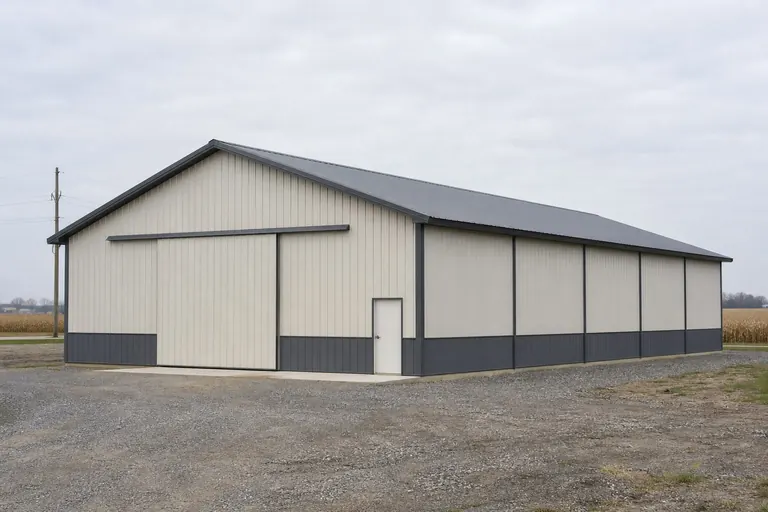 Equipment and produce storageCovered, dry storage for tractors, implements and harvested product on a farm averaging 71 acres.Small-scale livestock or specialty operation shelterA right-sized shelter matched to an intensively worked, acreage-limited parcel rather than a large-scale operation.Rural-residential general storageOn the state's remaining rural-residential lots, a pole barn frequently doubles as vehicle, boat or general storage close to a home.
Example Configuration — for planning purposes only.
Get New Jersey pole barn quotes
Tell us your parcel size, municipality and what you're storing or sheltering. We route it with the New Jersey and pole barn context attached.
Footprint
Sizes that fit a New Jersey working parcel
A 71-acre average farm size means most New Jersey pole barn footprints are chosen against real space constraints, not a theoretical maximum.
30′ × 40′
1,200 sq ft
A practical equipment and supply storage size that fits a modest working parcel.
36′ × 48′
1,728 sq ft
Room for equipment plus a small shelter or workshop bay.
40′ × 60′
2,400 sq ft
A larger option for a farm with more intensive production and storage needs.
48′ × 80′
3,840 sq ft
Upper-end footprint, appropriate only where the parcel and setbacks genuinely allow it.
Example Configuration — for planning purposes only.
Footprint pages carry bay and door layout detail; this page explains why New Jersey buyers land in this range.
Preparation
Before you request a New Jersey pole barn quote
These items address the frequent re-quote triggers for a New Jersey pole barn.
- Check your municipality's setback and agricultural-exemption rulesNew Jersey zoning and construction enforcement is local; confirm before fixing a footprint near a property line.
- Confirm proximity to neighbouring residential lotsIn a small, densely built state, a pole barn is more likely to sit near an occupied neighbour than in a larger rural state.
- Discuss roof pitch and truss spacing for your region's snowfallNorth Jersey's higher normal and south Jersey's lower normal warrant different conversations with your builder.
- Confirm the parcel's usable acreageWith the state's farms averaging just 71 acres, verify how much of your specific parcel is actually buildable before sizing the barn.
Questions
New Jersey pole barn questions
Honest state-level answers, with jurisdiction-specific items routed to the office that owns them.
Permit requirements, including any agricultural-use exemptions, are set by your municipality's construction office. There is no single statewide threshold we can publish; ask locally.
We do not state design loads here. Newark's normal runs about 31.5 inches of annual snowfall and the Philadelphia-area station serving southern New Jersey runs roughly 23.1 inches; your engineer and local building department determine the actual design requirement for your site.
Often, yes, but plan carefully. New Jersey's farms averaged 71 acres in 2022, one of the smallest averages nationally, so siting a pole barn usually means working around existing fields, structures and setback lines rather than choosing freely across open acreage.
It may be. New Jersey's 7,354.2 square miles of land area and its high share of multifamily construction (53.2% of 2023 permits) mean rural and rural-residential parcels are frequently closer to neighbouring development than in larger, more sparsely built states. Confirm setback and screening expectations with your municipality.
Yes. Newark's 1991-2020 normal snowfall is about 31.5 inches versus roughly 23.1 inches at the Philadelphia airport station serving the southern part of the state, a difference worth reflecting in roof pitch and truss planning.
Sources for the New Jersey facts on this page
This page states no code requirement, wind speed, snow load, permit rule, price or supplier claim. The state-specific facts it does use are listed with their publisher below.
New Jersey had 9,998 farms in 2022, up 1% from 2017.
USDA National Agricultural Statistics Service (NASS) · 2022 · Tier 1
https://www.nass.usda.gov/Publications/AgCensus/2022/Online_Resources/County_Profiles/New_Jersey/cp99034.pdfNew Jersey had 711,502 acres of land in farms in 2022, an average farm size of 71 acres, one of the smallest average farm sizes among U.S. states.
USDA NASS · 2022 · Tier 1
https://www.nass.usda.gov/Publications/AgCensus/2022/Online_Resources/County_Profiles/New_Jersey/cp99034.pdfNew Jersey's 2022 Census of Agriculture total market value of products sold was $1,487,751,000, up 36% from 2017.
USDA NASS · 2022 · Tier 1
https://www.nass.usda.gov/Publications/AgCensus/2022/Online_Resources/County_Profiles/New_Jersey/cp99034.pdfThe Census Bureau's 2023 annual building permits report notes that multifamily units (5+ units) made up 53.2% of New Jersey's 32,840 total authorized housing units that year, one of the highest multifamily shares among states.
U.S. Census Bureau · 2023 · Tier 1
https://www.census.gov/construction/bps/pdf/2023annualhighlights.pdfNewark Liberty International Airport's 1991-2020 annual normal precipitation is 46.60 inches with 31.5 inches of annual snowfall.
NOAA National Centers for Environmental Information (NCEI) · 1991-2020 · Tier 1
https://www.ncei.noaa.gov/access/services/data/v1?dataset=normals-annualseasonal-1991-2020&dataTypes=ANN-PRCP-NORMAL,ANN-SNOW-NORMAL&stations=USW00014734&format=jsonPhiladelphia/Mt. Holly NWS forecast office area's 1991-2020 annual normal precipitation is 44.11 inches with 23.1 inches of annual snowfall, using the co-located Philadelphia airport station as the primary long-term reference.
NOAA National Centers for Environmental Information (NCEI) · 1991-2020 · Tier 1
https://www.ncei.noaa.gov/access/services/data/v1?dataset=normals-annualseasonal-1991-2020&dataTypes=ANN-PRCP-NORMAL,ANN-SNOW-NORMAL&stations=USW00013739&format=jsonNew Jersey's total land area was measured at 7,354.2 square miles as of the 2010 Census.
U.S. Census Bureau · 2010 Census · Tier 1
https://www.census.gov/geographies/reference-files/2010/geo/state-local-geo-guides-2010/new-jersey.htmlLocal building permit offices in New Jersey authorized 34,932 new privately-owned housing units in 2024.
U.S. Census Bureau · 2024 (full calendar year) · Tier 1
https://www.census.gov/construction/bps/stateannual.html