
Barndominium · NH
Barndominiums in New Hampshire
A New Hampshire barndominium usually starts with a clearing decision, not a cropland decision. USDA's 2022 Census of Agriculture shows the state's 3,949 farms average 106 acres each, but woodland (249,287 acres) outweighs cropland and pastureland combined on that land base, so the buildable pad is more often carved out of forest than dropped onto open field. Add Concord's 1991-2020 normal of roughly 67.7 inches of annual snowfall and a state climatologist's documented note that temperature and precipitation vary considerably place to place with elevation and coastal proximity, and the planning conversation shifts from a single statewide answer to a site-specific one.
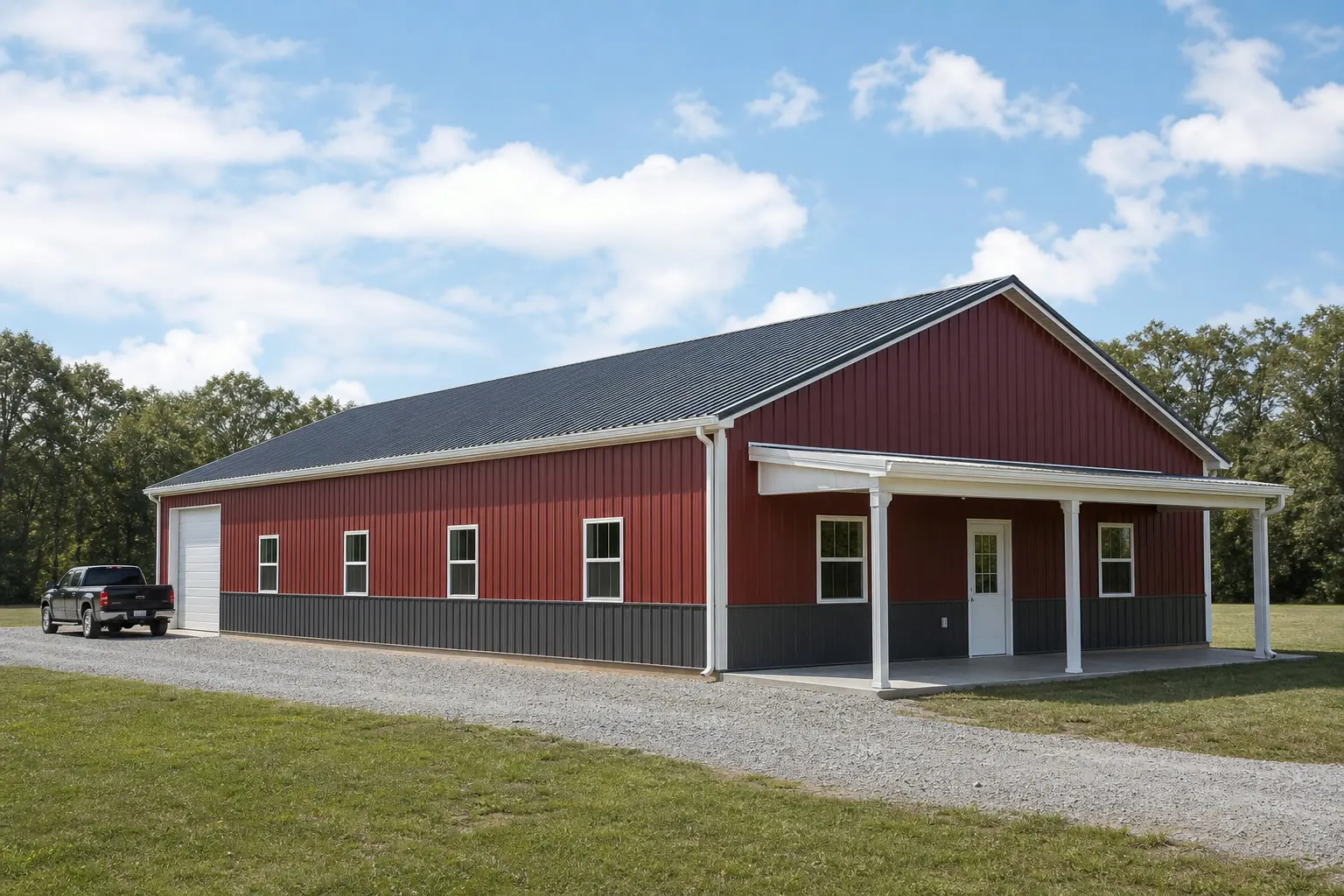
The intersection
What a New Hampshire site actually changes about a barndominium
The building type does not change. What changes is what's already on the land, and how much it varies by elevation.
USDA's 2022 Census of Agriculture put New Hampshire at 3,949 farms in 2022, down 4% from 2017, averaging 106 acres per farm across 417,187 total acres in farms. Of that land, woodland (249,287 acres) exceeds cropland (105,297 acres) and pastureland (24,246 acres) combined. That mix matters directly to a barndominium buyer: the typical New Hampshire building site is not an already-cleared field waiting for a foundation, it is forested ground that needs a clearing plan before site work even starts.
The second factor is winter, and it is not a single number. NOAA's 1991-2020 normals put Concord at roughly 41.95 inches of annual precipitation and about 67.7 inches of snowfall, while Manchester-Boston Regional Airport's normal precipitation runs closer to 40.39 inches. Those are two different stations inside one small state, and the New Hampshire state climatologist has separately documented that temperature and precipitation vary considerably from place to place because of latitude, topography and how close a site sits to the coast. None of that is a design load — that belongs with your engineer and local building department — but it does mean a mountain-adjacent lot and a Seacoast lot are not planning for the same winter.
The third factor is what the building competes against. The Census Bureau's Building Permits Survey shows local offices authorized 4,965 new privately-owned housing units statewide in 2024. This page makes no statewide permitting claim; it simply means a detached, hybrid house-and-shop building is one option among the annual construction mix, and confirming how your town classifies a combined residence-and-shop use is worth doing early with your local building department.
Site context
How New Hampshire terrain and climate vary by area
The state climatologist's documented elevation and coastal-proximity variation is the clearest way to anticipate site conditions before a quote.
White Mountains and northern uplands
Higher elevation, more variable weather, and generally more forest cover to clear. Confirm access road grade and clearing scope with a site visit.
Central lakes and valley region
Rolling terrain with a mix of wooded and previously cleared parcels; existing tree cover and drainage tend to be the practical variables.
Seacoast and southern tier
Lower elevation and closer to coastal moderation, with generally denser development pressure near Manchester and the coast.
Exposure
Roughly 67.7 inches of Concord-area snow shapes residence-grade detailing
Because a barndominium is lived in daily, winter detailing that a purely agricultural building could defer becomes a first planning conversation.
NOAA's 1991-2020 climate normal for Concord shows about 67.7 inches of average annual snowfall alongside roughly 41.95 inches of precipitation. This is a station normal, not a design value, and nothing here converts it into a load or a code requirement — that conversation belongs with your engineer and local building department. As a planning prompt, though, it means entry design, roof-to-gutter transitions, and where snow sheds off a metal roof relative to walkways and driveways are worth resolving before the plan is finalized.
Because a barndominium mixes a living space with a shop or garage bay, the entry sequence matters more than on a pure outbuilding: mudroom placement, a covered transition from the shop bay to the living quarters, and where plowed snow gets stacked relative to doors are details New Hampshire owners tend to revisit if skipped at the planning stage.
- Entry and mudroom placement
- Locate the transition between shop and living space away from the prevailing snow-shed side of the roof.
- Snow storage on-site
- Plan where plowed snow accumulates through the winter without blocking the shop bay door or the driveway approach.
- Clearing scope for access
- Because most sites start under tree cover, confirm driveway and utility clearing scope before finalizing a foundation location.
Get New Hampshire barndominium quotes
Tell us your parcel size, how much clearing it needs, and your living-to-shop ratio. We route it with the New Hampshire and barndominium context already attached.
Configuration
How New Hampshire barndominium programs typically split
With more average acreage per farm parcel than many New England neighbors, the configuration question is often about how much wooded acreage stays forested versus cleared.
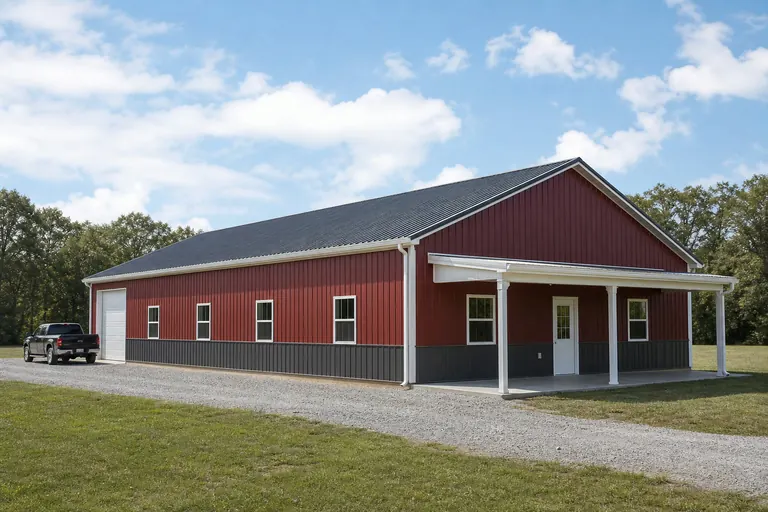 Compact residence with attached shopA smaller living footprint paired with a garage-scale bay, sited to minimize the clearing footprint on a wooded lot.
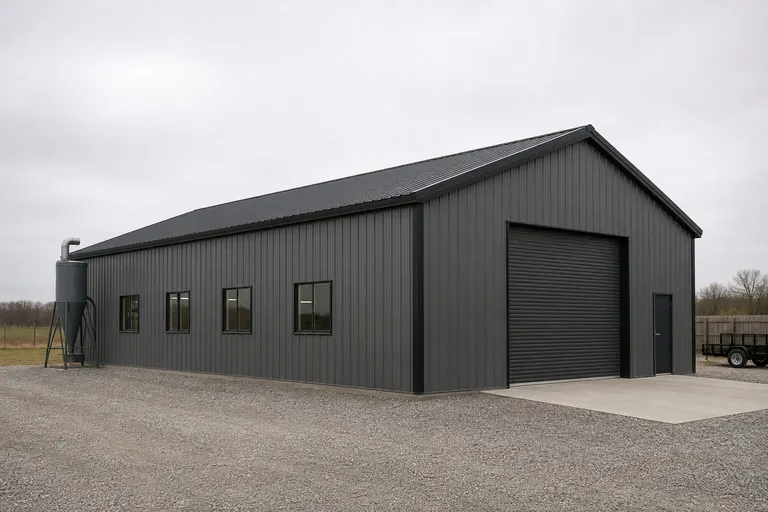 Full-time residence with home workshopA larger living share with a dedicated finished workshop, common on a 100-acre-class parcel with room to spare.Seasonal or camp-style useA simpler split favoring durability and low-maintenance finishes, often on a lake-region or northern parcel used part of the year.
Example Configuration — for planning purposes only.
Footprint
Sizes that suit a New Hampshire wooded parcel
With a 106-acre average farm size and a woodland-heavy land base, footprints here have more room to work with than in denser New England states, but clearing cost still shapes the decision.
30′ × 40′
1,200 sq ft
A compact footprint that limits clearing on a heavily wooded lot.
30′ × 50′
1,500 sq ft
Added length for a third bedroom or bonus room without expanding the shop bay.
40′ × 60′
2,400 sq ft
A common split between living space and an attached garage or shop bay.
40′ × 80′
3,200 sq ft
Where a larger workshop is genuinely part of the program alongside full-time living space.
Example Configuration — for planning purposes only.
Footprint pages carry the room-by-room layout detail; this page only explains why the New Hampshire brief tends to land in this range.
Preparation
Before you request a New Hampshire quote
These items address frequent sources of re-quoting on a hybrid house-and-shop building here.
Step 1
Confirm the residential use classification with your local building department
Ask early how your town classifies and permits a combined residence-and-shop building.
Step 2
Get a clearing estimate before fixing a foundation site
Because most parcels are wooded, clearing scope changes both cost and where the building can actually sit.
Step 3
Describe your elevation and location, not just your town
The state climatologist documents real place-to-place climate variation tied to elevation and coastal proximity.
Step 4
Decide the living-to-shop ratio before the quote
This single decision drives layout, utility runs and finish level more than any other variable.
Questions
New Hampshire barndominium questions
Honest state-level answers, with anything jurisdiction-specific routed to the office that actually owns it.
Zoning and building classification are set locally, parcel by parcel, and New Hampshire does not have a single statewide answer we can state here. Your local building and planning department is the right first call.
There is no official minimum, but the state's 106-acre average farm size suggests many barndominium sites here have more surrounding acreage than in denser New England states. Confirm your specific lot's buildable and clearable area with your local office.
We do not state design loads on this page — that is an engineering and code question for your local building department. Concord's climate normal shows roughly 67.7 inches of average annual snowfall, useful as planning context for entry placement and gutter scope, not as a specification.
Most New Hampshire parcels carry more woodland than open cropland statewide, so clearing is a common first step. Get a clearing estimate specific to your lot before finalizing a foundation location.
We do not publish state-level prices, because a credible number depends on your specification, clearing needs, site work and current material costs. Our cost pages explain what drives the number; a quote reflects your specific project.
Sources for the New Hampshire facts on this page
This page states no code requirement, wind speed, snow load, permit rule, price or supplier claim. The state-specific facts it does use are listed with their publisher below.
New Hampshire had 417,187 acres of land in farms in 2022, an average farm size of 106 acres.
USDA NASS · 2022 · Tier 1
https://www.nass.usda.gov/Publications/AgCensus/2022/Online_Resources/County_Profiles/New_Hampshire/cp99033.pdfOf New Hampshire's land in farms in 2022, woodland accounted for 249,287 acres, more than cropland (105,297 acres) and pastureland (24,246 acres) combined, reflecting the state's forested character.
USDA NASS · 2022 · Tier 1
https://www.nass.usda.gov/Publications/AgCensus/2022/Online_Resources/County_Profiles/New_Hampshire/cp99033.pdfConcord, NH's 1991-2020 annual normal precipitation is 41.95 inches with 67.7 inches of annual snowfall.
National Weather Service (NOAA), Gray/Portland ME office · 1991-2020 · Tier 1
https://www.weather.gov/media/gyx/climo/CONSeasonal.pdfUniversity of New Hampshire climatologists note the state, home to Mount Washington and its reputation for the 'World's Worst Weather,' has considerable place-to-place variation in temperature and precipitation due to latitude, topography, and proximity to the coast.
New Hampshire State Climatologist / CoCoRaHS · State climatologist reference article · Tier 2
https://media.cocorahs.org/docs/ClimateSum_NH.pdfLocal building permit offices in New Hampshire authorized 4,965 new privately-owned housing units in 2024.
U.S. Census Bureau · 2024 (full calendar year) · Tier 1
https://www.census.gov/construction/bps/stateannual.html