
Metal garage · NH
Metal Garages in New Hampshire
A metal garage in New Hampshire is planned around a genuinely heavy winter. NOAA's 1991-2020 normal for Concord shows roughly 67.7 inches of average annual snowfall on top of about 41.95 inches of precipitation, and the state climatologist notes that temperature and precipitation vary considerably from place to place with elevation, latitude and coastal proximity. Add a land base where woodland (249,287 acres) outweighs cropland and pastureland combined, and most garage sites here start as a clearing decision before they become a construction decision.
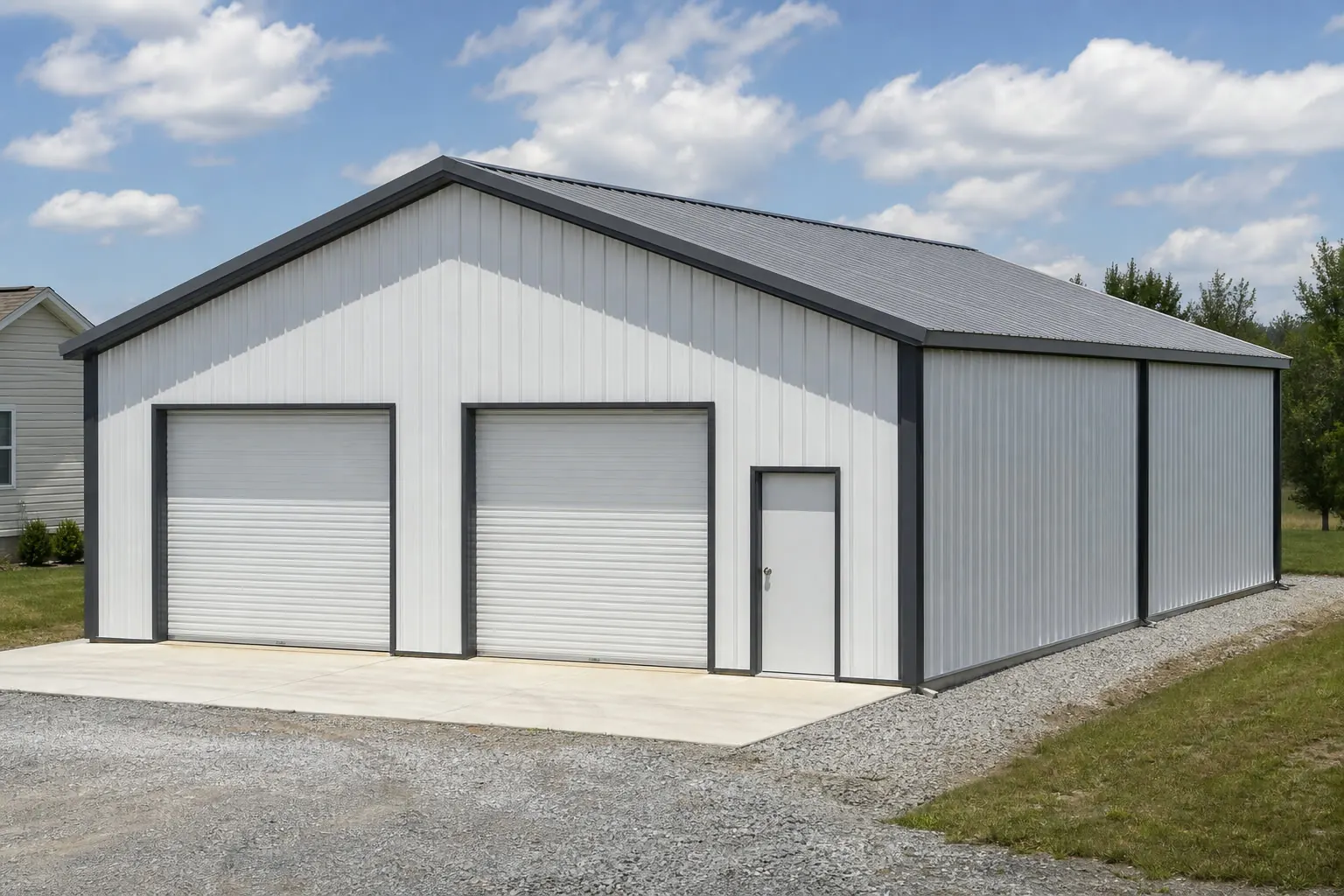
The intersection
What a New Hampshire site changes about a metal garage
The garage itself is standard steel-frame construction. What differs is how much winter it has to shrug off, and what's growing on the site beforehand.
NOAA's 1991-2020 climate normals put Concord at about 41.95 inches of annual precipitation and roughly 67.7 inches of average annual snowfall. None of that is a design load — that conversation is for your engineer and local building department — but it explains why a fully enclosed, walk-in garage with a properly sized door beats an open carport for most New Hampshire owners who want to stop scraping ice off a windshield through a genuinely long winter.
The second factor is that this exposure is not uniform. New Hampshire's own state climatologist documents considerable place-to-place variation in temperature and precipitation tied to latitude, topography and proximity to the coast — a reminder that a garage site near Mount Washington's foothills and one on the Seacoast are not planning for the same winter, even inside one state.
The third factor is the land itself. USDA's 2022 Census of Agriculture shows New Hampshire's farmland carries more woodland (249,287 acres) than cropland (105,297 acres) and pastureland (24,246 acres) combined. Translated to a garage build, that means most sites need a clearing plan before slab work starts, which changes both timeline and cost planning compared with an already-open lot.
Site context
How terrain and climate vary across New Hampshire
The state climatologist's documented elevation and coastal variation is the most useful lens for anticipating site conditions before a quote.
White Mountains and northern uplands
Higher elevation with more variable, generally harsher winter conditions and more forest cover to clear before a slab goes in.
Central lakes and valley region
Rolling terrain with a mix of wooded and previously cleared parcels; existing driveway grade and tree cover are the usual variables.
Seacoast and southern tier
Lower elevation with some coastal climate moderation and generally denser development near Manchester and the coast.
Exposure
Door orientation and snow shed matter more here
With roughly 67.7 inches of average annual snow at Concord, where the roof sheds and where the door faces are practical decisions, not aesthetic ones.
A detached garage that sheds snow directly across the door path defeats its own purpose in a New Hampshire winter. Positioning the door on the leeward side of prevailing storm tracks, or adding a modest roof overhang extension above the door, are adjustments worth raising during design rather than after the first heavy season.
Apron size also matters more here than in a low-snow state: a wider concrete apron gives you somewhere to stack plowed snow without blocking the door track, and it is far cheaper to pour wide the first time than to extend it later.
- Door-side snow shed
- Confirm which roof plane sheds toward the driveway before fixing door placement.
- Apron width
- A wider apron gives you snow-stacking room without blocking the door.
- Overhang above the door
- A small overhang keeps sliding snow off anyone opening the door by hand.
- Clearing scope before slab work
- Confirm how much of the site needs clearing before pricing the slab and apron.
Season
A short build-and-use window shapes scheduling
Concord's growing season normal runs about 146 days, from a last spring freeze near May 8 to a first fall freeze near October 3, which is also roughly the comfortable outdoor-construction window most New Hampshire garage projects work within.
Outside that roughly five-month stretch, site work competes with frozen or thawing ground, which is part of why New Hampshire garage builders book up early in spring: everyone with an outdoor concrete pour is trying to fit inside the same window. Confirming a build slot months ahead, rather than calling once the snow has melted, is a practical scheduling step distinct to a state with this short a season.
NOAA's own State Climate Summary for New Hampshire also documents more than 3°F of warming since the early 1900s, concentrated disproportionately in winter. That is a documented long-term trend, not a design value, and it does not change what your local building department requires — but it is a reason to ask your builder whether their scheduling assumptions and material choices still reflect current winters rather than decades-old norms.
- Book your build slot early
- The roughly 146-day frost-free window is shared by every outdoor concrete pour in the state; confirm a schedule slot well before spring.
- Ask about current winter assumptions
- NOAA documents measurable winter warming over the past century; ask your builder whether their planning reflects recent winters.
Get New Hampshire metal garage quotes
Tell us your lot size, clearing needs, and vehicle count. We route it with the New Hampshire and metal garage context attached.
Configuration
What New Hampshire metal garages are usually asked to do
Given the wooded-parcel pattern and heavy winter, most New Hampshire garages solve a specific storage or access problem.
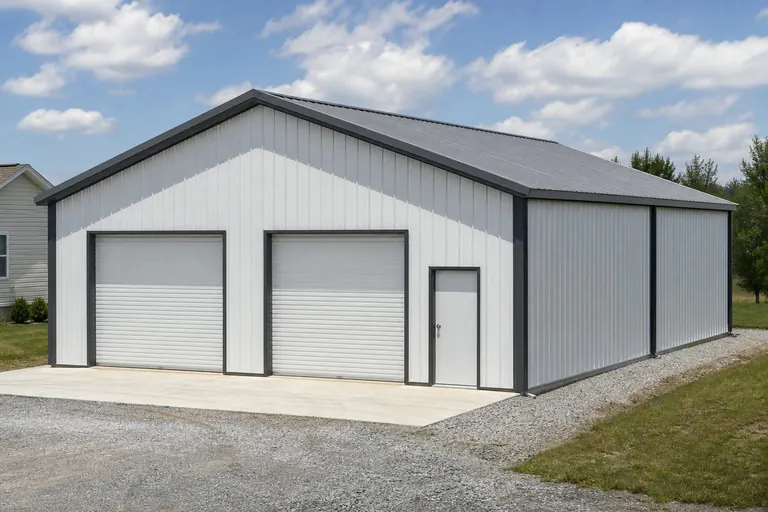 Single or two-car winter storageA frequent brief: a fully enclosed bay sized to eliminate daily ice-scraping and provide dry, plowed-in access.Garage plus small workshop endA partitioned end for tools or a workbench alongside vehicle storage, common on larger rural parcels.Snowmobile or ATV storageEnclosed bay sized for seasonal recreational vehicles common in the Lakes Region and northern counties.
Example Configuration — for planning purposes only.
Footprint
Sizes that fit a New Hampshire rural or wooded lot
With more average acreage per parcel than denser New England neighbors, footprint choice here is driven more by clearing cost and use than by lot constraints alone.
20′ × 20′
400 sq ft
A single-vehicle bay that limits the clearing footprint on a wooded lot.
24′ × 24′
576 sq ft
Comfortable single-vehicle storage with room to walk around the car.
24′ × 36′
864 sq ft
Two-vehicle storage with room for winter gear.
30′ × 40′
1,200 sq ft
Two vehicles plus a workbench or storage end.
Example Configuration — for planning purposes only.
Footprint pages carry the door and layout detail; this page explains why the New Hampshire brief lands in this range.
Preparation
Before you request a New Hampshire quote
These items address frequent re-quote triggers for a New Hampshire metal garage.
- Check setback rules with your local building departmentAccessory structure setbacks vary by town; confirm before fixing a footprint.
- Get a clearing estimate for your siteBecause most parcels are wooded, clearing scope affects both cost and where the slab can sit.
- Fix door orientation against snow shedDecide this before the slab is poured, not after the first storm.
- Confirm driveway grade and apron widthA rural driveway approach needs its transition and apron sized correctly the first time.
Questions
New Hampshire metal garage questions
Honest state-level answers, with jurisdiction-specific items routed to the office that owns them.
Permit requirements depend on your municipality, lot and structure size. Your local building department is the only reliable source; ask before finalizing dimensions.
We do not state design loads on this page. Concord's climate normal shows about 67.7 inches of average annual snowfall as planning context only; your engineer and local building department determine the actual design requirement for your site.
Yes — the state's own climatologist documents considerable place-to-place variation in temperature and precipitation tied to elevation, latitude and coastal proximity, so a mountain-area site and a Seacoast site plan differently.
Most New Hampshire land in farms is woodland rather than open cropland or pastureland statewide, so clearing is common. Get a site-specific clearing estimate before finalizing a footprint.
There's no official typical size. Rural parcels here tend to support 20x20 through 30x40 comfortably, though the right size depends on your clearing budget and vehicle count.
Sources for the New Hampshire facts on this page
This page states no code requirement, wind speed, snow load, permit rule, price or supplier claim. The state-specific facts it does use are listed with their publisher below.
Concord, NH's 1991-2020 annual normal precipitation is 41.95 inches with 67.7 inches of annual snowfall.
National Weather Service (NOAA), Gray/Portland ME office · 1991-2020 · Tier 1
https://www.weather.gov/media/gyx/climo/CONSeasonal.pdfConcord, NH's 1991-2020 annual normal precipitation is 41.95 inches with 67.7 inches of annual snowfall.
National Weather Service (NOAA), Gray/Portland ME office · 1991-2020 · Tier 1
https://www.weather.gov/media/gyx/climo/CONSeasonal.pdfUniversity of New Hampshire climatologists note the state, home to Mount Washington and its reputation for the 'World's Worst Weather,' has considerable place-to-place variation in temperature and precipitation due to latitude, topography, and proximity to the coast.
New Hampshire State Climatologist / CoCoRaHS · State climatologist reference article · Tier 2
https://media.cocorahs.org/docs/ClimateSum_NH.pdfOf New Hampshire's land in farms in 2022, woodland accounted for 249,287 acres, more than cropland (105,297 acres) and pastureland (24,246 acres) combined, reflecting the state's forested character.
USDA NASS · 2022 · Tier 1
https://www.nass.usda.gov/Publications/AgCensus/2022/Online_Resources/County_Profiles/New_Hampshire/cp99033.pdfLocal building permit offices in New Hampshire authorized 4,965 new privately-owned housing units in 2024.
U.S. Census Bureau · 2024 (full calendar year) · Tier 1
https://www.census.gov/construction/bps/stateannual.htmlConcord, NH's growing season normal runs from a last spring freeze around May 8 to a first fall freeze around October 3, a growing season length of 146 days.
National Weather Service (NOAA), Gray/Portland ME office · 1991-2020 · Tier 1
https://www.weather.gov/media/gyx/climo/CONSeasonal.pdfNOAA's State Climate Summaries 2022 states temperatures in New Hampshire have risen more than 3°F since the beginning of the 20th century, with winter warming exceeding any other season.
NOAA National Centers for Environmental Information (NCEI) · State Climate Summaries 2022 · Tier 1
https://statesummaries.ncics.org/downloads/NewHampshire-StateClimateSummary2022.pdf