
Pole barn · NH
Pole Barns in New Hampshire
A pole barn in New Hampshire is usually planned around two facts most Midwestern briefs don't have to weigh: the land is mostly forested, and the winter is heavy. USDA's 2022 Census of Agriculture counted 3,949 farms in the state, averaging 106 acres each, but woodland (249,287 acres) outweighs cropland (105,297 acres) and pastureland (24,246 acres) combined across that land base. Add Concord's 1991-2020 normal of roughly 67.7 inches of average annual snowfall, and a New Hampshire pole barn brief starts with clearing scope and roof planning before it gets to layout.
The intersection
What a New Hampshire site changes about a pole barn
The pole barn itself is a standard post-frame steel-clad structure. What differs is what's on the ground before you build, and how much snow the roof carries.
USDA's 2022 Census of Agriculture counted 3,949 farms in New Hampshire, down 4% from 2017, averaging 106 acres each across 417,187 total acres in farms. That's more average acreage per operation than several southern New England states, but the land-use split matters more than the acreage total: woodland (249,287 acres) outweighs cropland (105,297 acres) and pastureland (24,246 acres) combined. In practice, that means most New Hampshire pole barn sites start as a clearing project, not a field already prepared for construction.
Winter changes the roof, not the frame concept. Concord's NOAA 1991-2020 normal shows roughly 67.7 inches of average annual snowfall. A pole barn's wide clear-span roof carries real accumulated snow load over a winter, so truss spacing and roof pitch are worth discussing with your builder specifically — this page doesn't state a design load, since that's an engineering and local building department determination, but it's a conversation New Hampshire buyers should have that a buyer in a low-snow state wouldn't need to.
The state climatologist has separately documented that New Hampshire's temperature and precipitation vary considerably from place to place because of latitude, topography and coastal proximity. A northern or higher-elevation pole barn site should treat the statewide snowfall figure as a starting point for a conversation with a local builder, not a substitute for a site-specific assessment.
Site context
How terrain and climate vary for pole barn siting across New Hampshire
The state climatologist's documented elevation and coastal variation is the most useful lens for anticipating site prep before a quote.
White Mountains and northern uplands
Higher elevation, heavier and more variable winter conditions, and more forest cover to clear before footings go in.
Central lakes and valley region
Rolling terrain with a mix of wooded and previously cleared farmland, the usual small-farm mix of hay, equipment and livestock-adjacent storage needs.
Seacoast and southern tier
Lower elevation with some coastal climate moderation and generally more development pressure near Manchester and the coast.
Design
Clearing scope and roof planning drive the New Hampshire brief
New Hampshire pole barn projects balance a wooded land base against a roof that has to carry serious accumulated snow.
Because woodland dominates the state's farm acreage, most pole barn requests here start with a clearing estimate: stump removal, grading, and access road work before a post ever goes in the ground. That's a cost and timeline variable a buyer on already-open cropland in another state simply doesn't face.
At the same time, a wide-span pole barn roof is exactly the kind of structure where accumulated snow load matters most, given the roughly 67.7 inches of average annual snowfall Concord sees. Discussing truss spacing, roof pitch, and snow-shed direction with your builder before finalizing a design avoids a barn that looks right on paper but underperforms its first heavy winter.
- Get a clearing and grading estimate first
- This determines both cost and where the barn can realistically sit on a wooded parcel.
- Discuss roof pitch for snow
- Raise this with your builder and local building department before finalizing truss spacing.
- Confirm your elevation-specific exposure
- A mountain-adjacent site and a Seacoast site should not assume the same winter.
Get New Hampshire pole barn quotes
Tell us your parcel size, clearing needs, and what you're storing or sheltering. We route it with the New Hampshire and pole barn context attached.
Configuration
What New Hampshire pole barns are usually asked to do
Given the wooded, moderate-acreage land base, most New Hampshire pole barns serve a specific rural storage or shelter need.
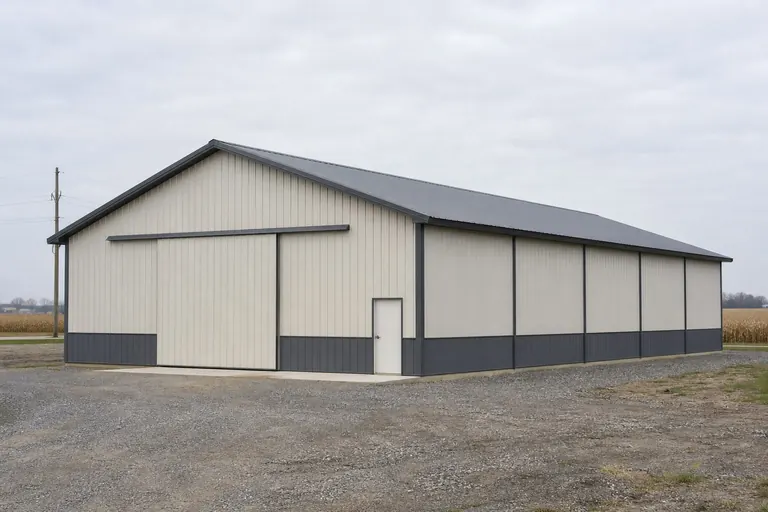 Equipment and hay storageA frequent brief: dry, covered storage for tractors, implements and hay on a 100-acre-class parcel.Small livestock shelterA run-in or partial-enclosure barn sized for a small herd or flock rather than large-scale livestock operations.Firewood and forestry-equipment storageGiven the state's heavily wooded land base, covered storage for firewood processing and forestry equipment is a common regional variant.
Example Configuration — for planning purposes only.
Footprint
Sizes that fit a New Hampshire rural parcel
A 106-acre average farm size gives more room to work with than denser New England states, but clearing cost still shapes the practical footprint.
30′ × 40′
1,200 sq ft
A practical equipment and hay storage size that limits clearing scope.
36′ × 48′
1,728 sq ft
Room for equipment plus a small livestock or workshop bay.
40′ × 60′
2,400 sq ft
Larger option for combined storage and shelter needs.
48′ × 80′
3,840 sq ft
Upper-end footprint for a larger operation with acreage to support it.
Example Configuration — for planning purposes only.
Footprint pages carry the bay and door layout detail; this page explains why the New Hampshire brief lands in this range.
Preparation
Before you request a New Hampshire quote
These items address frequent re-quote triggers for a New Hampshire pole barn.
Step 1
Check zoning and agricultural-exemption rules with your local building department
Agricultural-use exemptions and setback rules vary by town; confirm before fixing a footprint.
Step 2
Get a clearing and grading estimate
Because most parcels are wooded, this affects both siting and total project cost.
Step 3
Discuss roof pitch and truss spacing for snow
Raise this before finalizing the design, not after the first heavy winter.
Step 4
Confirm your elevation-specific exposure
New Hampshire's documented climate variation means your site's actual exposure may differ from the statewide normal.
Questions
New Hampshire pole barn questions
Honest state-level answers, with jurisdiction-specific items routed to the office that owns them.
Permit requirements, including any agricultural-use exemptions, depend on your municipality and how the structure will be used. Your local building department is the only reliable source.
We do not state design loads on this page. Concord's climate normal shows about 67.7 inches of average annual snowfall as planning context only; your engineer and local building department determine the actual design requirement for your site.
Most New Hampshire farmland is woodland rather than open cropland or pastureland statewide, so clearing is common. Get a site-specific estimate before finalizing a footprint.
There's no official standard size. Given the state's 106-acre average farm size in 2022, footprints from 30x40 through 48x80 tend to fit typical operations, depending on clearing budget.
Yes — the state climatologist documents considerable place-to-place variation in temperature and precipitation tied to elevation, latitude and coastal proximity, so a mountain-area site and a Seacoast site plan differently.
Sources for the New Hampshire facts on this page
This page states no code requirement, wind speed, snow load, permit rule, price or supplier claim. The state-specific facts it does use are listed with their publisher below.
New Hampshire had 3,949 farms in 2022, down 4% from 2017.
USDA National Agricultural Statistics Service (NASS) · 2022 · Tier 1
https://www.nass.usda.gov/Publications/AgCensus/2022/Online_Resources/County_Profiles/New_Hampshire/cp99033.pdfNew Hampshire had 417,187 acres of land in farms in 2022, an average farm size of 106 acres.
USDA NASS · 2022 · Tier 1
https://www.nass.usda.gov/Publications/AgCensus/2022/Online_Resources/County_Profiles/New_Hampshire/cp99033.pdfOf New Hampshire's land in farms in 2022, woodland accounted for 249,287 acres, more than cropland (105,297 acres) and pastureland (24,246 acres) combined, reflecting the state's forested character.
USDA NASS · 2022 · Tier 1
https://www.nass.usda.gov/Publications/AgCensus/2022/Online_Resources/County_Profiles/New_Hampshire/cp99033.pdfConcord, NH's 1991-2020 annual normal precipitation is 41.95 inches with 67.7 inches of annual snowfall.
National Weather Service (NOAA), Gray/Portland ME office · 1991-2020 · Tier 1
https://www.weather.gov/media/gyx/climo/CONSeasonal.pdfUniversity of New Hampshire climatologists note the state, home to Mount Washington and its reputation for the 'World's Worst Weather,' has considerable place-to-place variation in temperature and precipitation due to latitude, topography, and proximity to the coast.
New Hampshire State Climatologist / CoCoRaHS · State climatologist reference article · Tier 2
https://media.cocorahs.org/docs/ClimateSum_NH.pdf