
Barndominium · MO
Barndominiums in Missouri
A barndominium in Missouri is a residential build in a state that has no single statewide mandatory building code to point to. County commissions are separately empowered by statute to regulate construction and issue building permits, so the practical first move on any Missouri barndominium project is calling the county — not the state — to learn what applies to a combined shop-and-house structure. Layer onto that the fact that the Missouri Geological Survey describes the Ozark Plateau as covering roughly 33,000 of the state's 50,000 square miles, and siting a large-footprint residential steel building becomes a very different exercise depending on whether the parcel sits in that rugged southern half or on the flatter ground to the north.
Permitting
There Is No Missouri Building Code to Call
Missouri buyers who search for 'the state barndominium code' are searching for something that does not exist as a single document.
Missouri Revised Statute 64.170 gives county commissions their own authority to control construction and issue building permits — a structure that puts the decision-making authority for a barndominium project at the county level from day one. That is a meaningfully different starting point than a state with one adopted residential code cascading down to every jurisdiction. Two Missouri counties sitting next to each other can, and often do, apply different requirements to the same combined shop-and-house structure.
It is easy to assume the Missouri Division of Fire Safety, created and empowered under Chapter 320 of the Revised Statutes, fills the gap left by the absence of a statewide building code. It does not. Its rulemaking authority is scoped to fire-safety matters within the Department of Public Safety, not to general residential construction review. A barndominium buyer who treats a fire-safety inquiry as equivalent to a full building permit review is likely to discover mid-project that plumbing, electrical, or structural sign-off is a separate county-level process entirely.
The practical sequence for a Missouri barndominium is therefore: identify the county the parcel sits in, call that county's building or planning office directly, and confirm in writing what triggers a permit for a mixed residential-and-shop structure. Some rural Missouri counties apply light oversight to agricultural buildings but treat any structure with a kitchen and bathroom as fully residential regardless of its steel shell — so the presence of living quarters, not the exterior material, is usually what pulls the project into a fuller review.
Site Conditions
Ozark Bedrock Versus the Rest of the State
The Missouri Geological Survey places roughly 33,000 of the state's 50,000 square miles inside the Ozark Plateau, and that region behaves nothing like the flatter ground to the north.
South of the Missouri River, the Ozark Plateau is described by the state's own geological survey as rugged, with lofty hills, deep valleys, and cold, clear springs and streams. Karst topography — limestone bedrock riddled with solution features — is common across that footprint. For a barndominium's foundation, that means a crew may hit shallow rock far sooner than expected, or encounter a sinkhole-prone pocket that changes where the slab can safely sit. A soil and site evaluation before finalizing a floor plan is a far more consequential step on an Ozark parcel than on flatter ground.
Missouri's total land area of 68,746.3 square miles (U.S. Census Bureau) leaves a substantial northern and western portion outside the Ozark footprint, where excavation is generally more predictable and standard slab-on-grade or perimeter footing approaches are more likely to proceed without surprises. The consequence for planning is not that one region is harder in the abstract — it is that a Missouri-specific barndominium budget has to leave room for a geotechnical variable that a buyer in a single-terrain state does not have to weigh.
- Confirm bedrock depth first
- In Ozark counties, a test boring or soil scan before committing to a floor plan avoids a costly mid-project foundation redesign.
- Ask about karst history locally
- County soil-conservation or extension offices often know which areas near a proposed site have documented sinkhole activity.
- Budget site prep as a variable line item
- A flatland Missouri parcel and an Ozark parcel can carry very different excavation costs for the same footprint.
Geography
How Missouri's Terrain Splits Barndominium Planning
Across 68,746.3 square miles, Missouri runs from Ozark bedrock to river-bottom flatland, and each band changes the siting conversation.
Ozark Plateau (South-Central and Southern Missouri)
Rugged terrain with lofty hills and deep valleys per the Missouri Geological Survey. Expect shallow bedrock, karst features, and steeper grading; site evaluation should precede floor-plan finalization.
River Valleys and Bottomland
Land along the Missouri and Mississippi River corridors tends to be flatter but requires attention to drainage and flood exposure; a county floodplain check is a standard early step here.
Northern and Western Prairie Ground
Outside the Ozark footprint, excavation is generally more predictable, which is often where the larger 308-acre-average farm operations described by USDA NASS are concentrated.
Start Your Missouri Barndominium Project
Ready to plan a shop-house suited to your county's permit path and your parcel's terrain? Request a quote for a build tuned to Ozark or flatland Missouri sites.
Configuration
Common Missouri Barndominium Briefs
County-controlled permitting and the Ozark/flatland split produce a handful of recurring Missouri configurations.
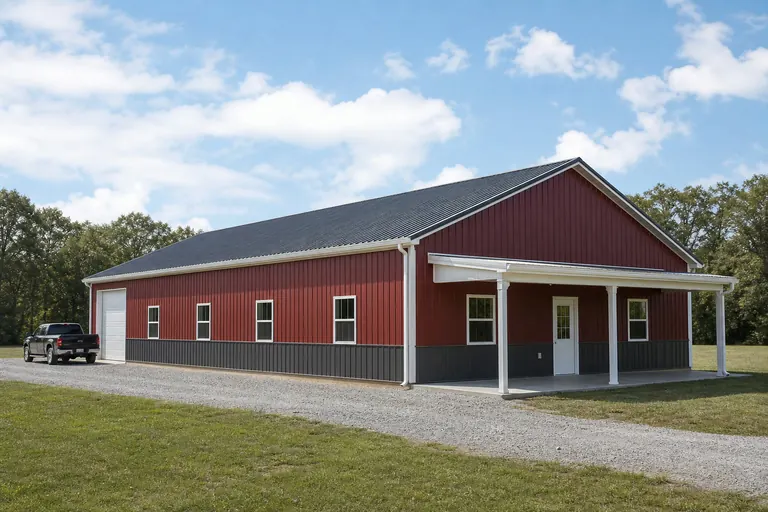 The Farm HeadquartersA large-span shop paired with a full residential wing, sited on a working operation near USDA NASS's ~308-acre average farm size.The Ozark RetreatA smaller-footprint build designed around bedrock and slope constraints on a wooded southern Missouri parcel.
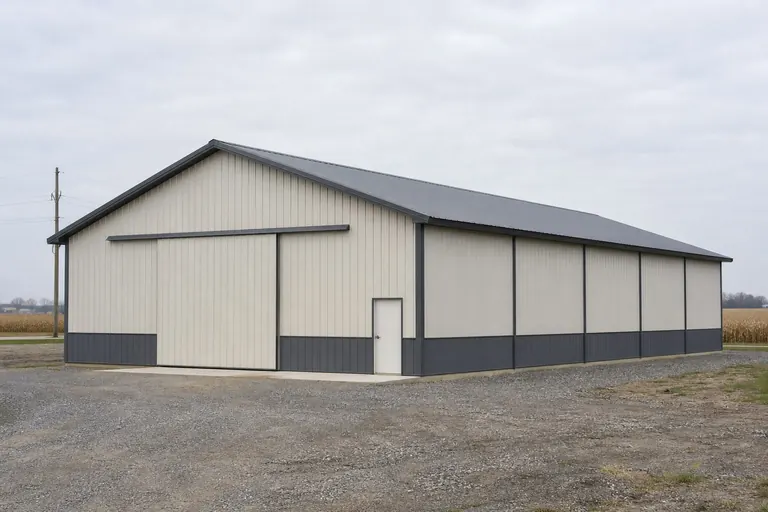 The County-Line BuildA project sited deliberately after comparing two neighboring counties' permit requirements for mixed-use residential structures.
Example Configuration — for planning purposes only.
Footprint
Sizes That Fit Missouri's Range of Sites
Footprint choice in Missouri should account for whether the site sits on Ozark bedrock or open flatland.
40′ × 60′
2,400 sq ft
A compact residential-forward footprint that keeps grading and foundation work manageable on a sloped Ozark parcel.
50′ × 80′
4,000 sq ft
A balanced mixed-use footprint common on flatter northern and western Missouri sites.
60′ × 100′
6,000 sq ft
A large-scale footprint suited to farm-headquarters builds on wide, open acreage.
Example Configuration — for planning purposes only.
Confirm setback, separation, and occupancy requirements with your county before finalizing dimensions; these vary by jurisdiction in Missouri.
Questions
Missouri Barndominium FAQ
Straight answers for planning a shop-house in Missouri's decentralized permitting environment.
No. Missouri has no single statewide mandatory building code; county commissions are separately empowered by statute (RSMo 64.170) to control construction and issue building permits, so requirements vary by county.
Its statutory authority is scoped to fire-safety rulemaking within the Department of Public Safety, not general construction review, so a fire-safety inquiry does not substitute for your county's building permit process.
Yes. The Missouri Geological Survey describes the Ozark Plateau, covering roughly 33,000 of the state's 50,000 square miles, as rugged terrain with shallow bedrock and karst features that can change foundation design compared with flatter ground elsewhere in the state.
NOAA NCEI describes a continental climate for Missouri with cold winters and hot, humid summers, so the building envelope needs to perform through both a real heating season and a humid cooling season rather than one dominant condition.
Many buyers plan it that way. With Missouri's average farm size at roughly 308 acres per USDA NASS, a combined shop-and-residence structure is a common way to consolidate a farm's equipment storage and living quarters on one footprint.
Your county commission or county building/planning office, since permitting authority in Missouri sits at the county level rather than with a single state building department.
Sources for the Missouri facts on this page
This page states no code requirement, wind speed, snow load, permit rule, price or supplier claim. The state-specific facts it does use are listed with their publisher below.
Missouri has no single statewide mandatory building code; the Missouri Division of Fire Safety administers state fire-safety-related rules while county commissions are separately empowered by statute to control construction and issue building permits.
Missouri General Assembly / Justia (statute text) · 2025 Missouri Revised Statutes · Tier 2
https://law.justia.com/codes/missouri/title-vi/chapter-64/section-64-170/The Missouri Division of Fire Safety (within the Department of Public Safety) is created and given fire-safety rulemaking authority by statute.
Missouri General Assembly / Justia (statute text) · 2025 Missouri Revised Statutes · Tier 2
https://law.justia.com/codes/missouri/title-xxi/chapter-320/section-320-202/The Missouri Geological Survey (part of Missouri DNR) describes the Ozarks region — covering about 33,000 of the region's 50,000 square miles within Missouri — as rugged, with lofty hills, deep valleys, and cold clear springs and streams south of the Missouri River.
Missouri Geological Survey, Missouri Department of Natural Resources · Fact sheet, rev. 2016 (orig. 2002) · Tier 2
https://dnr.mo.gov/print/document-search/pub0655Missouri's total land area is 68,746.3 square miles.
U.S. Census Bureau · Current Census Bureau geography data · Tier 1
https://data.census.gov/profile/Missouri?g=0400000US29Missouri had 27,026,243 acres of land in farms in 2022, an average farm size of 308 acres.
USDA NASS · 2022 · Tier 1
https://www.nass.usda.gov/Publications/AgCensus/2022/Online_Resources/County_Profiles/Missouri/cp99029.pdfNOAA NCEI publishes a narrative 'Climate of Missouri' describing the state's continental climate with cold winters and hot, humid summers.
NOAA National Centers for Environmental Information (NCEI) · Historical narrative (NCEI climate normals series) · Tier 1
https://www.ncei.noaa.gov/data/climate-normals-deprecated/access/clim60/states/Clim_MO_01.pdf